The word “determine” appears everywhere, from school essays and workplace emails to resumes, captions, reports, and everyday conversations. Using it repeatedly can make otherwise strong writing feel predictable, especially when a more precise word would express the idea better.
The best synonyms for determine depend on what you mean. You might need a formal word such as ascertain, a professional choice such as establish, a conversational alternative such as decide, or a stronger word such as resolve. Understanding these differences helps you sound clearer, more natural, and more confident.
What Does “Determine” Mean?
Determine means to find out, establish, decide, or cause something to happen depending on context. Useful alternatives include ascertain for formal writing, decide for everyday speech, establish for professional use, conclude for reasoning, and identify for finding something specific.
Meaning, Tone and Context
Simple Definition
Determine generally means to find out something through investigation, establish a fact, make a decision, or influence an outcome.
For example, “The test will determine the cause of the problem” means the test will help establish the cause.
In “She determined that the offer was unsuitable,” determine means she reached a decision after considering the situation.
Part of Speech
Determine is a verb.
Its common forms include:
Determine
Determines
Determined
Determining
Determination
Determinate
Determined
Tone
Determine is usually neutral. It does not automatically express a positive or negative feeling.
Its tone depends on the sentence. “The evidence determined the outcome” sounds factual, while “He determined to succeed” can communicate strong personal commitment.
Formality Level
Determine is versatile and works in casual, academic, professional, and formal contexts.
It can sound slightly more precise than everyday words such as decide or figure out, especially in reports and analytical writing.
Common Use Cases
Determine is commonly used when discussing:
Decisions
Facts
Causes
Results
Research findings
Business outcomes
Eligibility
Plans
Responsibilities
Problem solving
Personal goals
Scientific conclusions
When and How to Use “Determine”
Use determine when you want to communicate the idea of finding an answer, establishing a fact, making a decision, or influencing an outcome.
1. Professional Context
“The manager will determine which proposal best fits the company’s needs.”
Here, determine means make a considered decision.
2. Academic Context
“The researchers examined several factors to determine whether the treatment was effective.”
Here, determine means establish through investigation.
3. Personal Context
“I need some time to determine what I really want.”
The word suggests thoughtful decision making.
4. Workplace Email
“We will determine the next steps after reviewing the updated information.”
This sounds neutral and professional.
5. Emotional Context
“Her experience helped determine how she viewed the situation.”
Here, determine means influence or shape.
6. Creative Writing
“His choices would determine the fate of the entire village.”
This gives the word a stronger sense of influence over an outcome.
7. Social Media
“Your habits can determine how productive your day becomes.”
The word works well when discussing cause and effect.
Another Word for “Determine”
There is no single replacement that works perfectly in every sentence. The best choice depends on the intended meaning.
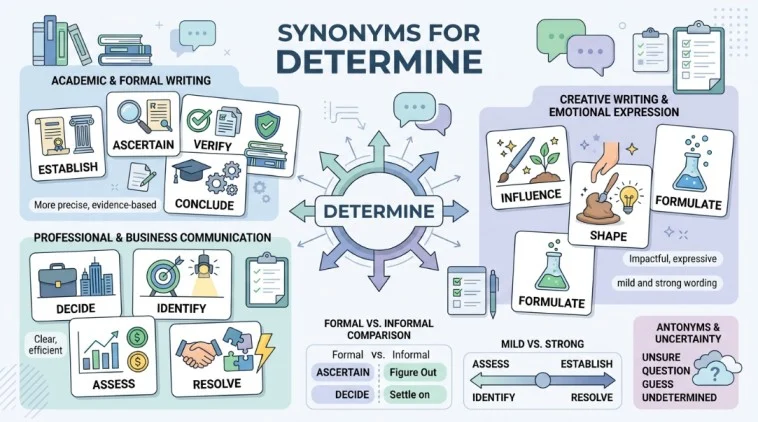
- Professional writing: Establish
- Academic writing: Ascertain
- Casual conversation: Decide
- Emotional writing: Resolve
- Creative writing: Shape
- Resume or workplace use: Establish
- Social media captions: Decide or shape
- Stronger meaning: Resolve
- Softer meaning: Assess
If determine means “find out,” ascertain or establish may be better. If it means “make a choice,” decide or resolve is usually more natural.
When Not to Use “Determine”
Determine can sometimes be too general when the sentence needs a more exact verb.
For example:
“The doctor determined the problem.”
This is understandable, but “The doctor identified the problem” is more specific if the meaning is simply finding the problem.
Similarly:
“She determined what to do.”
In casual conversation, “She decided what to do” sounds more natural.
Avoid replacing every instance of determine with a synonym simply to avoid repetition. A synonym should preserve the original meaning, not merely change the wording.
Words Commonly Confused With “Determine”
Determine vs. Decide
Determine can mean decide, but decide focuses more directly on making a choice.
Use determine for investigation, establishment, or formal decision making. Use decide for ordinary personal choices.
Determine vs. Identify
Identify means recognize or name something correctly.
Determine can involve identification, but it has broader meanings, including deciding and establishing.
Determine vs. Establish
Establish means prove, confirm, or set something firmly.
Determine can mean establish, but establish often emphasizes creating certainty or official acceptance.
Determine vs. Ascertain
Ascertain means find out something with careful investigation.
It is more formal than determine and is especially useful in professional, legal, academic, and technical writing.
Determine vs. Assess
Assess means evaluate or judge something after examining it.
Assess does not necessarily mean reaching a final decision. Determine can indicate a final conclusion.
Determine vs. Resolve
Resolve can mean settle a problem or make a firm decision.
It often carries a stronger sense of finality or commitment than determine.
Best Synonym by Context for “Determine”
| Context | Best Synonym | Why It Works | Example |
|---|---|---|---|
| Formal writing | Ascertain | Sounds precise and formal | The committee sought to ascertain the facts. |
| Academic writing | Establish | Clearly communicates verified findings | The study established a link between the variables. |
| Professional use | Establish | Sounds confident and business appropriate | The review will establish the project requirements. |
| Resume | Assess | Highlights analytical ability | Assessed customer needs and recommended solutions. |
| Casual conversation | Decide | Natural in everyday speech | I need to decide what to do. |
| Creative writing | Shape | Emphasizes influence | Her choices shaped the story. |
| Emotional writing | Resolve | Suggests determination and commitment | He resolved to change his habits. |
| Strong intensity | Resolve | Communicates firm intention | She resolved to finish the project. |
| Soft or moderate tone | Assess | Suggests evaluation without finality | We should assess the situation first. |
| Social media captions | Shape | Short, expressive, and accessible | Small choices shape your future. |
| US usage | Determine | Common and versatile | The results will determine the next step. |
| UK usage | Determine | Also standard and widely understood | The evidence will determine the outcome. |
Which Synonym Should You Choose?
Start by identifying what determine means in your sentence.
- If you mean make a choice, choose decide.
- If you mean find out, choose ascertain or discover.
- If you mean recognize something, choose identify.
- If you mean prove or confirm, choose establish.
- If you mean evaluate, choose assess or evaluate.
- If you mean reach a conclusion, choose conclude.
- If you mean settle something firmly, choose resolve.
- If you mean influence an outcome, choose shape, affect, influence, or govern.
The strongest synonym is not always the best synonym. Precision matters more than intensity.
Real Life Examples of “Determine” in Sentences
School
“The experiment helped students determine which material conducted heat most effectively.”
Workplace
“The supervisor will determine the final schedule after reviewing everyone’s availability.”
Writing
“The author uses several examples to determine the central argument.”
Conversation
“I have not determined what I want to do this weekend.”
Social Media
“Your daily choices can determine the direction of your future.”
Resume
“Analyzed customer feedback to determine areas for service improvement.”
“We will determine the appropriate response after reviewing the documents.”
Storytelling
“Only one decision would determine whether the hero returned home safely.”
25 Synonyms for “Determine”
| Synonym | Simple Meaning | Best Used For | Example Sentence |
|---|---|---|---|
| Decide | Make a choice | Everyday decisions | We need to decide before Friday. |
| Ascertain | Find out with care | Formal and academic writing | The team worked to ascertain the cause. |
| Establish | Prove or confirm | Professional and academic writing | The evidence established the timeline. |
| Identify | Recognize or name | Problems, people, causes, objects | The technician identified the faulty component. |
| Conclude | Reach a judgment | Reasoning and analysis | The researchers concluded that the method was effective. |
| Resolve | Settle or decide firmly | Problems and strong decisions | She resolved to improve her writing skills. |
| Assess | Evaluate | Professional and analytical contexts | The consultant assessed the company’s needs. |
| Evaluate | Judge value or quality | Academic and professional writing | The committee evaluated each proposal. |
| Discover | Find something previously unknown | Research and exploration | Scientists discovered a possible explanation. |
| Find | Learn or discover information | Casual and general use | We need to find the source of the error. |
| Judge | Form an opinion after consideration | Opinions and evaluations | The panel judged the entries fairly. |
| Calculate | Work out using information or numbers | Mathematics and planning | The engineer calculated the required amount. |
| Infer | Reach an idea from evidence | Academic and analytical writing | We can infer the meaning from the surrounding text. |
| Diagnose | Identify a problem or condition | Medicine and technical troubleshooting | The mechanic diagnosed the engine problem. |
| Verify | Check that something is true | Professional and factual contexts | Please verify the information before publishing. |
| Confirm | Establish that something is correct | Emails and professional communication | The office confirmed the appointment time. |
| Specify | State something clearly and exactly | Instructions and technical writing | The contract specifies the required materials. |
| Define | State the exact meaning or limits | Academic and explanatory writing | The introduction defines the key terms. |
| Deliberate | Think carefully before deciding | Formal decision making | The board deliberated before voting. |
| Analyze | Examine information carefully | Academic and professional contexts | The report analyzes customer behavior. |
| Investigate | Examine facts to discover an answer | Problems and research | The company investigated the complaint. |
| Examine | Look at something carefully | General analysis | The committee examined the available evidence. |
| Influence | Affect an outcome | Cause and effect | Several factors influence the final result. |
| Shape | Strongly affect development or direction | Creative and general writing | Early experiences can shape personality. |
| Govern | Control or determine how something works | Formal and institutional contexts | Several rules govern the process. |
Synonym Groups and Usage Differences
Professional vs. Personal Synonyms
Professional writing often benefits from words such as establish, assess, evaluate, ascertain, verify, and analyze.
Personal communication usually sounds more natural with decide, find, discover, or figure out.
For example, “We will assess the proposal” sounds professional, while “I need to decide” sounds natural in personal conversation.
Formal vs. Conversational Synonyms
Formal writing favors ascertain, establish, conclude, verify, evaluate, and determine.
Conversational English generally favors decide, find, figure out, check, and choose.
Using highly formal vocabulary in a casual text can make a simple thought sound unnecessarily complicated.
Academic Synonyms
Academic writing benefits from precise verbs such as establish, ascertain, conclude, infer, evaluate, analyze, and examine.
These words help show the exact type of reasoning involved.
For example, use “infer” when a conclusion comes from evidence rather than direct confirmation.
Professional and Business Synonyms
In workplace communication, establish, assess, evaluate, verify, identify, determine, and confirm are especially useful.
They can make emails, reports, presentations, and resumes sound precise without becoming overly complicated.
Creative or Literary Synonyms
Creative writing can use shape, influence, govern, resolve, and define when the goal is to create stronger imagery or emotional meaning.
For example, “The decision shaped his future” can feel more expressive than “The decision determined his future.”
Slang or Modern Synonyms
There is no single slang equivalent for determine that works everywhere.
In casual American English, phrases such as “figure out,” “work out,” and “make up your mind” can replace determine in appropriate situations.
They should generally be avoided in academic papers, formal reports, and highly professional documents.
Strongest vs. Weaker Synonyms
A useful intensity scale is:
Mild: Assess
Moderate: Evaluate
Clear: Determine
Firm: Establish
Strong: Resolve
Very influential: Govern
Intensity depends on context. Govern can be stronger than determine when describing control, while resolve is stronger when discussing personal commitment.
Emotional vs. Neutral Synonyms
Determine is generally neutral.
Establish, verify, assess, calculate, and identify are also mostly factual.
Resolve can suggest determination and personal strength.
Shape and influence can suggest emotional or personal impact depending on the sentence.
Antonyms of “Determine”
The opposite of determine depends on which meaning is intended. The following words and expressions represent uncertainty, lack of decision, failure to establish, or lack of control.
| Antonym | Meaning | Example Sentence |
|---|---|---|
| Doubt | Feel uncertain about something | She doubted the accuracy of the report. |
| Question | Express uncertainty about something | The reviewer questioned the original conclusion. |
| Guess | Give an answer without certainty | I can only guess the final cost. |
| Speculate | Consider possibilities without proof | Analysts speculated about the possible outcome. |
| Hesitate | Delay making a choice | He hesitated before accepting the offer. |
| Waver | Become uncertain between choices | She wavered between the two options. |
| Vacillate | Repeatedly change between choices | The committee continued to vacillate over the proposal. |
| Ignore | Fail to consider something | The report ignored several important factors. |
| Overlook | Fail to notice something | The editor overlooked a small error. |
| Confuse | Make something unclear | The unclear instructions confused the new employees. |
| Obscure | Make something difficult to understand | The complicated wording obscured the main point. |
| Misidentify | Identify something incorrectly | The witness misidentified the person. |
| Disregard | Treat something as unimportant | The manager disregarded the available evidence. |
| Unsettle | Make a situation uncertain or unstable | The unexpected news unsettled the plan. |
| Leave undecided | Avoid reaching a final decision | The board left the issue undecided. |
Comparison: “Determine” vs. Similar Words
Determine vs. Decide
Main difference: Determine can mean establish a fact or influence an outcome, while decide primarily means make a choice.
Which one is stronger: Determine can sound more deliberate.
Which one is more formal: Determine is generally more formal.
Example: “The evidence will determine the outcome.”
Example: “We need to decide which option to choose.”
Determine vs. Identify
Main difference: Identify means recognize or name something, while determine has broader meanings.
Which one is stronger: Neither is inherently stronger.
Which one is more formal: Both work well in formal writing.
Example: “The investigation determined the cause.”
Example: “The investigation identified the cause.”
Determine vs. Establish
Main difference: Establish emphasizes proving, confirming, or setting something firmly.
Which one is stronger: Establish can sound more definitive when evidence is involved.
Which one is more formal: Both are suitable for formal writing.
Example: “The study determined the likely cause.”
Example: “The study established a clear connection.”
Determine vs. Ascertain
Main difference: Ascertain specifically emphasizes finding out something through investigation.
Which one is stronger: Ascertain can sound more deliberate.
Which one is more formal: Ascertain is more formal.
Example: “The team determined the source of the error.”
Example: “The team ascertained the source of the error.”
Determine vs. Assess
Main difference: Assess means evaluate, while determine can indicate a final answer or decision.
Which one is stronger: Determine usually suggests greater finality.
Which one is more formal: Both are professional.
Example: “We assessed the risks.”
Example: “We determined the safest approach.”
Determine vs. Resolve
Main difference: Resolve emphasizes settling a matter or making a firm decision.
Which one is stronger: Resolve often has a stronger sense of finality.
Which one is more formal: Both can work in formal contexts.
Example: “The review determined the cause.”
Example: “The team resolved the dispute.”
Common Phrases and Expressions with “Determine”
1. Determine the cause
Meaning: Find out why something happened.
Example sentence: “The investigation was designed to determine the cause of the failure.”
2. Determine the outcome
Meaning: Influence or establish the final result.
Example sentence: “Several factors may determine the outcome of the competition.”
3. Determine whether
Meaning: Find out if something is true or applicable.
Example sentence: “The test will determine whether the material is safe.”
4. Determine the best option
Meaning: Decide which choice is most suitable.
Example sentence: “The team met to determine the best option for the client.”
5. Determine eligibility
Meaning: Establish whether someone qualifies for something.
Example sentence: “The organization will determine eligibility based on the submitted documents.”
6. Determine the value
Meaning: Calculate or establish how much something is worth.
Example sentence: “An independent expert will determine the value of the property.”
7. Determine the next step
Meaning: Decide what should happen next.
Example sentence: “We will determine the next step after reviewing the results.”
8. Determine the difference
Meaning: Establish how two things differ.
Example sentence: “The comparison helps determine the difference between the two approaches.”
Common Mistakes to Avoid
1. Using Determine When Identify Is More Precise
If you simply mean recognizing something, identify is often clearer.
Instead of “The technician determined the damaged wire,” write “The technician identified the damaged wire.”
2. Confusing Determine With Decide
Determine can mean decide, but the two words are not interchangeable in every context.
Use decide for ordinary choices and determine when investigation, evidence, or formal judgment is involved.
3. Using a Casual Synonym in Formal Writing
“Figure out” works in conversation but can sound too informal in academic or professional writing.
Use determine, ascertain, establish, or identify when the context requires a formal tone.
4. Using an Overly Dramatic Synonym
Replacing determine with govern or control can exaggerate the original meaning.
Choose the stronger word only when the sentence genuinely describes significant influence or control.
5. Repeating Determine Too Often
Repeating the same word can make an article, essay, or report feel monotonous.
Use relevant alternatives such as establish, identify, assess, conclude, or decide when their meanings fit.
6. Choosing the Wrong Emotional Tone
Resolve can suggest determination and personal commitment.
If you only mean reaching a neutral conclusion, determine or conclude may be more appropriate.
7. Using Slang in Academic or Professional Writing
Phrases such as “figure out” and “make up your mind” are conversational.
They are usually better suited to texts, informal conversations, casual posts, and friendly emails.
FAQs
What is the best synonym for “determine”?
The best synonym depends on meaning. Use decide for choices, ascertain for finding out, establish for confirming, assess for evaluation, and resolve for firm decisions.
What is a formal synonym for “determine”?
Ascertain is a strong formal synonym when determine means finding out through investigation. Establish is also excellent for confirming facts or results.
What is an informal synonym for “determine”?
Decide is the most natural informal synonym when determine means making a choice. “Figure out” also works in casual American English.
What is another word for “determine” in professional writing?
Establish, assess, identify, verify, evaluate, and ascertain are useful professional alternatives, depending on whether you mean confirmation, evaluation, or discovery.
What is the difference between “determine” and “decide”?
Determine can mean establish a fact, influence an outcome, or make a decision. Decide specifically focuses on choosing between possibilities.
What is the opposite of “determine”?
Common opposites include doubt, guess, speculate, hesitate, waver, vacillate, question, and leave undecided, depending on the intended meaning.
Conclusion
The word determine can mean finding out, establishing a fact, making a decision, or influencing an outcome. Its best synonym changes according to the meaning, audience, tone, and level of formality.
Everyday choices, decide is usually the clearest option. Formal investigation, choose ascertain. For confirmed findings, establish works well. For evaluation, use assess or evaluate. Strong personal commitment, resolve can add greater intensity.
A practical vocabulary tip is to replace determine only when the alternative makes the meaning more precise. Good synonym use is not about using complicated words. It is about choosing the exact word that communicates your intended idea.
Discover More Post
- 25+ Synonyms for Navigate | Meanings, Examples, and Best …
- 25+ Synonyms for Friendship | Meanings, Examples, and Best …
- 25+ Synonyms for Compassion | Meanings, Examples, and …