Using the same word again and again can make even a good sentence feel flat. If you keep writing “saying” in emails, essays, captions, conversations, or stories, the right alternative can make your language sharper and more natural.
The best synonyms for saying depend on what you mean. You might need a formal word for professional writing, a precise verb for academic work, an emotional choice for storytelling, or a casual expression for everyday conversation. This guide explains the differences so you can choose the word that fits your exact situation.
What Does “Saying” Mean?
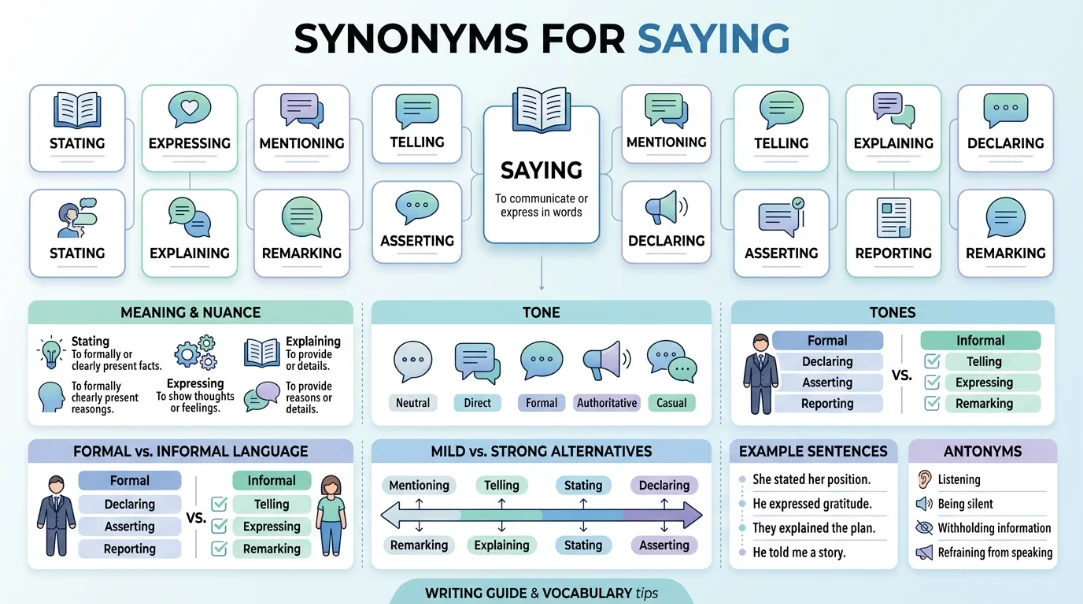
“Saying” can mean expressing something in words, either aloud or in writing. Depending on context, useful alternatives include stating, expressing, mentioning, explaining, declaring, remarking, telling, noting, or asserting.
Meaning, Tone and Context
Simple Definition
“Saying” generally refers to expressing words, thoughts, opinions, information, or feelings. It comes from the verb “say.”
For example:
“She is saying that she needs more time.”
However, “saying” can also be a noun when it refers to a familiar expression, proverb, or memorable statement.
For example:
“Her grandmother often repeated the saying, ‘Actions speak louder than words.’”
Because of this double meaning, choosing a synonym requires attention to the sentence.
Part of Speech
“Saying” can function as a verb form or a noun.
As a verb form, it describes the act of expressing something.
Example:
“He is saying exactly what he thinks.”
As a noun, it can describe a familiar phrase, proverb, or traditional expression.
Example:
“That old saying still applies today.”
Tone
“Saying” is usually neutral. It does not automatically sound positive or negative.
The tone changes according to the surrounding words and the alternative you choose.
“Mentioning” can sound lighter, while “declaring” sounds stronger. “Whispering” adds a quiet quality, while “arguing” suggests disagreement.
Formality Level
“Saying” is common in everyday English and works in most situations.
For professional or academic writing, more specific choices such as stating, explaining, noting, asserting, or reporting can make the sentence more precise.
Common Use Cases
“Saying” commonly appears in:
- Everyday conversation
- Academic writing
- Professional communication
- Emails
- Essays
- Storytelling
- Interviews
- Social media captions
- Personal writing
- Dialogue
Important Word Forms
The main forms connected with “say” include:
Say: the base verb.
Says: the third person singular form.
Said: the past tense and past participle.
Saying: the present participle or gerund.
The noun “saying” can also refer to a proverb or familiar expression.
When and How to Use “Saying”
Use “saying” when you want to describe someone expressing words, information, opinions, or thoughts without adding a more specific meaning.
Professional
“The manager is saying that the deadline may need to change.”
Personal
“My friend was saying that she might visit next weekend.”
Academic
“The author is saying that social conditions influence individual choices.”
Emotional
“He was saying that he felt completely overwhelmed.”
Creative
“She was saying the words so quietly that nobody heard her.”
Social Media
“Just saying what needed to be said.”
Casual
“I was just saying that it might be easier this way.”
The word works naturally in all these examples, but a more precise synonym can make each sentence stronger.
Another Word for “Saying”
There is no single best replacement for “saying” in every sentence. The strongest choice depends on the intended meaning.
- Professional writing: stating
- Academic writing: asserting or arguing
- Casual conversation: mentioning
- Emotional writing: expressing
- Creative writing: remarking, whispering, or murmuring
- Resume or workplace use: communicating or stating
- Social media captions: expressing or speaking
- Stronger meaning: declaring or asserting
- Softer meaning: mentioning or remarking
When “saying” refers to a proverb or familiar expression, different synonyms are appropriate, including phrase, expression, proverb, maxim, adage, and aphorism.
When Not to Use “Saying”
“Saying” is not wrong in most everyday sentences, but it can be too general when the exact manner or purpose of communication matters.
Instead of:
“The report is saying that sales increased.”
A more precise sentence is:
“The report states that sales increased.”
Instead of:
“She was saying her opinion during the meeting.”
A stronger option is:
“She was expressing her opinion during the meeting.”
Instead of:
“He was saying that the policy was unfair.”
If he presented a reasoned position, “arguing” may be more accurate.
Avoid replacing “saying” with an impressive sounding word simply to make writing appear sophisticated. Precision matters more than complexity.
Words Commonly Confused With “Saying”
Saying vs. Telling
“Saying” focuses on the words expressed. “Telling” often focuses on giving information to another person.
“She said she was tired.”
“She told me she was tired.”
Saying vs. Speaking
“Speaking” usually refers to the broader act of talking or communicating through speech.
“He was speaking about climate policy.”
“He was saying that the policy needed revision.”
Saying vs. Mentioning
“Mentioning” suggests bringing something up briefly or casually.
“She mentioned the meeting.”
“She said the meeting was canceled.”
Saying vs. Stating
“Stating” suggests expressing information clearly and directly, especially in formal contexts.
“The document states the requirements.”
“The student said the requirements were difficult.”
Saying vs. Expressing
“Expressing” emphasizes communicating a thought, feeling, opinion, or idea.
“She expressed concern about the decision.”
“She said she was concerned about the decision.”
Saying vs. Declaring
“Declaring” suggests a firm, confident, or official statement.
“The company declared its commitment to sustainability.”
“The company said it supported sustainability.”
Best Synonym by Context for “Saying”
| Context | Best Synonym | Why It Works | Example |
|---|---|---|---|
| Formal writing | Stating | Clear and professional | The report states the main findings. |
| Academic writing | Asserting | Shows a firm position | The researcher asserts that the results are significant. |
| Professional use | Communicating | Focuses on delivering information | The manager communicated the new expectations. |
| Resume | Communicating | Highlights workplace skill | Communicated project updates to clients. |
| Casual conversation | Mentioning | Sounds natural and relaxed | She mentioned the new restaurant. |
| Creative writing | Remarking | Adds narrative variety | He remarked that the room felt unusually quiet. |
| Emotional tone | Expressing | Highlights feelings or thoughts | She expressed her disappointment. |
| Strong intensity | Declaring | Suggests confidence or authority | He declared his support for the proposal. |
| Soft tone | Mentioning | Keeps the statement understated | She mentioned a possible change. |
| Social media captions | Expressing | Works well for opinions and feelings | Expressing what many people are thinking. |
| US usage | Saying | Natural and widely used | He was saying that the plan had changed. |
| UK usage | Saying | Also natural and widely used | She was saying that she needed more time. |
Which Synonym Should You Choose?
Start with the meaning, not the synonym.
If someone gives straightforward information, use “stating.” If someone briefly brings something into a conversation, “mentioning” may be better.
For an opinion or feeling, consider “expressing.” For a strong position, use “asserting” or “declaring.”
In professional writing, favor clarity and accuracy. In creative writing, you have more freedom to select words that show emotion, volume, attitude, or manner of speech.
A useful rule is simple: choose the word that adds information instead of merely replacing “saying.”
Real Life Examples of “Saying” in Sentences
School
“The teacher was saying that the assignment required three sources.”
A more precise alternative is:
“The teacher explained that the assignment required three sources.”
Workplace
“The director is saying that the project needs more funding.”
A more professional alternative is:
“The director stated that the project needs more funding.”
Writing
“The author is saying that technology affects modern relationships.”
A more analytical option is:
“The author argues that technology affects modern relationships.”
Conversation
“I was just saying that we could leave earlier.”
“Mentioning” may work if the speaker simply introduced the idea.
Social Media
“Just saying what I believe.”
“Expressing” can add a stronger sense of personal opinion.
Resume
“Responsible for saying project updates to the team” is unnatural.
A better professional choice is:
“Communicated project updates to the team.”
“I am saying that we need additional time” sounds awkward in many business emails.
A clearer version is:
“I am writing to explain that we need additional time.”
Storytelling
“She was saying something when the lights suddenly went out.”
For more vivid storytelling:
“She was whispering something when the lights suddenly went out.”
25 Synonyms for “Saying”
The following list focuses primarily on “saying” as an act of communicating words, ideas, opinions, or information. Some alternatives have narrower meanings, so context remains important.
| Synonym | Simple Meaning | Best Used For | Example Sentence |
|---|---|---|---|
| Stating | Giving information clearly | Formal and professional writing | The report states the final results. |
| Expressing | Communicating a thought or feeling | Opinions and emotions | She expressed her concerns politely. |
| Mentioning | Bringing something up briefly | Casual and professional conversation | He mentioned the schedule during the meeting. |
| Telling | Giving information to someone | Personal communication | She told me about the change. |
| Speaking | Using spoken language | General communication | He was speaking about the new policy. |
| Communicating | Sharing information or ideas | Workplace and professional use | The team communicated the changes effectively. |
| Explaining | Making something clear | Teaching and clarification | The professor explained the concept carefully. |
| Declaring | Making a firm statement | Strong or official statements | The leader declared his support for the plan. |
| Asserting | Presenting something confidently | Academic and formal writing | The writer asserts that the evidence is convincing. |
| Arguing | Presenting reasons for a position | Academic and persuasive writing | The author argues that education should be more accessible. |
| Claiming | Saying something is true | Reports, debates, and analysis | The company claims that the product improves efficiency. |
| Reporting | Giving information about something | News and professional contexts | The journalist reported that the event was canceled. |
| Remarking | Making a comment | Conversation and storytelling | She remarked that the weather had changed. |
| Commenting | Giving an observation or opinion | Discussions and online communication | He commented on the unusual design. |
| Announcing | Giving information publicly | News and official communication | The school announced the new schedule. |
| Revealing | Making previously unknown information known | Secrets and discoveries | She revealed the reason for her decision. |
| Admitting | Acknowledging something, often reluctantly | Personal and emotional contexts | He admitted that he had made a mistake. |
| Confessing | Admitting something personal or hidden | Emotional and serious situations | She confessed that she had been nervous. |
| Whispering | Speaking very quietly | Stories and private conversations | He whispered the answer to his friend. |
| Murmuring | Speaking in a soft or unclear voice | Literary and descriptive writing | She murmured a quiet response. |
| Repeating | Saying something again | Instructions and clarification | The teacher repeated the question. |
| Suggesting | Presenting an idea indirectly | Advice and discussion | She suggested that we try another approach. |
| Insisting | Saying something firmly and repeatedly | Conflict and strong opinions | He insisted that the decision was fair. |
| Proclaiming | Announcing something publicly and strongly | Formal or dramatic writing | The speaker proclaimed his confidence in the team. |
| Uttering | Producing a word or sound | Formal and literary writing | He could barely utter a response. |
Synonym Groups and Usage Differences
Professional vs. Personal Synonyms
Professional communication benefits from precise verbs.
Use “stating,” “communicating,” “reporting,” “explaining,” or “announcing” when discussing workplace information.
Personal conversations can use “saying,” “telling,” “mentioning,” “remarking,” or “commenting” naturally.
Compare:
“The manager stated the updated policy.”
“My friend mentioned the updated policy.”
Both are correct, but the context changes the most natural choice.
Formal vs. Conversational Synonyms
Formal writing often benefits from “stating,” “asserting,” “declaring,” “reporting,” or “proclaiming.”
Conversational English commonly uses “saying,” “telling,” “mentioning,” and “talking about.”
Avoid using unusually formal words in casual situations unless you intentionally want a formal tone.
Academic Synonyms
Academic writing often requires verbs that explain the author’s purpose.
- Use “argues” when an author presents a position supported by reasoning.
- Use “asserts” when an author makes a firm claim.
- Use “states” for straightforward information.
- Use “suggests” when the author’s conclusion is less direct or certain.
- Use “explains” when the author clarifies an idea.
Professional and Business Synonyms
Business writing rewards clarity.
“States,” “reports,” “communicates,” “explains,” “announces,” and “confirms” can be useful when the context supports them.
For example:
“The company announced its updated policy.”
This is more specific than:
“The company said its policy had changed.”
Creative or Literary Synonyms
Creative writing can use verbs that show how someone speaks.
“Whispering” suggests quiet speech.
“Murmuring” suggests soft or indistinct speech.
“Uttering” can create a formal or dramatic effect.
“Remarking” can provide a subtle narrative voice.
Choose these words only when the manner of speech matters.
Slang or Modern Synonyms
There are casual expressions that can sometimes replace “saying,” but they are highly context dependent.
Words such as “claiming” or “calling out” can work in modern online communication, but they do not always mean the same thing as “saying.”
Avoid slang in academic essays, formal reports, resumes, and important business communication unless the context specifically requires it.
Strongest vs. Weaker Synonyms
A useful intensity scale is:
Mild: mentioning
Moderate: saying
Clear: stating
Firm: asserting
Strong: insisting
Very strong or official: declaring
The scale is approximate because context can change the perceived strength of each word.
Emotional vs. Neutral Synonyms
Neutral choices include “saying,” “stating,” and “mentioning.”
Emotionally loaded choices include “admitting,” “confessing,” “insisting,” and “proclaiming.”
If your sentence should sound factual, use a neutral word. If the speaker’s attitude matters, select a word that communicates that attitude.
Antonyms of “Saying”
Because “saying” can mean expressing something, its true opposite depends on context. The following words represent withholding, concealing, denying, or avoiding communication.
| Antonym | Meaning | Example Sentence |
|---|---|---|
| Silence | Choosing not to speak | He responded with silence. |
| Withholding | Keeping information back | She was withholding important details. |
| Concealing | Hiding information | He was concealing the truth. |
| Hiding | Keeping something from others | She was hiding the reason for her decision. |
| Suppressing | Preventing information or expression | He suppressed his feelings. |
| Keeping quiet | Choosing not to speak | She decided to keep quiet. |
| Omitting | Leaving information out | The report omitted several details. |
| Denying | Saying something is not true | He denied the accusation. |
| Refusing | Declining to provide information | She refused to answer the question. |
| Avoiding | Staying away from a topic | He avoided discussing the issue. |
| Concealing information | Deliberately keeping facts private | The organization was concealing information. |
| Evading | Avoiding a direct response | The spokesperson kept evading the question. |
| Muting | Reducing or preventing expression | He muted his reaction. |
| Suppressing speech | Preventing verbal expression | The rule was criticized for suppressing speech. |
| Listening | Receiving communication rather than expressing it | She listened while her colleague spoke. |
Comparison: “Saying” vs. Similar Words
“Saying” vs. “Stating”
The main difference is precision and formality.
“Stating” is generally more formal and direct.
“Saying” is more conversational.
“Saying” example:
“She was saying that the results were surprising.”
“Stating” example:
“She stated that the results were surprising.”
“Saying” vs. “Telling”
“Saying” focuses on the words spoken. “Telling” often involves giving information to another person.
“Saying” example:
“He said that he was busy.”
“Telling” example:
“He told me that he was busy.”
“Saying” vs. “Mentioning”
“Mentioning” usually means referring to something briefly.
“Saying” example:
“She said the project was difficult.”
“Mentioning” example:
“She mentioned that the project was difficult.”
“Saying” vs. “Expressing”
“Expressing” emphasizes communicating an idea, opinion, or feeling.
“Saying” example:
“He said he was disappointed.”
“Expressing” example:
“He expressed his disappointment.”
“Saying” vs. “Explaining”
“Explaining” involves making something understandable, usually by providing information or reasoning.
“Saying” example:
“She said the process was complicated.”
“Explaining” example:
“She explained why the process was complicated.”
“Saying” vs. “Declaring”
“Declaring” is stronger and often more public or official.
“Saying” example:
“The company said it supported the proposal.”
“Declaring” example:
“The company declared its support for the proposal.”
Common Phrases and Expressions with “Saying”
1. Saying something out loud
Meaning:
Speaking words so that other people can hear them.
Example sentence:
“She was saying her thoughts out loud during the meeting.”
2. That is saying something
Meaning:
Indicates that something communicates an important point or reveals something meaningful.
Example sentence:
“The fact that everyone volunteered is saying something about the team’s culture.”
3. Easier said than done
Meaning:
Something sounds simple when discussed but is difficult to accomplish.
Example sentence:
“Starting a new business is easier said than done.”
4. As the saying goes
Meaning:
Introduces a familiar proverb or traditional expression.
Example sentence:
“As the saying goes, preparation makes a difference.”
5. Saying the quiet part out loud
Meaning:
Expressing an idea that people usually leave unspoken.
Example sentence:
“She was saying the quiet part out loud during the discussion.”
6. Needless to say
Meaning:
Introduces information that the speaker considers obvious or expected.
Example sentence:
“Needless to say, everyone was relieved when the problem was solved.”
7. Saying goes
Meaning:
Refers to a familiar expression or proverb.
Example sentence:
“There is an old saying that patience pays off.”
Common Mistakes to Avoid
1. Using “Saying” When a More Precise Word Is Better
“Saying” is broad. If the person is explaining, announcing, whispering, or arguing, use the more accurate verb.
2. Confusing “Saying” With “Telling”
Remember that “tell” commonly takes a person as its object.
Correct:
“She told me the news.”
Correct:
“She said the news was surprising.”
3. Using a Casual Synonym in Formal Writing
Words that sound natural in conversation may not fit an academic paper or business report.
Choose “stating” or “reporting” when those meanings are accurate.
4. Using an Overly Dramatic Synonym
“Proclaiming” can sound excessive when someone simply makes an ordinary comment.
Use the simplest accurate word.
5. Repeating “Saying” Too Often
Repeated use can make dialogue and narrative writing monotonous.
Replace it only when the replacement adds useful information about meaning, tone, or manner.
6. Choosing the Wrong Emotional Tone
“Confessing” suggests admission. “Insisting” suggests firmness. “Whispering” suggests quiet speech.
Do not treat these words as interchangeable with neutral “saying.”
7. Using Slang in Academic or Professional Writing
Informal expressions may reduce clarity or professionalism.
Always consider the reader, purpose, and setting before choosing a casual alternative.
FAQs
What is the best synonym for “saying”?
The best synonym depends on context. “Stating” works for formal writing, “mentioning” for casual reference, and “expressing” for thoughts or feelings.
What is a formal synonym for “saying”?
“Stating” is one of the best formal alternatives when you mean giving information clearly. “Asserting” and “declaring” can work for stronger statements.
What is an informal synonym for “saying”?
“Mentioning” is a natural informal alternative when someone briefly brings something up. “Telling” also works when information is directed toward another person.
What is another word for “saying” in professional writing?
Use “stating,” “communicating,” “reporting,” “explaining,” or “announcing” when those words accurately describe the purpose of the communication.
What is the difference between “saying” and “speaking”?
“Saying” focuses on particular words or information being expressed. “Speaking” refers more broadly to the act of talking or communicating through speech.
What is the opposite of “saying”?
There is no single perfect antonym in every context. Depending on meaning, opposites can include silence, withholding, concealing, avoiding, denying, or refusing to answer.
Conclusion
“Saying” is a flexible and useful word, but its best replacement depends on what the speaker is actually doing. “Stating” works well for formal information, “mentioning” suits brief references, “expressing” highlights feelings or ideas, and “declaring” adds strength or authority.
The key is not to replace every instance of “saying.” Instead, look at the meaning, tone, audience, and purpose of the sentence. A precise synonym should make your writing clearer, not simply more complicated.
For stronger vocabulary, ask yourself what the speaker is really doing. Are they stating, explaining, mentioning, arguing, admitting, announcing, or expressing? Choosing that exact word is one of the easiest ways to make your English more natural and effective.
Discover More Post:
- 25+ Synonyms for Compassion | Meanings, Examples, and …
- 25+ Synonyms for Friendship | Meanings, Examples, and Best …