You may know exactly what you feel, yet the word anxiety keeps appearing in your essays, emails, captions, conversations, and professional writing. Repeating one word can make otherwise strong writing sound flat.
The right alternative can add precision. Worry may sound everyday and natural, while apprehension feels more formal, dread suggests stronger fear, and unease gives a softer emotional tone. Understanding these differences helps you choose words that actually fit your meaning.
What Does “Anxiety” Mean?
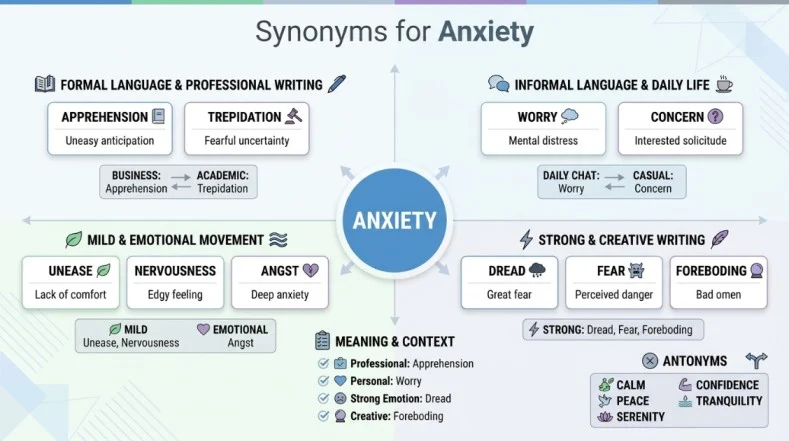
Anxiety means a feeling of worry, nervousness, uneasiness, or fear about something uncertain or potentially unpleasant. Depending on context, useful alternatives include worry, concern, apprehension, nervousness, unease, dread, trepidation, and angst.
Meaning, Tone and Context
Simple Definition
Anxiety is a feeling of worry, nervousness, or uneasiness, especially when you are concerned about something that may happen or is difficult to control.
The word can describe a temporary emotional reaction or a more persistent feeling, depending on the context.
Part of Speech
Anxiety is a noun.
Example:
Her anxiety about the interview made it difficult to sleep.
The related adjective is anxious.
Example:
He felt anxious before giving his presentation.
The adverb is anxiously.
Example:
She waited anxiously for the results.
The verb anxiate exists, but it is uncommon in everyday US English. Writers normally use phrases such as feel anxious, worry, or be concerned instead.
Tone
Anxiety usually has a negative emotional tone because it describes discomfort, worry, nervousness, or fear.
However, the strength of that feeling can vary considerably.
Unease can suggest mild discomfort.
Worry often describes ordinary concern.
Apprehension can suggest nervous anticipation.
Dread usually indicates a much stronger sense of fear or reluctance.
Formality Level
Anxiety is neutral and widely accepted.
It works in casual conversation, academic writing, professional communication, journalism, personal writing, and creative work.
Some alternatives are more formal, while others sound more conversational.
Common Use Cases
Anxiety commonly appears when discussing:
- Exams and school performance
- Job interviews
- Public speaking
- Important decisions
- Health concerns
- Financial uncertainty
- Relationships
- Future events
- Social situations
- Unexpected changes
When and How to Use “Anxiety”
The word anxiety works best when you want to describe a general state of worry or nervousness rather than one very specific emotion.
1. Professional
The upcoming presentation caused considerable anxiety among the new employees.
2. Academic
Students may experience anxiety before major examinations.
3. Personal
I felt a wave of anxiety before calling my old friend.
4. Emotional
Her anxiety grew as the deadline approached.
5. Creative
A quiet sense of anxiety filled the room as the storm moved closer.
6. Social Media
A little anxiety before a big change is completely understandable.
7. Email
I wanted to share my concerns about the upcoming deadline.
In the last example, concerns may sound more professional and constructive than anxiety.
Another Word for “Anxiety”
There is no single best synonym for every situation. The strongest replacement depends on what kind of anxiety you mean.
Professional Writing
Use concern, apprehension, or unease when you want a controlled and professional tone.
Academic Writing
Use apprehension, distress, nervousness, or concern, depending on the exact meaning.
Casual Conversation
Use worry, nervousness, unease, or jitters.
Emotional Writing
Use dread, anguish, angst, fear, or foreboding when the emotion is stronger.
Creative Writing
Use dread, foreboding, disquiet, trepidation, or angst to create a more expressive tone.
Resume or Workplace Use
Avoid describing yourself as anxious unless the context genuinely requires it. In professional writing, concern, careful consideration, or uncertainty may communicate the intended idea more effectively.
Social Media Captions
Worry, nerves, jitters, and unease can sound more natural and conversational.
Stronger Meaning
Choose dread, panic, terror, or anguish only when the situation genuinely supports a much stronger emotional reaction. These words are not interchangeable with ordinary anxiety in every sentence.
Softer Meaning
Choose unease, concern, nervousness, or misgiving when you want to communicate a milder feeling.
When Not to Use “Anxiety”
Anxiety can sometimes be too general when you need to identify the exact emotion.
For example:
I felt anxiety before the interview.
This is correct, but nervousness may be more specific because the feeling is connected to performance and anticipation.
I felt nervousness before the interview.
In another situation:
The announcement caused anxiety among employees.
If employees are mainly uncertain about what will happen, apprehension may be more precise.
The announcement caused apprehension among employees.
Avoid using an extremely strong synonym for a minor concern.
For example, saying that you felt terror because your meeting started five minutes late sounds dramatically overstated.
Words Commonly Confused With “Anxiety”
Anxiety vs. Worry
Anxiety often describes a broader emotional state of nervousness or uneasiness.
Worry usually focuses more directly on a problem or possible negative outcome.
She felt anxiety before the trip.
She worried about missing her flight.
Anxiety vs. Fear
Fear usually involves a perceived threat or danger.
Anxiety can exist even when the threat is uncertain, distant, or unclear.
He felt fear when the dog charged toward him.
He felt anxiety while waiting to hear whether he got the job.
Anxiety vs. Nervousness
Nervousness is often temporary and connected to a particular situation.
Anxiety can be broader and may involve uncertainty about many things.
Her nervousness disappeared after the presentation began.
Anxiety vs. Apprehension
Apprehension usually describes uneasy anticipation about something that may happen.
It often sounds more formal than anxiety.
He felt apprehension before the difficult conversation.
Anxiety vs. Dread
Dread is stronger than ordinary anxiety.
It suggests intense fear or reluctance about something expected.
She felt anxiety about the meeting.
She felt dread at the thought of returning to the same situation.
Anxiety vs. Panic
Panic describes a sudden and intense feeling of fear or alarm.
It is generally much stronger and more immediate than ordinary anxiety.
He felt anxious while waiting for the results.
She panicked when she realized the deadline had passed.
Best Synonym by Context for “Anxiety”
| Context | Best Synonym | Why It Works | Example |
|---|---|---|---|
| Formal writing | Apprehension | Sounds controlled and precise | His apprehension about the decision was understandable. |
| Academic writing | Concern | Clear and neutral | The study examined student concern about performance. |
| Professional use | Concern | Sounds constructive and workplace appropriate | Several employees expressed concern about the change. |
| Resume use | Nervousness | Useful when describing a specific experience honestly | Public speaking once caused nervousness, but practice improved my confidence. |
| Casual conversation | Worry | Common and natural | I am worried about tomorrow. |
| Creative writing | Dread | Adds emotional intensity | Dread settled over the house before sunset. |
| Emotional writing | Angst | Conveys deep emotional uneasiness | The character struggled with teenage angst. |
| Strong intensity | Dread | Much stronger than ordinary concern | She felt dread before entering the room. |
| Soft or moderate tone | Unease | Suggests mild discomfort | There was a slight sense of unease. |
| Social media captions | Nerves | Short, natural, and conversational | Pre interview nerves are real. |
| US usage | Worry | Extremely common in everyday American English | I have been worrying about the results. |
| UK usage | Apprehension | Commonly understood and somewhat formal | He approached the decision with apprehension. |
Which Synonym Should You Choose?
Start by asking what the person actually feels.
- If the emotion is ordinary concern about a possible problem, worry is usually the safest choice.
- If the feeling is connected to an upcoming event, apprehension or nervousness may be more precise.
- If the emotion is mild and difficult to define, unease works well.
- If the feeling is powerful and connected to something expected, dread is stronger.
For workplace writing, prioritize words such as concern, apprehension, and uncertainty when they accurately describe the situation.
For creative writing, stronger words such as foreboding, disquiet, angst, and dread can create more emotional depth.
The best synonym is not necessarily the most impressive word. It is the word that communicates the intended feeling most accurately.
Real Life Examples of “Anxiety” in Sentences
School
Exam anxiety can make it difficult for students to concentrate.
A more specific alternative is:
Students may experience nervousness before a major exam.
Workplace
The unexpected policy change created anxiety among employees.
A more professional alternative is:
The unexpected policy change created concern among employees.
Writing
The writer uses anxiety to create tension throughout the story.
A stronger literary alternative is:
The writer uses dread to create tension throughout the story.
Conversation
I have some anxiety about tomorrow’s appointment.
A more conversational option is:
I am a little worried about tomorrow’s appointment.
Social Media
New beginnings often come with excitement and a little anxiety.
A casual alternative is:
New beginnings often bring excitement and a few nerves.
Resume
Public speaking once caused anxiety, but regular practice helped me become more confident.
A more constructive professional version is:
Regular public speaking practice strengthened my confidence and communication skills.
I have some anxiety about the proposed timeline.
A more professional alternative is:
I have some concerns about the proposed timeline.
Storytelling
A strange anxiety followed him through the empty hallway.
A more atmospheric alternative is:
A quiet sense of foreboding followed him through the empty hallway.
25 Synonyms for “Anxiety”
| Synonym | Simple Meaning | Best Used For | Example Sentence |
|---|---|---|---|
| Worry | Concern about a possible problem | Everyday conversation | Her worry about the deadline kept her awake. |
| Concern | Uneasiness about a situation | Professional and neutral writing | The manager expressed concern about the delay. |
| Apprehension | Uneasy anticipation | Formal and professional contexts | He approached the interview with apprehension. |
| Unease | A mild uncomfortable feeling | Subtle emotional descriptions | A sense of unease filled the room. |
| Nervousness | Feeling tense before an event | Social and performance situations | His nervousness disappeared after he began speaking. |
| Fear | Distress caused by perceived danger | Threats and serious situations | She felt fear when the alarm sounded. |
| Dread | Strong fear about something expected | Emotional and creative writing | He felt dread as the storm approached. |
| Trepidation | Nervous fear about what may happen | Formal and literary writing | She entered the unfamiliar building with trepidation. |
| Angst | Deep emotional worry or distress | Emotional and literary contexts | The novel explores the character’s inner angst. |
| Disquiet | A disturbed or uneasy state | Formal and literary writing | The news caused widespread disquiet. |
| Foreboding | A feeling that something bad may happen | Creative writing | A feeling of foreboding followed the strange discovery. |
| Misgiving | A doubt or uneasy feeling about something | Decisions and formal writing | He had misgivings about accepting the offer. |
| Jitters | Nervous feelings, especially before an event | Casual conversation | I always get the jitters before a big presentation. |
| Edginess | A tense or nervous state | Informal descriptions | The long wait left everyone feeling edgy. |
| Restlessness | Difficulty staying calm or still | Emotional and behavioral descriptions | Her restlessness increased as the announcement drew closer. |
| Agitation | A state of emotional disturbance | Formal and descriptive writing | The uncertainty caused visible agitation. |
| Distress | Significant emotional suffering or upset | Serious emotional situations | The sudden news caused considerable distress. |
| Tension | Mental or emotional strain | Workplace, relationships, and stories | The uncertainty created tension among the team. |
| Insecurity | Lack of confidence or emotional certainty | Personal and social situations | His insecurity made the interview more difficult. |
| Alarm | Sudden concern caused by possible danger | Immediate situations | The unusual noise caused alarm among the guests. |
| Consternation | Strong confusion and distress | Formal writing | The sudden announcement caused consternation. |
| Discomposure | Loss of calm or self control | Formal and literary writing | The unexpected question caused some discomposure. |
| Fretfulness | A tendency to worry or become uneasy | Descriptive and literary writing | His fretfulness was obvious during the long wait. |
| Qualm | A sudden feeling of doubt or concern | Decisions and moral uncertainty | She had a qualm about accepting the proposal. |
| Anguish | Severe emotional pain or distress | Strong emotional writing | The character struggled with anguish after the loss. |
Synonym Groups and Usage Differences
Professional vs. Personal Synonyms
Professional writing usually benefits from controlled words such as concern, apprehension, uncertainty, and tension.
Personal writing can be more direct and emotional. Words such as worry, fear, nervousness, and dread may sound more natural.
Compare:
I have anxiety about the project.
I have concerns about the project timeline.
The second version is often more constructive in a workplace setting.
Formal vs. Conversational Synonyms
Formal writing can use apprehension, trepidation, disquiet, misgiving, and consternation.
Everyday conversation usually favors worry, nervousness, nerves, jitters, and unease.
A text message might say:
I have some nerves about tomorrow.
An academic essay might say:
Participants reported apprehension about the proposed changes.
Academic Synonyms
Academic writing benefits from precision rather than dramatic vocabulary.
Good options include:
Concern
Apprehension
Nervousness
Distress
Tension
Anxiety
Choose the word according to what is actually being measured or described.
Do not replace anxiety with a more complicated word simply to make an essay sound sophisticated.
Professional and Business Synonyms
For emails, reports, presentations, and workplace discussions, concern is often the most useful alternative.
Apprehension works when people are uneasy about an upcoming decision.
Uncertainty is useful when the issue involves a lack of information or predictability.
Tension works when pressure exists between people or groups.
Example:
Employees expressed concern about the new schedule.
This is generally more professional than:
Employees were freaking out about the new schedule.
Creative or Literary Synonyms
Creative writing gives you more freedom to choose emotionally expressive language.
Dread can create suspense.
Foreboding can suggest that something bad is approaching.
Disquiet can create a subtle sense of discomfort.
Trepidation can describe nervous anticipation.
Angst can highlight internal emotional conflict.
Example:
A feeling of foreboding lingered beneath the celebration.
Slang or Modern Synonyms
Casual expressions such as jitters, nerves, and edginess can work in conversations, texts, captions, and informal posts.
They are usually inappropriate for academic research, formal reports, and professional documents unless the context specifically calls for conversational language.
Strongest vs. Weaker Synonyms
A useful approximate intensity scale is:
Mild: unease, concern, misgiving
Moderate: worry, nervousness, apprehension, tension
Strong: fear, dread, distress, anguish
Highly intense or situation specific: panic, terror
Intensity depends heavily on context. A word should never be selected only because it appears stronger.
Emotional vs. Neutral Synonyms
Neutral choices include concern, apprehension, and uncertainty.
More emotional choices include dread, anguish, angst, and fear.
If you want your sentence to sound objective, choose a neutral term.
If you want readers to feel the character’s emotional state, a more expressive synonym may work better.
Antonyms of “Anxiety”
Not every opposite below is a perfect dictionary antonym in every context. These are useful contextual opposites that represent calmness, confidence, security, or emotional ease.
| Antonym | Meaning | Example Sentence |
|---|---|---|
| Calmness | A peaceful emotional state | She maintained calmness during the interview. |
| Calm | Free from agitation or worry | He remained calm under pressure. |
| Peace | A state without disturbance or worry | The quiet environment gave her a sense of peace. |
| Confidence | Belief in your ability or judgment | His confidence helped him handle the presentation. |
| Assurance | A feeling of certainty or security | The manager’s explanation gave everyone assurance. |
| Security | Freedom from danger or uncertainty | The new policy provided greater security. |
| Certainty | A strong sense that something is true or definite | The information gave us certainty about the plan. |
| Composure | Control over your emotions | She kept her composure during the difficult conversation. |
| Relaxation | A state of physical or mental ease | A short walk helped him find relaxation. |
| Ease | Freedom from discomfort or worry | The clear instructions put everyone at ease. |
| Tranquility | A peaceful and undisturbed state | The garden offered a sense of tranquility. |
| Serenity | Deep calmness and peace | The lake created an atmosphere of serenity. |
| Reassurance | Something that reduces doubt or worry | Her message provided reassurance. |
| Hope | Positive expectation about the future | Hope replaced some of his earlier worry. |
| Contentment | A satisfied and peaceful state | She felt contentment after completing the project. |
Comparison: Anxiety vs. Similar Words
Anxiety vs. Worry
Main difference: Anxiety is often broader, while worry commonly focuses on a particular problem.
Which one is stronger: Anxiety can be stronger or more persistent, depending on context.
Which one is more formal: Anxiety is generally more formal and neutral.
Examples:
She felt anxiety before the presentation.
She worried about forgetting her notes.
Anxiety vs. Fear
Main difference: Fear usually responds to a perceived threat, while anxiety can arise from uncertainty.
Which one is stronger: Fear can be stronger when immediate danger is involved.
Which one is more formal: Both are standard words.
Examples:
He felt anxiety about the uncertain outcome.
He felt fear when he saw the approaching vehicle.
Anxiety vs. Nervousness
Main difference: Nervousness often describes a temporary reaction to a specific event.
Which one is stronger: Anxiety can suggest a broader emotional state.
Which one is more formal: Anxiety is slightly more formal and general.
Examples:
Her anxiety about the future continued for weeks.
His nervousness disappeared after the interview began.
Anxiety vs. Apprehension
Main difference: Apprehension emphasizes uneasy anticipation.
Which one is stronger: Apprehension can sound more serious or formal, but intensity depends on context.
Which one is more formal: Apprehension is more formal.
Examples:
She felt anxiety about the change.
She approached the change with apprehension.
Anxiety vs. Dread
Main difference: Dread suggests a strong expectation of something unpleasant.
Which one is stronger: Dread is usually stronger.
Which one is more formal: Both are acceptable, but dread is more emotionally direct.
Examples:
He felt anxiety before the meeting.
He felt dread at the thought of repeating the experience.
Anxiety vs. Unease
Main difference: Unease usually describes a milder and less defined discomfort.
Which one is stronger: Anxiety is usually broader or stronger.
Which one is more formal: Both are neutral, although unease can sound especially natural in descriptive writing.
Examples:
She felt anxiety about the results.
A slight unease remained after the conversation.
Common Phrases and Expressions with “Anxiety”
1. Anxiety about the Future
Meaning:
Worry or uncertainty about what may happen later.
Example sentence:
His anxiety about the future made it difficult to focus on the present.
2. Anxiety Over a Decision
Meaning:
Worry connected to making an important choice.
Example sentence:
She experienced anxiety over whether to accept the new position.
3. Anxiety Before an Exam
Meaning:
Nervousness or worry before a test.
Example sentence:
Many students experience anxiety before an important exam.
4. Social Anxiety
Meaning:
Anxiety connected to social interaction or social situations.
Example sentence:
He felt nervous about attending the large networking event.
5. Performance Anxiety
Meaning:
Nervousness related to performing, presenting, competing, or being evaluated.
Example sentence:
Practice helped reduce her performance anxiety before the presentation.
6. Feelings of Anxiety
Meaning:
A general phrase for experiencing worry, nervousness, or unease.
Example sentence:
He described feelings of anxiety before the announcement.
7. Reduce Anxiety
Meaning:
To make feelings of worry or nervousness less intense.
Example sentence:
Clear instructions can reduce anxiety during a complicated process.
8. Cause Anxiety
Meaning:
To create worry, nervousness, or unease.
Example sentence:
Unclear expectations can cause anxiety in a new workplace.
Common Mistakes to Avoid
1. Using Anxiety When a More Precise Word Works Better
Instead of repeating anxiety, identify the exact feeling.
- Use nervousness for a temporary reaction.
- Use dread for strong fear.
- Use concern for a professional issue.
2. Confusing Anxiety With Fear
Do not treat every instance of anxiety as fear.
Anxiety often involves uncertainty, anticipation, or general worry, while fear commonly involves a perceived threat.
3. Using a Casual Synonym in Formal Writing
Words such as jitters and nerves can sound too casual in academic or professional documents.
Choose apprehension, concern, or nervousness when appropriate.
4. Using an Overly Dramatic Synonym
Do not replace ordinary anxiety with terror or anguish unless the situation genuinely involves extreme emotional intensity.
Strong vocabulary is useful only when it is accurate.
5. Repeating Anxiety Too Often
If the same word appears several times in one paragraph, look for opportunities to use precise alternatives.
Do not replace every instance mechanically. Choose a synonym only when the meaning remains accurate.
6. Choosing the Wrong Emotional Tone
Concern sounds controlled.
Dread sounds intense.
Unease sounds subtle.
Angst sounds emotionally expressive.
Match the word to the feeling you want readers to understand.
7. Using Slang in Academic or Professional Writing
Terms such as jitters may be perfectly natural in conversation but can weaken the tone of a formal report.
Always consider who will read your writing and why.
FAQs
What is the best synonym for anxiety?
The best synonym depends on context. Worry works for everyday situations, concern for professional writing, and apprehension for formal or academic contexts.
What is a formal synonym for anxiety?
Apprehension is one of the strongest formal alternatives when anxiety means uneasy anticipation. Concern is another useful choice for professional communication.
What is an informal synonym for anxiety?
Worry, nerves, and jitters are natural informal alternatives. They work well in conversations, texts, casual captions, and relaxed writing.
What is another word for anxiety in professional writing?
Concern is often the best professional alternative because it communicates uneasiness without sounding overly emotional or dramatic.
What is the difference between anxiety and worry?
Anxiety can describe a broader state of nervousness or unease, while worry often focuses on a particular problem, possibility, or negative outcome.
What is the opposite of anxiety?
Common contextual opposites include calmness, confidence, peace, composure, ease, serenity, and reassurance.
Conclusion
Anxiety describes a feeling of worry, nervousness, unease, or fear about uncertainty or a possible negative outcome. The best alternative depends on the exact emotion, situation, audience, and level of formality.
Use worry for everyday communication, concern for professional writing, apprehension for formal contexts, nervousness for temporary situations, unease for subtle discomfort, and dread when the feeling is much stronger.
The most useful vocabulary tip is simple: do not choose a synonym because it sounds impressive. Choose it because it expresses your exact meaning. Precise word choice makes writing clearer, more natural, and more effective.
Discover More Post:
- 25+ Synonyms for Affect | Meanings, Examples, and Best …
- 25+ Synonyms for Achieve | Meanings, Examples, and Best …
- 25+ Synonyms for Real | Meanings, Examples, and Best …