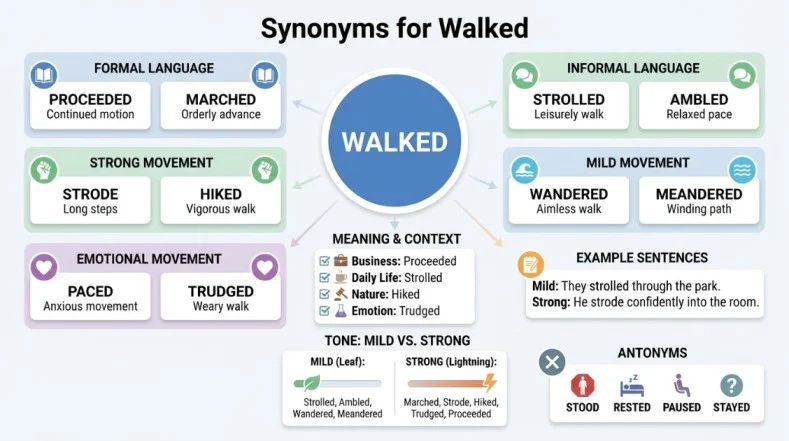
Repeating the word “walked” can make an essay, story, caption, email, or everyday sentence feel flat. The right alternative can instantly show speed, mood, direction, effort, or personality.
The best synonyms for walked depend on what actually happened. Someone may have strolled through a park, marched into a room, wandered around a city, or trudged home after a long day.
This guide explains the meaning, tone, context, and practical use of synonyms for walked. You will also find choices for academic writing, professional communication, creative writing, resumes, conversations, captions, and everyday English.
What Does “Walked” Mean?
“Walked” is the past tense of “walk” and means moved from one place to another on foot. Depending on context, alternatives include strolled, marched, ambled, wandered, strode, hiked, trekked, paced, and proceeded.
Meaning, Tone and Context
Simple Definition
“Walked” means moved by taking steps on your feet rather than traveling by a vehicle or another form of transportation.
For example:
“She walked to the store.”
The sentence simply tells the reader that she traveled to the store on foot.
Part of Speech
“Walked” is a verb. It is the simple past tense and past participle of “walk.”
Common forms include:
Walk
Walked
Walking
Walks
The related noun is “walk,” as in “We went for a walk.”
Tone
“Walked” usually has a neutral tone. It does not automatically tell the reader whether the movement was fast, slow, happy, nervous, tired, confident, or angry.
That neutrality is useful when the manner of movement is not important.
Formality Level
“Walked” is common in casual, academic, professional, and creative English.
More specific alternatives can create a more precise tone. For example, “proceeded” sounds more formal, while “strolled” sounds relaxed.
Common Use Cases
“Walked” commonly appears in:
Personal conversations
School assignments
Professional writing
Emails
Storytelling
Social media captions
Travel writing
Resume descriptions
News writing
Everyday descriptions
Important Word Forms
Verb: walk
Past tense: walked
Present participle: walking
Third person singular: walks
Noun: walk
Adjective: walkable
Adverbial expression: on foot
When and How to Use “Walked”
Use “walked” when the basic fact of movement matters more than the manner of movement.
Professional
“She walked to the conference room before the presentation began.”
This is clear and neutral.
Personal
“I walked home after dinner.”
The word sounds natural in everyday conversation.
Academic
“The participants walked across the campus before entering the research facility.”
The straightforward verb works well when the manner of movement is not significant.
Emotional
“He walked away without saying another word.”
Here, “walked away” can suggest emotional distance even though the verb itself remains neutral.
Creative
“The traveler walked beneath the fading afternoon light.”
The surrounding description creates the mood.
Social Media
“Walked through downtown and found the perfect little bookstore.”
This casual use feels natural for a caption.
“I walked over to the other department to confirm the details.”
The wording is conversational and suitable for an informal workplace email.
Another Word for “Walked”
The best single replacement depends on what kind of movement you want to describe.
- Professional writing: proceeded
- Academic writing: proceeded
- Casual conversation: went or strolled
- Emotional writing: wandered or trudged
- Creative writing: sauntered or meandered
- Resume or workplace use: proceeded or traveled, depending on context
- Social media captions: strolled or wandered
- Stronger meaning: marched or strode
- Softer meaning: ambled or strolled
Remember that “went” is broader than “walked.” It can describe travel by car, train, plane, or other transportation, so it is not always a precise replacement.
When Not to Use “Walked”
“Walked” may be too general when the manner of movement matters.
Instead of:
“She walked into the room confidently.”
A more precise choice could be:
“She strode into the room confidently.”
“Strode” emphasizes confident, purposeful movement.
Instead of:
“He walked through the park slowly.”
You could write:
“He strolled through the park.”
“Strolled” communicates relaxed movement more naturally.
Instead of:
“The exhausted worker walked home.”
You could write:
“The exhausted worker trudged home.”
“Trudged” suggests slow, difficult movement caused by tiredness or effort.
The goal is not to replace “walked” every time. The goal is to choose a more precise word when the context calls for it.
Words Commonly Confused With “Walked”
Walked vs. Strolled
“Walked” simply describes movement on foot. “Strolled” suggests a relaxed, unhurried walk.
Better choice: Use “walked” for neutral movement and “strolled” for leisurely movement.
Walked vs. Marched
“Marched” suggests purposeful, rhythmic, organized, or forceful movement.
Better choice: Use “marched” when determination, military movement, protest activity, or strong purpose is important.
Walked vs. Wandered
“Wandered” suggests movement without a clear destination or with little concern about direction.
Better choice: Use “wandered” for exploration, uncertainty, or aimless movement.
Walked vs. Hiked
“Hiked” usually means walking for a relatively long distance, especially outdoors and often on trails or natural terrain.
Better choice: Use “hiked” when the activity involves outdoor walking over a substantial route.
Walked vs. Paced
“Paced” means walking repeatedly back and forth, often because of nervousness, impatience, thought, or concern.
Better choice: Use “paced” when repeated movement is part of the meaning.
Walked vs. Proceeded
“Proceeded” means moved forward or continued toward a place or next stage. It has a more formal tone.
Better choice: Use “proceeded” in formal instructions, reports, or professional contexts when the direction or progression matters.
Best Synonym by Context for “Walked”
| Context | Best Synonym | Why It Works | Example |
|---|---|---|---|
| Formal writing | Proceeded | Sounds precise and formal | The committee proceeded toward the main hall. |
| Academic writing | Proceeded | Fits objective descriptions | The students proceeded to the testing area. |
| Professional or business use | Proceeded | Communicates movement formally | The manager proceeded to the meeting room. |
| Resume | Traveled | Describes movement across locations | Traveled between offices to support clients. |
| Casual conversation | Strolled | Sounds natural and relaxed | We strolled around the neighborhood. |
| Creative writing | Meandered | Adds descriptive movement | She meandered along the riverbank. |
| Emotional tone | Trudged | Suggests tired or difficult movement | He trudged home after the disappointing game. |
| Strong intensity | Marched | Shows determination or force | She marched into the office with confidence. |
| Soft or moderate tone | Ambled | Suggests relaxed movement | He ambled down the quiet street. |
| Social media captions | Wandered | Creates an exploratory feeling | Wandered through the city and discovered hidden cafés. |
| US usage | Walked | Common and neutral | We walked across the street. |
| UK usage | Walked | Also common and neutral | We walked to the station. |
Which Synonym Should You Choose?
Start with the basic meaning. If you only need to say that someone moved on foot, “walked” is usually the clearest option.
Next, consider speed. A person can “stroll” slowly, “stride” confidently, or “trudge” with difficulty.
Consider purpose and direction. “Marched” can show determination, while “proceeded” can show formal forward movement.
Think about emotional tone. “Wandered” may suggest uncertainty or curiosity, while “paced” can suggest nervousness or impatience.
Finally, consider your audience. A creative story can benefit from vivid verbs, while an academic paper may be clearer with simple and objective language.
Real Life Examples of “Walked” in Sentences
School
“Maria walked across campus before her first class.”
A more descriptive version is:
“Maria hurried across campus before her first class.”
Workplace
“The manager walked into the conference room.”
For a more formal tone:
“The manager proceeded to the conference room.”
Writing
“The character walked through the forest.”
A more vivid version is:
“The character wandered through the forest.”
Conversation
“I walked home after work.”
This is simple and completely natural.
Social Media
“Walked around the city all afternoon and found some amazing food.”
A more expressive caption could use:
“Wandered around the city all afternoon and found some amazing food.”
Resume
“Walked between departments to coordinate project materials.”
For a professional resume, it may be better to describe the actual responsibility rather than the physical movement if the movement itself is not important.
“I walked over to the finance team to confirm the figures.”
This works in a conversational workplace email.
Storytelling
“He walked toward the door.”
A stronger creative version could be:
“He strode toward the door.”
The second sentence gives the reader more information about his manner and attitude.
25 Synonyms for “Walked”
Some words below are close synonyms, while others are contextual alternatives that describe a particular type or manner of walking. Choosing accurately is more important than forcing a synonym into every sentence.
| Synonym | Simple Meaning | Best Used For | Example Sentence |
|---|---|---|---|
| Strolled | Walked slowly and casually | Relaxed movement | We strolled through the park after lunch. |
| Ambled | Walked at an easy pace | Leisurely movement | He ambled down the sidewalk without rushing. |
| Sauntered | Walked slowly and confidently | Casual confidence | She sauntered into the café with a smile. |
| Marched | Walked with purpose or rhythm | Determination or organized movement | The students marched toward the auditorium. |
| Strode | Walked with long, confident steps | Confidence and purpose | He strode across the stage. |
| Wandered | Walked without a fixed direction | Exploration or uncertainty | We wandered through the old neighborhood. |
| Meandered | Followed a winding or indirect route | Scenic or literary writing | They meandered along the river. |
| Paced | Walked repeatedly back and forth | Nervousness or impatience | She paced the room while waiting for the call. |
| Hiked | Walked a considerable distance outdoors | Trails and nature | We hiked through the national forest. |
| Trekked | Walked a long or challenging route | Difficult journeys | They trekked across the mountain region. |
| Trudged | Walked slowly with effort | Fatigue or difficulty | He trudged home after a long shift. |
| Plodded | Walked slowly and heavily | Tired or dull movement | The tired dog plodded behind its owner. |
| Shuffled | Walked with small dragging steps | Fatigue or limited movement | He shuffled toward the kitchen. |
| Tiptoed | Walked quietly on the toes | Silence and caution | She tiptoed past the sleeping baby. |
| Crept | Moved slowly and carefully | Secrecy or caution | He crept toward the doorway. |
| Limped | Walked unevenly because of injury or pain | Physical difficulty | She limped home after hurting her ankle. |
| Stomped | Walked heavily and forcefully | Anger or emphasis | The child stomped out of the room. |
| Tramped | Walked heavily or for a long distance | Rough terrain or long travel | They tramped through the muddy field. |
| Promenaded | Walked for pleasure or display | Formal or literary contexts | The couple promenaded along the waterfront. |
| Perambulated | Walked around or through a place | Formal or literary writing | The visitor perambulated through the historic district. |
| Proceeded | Moved forward toward a destination | Formal and professional writing | The guests proceeded to the reception area. |
| Traveled | Moved from one place to another | General travel context | She traveled across campus on foot. |
| Advanced | Moved forward | Formal or purposeful movement | The hikers advanced toward the summit. |
| Paraded | Walked in an organized or public display | Ceremonies and public events | The performers paraded through the town. |
| Trod | Walked or stepped on something | Literary and descriptive writing | He trod carefully across the wet stones. |
Synonym Groups and Usage Differences
Professional vs. Personal Synonyms
Professional writing usually benefits from precise and neutral words.
“Proceeded” works well when describing formal movement or the next stage of an activity.
Personal writing can use expressive words such as “strolled,” “wandered,” or “ambled” when the manner of movement matters.
Formal vs. Conversational Synonyms
“Perambulated” and “promenaded” are much more formal or literary than “walked.”
“Strolled,” “wandered,” and “ambled” are more natural in everyday conversation.
For a normal email, “walked” is usually better than an unusually formal word unless the context specifically calls for it.
Academic Synonyms
Academic writing generally values precision over decoration.
“Proceeded,” “advanced,” and “traveled” can work when they accurately describe the movement being discussed.
Avoid choosing an unusual synonym simply to make an essay sound sophisticated. Precision is more valuable than complexity.
Professional and Business Synonyms
In workplace communication, “proceeded” can be useful when describing formal movement from one stage or location to another.
However, if physical walking is not relevant to the work, focus on the actual professional action instead.
For example, “visited the client site” may communicate more useful information than “walked to the client site.”
Creative or Literary Synonyms
Creative writing often benefits from verbs that reveal character or atmosphere.
“Sauntered” can suggest confidence. “Trudged” can suggest exhaustion. “Wandered” can suggest uncertainty or curiosity.
The best choice adds meaning without making the sentence feel unnatural.
Slang or Modern Synonyms
There are informal expressions for walking, but they are highly dependent on region, age group, and situation.
For broad US audiences, standard words such as “strolled,” “wandered,” “marched,” and “hiked” are safer and clearer than highly localized slang.
Strongest vs. Weaker Synonyms
A useful intensity scale is:
Mild: ambled, strolled
Neutral: walked, proceeded
Purposeful: strode, advanced
Strong: marched, stomped
Difficult: trudged, plodded
Highly descriptive: limped, tiptoed, crept
The strongest word is not always the best word. Choose the word that matches the actual action.
Emotional vs. Neutral Synonyms
Neutral:
“She walked home.”
Relaxed:
“She strolled home.”
Tired:
“She trudged home.”
Angry:
“She stomped home.”
Uncertain:
“She wandered home.”
Each verb changes the emotional information the reader receives.
Antonyms of “Walked”
Some antonyms below are direct opposites of movement, while others are contextual opposites that describe traveling without walking.
| Antonym | Meaning | Example Sentence |
|---|---|---|
| Stopped | Ceased movement | She stopped near the entrance. |
| Halted | Brought movement to an end | The group halted at the gate. |
| Stood | Remained upright without moving | He stood beside the door. |
| Stayed | Remained in one place | She stayed at home all evening. |
| Remained | Continued to be in the same place | He remained in his office. |
| Sat | Rested in a seated position | She sat by the window. |
| Rested | Stopped activity to recover | He rested after the long trip. |
| Paused | Temporarily stopped | They paused before crossing the street. |
| Waited | Remained until something happened | We waited outside the building. |
| Stayed put | Remained in the same location | Please stay put until I return. |
| Drove | Traveled using a car | She drove to work instead. |
| Rode | Traveled using a bicycle, animal, or vehicle | He rode his bike to school. |
| Flew | Traveled by air | They flew to Chicago for the conference. |
| Sailed | Traveled by boat | We sailed across the lake. |
| Parked | Stopped and left a vehicle in a location | She parked near the office. |
Comparison: “Walked” vs. Similar Words
- “Walked” vs. “Strolled”
- Main difference: “Walked” is neutral, while “strolled” suggests relaxed movement.
- Stronger: “Strolled” provides more descriptive information.
- More formal: Neither is strongly formal, although “walked” is more universally neutral.
- Example: “She walked through the park.” “She strolled through the park.”
- “Walked” vs. “Wandered”
- Main difference: “Walked” can involve a clear destination, while “wandered” suggests uncertain or aimless movement.
- Stronger: “Wandered” creates a more specific image.
- More formal: “Walked” is more neutral.
- Example: “He walked around the city.” “He wandered around the city.”
- “Walked” vs. “Marched”
- Main difference: “Marched” suggests purpose, rhythm, force, or organization.
- Stronger: “Marched” is stronger.
- More formal: “Marched” is not necessarily more formal, but it is more specific.
- Example: “She walked into the room.” “She marched into the room.”
- “Walked” vs. “Hiked”
- Main difference: “Hiked” normally refers to walking outdoors over a longer or more challenging route.
- Stronger: “Hiked” gives more information about the activity.
- More formal: Both are neutral.
- Example: “We walked through the woods.” “We hiked through the woods.”
- “Walked” vs. “Paced”
- Main difference: “Paced” usually means repeatedly walking back and forth.
- Stronger: “Paced” communicates a specific pattern of movement.
- More formal: Neither is especially formal.
- Example: “He walked around the room.” “He paced around the room.”
- “Walked” vs. “Proceeded”
- Main difference: “Walked” specifically describes movement on foot, while “proceeded” means moved forward or continued and does not necessarily involve walking.
- Stronger: “Proceeded” sounds more formal.
- More formal: “Proceeded” is more formal.
- Example: “They walked to the next room.” “They proceeded to the next room.”
Common Phrases and Expressions with “Walked”
1. Walked away
Meaning:
Moved away from a person, place, situation, or conversation.
Example sentence:
“She walked away before the argument became worse.”
2. Walked into
Meaning:
Entered a place by walking.
Example sentence:
“He walked into the office at nine.”
3. Walked out
Meaning:
Left a place, sometimes suddenly or in protest.
Example sentence:
“She walked out of the meeting after the disagreement.”
4. Walked around
Meaning:
Moved around an area on foot.
Example sentence:
“We walked around downtown for several hours.”
5. Walked through
Meaning:
Moved through a place or completed something step by step.
Example sentence:
“The instructor walked us through the new process.”
6. Walked past
Meaning:
Moved by someone or something without stopping.
Example sentence:
“I walked past the bookstore on my way home.”
7. Walked over
Meaning:
Moved toward a nearby person or place on foot.
Example sentence:
“I walked over to ask my coworker for help.”
8. Walked off
Meaning:
Left a place, often after an emotional moment.
Example sentence:
“He walked off before anyone could respond.”
Common Mistakes to Avoid
1. Replacing “walked” Without Considering Meaning
Not every synonym means exactly the same thing.
“Strolled” suggests relaxation, while “marched” suggests purpose or force.
2. Using a Related Word as an Exact Synonym
“Proceeded” does not always mean walked because a person can proceed by car or another method.
Always check whether the replacement preserves the original meaning.
3. Using a Casual Synonym in Formal Writing
Words that sound natural in conversation may feel inappropriate in academic or professional writing.
Choose neutral vocabulary when the audience expects formal communication.
4. Making a Simple Action Sound Too Dramatic
If someone simply moved across a room, “stomped” may create an emotion that was never intended.
Use expressive verbs only when the context supports them.
5. Repeating “Walked” Too Often
Repeated use can make storytelling feel predictable.
Instead of replacing every occurrence, keep “walked” where it is the clearest choice and vary only the sentences that need additional detail.
6. Choosing the Wrong Emotional Tone
“Trudged” suggests difficulty. “Sauntered” suggests confidence or relaxed movement.
Using the wrong word can accidentally change the meaning of a sentence.
7. Using Unnecessary Slang
Highly casual expressions may not work well in academic essays, business emails, or professional documents.
Standard vocabulary is usually the safest choice for broad audiences.
FAQs
What is the best synonym for “walked”?
“Strolled” is a strong choice for relaxed movement, while “strode,” “marched,” “wandered,” and “trudged” work better when the manner of movement matters.
What is a formal synonym for “walked”?
“Proceeded” is a useful formal alternative when someone moves forward or toward a destination. It does not always specifically mean movement on foot.
What is an informal synonym for “walked”?
“Strolled” is a natural informal alternative when the person is walking casually or without hurry.
What is another word for “walked” in professional writing?
“Proceeded” can work in professional writing when formal movement or progression is relevant. “Traveled” may work when describing movement between locations.
What is the difference between “walked” and “strolled”?
“Walked” is neutral and simply describes movement on foot. “Strolled” suggests a relaxed, leisurely, and usually unhurried manner.
What is the opposite of “walked”?
Contextual opposites include stopped, halted, stayed, remained, sat, rested, drove, rode, flew, and sailed, depending on the intended meaning.
Conclusion
“Walked” is a clear, flexible verb for describing movement on foot, but a more precise alternative can make your writing stronger. “Strolled” suggests relaxation, “marched” shows purpose, “wandered” suggests uncertainty, and “trudged” communicates difficulty.
The best synonyms for walked are always context dependent. Before choosing another word, consider the person’s speed, purpose, emotion, direction, physical condition, and your audience.
A simple vocabulary tip can make a major difference: do not replace a common word just to sound sophisticated. Replace it when the new word communicates something more precise.
Discover More Post:
- 25+ Synonyms for Affect | Meanings, Examples, and Best …
- 25+ Synonyms for Achieve | Meanings, Examples, and Best …
- 25+ Synonyms for Real | Meanings, Examples, and Best …