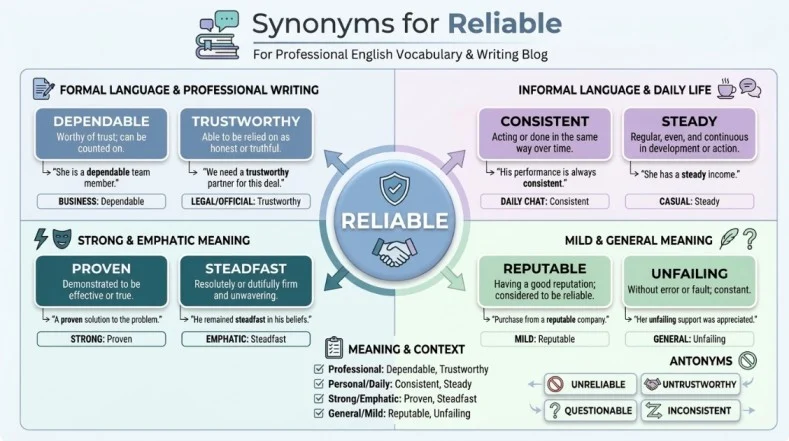
You may describe a coworker as reliable, call a product reliable, praise a reliable friend, and even mention a reliable source several times in the same piece of writing. The word is useful, but repeating it can make your vocabulary feel predictable.
Learning the right synonyms for reliable helps you communicate with greater precision. A resume may benefit from dependable or responsible, while an academic paper may need credible or consistent. In personal writing, trustworthy or steadfast can express a warmer meaning.
The key is not simply replacing reliable with another word. The strongest vocabulary choice depends on what you are describing, how formal the situation is, and what quality you want to emphasize.
What Does “Reliable” Mean?
Reliable means consistently dependable, trustworthy, or likely to perform as expected. Depending on context, strong alternatives include dependable for professional use, credible for information, trustworthy for people, consistent for performance, and steadfast for emotional or personal writing.
Meaning, Tone and Context
Simple Definition
Reliable describes someone or something that can be trusted to work properly, behave consistently, keep promises, or produce an expected result.
For example, a reliable employee completes assignments on time, while a reliable car starts and operates consistently.
Part of Speech
Reliable is an adjective.
It describes a person, object, service, system, source, method, or situation.
Examples include:
- A reliable employee.
- A reliable source.
- A reliable vehicle.
- A reliable method.
- A reliable internet connection.
Tone
Reliable usually has a positive and neutral tone.
It suggests trust, consistency, dependability, and confidence. The exact feeling changes according to the noun it describes.
Calling a friend reliable sounds appreciative. Calling a research source reliable sounds factual and objective.
Formality Level
Reliable works comfortably in casual, academic, professional, and formal communication.
It is common enough for everyday speech but precise enough for resumes, reports, essays, business writing, and professional communication.
Common Use Cases
Reliable is frequently used for:
People and relationships.
Employees and coworkers.
Products and technology.
Transportation.
Information and sources.
Research methods.
Services and businesses.
Systems and processes.
Promises and support.
Important Word Forms
Reliable is related to several useful forms:
Reliable: adjective.
Reliability: noun.
Reliably: adverb.
Rely: verb.
Relied: past form of rely.
For example, “The system is reliable,” “The system has excellent reliability,” and “The system operates reliably.”
When and How to Use “Reliable”
Use reliable when you want to communicate that someone or something can be trusted to behave, perform, or deliver consistently.
Professional
“She is one of the most reliable members of the marketing team.”
This highlights consistent workplace performance.
Personal
“My brother has always been reliable when I need help.”
Here, reliable emphasizes trust and dependability.
Academic
“The study uses reliable sources to support its conclusions.”
In academic writing, reliable suggests that the sources can reasonably be trusted.
Emotional
“Her reliable support helped me through a difficult period.”
The word communicates stability and trust without sounding overly dramatic.
Creative
“The old lighthouse remained a reliable guide for ships approaching the coast.”
Here, reliable emphasizes steady function and predictable guidance.
Social Media
“Grateful for the reliable people who always show up.”
This gives reliable a warm and appreciative feeling.
“Thank you for being so reliable throughout the project.”
This is suitable for professional appreciation.
Another Word for “Reliable”
The best single replacement depends on what you mean.
- For professional writing, dependable is often the safest choice because it clearly describes consistent performance.
- For academic writing, credible works well when discussing information, sources, or claims.
- For casual conversation, dependable or trustworthy sounds natural.
- For emotional writing, steadfast can communicate stronger loyalty and commitment.
- For creative writing, unfailing can create a more expressive tone.
- For resumes and workplace communication, dependable, consistent, and responsible are particularly useful.
- For social media captions, trustworthy, steady, or dependable usually sounds natural.
- For a stronger meaning, choose unfailing or steadfast when the context genuinely supports that intensity.
- For a softer meaning, choose steady or consistent when you want to emphasize predictability without making a strong statement about trust.
When Not to Use “Reliable”
Reliable can become too general when you need to explain exactly why someone or something deserves confidence.
For example:
“Maria is a reliable employee.”
This is positive but broad.
“Maria consistently meets deadlines and completes assignments accurately.”
The second sentence gives specific evidence instead of relying on a general description.
Reliable can also sound too weak when the intended meaning is strong loyalty or unwavering support.
“Her reliable friendship helped me.”
“Her steadfast friendship helped me.”
The second sentence carries a stronger emotional meaning.
Likewise, reliable may be too broad when describing information. In that situation, credible, authoritative, or well supported may communicate the intended quality more precisely.
Words Commonly Confused With “Reliable”
Dependable
Dependable means consistently capable of being trusted to do what is expected.
It is especially natural for people, employees, services, and equipment.
Trustworthy
Trustworthy focuses more strongly on honesty and the ability to trust someone or something.
A trustworthy person can be relied upon to act honestly.
Credible
Credible means believable or worthy of being trusted.
It is particularly useful for sources, information, experts, explanations, and claims.
Consistent
Consistent means staying similar or predictable over time.
It does not always imply trustworthiness. A person can be consistently late, for example.
Responsible
Responsible focuses on fulfilling duties, obligations, and expectations.
It is useful for employees, students, parents, and professionals.
Reputable
Reputable means having a good reputation.
It often describes businesses, organizations, professionals, and institutions rather than everyday objects.
Best Synonym by Context for “Reliable”
| Context | Best Synonym | Why It Works | Example |
|---|---|---|---|
| Formal writing | Dependable | Clear and professional | The organization needs dependable suppliers. |
| Academic writing | Credible | Strong for information and sources | The paper relies on credible evidence. |
| Professional use | Dependable | Highlights consistent performance | We need a dependable team member. |
| Resume | Consistent | Shows stable performance | Delivered consistent results across multiple projects. |
| Casual conversation | Dependable | Sounds natural and friendly | Jake is really dependable. |
| Creative writing | Unfailing | Adds expressive strength | Her unfailing courage inspired everyone. |
| Emotional tone | Steadfast | Suggests loyalty and commitment | He remained a steadfast friend. |
| Strong intensity | Unfailing | Suggests exceptional consistency | She offered unfailing support. |
| Soft or moderate tone | Steady | Suggests calm predictability | The company has maintained steady growth. |
| Social media | Trustworthy | Communicates confidence and appreciation | Surround yourself with trustworthy people. |
| Information | Credible | Focuses on believability | Use credible sources for your research. |
| Business reputation | Reputable | Highlights public trust | They work with a reputable supplier. |
Which Synonym Should You Choose?
Start by identifying what reliable means in your sentence.
- If you mean someone consistently does what they promise, choose dependable.
- If you mean someone is honest and worthy of trust, choose trustworthy.
- If you mean information can be believed, choose credible.
- If you mean performance remains stable, choose consistent.
- If you mean someone fulfills duties responsibly, choose responsible.
- If you mean a company or professional has earned public respect, choose reputable.
- If you want to express deep loyalty or unwavering support, choose steadfast.
The best synonym is therefore not always the most sophisticated word. It is the word that communicates the intended meaning most accurately.
Real Life Examples of “Reliable” in Sentences
School
“Students should use reliable sources when researching a historical topic.”
Workplace
“Everyone appreciates an employee who is reliable and organized.”
Writing
“The author presents reliable evidence before making the central argument.”
Conversation
“I know I can count on Maya because she is reliable.”
Social Media
“Reliable friends make difficult days easier.”
Resume
“Built a reputation for reliable performance and timely project completion.”
“Thank you for your reliable support during the transition.”
Storytelling
“The traveler trusted the reliable compass to guide him through the forest.”
25 Synonyms for “Reliable”
| Synonym | Simple Meaning | Best Used For | Example Sentence |
|---|---|---|---|
| Dependable | Can be trusted to do what is expected | People, services, equipment | We need a dependable employee for this role. |
| Trustworthy | Deserving of trust | People, information, organizations | She is a trustworthy colleague. |
| Credible | Worth believing or trusting | Sources, experts, claims | The journalist used credible sources. |
| Consistent | Performs or behaves in a stable way | Results, performance, behavior | The team delivers consistent results. |
| Responsible | Reliably fulfills duties | People, employees, students | He is a responsible member of the team. |
| Steady | Stable and predictable | Performance, progress, behavior | The company has shown steady growth. |
| Reputable | Known for a good reputation | Businesses, professionals, organizations | They hired a reputable contractor. |
| Sound | Solid, dependable, or logically reliable | Decisions, methods, systems | The researchers developed a sound method. |
| Solid | Dependable and strong | Plans, performance, choices | She has a solid record of success. |
| Proven | Demonstrated to work successfully | Methods, products, strategies | This is a proven approach to customer service. |
| Unfailing | Consistently present or effective | Support, loyalty, performance | Her unfailing support gave him confidence. |
| Steadfast | Firm, loyal, and dependable | People, loyalty, support | He remained steadfast during the crisis. |
| Faithful | Loyal and dependable | People, relationships, traditions | The faithful friend stayed by her side. |
| Sure | Certain or dependable in a particular context | Outcomes, choices, methods | This is a sure way to avoid the common mistake. |
| Secure | Safe, stable, or dependable | Systems, arrangements, situations | The company needs a secure backup system. |
| Stable | Not likely to change suddenly | Systems, conditions, performance | The software provides stable performance. |
| Durable | Able to remain useful over time | Products, materials, equipment | The durable equipment is designed for frequent use. |
| Robust | Strong enough to withstand problems | Systems, processes, technology | The platform has a robust security structure. |
| Resilient | Able to recover and continue functioning | People, systems, organizations | The resilient system recovered quickly. |
| Reliable | Consistently dependable | General use | We need a reliable source of information. |
| Authentic | Genuine and worthy of confidence | People, experiences, content | The writer presents an authentic perspective. |
| Valid | Sound, acceptable, or logically supported | Arguments, evidence, methods | The researchers used a valid measurement method. |
| Authoritative | Highly trusted because of expertise or recognized authority | Sources, experts, information | The report cites authoritative medical references. |
| Dependable | Consistently trustworthy and capable | Professional and everyday use | Her dependable work earned the team’s confidence. |
| Constant | Present or continuing without interruption | Support, presence, conditions | His constant encouragement kept the team motivated. |
Synonym Groups and Usage Differences
Professional vs. Personal Synonyms
Professional contexts often favor dependable, consistent, responsible, reputable, proven, and credible.
These words emphasize performance, competence, evidence, and trust.
Personal writing can use trustworthy, steadfast, faithful, dependable, and unfailing.
These choices can communicate loyalty, emotional support, and personal trust.
Formal vs. Conversational Synonyms
Formal writing benefits from credible, authoritative, reputable, sound, valid, and proven when the meaning fits.
Conversational English usually sounds more natural with dependable, trustworthy, steady, or solid.
For example, “That is a credible source” sounds appropriate in research. “She is really dependable” sounds more natural in everyday conversation.
Academic Synonyms
Academic writing often requires precision.
Use credible for sources and claims, valid for methods or arguments, consistent for results, authoritative for recognized sources, and sound for reasoning or methodology.
Avoid replacing reliable with an impressive sounding word unless that word actually matches the intended meaning.
Professional and Business Synonyms
Dependable is excellent for employees, suppliers, contractors, and services.
Consistent works well for performance and results.
Responsible highlights accountability.
Reputable describes businesses and professionals with a strong public reputation.
Proven is useful for strategies, processes, technologies, and methods that have demonstrated success.
Creative or Literary Synonyms
Creative writing gives you more room to emphasize emotion and imagery.
Steadfast suggests loyalty and determination.
Unfailing suggests remarkable consistency.
Faithful can suggest loyalty or enduring attachment.
Constant can emphasize something that remains present over time.
Slang or Modern Synonyms
There is no universally appropriate slang replacement for reliable.
Words such as solid can work casually in American English when describing a person, choice, recommendation, or performance.
For example, “He is a solid teammate” sounds natural and informal.
However, solid may be too vague for an academic paper or formal business document.
Strongest vs. Weaker Synonyms
A useful intensity scale is:
Mild: steady
Moderate: consistent
Strong: dependable
Stronger: trustworthy
Very strong: steadfast
Very strong and expressive: unfailing
These words are not interchangeable in every sentence. Intensity should match the actual situation.
Emotional vs. Neutral Synonyms
Reliable is generally neutral and positive.
Consistent and stable tend to remain factual.
Dependable adds a sense of trust.
Trustworthy emphasizes honesty.
Steadfast adds loyalty.
Unfailing adds emotional or expressive strength.
Choose the neutral option when you want to sound objective. Choose an emotional synonym when the relationship or personal meaning matters.
Antonyms of “Reliable”
| Antonym | Meaning | Example Sentence |
|---|---|---|
| Unreliable | Cannot consistently be trusted | The unreliable service caused repeated delays. |
| Undependable | Not dependable | The equipment proved undependable. |
| Inconsistent | Changes unpredictably | His performance has been inconsistent. |
| Untrustworthy | Not worthy of trust | The source appeared untrustworthy. |
| Unstable | Likely to change or fail | The system remains unstable. |
| Erratic | Unpredictable in behavior or performance | The machine has become erratic. |
| Uncertain | Not definite or dependable | The outcome remains uncertain. |
| Unpredictable | Difficult to anticipate | Weather conditions can be unpredictable. |
| Irresponsible | Fails to meet duties or obligations | His irresponsible behavior affected the project. |
| Careless | Not sufficiently careful | A careless mistake damaged the report. |
| Fickle | Changes loyalty or preference easily | The fickle customer changed plans repeatedly. |
| Inconstant | Frequently changing | Her inconstant support made planning difficult. |
| Faulty | Not functioning correctly | The technician replaced the faulty component. |
| Defective | Having a flaw that affects performance | The defective product was returned. |
| Doubtful | Not likely to be trusted or believed | The accuracy of the claim is doubtful. |
Comparison: “Reliable” vs. Similar Words
Reliable vs. Dependable
Main difference: Both mean consistently trustworthy, but dependable often emphasizes a person’s willingness or ability to do what is expected.
Which one is stronger: Neither is automatically stronger.
Which one is more formal: Both work in formal and casual contexts.
Reliable: “The car is reliable even after years of use.”
Dependable: “She is a dependable employee who meets every deadline.”
Reliable vs. Trustworthy
Main difference: Reliable focuses on consistency, while trustworthy focuses more strongly on honesty and trust.
Which one is stronger: Trustworthy can feel stronger when discussing personal character.
Which one is more formal: Both are widely accepted.
Reliable: “The software is reliable.”
Trustworthy: “He is a trustworthy advisor.”
Reliable vs. Credible
Main difference: Credible is mainly about whether something deserves belief, while reliable often concerns consistent performance or behavior.
Which one is stronger: Neither is universally stronger.
Which one is more formal: Credible often sounds more academic.
Reliable: “She is a reliable assistant.”
Credible: “The article uses credible evidence.”
Reliable vs. Consistent
Main difference: Consistent means stable or similar over time. Reliable additionally suggests that the result can be trusted.
Which one is stronger: Reliable usually carries a stronger sense of dependability.
Which one is more formal: Both work well in formal writing.
Reliable: “The device is reliable.”
Consistent: “The device produces consistent readings.”
Reliable vs. Responsible
Main difference: Responsible focuses on duties and accountability, while reliable focuses on consistent dependability.
Which one is stronger: Neither is automatically stronger.
Which one is more formal: Both are appropriate in professional settings.
Reliable: “Our most reliable technician handled the repair.”
Responsible: “Our responsible technician followed every safety procedure.”
Reliable vs. Reputable
Main difference: Reliable describes dependability, while reputable describes a positive reputation.
Which one is stronger: Reputable is stronger when public reputation is the focus.
Which one is more formal: Reputable often sounds more business focused.
Reliable: “The supplier provides reliable equipment.”
Reputable: “We selected a reputable supplier.”
Common Phrases and Expressions with “Reliable”
1. Reliable source
Meaning:
Information that can reasonably be trusted for accuracy.
Example sentence:
“Always evaluate whether a website is a reliable source before using it in an essay.”
2. Reliable information
Meaning:
Information considered trustworthy and dependable.
Example sentence:
“Students need reliable information when preparing research assignments.”
3. Reliable employee
Meaning:
A worker who consistently fulfills responsibilities and expectations.
Example sentence:
“Every manager values a reliable employee who can handle important tasks independently.”
4. Reliable service
Meaning:
A service that performs consistently and meets expectations.
Example sentence:
“Customers expect reliable service when they pay for a premium plan.”
5. Reliable friend
Meaning:
A person who can be trusted for support and assistance.
Example sentence:
“Everyone needs a reliable friend who will be there during difficult moments.”
6. Reliable method
Meaning:
A method that consistently produces dependable or useful results.
Example sentence:
“The researchers selected a reliable method for collecting data.”
7. Reliable evidence
Meaning:
Evidence that can reasonably be trusted to support a conclusion.
Example sentence:
“The argument becomes stronger when it is supported by reliable evidence.”
8. Reliable performance
Meaning:
Performance that remains dependable over time.
Example sentence:
“The new system has delivered reliable performance throughout the year.”
Common Mistakes to Avoid
1. Using Reliable When a More Precise Synonym Is Better
Reliable is broad.
If you are discussing a research source, credible may be more precise. If you are discussing a person’s honesty, trustworthy may be better.
2. Confusing Reliable With Consistent
Consistent means something remains stable or similar.
Reliable means something can be depended upon. A consistently poor service is consistent but not reliable.
3. Using a Casual Synonym in Formal Writing
Words such as solid can sound natural in conversation but may be too informal or vague for academic writing.
Choose credible, dependable, valid, or authoritative when appropriate.
4. Using an Overly Dramatic Synonym
Unfailing and steadfast can sound powerful.
They may feel excessive when you are simply describing a product that works properly.
5. Repeating Reliable Too Often
Repeated use makes writing feel limited.
Instead of changing every instance mechanically, identify the exact meaning and select a synonym that adds useful precision.
6. Choosing the Wrong Emotional Tone
Trustworthy suggests honesty.
Steadfast suggests loyalty.
Consistent sounds more neutral.
Choosing the wrong word can subtly change your message.
7. Using Slang in Academic or Professional Writing
Casual words such as solid can work in conversation but may weaken precision in essays, reports, and formal workplace communication.
FAQs
What is the best synonym for reliable?
Dependable is often the best general synonym for reliable, especially when describing people, employees, services, equipment, or consistent performance.
What is a formal synonym for reliable?
Credible, dependable, authoritative, reputable, and sound can work as formal alternatives, depending on whether you describe information, people, organizations, or methods.
What is an informal synonym for reliable?
Dependable is natural in everyday conversation. Solid can also work casually when describing a person, recommendation, choice, or performance.
What is another word for reliable in professional writing?
Dependable is an excellent professional alternative. Consistent, responsible, reputable, and proven can be more precise for specific workplace situations.
What is the difference between reliable and dependable?
Reliable means consistently trustworthy or likely to perform as expected. Dependable emphasizes the ability or willingness to fulfill expectations consistently.
What is the opposite of reliable?
The most direct opposite is unreliable. Other related antonyms include inconsistent, untrustworthy, unstable, unpredictable, erratic, and undependable.
Conclusion
Reliable describes someone or something that can be trusted to perform, behave, or deliver consistently. Its meaning is broad, which makes it useful across everyday conversation, academic writing, workplace communication, resumes, emails, and creative writing.
The best synonyms for reliable depend on context. Choose dependable for general professional use, trustworthy for personal trust, credible for information, consistent for stable performance, reputable for public reputation, and steadfast for loyalty.
The most useful vocabulary tip is simple: do not replace a word merely to avoid repetition. First identify the exact quality you want to express, then choose the synonym that communicates that quality naturally and accurately.
Before publishing a vocabulary article, verify definitions and usage with trusted dictionaries such as Cambridge, Oxford, Merriam Webster, Collins, or Britannica.
Discover More Post:
- 25+ Synonyms for Navigate | Meanings, Examples, and Best …
- 25+ Synonyms for We | Meanings, Examples, and Best …
- 25+ Synonyms for Achieve | Meanings, Examples, and Best …