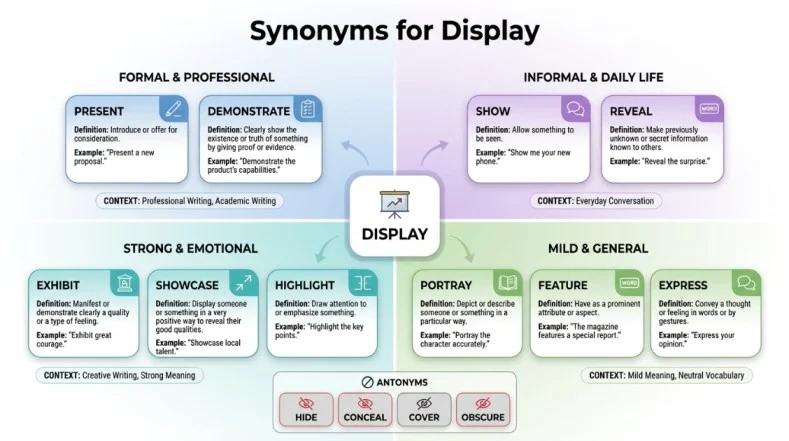
Repeating the word “display” can make an email, essay, caption, resume, or presentation sound predictable. The right alternative can make your writing more precise, professional, emotional, or creative without changing the basic idea.
This guide to synonyms for display explains which words work best in different situations. You will find formal choices for professional writing, academic alternatives for essays, natural options for everyday speech, and stronger words for situations where you want to emphasize visibility, expression, or presentation.
What Does “Display” Mean?
“Display” means to show, present, exhibit, or make something visible. The best synonym depends on context. Use exhibit formally, showcase professionally, present academically, reveal for information, and express for emotions or ideas.
Meaning, Tone and Context
Simple Definition
The verb display means to show something so that people can see, notice, understand, or appreciate it.
For example, a museum may display a painting, a person may display confidence, and a website may display information.
As a noun, display can refer to something arranged or presented for people to see. A store window display is one common example.
Part of Speech
Display can function as both a verb and a noun.
As a verb:
“The gallery displayed several historic photographs.”
As a noun:
“The store created an attractive holiday display.”
Tone
Display is generally neutral. It can become positive, negative, formal, or emotional depending on the context.
For example, “display professionalism” sounds positive, while “display anger” can sound negative or emotionally intense.
Formality Level
Display works well in casual conversation, academic writing, business communication, journalism, and creative writing.
Because it is versatile, it is often useful as a default word. However, a more specific synonym can make your sentence clearer.
Common Use Cases
Display is commonly used for:
- Showing information
- Presenting products
- Exhibiting artwork
- Showing emotions
- Demonstrating qualities
- Presenting achievements
- Showing images or text on a screen
- Making evidence visible
- Describing public behavior
- Highlighting something important
Related Word Forms
The main related forms include displayed, displaying, and displayable.
The noun display can describe both a physical arrangement and the act or result of showing something.
When and How to Use “Display”
Use display when something is intentionally made visible, presented for attention, or shown through behavior.
Professional
“The report displays a clear understanding of the company’s financial position.”
Here, display means demonstrate or show evidence of a quality.
Personal
“She displayed genuine kindness toward everyone at the event.”
The word describes visible behavior.
Academic
“The experiment displayed a consistent pattern across all three groups.”
Display works when a result visibly demonstrates a pattern.
Emotional
“He displayed frustration after receiving the unexpected decision.”
Here, display means openly show an emotion.
Creative
“The artist displayed her newest paintings in a downtown gallery.”
In this context, exhibit would also be a strong choice.
Social Media
“The brand displayed its new collection through a series of short videos.”
Showcased may sound more promotional in this situation.
“The attached chart displays the latest sales figures.”
Presents or shows could also work, depending on the tone.
Another Word for “Display”
There is no single best replacement for every meaning of display. The strongest choice depends on what you are actually trying to communicate.
- Professional writing: present, demonstrate, showcase
- Academic writing: demonstrate, illustrate, indicate
- Casual conversation: show
- Emotional writing: express, reveal
- Creative writing: portray, depict, unveil
- Resume or workplace use: demonstrate, showcase, highlight
- Social media captions: showcase, feature, highlight
- Stronger meaning: flaunt, emphasize, demonstrate
- Softer meaning: present, show, indicate
For most general situations, show is the simplest alternative. For polished professional writing, demonstrate, present, or showcase is often more precise.
When Not to Use “Display”
Display is not always the most precise choice.
If you mean prove or demonstrate a skill, “demonstrate” is often stronger.
Weak:
“She displayed strong leadership skills.”
More precise:
“She demonstrated strong leadership skills.”
If you mean put artwork or objects in a public exhibition, “exhibit” is more specific.
Weak:
“The museum displayed ancient artifacts.”
More specific:
“The museum exhibited ancient artifacts.”
If you mean promote something attractively, “showcase” may communicate the intention better.
Weak:
“The website displays the company’s new services.”
More promotional:
“The website showcases the company’s new services.”
If you mean show an emotion, “express” may sound more natural.
Weak:
“She displayed her feelings clearly.”
More direct:
“She expressed her feelings clearly.”
Words Commonly Confused With “Display”
Display vs. Show
Show is broader and more conversational. Display often suggests intentionally making something visible or noticeable.
Display vs. Demonstrate
Demonstrate usually means show how something works or provide evidence of a skill, quality, or fact.
Display vs. Exhibit
Exhibit is especially common for artwork, artifacts, products, or objects presented publicly.
Display vs. Showcase
Showcase suggests presenting something in an especially attractive, impressive, or prominent way.
Display vs. Reveal
Reveal focuses on making something previously hidden, unknown, or private known or visible.
Display vs. Present
Present focuses on formally introducing, explaining, or offering information, ideas, products, or results.
Best Synonym by Context for “Display”
| Context | Best Synonym | Why It Works | Example |
|---|---|---|---|
| Formal writing | Exhibit | Sounds precise when something is publicly shown | The museum exhibits historical documents. |
| Academic writing | Demonstrate | Clearly connects evidence with a conclusion | The results demonstrate a significant trend. |
| Professional or business use | Showcase | Emphasizes strengths or valuable features | The presentation showcases our latest achievements. |
| Resume | Demonstrate | Highlights skills and abilities | Demonstrated strong leadership during the project. |
| Casual conversation | Show | Natural and simple | She showed me her new apartment. |
| Creative writing | Portray | Adds descriptive depth | The novel portrays life in a changing city. |
| Emotional tone | Express | Works naturally with feelings | He expressed genuine concern. |
| Strong intensity | Flaunt | Suggests openly showing something with pride | She flaunted her expensive new watch. |
| Soft or moderate tone | Present | Neutral and polished | The report presents several possible solutions. |
| Social media captions | Showcase | Works well for promotional content | We are showcasing our newest designs. |
| Technology | Render | Refers to producing visible content on a screen | The browser renders the image quickly. |
| Evidence | Reveal | Emphasizes previously unknown information | The investigation revealed new evidence. |
| Visual art | Exhibit | Specifically suits public presentation | The gallery exhibits contemporary paintings. |
| Ideas | Present | Natural for explaining concepts | The speaker presented a new proposal. |
| Data | Illustrate | Helps explain information clearly | The chart illustrates the growth trend. |
| Products | Feature | Highlights something prominently | The homepage features our newest product. |
| Achievements | Highlight | Draws attention to important accomplishments | The report highlights major improvements. |
| Behavior | Demonstrate | Shows a quality through actions | She demonstrated patience throughout the process. |
| Information | Provide | Works when the emphasis is supplying information | The website provides detailed instructions. |
| US usage | Display | Common and versatile in American English | The screen displays the current temperature. |
| UK usage | Display | Equally natural in British English | The gallery displays local artwork. |
Which Synonym Should You Choose?
Start by identifying what “display” actually means in your sentence.
- If something is simply being made visible, show is usually the safest choice.
- If you are presenting information in a formal setting, choose present.
- If something provides evidence of a skill, behavior, or quality, use demonstrate.
- If you are promoting a product, service, achievement, or talent, showcase or highlight may be better.
- If previously hidden information becomes known, use reveal.
- If an emotion becomes visible through words or behavior, express is usually more natural.
- If artwork or historical objects are presented publicly, exhibit is especially precise.
The best synonym is therefore not necessarily the most sophisticated word. It is the word that communicates your intended meaning most accurately.
Real Life Examples of “Display” in Sentences
School
“The science project displayed an interesting relationship between temperature and pressure.”
Workplace
“The presentation displayed the team’s progress throughout the quarter.”
A stronger professional alternative would be:
“The presentation highlighted the team’s progress throughout the quarter.”
Writing
“The article displays a balanced approach to the issue.”
A more precise alternative is:
“The article demonstrates a balanced approach to the issue.”
Conversation
“She displayed her new artwork at the community event.”
In casual speech, “showed” would sound more natural.
Social Media
“The designer displayed the new collection on Instagram.”
For promotional content, “showcased” is usually more engaging.
Resume
“Displayed strong communication skills during client meetings.”
For a resume, “demonstrated strong communication skills” is usually more powerful.
“The attached document displays the updated project timeline.”
“Presents” may sound more polished in formal workplace communication.
Storytelling
“The character displayed unusual courage when everyone else ran away.”
“Demonstrated unusual courage” would emphasize the character’s actions, while “revealed unusual courage” would emphasize the discovery of that quality.
25 Synonyms for “Display”
| Synonym | Simple Meaning | Best Used For | Example Sentence |
|---|---|---|---|
| Show | Make something visible or known | Everyday speech | She showed me her new painting. |
| Exhibit | Present something publicly | Museums and galleries | The museum exhibits rare photographs. |
| Showcase | Present something attractively or prominently | Marketing and achievements | The website showcases local designers. |
| Present | Put forward for consideration or viewing | Business and academic writing | The researcher presented the findings. |
| Demonstrate | Show clearly through evidence or action | Skills, facts, and abilities | The results demonstrate the value of the approach. |
| Reveal | Make something previously hidden known | Information and discoveries | The report revealed several unexpected findings. |
| Unveil | Introduce something new publicly | Products, plans, and designs | The company unveiled its newest model. |
| Highlight | Give special attention to something | Reports and presentations | The article highlights several important issues. |
| Feature | Give something a prominent place | Websites and media | The magazine features emerging artists. |
| Illustrate | Make an idea clearer through examples or visuals | Academic writing | The example illustrates the main principle. |
| Depict | Represent something through an image or description | Art and literature | The painting depicts a peaceful village. |
| Portray | Represent a person, situation, or idea | Creative writing | The film portrays the challenges of modern life. |
| Express | Show thoughts or feelings | Emotions and opinions | She expressed her gratitude openly. |
| Manifest | Make a quality or condition apparent | Formal writing | His actions manifested genuine concern. |
| Indicate | Point to or show evidence of something | Academic and analytical writing | The results indicate steady improvement. |
| Represent | Stand for or visually symbolize something | Ideas, symbols, and data | The color represents growth and renewal. |
| Advertise | Make something publicly known to attract attention | Marketing | The company advertised its new service online. |
| Broadcast | Send information to a wide audience | Media and communication | The station broadcast the announcement nationwide. |
| Publish | Make written or digital material publicly available | Articles and information | The researcher published the study online. |
| Project | Make an image or impression visible or apparent | Images and qualities | The presentation projected confidence and clarity. |
| Flaunt | Show something openly and often proudly | Informal or critical contexts | He flaunted his expensive new car. |
| Parade | Display something publicly and conspicuously | Attention seeking contexts | The team paraded its championship trophy. |
| Air | Make opinions or complaints publicly known | Informal communication | She aired her concerns during the meeting. |
| Expose | Make something visible or known, often something hidden | Problems and secrets | The investigation exposed serious weaknesses. |
| Render | Produce or make visible, especially digitally | Technology and graphics | The software renders the image in seconds. |
Synonym Groups and Usage Differences
Professional vs. Personal Synonyms
Professional writing benefits from precise words such as demonstrate, present, highlight, showcase, and indicate.
Personal communication can use simpler words such as show, express, and reveal.
For example:
Professional:
“The results demonstrate strong customer satisfaction.”
Personal:
“She showed how much she appreciated the support.”
Both sentences communicate visibility, but the vocabulary matches the setting.
Formal vs. Conversational Synonyms
Formal alternatives include demonstrate, exhibit, indicate, illustrate, manifest, and present.
Conversational alternatives include show, reveal, and sometimes air.
For a college essay, “demonstrate” may be more appropriate than “show” when discussing evidence.
For a text message, “show” is usually the more natural option.
Academic Synonyms
Academic writing benefits from words that explain the relationship between evidence and conclusions.
Strong choices include demonstrate, indicate, illustrate, represent, and reveal.
For example:
“The findings indicate a gradual increase in participation.”
This is more precise than saying:
“The findings display a gradual increase in participation.”
Professional and Business Synonyms
Business communication often requires vocabulary that emphasizes value and evidence.
- Use showcase when presenting strengths.
- Use demonstrate when discussing abilities or results.
- Use highlight when drawing attention to important information.
- Use present when introducing information or proposals.
- Use feature when describing prominent content on a website, product page, or publication.
Creative or Literary Synonyms
Creative writing can benefit from portray, depict, reveal, express, unveil, and manifest.
These words can communicate more than simple visibility.
For example:
“The painting displays a lonely figure.”
This is straightforward.
“The painting portrays a lonely figure against a fading landscape.”
The second version provides more descriptive depth.
Slang or Modern Synonyms
There are few true slang synonyms for display.
Informal expressions such as show off can sometimes replace display when someone intentionally presents a possession, talent, or achievement to attract attention.
For example:
“He displayed his new watch.”
“He showed off his new watch.”
The second sentence is more casual and can suggest pride, vanity, or attention seeking behavior.
Avoid expressions such as “show off” in academic essays, formal reports, and professional documents unless the tone specifically calls for it.
Strongest vs. Weaker Synonyms
A practical intensity scale can look like this:
Indicate: mild and factual
Show: neutral and broad
Present: neutral and polished
Highlight: stronger attention
Demonstrate: strong evidence or proof
Showcase: strong positive presentation
Flaunt: strong and often critical
Expose: strong, especially when something hidden is made known
Intensity depends heavily on context. A word that sounds strong in one sentence may sound neutral in another.
Emotional vs. Neutral Synonyms
Neutral choices include show, present, indicate, and display.
Emotionally stronger choices include express, reveal, flaunt, and expose.
Compare:
“He displayed his anger.”
“He expressed his anger.”
The first focuses on visible behavior. The second focuses more directly on communicating the emotion.
Antonyms of “Display”
Because display has several meanings, its opposite depends on the situation. The following words work as antonyms when display means showing, revealing, or making something visible.
| Antonym | Meaning | Example Sentence |
|---|---|---|
| Hide | Keep something from view | She hid the document in a drawer. |
| Conceal | Deliberately keep something secret or unseen | He concealed the evidence. |
| Cover | Put something over another thing so it cannot be seen | She covered the painting with a cloth. |
| Obscure | Make something difficult to see or understand | The fog obscured the mountains. |
| Mask | Hide the true appearance or nature of something | He masked his disappointment with a smile. |
| Disguise | Change the appearance to prevent recognition | She disguised the package before sending it. |
| Suppress | Prevent something from being expressed or revealed | He suppressed his anger during the meeting. |
| Withhold | Keep information or something else from being given | The company withheld important details. |
| Secrete | Hide something in a concealed location | The animal secreted food beneath the leaves. |
| Bury | Put something out of sight or deeply conceal it | She buried the old photographs in a box. |
| Cover up | Deliberately hide a problem or fact | The investigation uncovered an attempt to cover up the mistake. |
| Veil | Partially hide or obscure something | The curtains veiled the room from view. |
| Block | Prevent something from being seen or accessed | The wall blocked the view. |
| Omit | Leave something out rather than include or show it | The report omitted several minor details. |
| Suppress | Keep information, expression, or activity from becoming public | Officials suppressed the information. |
Comparison: “Display” vs. Similar Words
Display vs. Show
Main difference: Show is broad and conversational, while display often suggests intentional presentation or visibility.
Which one is stronger: Display can sound slightly more deliberate.
Which one is more formal: Display is somewhat more polished, although both are standard English.
Examples:
“She showed me the photograph.”
“The gallery displayed the photograph.”
Display vs. Demonstrate
Main difference: Demonstrate emphasizes evidence, ability, or how something works.
Which one is stronger: Demonstrate is stronger when proving a skill or point.
Which one is more formal: Demonstrate is more formal.
Examples:
“The report displayed several trends.”
“The report demonstrated a significant improvement.”
Display vs. Exhibit
Main difference: Exhibit commonly refers to publicly presenting objects, artwork, or evidence.
Which one is stronger: Neither is universally stronger.
Which one is more formal: Exhibit is especially precise in museum, gallery, and legal contexts.
Examples:
“The screen displays the image.”
“The gallery exhibits the painting.”
Display vs. Showcase
Main difference: Showcase suggests presenting something in a particularly attractive or impressive way.
Which one is stronger: Showcase often has a stronger promotional effect.
Which one is more formal: Both can work professionally, but showcase is more promotional.
Examples:
“The page displays several products.”
“The campaign showcases the company’s best products.”
Display vs. Reveal
Main difference: Reveal suggests that something was previously unknown, hidden, or secret.
Which one is stronger: Reveal usually carries a stronger sense of discovery.
Which one is more formal: Both can be formal depending on the sentence.
Examples:
“The screen displays the results.”
“The investigation revealed the cause.”
Display vs. Present
Main difference: Present often means formally introducing or explaining information, while display emphasizes visibility.
Which one is stronger: Present is stronger for formal communication.
Which one is more formal: Present is often preferable in academic and business settings.
Examples:
“The chart displays the data.”
“The researcher presented the data.”
Common Phrases and Expressions with “Display”
1. Display information
Meaning:
To make information visible or available for people to read or understand.
Example sentence:
“The dashboard displays information about current sales.”
2. Display confidence
Meaning:
To show confidence through words, behavior, or appearance.
Example sentence:
“She displayed confidence during the interview.”
3. Display emotions
Meaning:
To openly show feelings through words, facial expressions, or behavior.
Example sentence:
“He rarely displays strong emotions in public.”
4. Display products
Meaning:
To arrange products so customers can see them.
Example sentence:
“The store displays new products near the entrance.”
5. Display on screen
Meaning:
To make digital information visible on a device.
Example sentence:
“The application displays the results on screen.”
6. On display
Meaning:
Available for people to see, usually in a public or arranged setting.
Example sentence:
“Several original paintings are now on display.”
7. Display a skill
Meaning:
To visibly demonstrate an ability.
Example sentence:
“The candidate displayed excellent problem solving skills.”
8. Public display
Meaning:
Something openly shown where other people can see it.
Example sentence:
“The museum created a public display of historical artifacts.”
Common Mistakes to Avoid
1. Using Display When Demonstrate Is More Precise
“Display” can describe a skill, but “demonstrate” often communicates ability more clearly.
Instead of:
“She displayed excellent leadership.”
Consider:
“She demonstrated excellent leadership.”
2. Confusing Display With Reveal
Reveal suggests that information was previously hidden or unknown.
If something was already visible, display may be more appropriate.
3. Using a Casual Synonym in Formal Writing
“Show off” can sound too casual or judgmental for academic or professional writing.
Use “showcase” or “highlight” when you want a polished alternative.
4. Using an Overly Dramatic Synonym
“Expose” can imply that something problematic or hidden has been uncovered.
Do not use it simply because you want a stronger version of display.
5. Repeating Display Too Often
Repeated use can make writing sound mechanical.
Replace it with a contextually accurate word such as present, demonstrate, highlight, showcase, reveal, or exhibit.
6. Choosing the Wrong Emotional Tone
“Flaunt” usually suggests excessive or attention seeking display.
If you simply mean showing something proudly, “showcase” may be more positive.
7. Using Slang in Academic or Professional Writing
Expressions such as “show off” may be natural in conversation but inappropriate in formal reports, essays, resumes, or business communication.
FAQs
What is the best synonym for “display”?
The best synonym depends on context. Show is the simplest general alternative, while demonstrate, exhibit, showcase, and present offer more specific meanings.
What is a formal synonym for “display”?
Common formal synonyms include demonstrate, exhibit, present, indicate, illustrate, and manifest. The best option depends on the sentence.
What is an informal synonym for “display”?
Show is the most natural informal synonym. In certain contexts, show off can work when someone intentionally presents something to attract attention.
What is another word for “display” in professional writing?
Strong professional alternatives include demonstrate, showcase, present, highlight, and feature. Choose based on whether you mean evidence, promotion, or visibility.
What is the difference between “display” and “show”?
Display often suggests intentionally presenting something for attention or viewing. Show is broader, simpler, and more common in everyday conversation.
What is the opposite of “display”?
Common opposites include hide, conceal, cover, obscure, mask, disguise, suppress, and withhold, depending on the intended meaning.
Conclusion
Display is a versatile word that can mean showing something, making information visible, presenting an object, demonstrating a quality, or expressing an emotion. Its best synonym depends on exactly what you want the reader or listener to understand.
For everyday language, show is usually the easiest choice. For academic writing, demonstrate, indicate, and illustrate can provide greater precision. In business communication, showcase, highlight, and present often sound more polished. For emotions, express may be more natural, while exhibit works especially well for art and public collections.
The most useful vocabulary habit is simple: do not replace a word just to sound more advanced. Choose the synonym that matches your meaning, audience, tone, and situation.
Discover More Post:
- 25+ Synonyms for Navigate | Meanings, Examples, and Best …
- 25+ Synonyms for We | Meanings, Examples, and Best …
- 25+ Synonyms for Achieve | Meanings, Examples, and Best …