The word “guide” appears everywhere. You might use it in an essay, email, resume, presentation, blog post, caption, or everyday conversation, only to notice that the same word keeps appearing again and again.
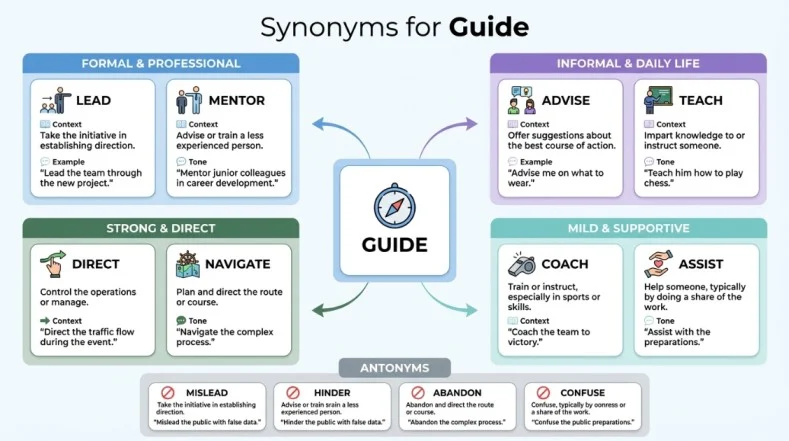
The good news is that synonyms for guide can make your writing more precise without making it sound complicated. Words such as mentor, adviser, instructor, leader, coach, direct, and navigate each express a slightly different idea.
Choosing the right alternative depends on what you mean, how formal your writing is, and the effect you want your words to create. This guide explains those differences with practical examples.
What Does “Guide” Mean?
“Guide” means to lead, direct, advise, teach, or help someone understand how to reach a goal. The best synonyms for guide include mentor for personal support, direct for formal instruction, coach for skill development, navigate for difficult situations, and adviser for professional guidance.
Meaning, Tone and Context
Simple Definition
Guide means to show someone what to do, where to go, or how to understand something. It can describe physical direction, instruction, advice, leadership, or support.
For example, a person can guide a tourist through a city, guide a student through an assignment, or guide a team toward a business goal.
Part of Speech
“Guide” can function as both a verb and a noun.
As a verb, it means to lead, direct, advise, or help someone.
Example: “The teacher guided the students through the research process.”
As a noun, it can mean a person, book, document, or resource that provides direction or information.
Example: “This handbook is a useful guide for new employees.”
Tone
“Guide” usually has a neutral and helpful tone.
It can sound professional in workplace communication, educational in academic settings, supportive in personal situations, and informative in content writing.
Formality Level
“Guide” works in casual, professional, academic, and creative communication.
Its alternatives can change the tone. “Direct” may sound more authoritative, while “mentor” feels more personal and supportive.
Common Use Cases
The word frequently appears in:
- Education
- Business communication
- Career development
- Travel
- Instructions
- Personal development
- Leadership
- Writing and publishing
- Customer support
- Technology and tutorials
Related Word Forms
Common related forms include:
Guide: noun and verb
Guidance: advice or direction provided to someone
Guided: led or directed
Guiding: currently providing direction
Guideline: a recommended principle or instruction
Guidebook: a book containing useful information and directions
When and How to Use “Guide”
Use “guide” when you want to express the general idea of helping someone move toward a destination, decision, skill, understanding, or goal.
Professional
“The manager guided the team through the new implementation process.”
Personal
“My older sister guided me when I was choosing a college.”
Academic
“The professor guided students through the research methodology.”
Emotional
“Her advice guided me through a difficult period.”
Creative
“The author guides readers through a mysterious world.”
Social Media
“This short video guides beginners through the basic steps.”
“I am happy to guide you through the application process.”
Another Word for “Guide”
The best single replacement depends on the meaning you want.
| Situation | Best Alternative |
|---|---|
| Professional writing | Direct |
| Academic writing | Instruct |
| Casual conversation | Help |
| Emotional writing | Mentor |
| Creative writing | Lead |
| Resume or workplace use | Advise |
| Social media captions | Show |
| Stronger meaning | Direct |
| Softer meaning | Assist |
- If you mean providing long term personal development, mentor is usually stronger than guide.
- If you mean giving clear instructions, direct or instruct may be more precise.
- If you mean helping someone develop a skill, coach is often the better choice.
When Not to Use “Guide”
“Guide” can become too general when your sentence requires a specific type of help.
Instead of saying:
“The manager guided the employee.”
You could say:
“The manager mentored the employee.”
This version suggests ongoing personal and professional development.
For instructions, consider:
“The technician instructed the employee.”
For physical direction, consider:
“The officer directed traffic.”
The more specific word gives readers a clearer picture of what actually happened.
Words Commonly Confused With “Guide”
Guide vs. Lead
“Guide” emphasizes direction, advice, or support. “Lead” often suggests taking responsibility and moving others toward a goal.
Guide vs. Direct
“Direct” is more authoritative. “Guide” can sound more supportive and collaborative.
Guide vs. Advise
“Advise” focuses on recommendations or opinions. “Guide” can include advice but may also involve instruction or direction.
Guide vs. Mentor
“Mentor” usually describes long term personal or professional development. “Guide” can describe a single interaction.
Guide vs. Teach
“Teach” focuses on transferring knowledge or skills. “Guide” can involve teaching but does not always require formal instruction.
Guide vs. Coach
“Coach” usually involves helping someone improve performance or develop a specific skill. “Guide” has a broader meaning.
Best Synonym by Context for “Guide”
| Context | Best Synonym | Why It Works | Example |
|---|---|---|---|
| Formal writing | Direct | Sounds clear and authoritative | The policy directs employees toward the required procedure. |
| Academic writing | Instruct | Clearly expresses teaching or explaining | The professor instructed students on proper research methods. |
| Professional or business use | Advise | Works well for recommendations | The consultant advised the company on its next steps. |
| Resume | Mentor | Highlights development of others | Mentored new employees during onboarding. |
| Casual conversation | Help | Natural and familiar | Can you help me find the right room? |
| Creative writing | Lead | Creates movement and direction | A narrow trail led them toward the village. |
| Emotional tone | Mentor | Suggests personal support | Her coach became a mentor during a difficult period. |
| Strong intensity | Direct | Implies firm control or instruction | The supervisor directed the team during the emergency. |
| Soft or moderate tone | Assist | Sounds supportive rather than commanding | Our staff can assist you with registration. |
| Social media captions | Show | Simple and conversational | This video shows you how to organize your workspace. |
| US usage | Guide | Very common and versatile | The handbook guides new employees through the process. |
| UK usage | Adviser | Common in professional contexts | The adviser helped students plan their careers. |
Which Synonym Should You Choose?
Start with the exact meaning you want to communicate.
- If someone is giving advice, choose advise or counsel.
- If someone is developing another person’s skills, choose mentor or coach.
- If someone is giving instructions, choose instruct or direct.
- If someone is showing how something works, choose demonstrate or show.
- If someone is leading a person or group, choose lead.
- If someone is helping someone through a difficult process, choose assist, support, or help.
Also consider tone. A strong word can make your sentence sound authoritative, while a softer word can make it feel more cooperative.
Real Life Examples of “Guide” in Sentences
School
“The counselor guided students through the college application process.”
Workplace
“Our manager guided the team through the transition.”
Writing
“This article guides readers toward clearer word choices.”
Conversation
“Could you guide me to the nearest entrance?”
Social Media
“This tutorial guides beginners through five simple steps.”
Resume
“Guided new team members during their first month.”
“I would be glad to guide you through the next stage.”
Storytelling
“The old map guided the travelers toward the hidden valley.”
25 Synonyms for “Guide”
| Synonym | Simple Meaning | Best Used For | Example Sentence |
|---|---|---|---|
| Lead | Take someone toward a goal or place | Leadership and direction | She led the team toward a successful launch. |
| Direct | Give clear instructions or control movement | Formal and professional settings | The supervisor directed the staff to the correct department. |
| Advise | Give recommendations or useful opinions | Professional and personal advice | The lawyer advised him to review the agreement carefully. |
| Mentor | Support someone’s long term development | Career and personal growth | She mentored several young professionals. |
| Coach | Help someone improve a skill or performance | Sports, careers, and skills | The coach helped the players improve their technique. |
| Instruct | Teach or tell someone how to do something | Education and procedures | The trainer instructed employees on safety procedures. |
| Teach | Give knowledge or skills | Education | The instructor taught the class how to analyze data. |
| Assist | Help someone accomplish something | Professional and polite communication | Our team can assist you with your request. |
| Help | Make something easier for someone | Casual and general use | My friend helped me choose the right laptop. |
| Counsel | Give serious advice or guidance | Legal, professional, and emotional contexts | The adviser counseled the client before the decision. |
| Navigate | Help someone deal with a difficult path or process | Complex situations | She helped him navigate the hiring process. |
| Steer | Direct someone or something toward a particular outcome | Decisions and leadership | The director steered the company toward a new market. |
| Shepherd | Carefully lead or support someone through a process | Formal and figurative writing | The editor shepherded the project from concept to publication. |
| Show | Demonstrate how to do or understand something | Casual communication and tutorials | He showed me how to fix the problem. |
| Demonstrate | Show how something works | Academic and instructional contexts | The instructor demonstrated the new software. |
| Recommend | Suggest a suitable choice | Advice and decision making | The consultant recommended a more efficient approach. |
| Counsel | Provide thoughtful advice | Formal or serious situations | The counselor counseled the student about career options. |
| Inform | Give information that helps someone decide | Professional and educational writing | The report informed customers about the policy change. |
| Orient | Help someone understand a new environment or situation | Workplace and education | The program helps orient new employees. |
| Point | Direct someone’s attention toward something | Casual and concise communication | She pointed me toward the correct office. |
| Accompany | Go with someone while providing support | Travel and personal situations | The staff member accompanied visitors through the facility. |
| Advise | Offer practical recommendations | Business and personal decisions | Experts advise consumers to compare their options. |
| Support | Help someone succeed or continue | Personal and professional contexts | Her manager supported her throughout the project. |
| Facilitate | Make a process easier or more effective | Business and academic writing | The workshop facilitated discussion among the participants. |
| Navigate | Help someone successfully handle a process | Modern professional communication | The specialist helped clients navigate the application system. |
Note: Some words above overlap in meaning but are not interchangeable in every sentence. Context determines whether a word is a true replacement.
Synonym Groups and Usage Differences
Professional vs. Personal Synonyms
Professional settings often favor advise, direct, instruct, facilitate, and assist.
Personal situations may sound more natural with help, support, mentor, coach, and accompany.
For example, “The consultant advised the client” sounds professional, while “My friend helped me” sounds natural in everyday speech.
Formal vs. Conversational Synonyms
Formal writing benefits from precise words such as direct, instruct, facilitate, counsel, and advise.
Conversational English often favors help, show, lead, and point.
Using a simple word is not automatically less intelligent. In many situations, clarity is more valuable than complexity.
Academic Synonyms
Academic writing benefits from precise verbs such as instruct, demonstrate, facilitate, advise, and inform.
For example:
“The study guides future research.”
A more specific version could be:
“The findings inform future research.”
The second sentence explains the relationship more precisely.
Professional and Business Synonyms
For emails, presentations, resumes, and workplace communication, consider advise, assist, direct, mentor, facilitate, and instruct.
Choose the word according to the action.
- If you provided career development, use “mentored.”
- If you provided recommendations, use “advised.”
- If you made a process easier, use “facilitated.”
- If you gave instructions, use “instructed.”
Creative or Literary Synonyms
Creative writing can benefit from lead, steer, shepherd, navigate, and accompany.
These words can create movement, atmosphere, or emotional meaning.
For example:
“The moonlight guided them through the forest.”
This can become:
“Moonlight led them deeper into the forest.”
“Led” creates a stronger sense of movement.
Slang or Modern Synonyms
There are few genuine slang replacements for “guide” that work universally.
Words such as “show” and “help” are informal and modern enough for social media, texts, videos, and casual conversation.
Avoid forcing slang into professional or academic writing simply to sound current.
Strongest vs. Weaker Synonyms
A useful intensity scale is:
Mild: Help
Moderate: Assist
Supportive: Guide
Development focused: Mentor
Skill focused: Coach
Instruction focused: Instruct
Strong and authoritative: Direct
Leadership focused: Lead
The strongest choice depends on context rather than the word itself.
Emotional vs. Neutral Synonyms
Words such as direct, instruct, and inform are usually neutral or practical.
Words such as mentor, support, shepherd, and accompany can carry more emotional or personal meaning.
If you want your sentence to remain factual, choose a neutral term.
If you want to emphasize care or personal involvement, choose a more supportive term.
Antonyms of “Guide”
Because “guide” has several meanings, its opposites vary according to context.
| Antonym | Meaning | Example Sentence |
|---|---|---|
| Mislead | Lead someone toward the wrong conclusion | The false information misled the readers. |
| Confuse | Make something difficult to understand | The unclear instructions confused the students. |
| Misdirect | Send someone toward the wrong place or action | The sign misdirected visitors. |
| Abandon | Leave someone without support | The team abandoned the new employee without assistance. |
| Neglect | Fail to provide needed attention | The supervisor neglected the trainee. |
| Hinder | Make progress more difficult | Poor communication hindered the project. |
| Obstruct | Block progress or movement | The damaged road obstructed traffic. |
| Discourage | Reduce someone’s confidence or motivation | The criticism discouraged the student. |
| Ignore | Give no attention or assistance | The manager ignored the employee’s concerns. |
| Disorient | Cause someone to lose their sense of direction | The unfamiliar surroundings disoriented the travelers. |
| Distract | Draw attention away from the important matter | The noise distracted the class. |
| Block | Prevent movement or progress | The barrier blocked the path. |
| Prevent | Stop something from happening | The new rule prevented further mistakes. |
| Oppose | Act against an idea, plan, or action | Several members opposed the proposal. |
| Derail | Cause a plan or process to move away from its intended direction | Unexpected delays derailed the project. |
Comparison: “Guide” vs. Similar Words
Guide vs. Lead
Main difference: Guide emphasizes direction and support, while lead often emphasizes responsibility and leadership.
Stronger: Lead can sound stronger because it suggests taking charge.
More formal: Both are appropriate, depending on the sentence.
Guide example: “She guided the team through the transition.”
Lead example: “She led the team through the transition.”
Guide vs. Direct
Main difference: Guide can sound collaborative, while direct can imply authority.
Stronger: Direct is usually stronger.
More formal: Direct often sounds more official.
Guide example: “The trainer guided employees through the system.”
Direct example: “The supervisor directed employees to follow the new procedure.”
Guide vs. Advise
Main difference: Advise focuses on recommendations, while guide has a broader meaning.
Stronger: Neither is always stronger.
More formal: Advise is especially common in professional writing.
Guide example: “She guided me through my career options.”
Advise example: “She advised me to apply for the position.”
Guide vs. Mentor
Main difference: Mentor suggests ongoing development, while guide may describe a short interaction.
Stronger: Mentor is more specific for long term development.
More formal: Both can work professionally.
Guide example: “He guided the new employee through the first week.”
Mentor example: “He mentored the employee throughout her career.”
Guide vs. Teach
Main difference: Teach involves knowledge or skill development. Guide can involve direction without teaching.
Stronger: Teach is more specific when learning is the central idea.
More formal: Both work in academic communication.
Guide example: “The instructor guided students through the assignment.”
Teach example: “The instructor taught students how to analyze the results.”
Guide vs. Coach
Main difference: Coach usually focuses on performance and improvement.
Stronger: Coach can imply a more active development role.
More formal: Both work professionally, but “coach” is especially common in performance contexts.
Guide example: “She guided the team toward its goals.”
Coach example: “She coached the team to improve its performance.”
Common Phrases and Expressions with “Guide”
1. Guide someone through something
Meaning: Help someone understand or complete a process.
Example sentence: “The specialist guided me through the registration process.”
2. Guide the way
Meaning: Lead or provide direction.
Example sentence: “The experienced manager helped guide the way for the new team.”
3. Serve as a guide
Meaning: Provide direction, advice, or information.
Example sentence: “The handbook serves as a guide for new employees.”
4. Guide someone toward something
Meaning: Help someone move toward a particular goal or choice.
Example sentence: “Her experience guided her toward a career in education.”
5. Be guided by
Meaning: Make decisions based on a particular principle, value, or source.
Example sentence: “The company is guided by customer needs.”
6. A useful guide
Meaning: A resource that provides practical information.
Example sentence: “This checklist is a useful guide for first time applicants.”
7. Step by step guide
Meaning: Instructions presented in a clear sequence.
Example sentence: “The website includes a step by step guide for beginners.”
Common Mistakes to Avoid
1. Using “Guide” When a More Precise Word Is Better
“Guide” is broad. If you specifically mean advice, use “advise.”
Instead of “She guided me to apply,” write “She advised me to apply.”
2. Confusing “Guide” With “Mentor”
A mentor usually provides continuing support and development.
Do not use “mentor” for a single simple instruction unless the context supports a broader relationship.
3. Using a Casual Synonym in Formal Writing
Words such as “help” and “show” are perfectly correct, but a professional sentence may need more precision.
For example, “The consultant advised the client” is more specific than “The consultant helped the client.”
4. Using an Overly Dramatic Synonym
“Steer” or “shepherd” can sound unnecessarily figurative in a simple business sentence.
Choose the simplest accurate word.
5. Repeating “Guide” Too Often
Repeated use can make an article or essay feel mechanical.
Replace some instances with accurate alternatives such as direct, advise, lead, teach, mentor, or assist.
6. Choosing the Wrong Emotional Tone
“Direct” can sound authoritative, while “support” sounds more caring.
Choose according to the relationship and situation.
7. Using Slang in Academic or Professional Writing
Casual alternatives may work well in conversation but can weaken formal communication.
Use precise, standard vocabulary in essays, reports, resumes, and professional documents.
FAQs
What is the best synonym for “guide”?
The best synonym depends on context. “Lead” works for leadership, “mentor” for development, “direct” for instructions, and “advise” for recommendations.
What is a formal synonym for “guide”?
“Direct,” “advise,” “instruct,” “facilitate,” and “counsel” can work as formal alternatives, depending on the intended meaning.
What is an informal synonym for “guide”?
“Help,” “show,” “lead,” and “point” are natural informal alternatives. They work well in conversations, texts, and casual online content.
What is another word for “guide” in professional writing?
“Advise,” “direct,” “assist,” “mentor,” and “facilitate” are strong professional alternatives when their specific meanings fit the sentence.
What is the difference between “guide” and “lead”?
“Guide” emphasizes direction or support, while “lead” often emphasizes responsibility, authority, or moving a person or group toward a goal.
What is the opposite of “guide”?
Common opposites include “mislead,” “misdirect,” “confuse,” “hinder,” “ignore,” and “disorient.” The best antonym depends on the intended meaning.
Conclusion
The word “guide” is versatile because it can describe direction, advice, teaching, leadership, and support. However, the right alternative can make your communication much more precise.
Use mentor for long term development, advise for recommendations, direct for authoritative instructions, coach for skill improvement, lead for leadership, and assist for professional support.
When choosing among synonyms for guide, focus first on meaning, then consider tone, formality, emotional intensity, and audience. A practical vocabulary habit is to replace a repeated word only when the alternative adds a clearer meaning.
Discover More Post:
- 25+ Synonyms for Navigate | Meanings, Examples, and Best …
- 25+ Synonyms for We | Meanings, Examples, and Best …
- 25+ Synonyms for Achieve | Meanings, Examples, and Best …