Words can change the entire tone of a sentence. The word “slut” is a strong example because it can sound insulting, judgmental, or deliberately provocative depending on who uses it and why. Writers, students, speakers, and content creators often need a more precise word when describing sexual behavior or discussing the term itself.
This guide to synonyms for slut explains the word’s meaning, tone, related expressions, and safer alternatives. You will find formal vocabulary, conversational terms, literary choices, slang, and neutral descriptions that help you communicate accurately without creating unnecessary offense.
What Does “Slut” Mean?
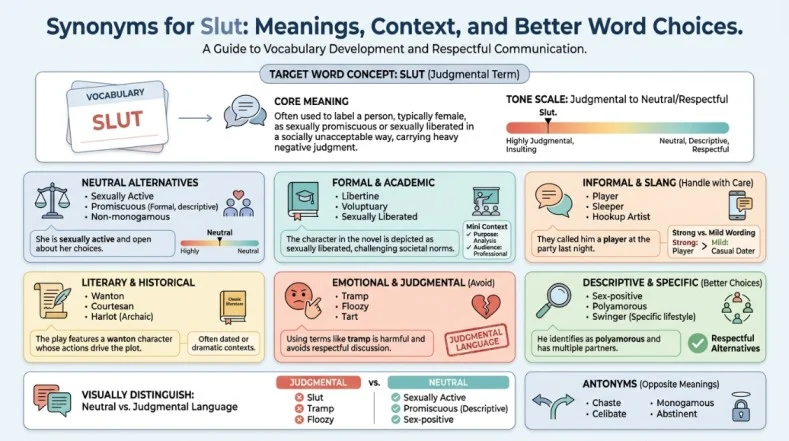
“Slut” is a derogatory noun traditionally used to criticize someone, especially a woman, for perceived sexual behavior. Depending on context, alternatives include promiscuous, sexually active, flirtatious, indiscriminate, or sexually liberated.
Meaning, Tone and Context
Simple Definition
“Slut” is a noun used as an insulting or judgmental label for a person perceived as having many sexual partners or behaving in a sexually uninhibited way.
The word is generally derogatory. In some contexts, people may reclaim it or use it humorously, but that does not remove its potentially offensive meaning for other audiences.
Part of Speech
“Slut” is primarily a noun.
Example:
“She was called a slut by someone who disagreed with her choices.”
The related adjective “slutty” is also used informally, although it can be equally judgmental or insulting.
Tone
The usual tone is negative, insulting, judgmental, or contemptuous.
In some communities, the word can be used self referentially or as a reclaimed identity term. This depends heavily on speaker, audience, and context.
Formality Level
“Slut” is informal and offensive in many situations.
It should generally be avoided in academic writing, professional communication, formal reports, and respectful descriptions unless you are specifically discussing the word itself.
Common Use Cases
The term may appear in:
- Arguments and insults
- Discussions of sexism and sexual stigma
- Popular culture
- Literary dialogue
- Social media conversations
- Discussions about reclaimed language
- Analysis of derogatory language
Related Word Forms
Noun: slut
Informal adjective: slutty
Related concepts include promiscuity, sexual behavior, sexual freedom, sexual stigma, and sexual double standards.
When and How to Use “Slut”
The word should mainly be used when the exact language itself is relevant. For example, an article about gendered insults may need to mention the term.
Using it as a label for a real person can be unnecessarily insulting and may communicate judgment rather than useful information.
1. Academic Context
“The novel uses the word ‘slut’ to demonstrate the character’s prejudice.”
2. Personal Context
“He apologized after realizing that calling someone a slut was disrespectful.”
3. Literary Context
“The character angrily called her a slut during the confrontation.”
4. Social Media Context
“The post discusses why the word ‘slut’ is often used to shame women.”
5. Cultural Context
“The documentary examines how sexual labels have changed over time.”
6. Language Discussion
“Students analyzed how the term functions as a gendered insult.”
7. Casual Conversation
“She said the word was offensive and asked her friend not to use it.”
Another Word for “Slut”
There is no single perfect replacement because “slut” combines a description of perceived sexual behavior with a judgmental attitude.
- For professional writing, use precise phrases such as sexually active or sexually promiscuous when the factual distinction is genuinely relevant.
- For academic writing, terms such as promiscuous or sexually active may be more appropriate, depending on the evidence and intended meaning.
- For casual conversation, sexually active or seeing multiple partners can communicate information without using an insult.
- For emotional writing, words such as shamed, judged, or stigmatized may describe the social experience more accurately.
- For creative writing, a writer may use a character’s insult when dialogue requires authentic characterization.
- For resume or workplace use, the term should not be used to describe a colleague or professional situation.
- For social media captions, neutral wording such as sexually liberated or confident about sexuality may be more appropriate when that is the intended meaning.
- For a stronger insulting meaning, derogatory sexual insult is more accurate as a description of the language itself than substituting another offensive label.
- For a softer meaning, sexually active, sexually expressive, or seeing multiple partners may work when the context supports those descriptions.
When Not to Use “Slut”
Avoid the word when you are trying to communicate factual information without judgment.
For example:
“She is a slut.”
This expresses a judgment and gives the reader little reliable information.
A more precise sentence might be:
“She has openly discussed having multiple sexual partners.”
Avoid the term in workplace communication, academic analysis that does not specifically concern the word, professional biographies, formal descriptions, and respectful personal discussions.
Words Commonly Confused With “Slut”
Promiscuous
“Promiscuous” can describe someone perceived as having many sexual partners, but it is still potentially judgmental. It can also describe behavior more generally.
Sexually Active
“Sexually active” is much more neutral. It describes participation in sexual activity without automatically implying a particular number of partners or a moral judgment.
Flirtatious
“Flirtatious” describes behavior intended to show romantic or sexual interest. It does not necessarily imply sexual activity.
Seductive
“Seductive” describes behavior, appearance, or communication intended to create sexual attraction. It does not mean someone has multiple sexual partners.
Sexually Liberated
“Sexually liberated” generally has a more positive or neutral meaning. It suggests freedom from restrictive attitudes toward sexuality.
Promiscuity
“Promiscuity” is a noun referring to sexual behavior involving multiple partners, often with a judgmental implication depending on context.
Best Synonym by Context for “Slut”
| Context | Best Synonym | Why It Works | Example |
|---|---|---|---|
| Formal writing | Sexually active | Neutral and factual | The report describes her as sexually active. |
| Academic writing | Promiscuous | Useful when discussing perceived multiple partner behavior | The study examines stereotypes about promiscuous behavior. |
| Professional use | Sexually active | Avoids unnecessary judgment | Personal sexual behavior is irrelevant to professional performance. |
| Resume | None | Sexual labels have no legitimate resume purpose | A resume should focus on skills and experience. |
| Casual conversation | Seeing multiple partners | Clear and conversational | She is currently seeing multiple partners. |
| Creative writing | Slut | Can accurately reproduce dialogue or characterization | The character used the insult during an argument. |
| Emotional tone | Shamed | Describes the social experience | She felt shamed because of the label. |
| Strong intensity | Sexually promiscuous | More specific about the intended behavior | The character was described as sexually promiscuous. |
| Soft or moderate tone | Sexually active | Avoids moral judgment | They discussed being sexually active. |
| Social media | Sexually liberated | Positive when freedom is the intended idea | Her post celebrates feeling sexually liberated. |
| US usage | Sexually active | Familiar and neutral in American English | The health educator used neutral language. |
| UK usage | Sexually active | Also widely understandable and neutral | The phrase works naturally in British English too. |
Which Synonym Should You Choose?
Start with the meaning you actually want to communicate.
- If you mean someone participates in sexual activity, “sexually active” is usually clearer.
- If you mean someone has multiple sexual partners, “seeing multiple partners” or “sexually promiscuous” may be more precise.
- If you mean someone behaves in a sexually expressive or unrestricted way, “sexually liberated” may better communicate the intended positive meaning.
- If you are discussing an insult, stigma, or dialogue, retain “slut” only when the word itself matters to the discussion.
Always consider audience, formality, emotional intensity, and whether you are describing behavior or expressing judgment.
Real Life Examples of “Slut” in Sentences
School
“The class examined how the word ‘slut’ can reflect gender stereotypes in literature.”
Workplace
“The employee handbook discourages insulting or sexually derogatory language.”
Writing
“The author deliberately used the word to reveal the speaker’s prejudice.”
Conversation
“She objected when someone used the term to judge another person.”
Social Media
“The creator discussed the history of sexual shaming and the language surrounding it.”
Resume
“Sexual labels have no appropriate role in a professional resume.”
“The email focused on respectful communication and avoided derogatory labels.”
Storytelling
“The writer used the insult in dialogue to show how hostile the character was.”
25 Synonyms for “Slut”
Important note: The following 25 entries are not all exact synonyms. Some are neutral alternatives, descriptive terms, related concepts, euphemisms, or context specific substitutes. This distinction matters because replacing one insulting word with another can change the meaning without improving accuracy.
| Synonym | Simple Meaning | Best Used For | Example Sentence |
|---|---|---|---|
| Promiscuous | Having many sexual partners | Formal or descriptive discussion | The article examines stereotypes about promiscuous behavior. |
| Promiscuous person | Person perceived as having many sexual partners | Neutralized discussion of the label | The character was described as a promiscuous person. |
| Sexually active | Participating in sexual activity | Neutral communication | The counselor used the phrase sexually active. |
| Sexually liberated | Comfortable with sexual freedom | Positive or supportive contexts | She described herself as sexually liberated. |
| Sexually expressive | Openly expressing sexuality | Neutral or positive writing | The character is sexually expressive and confident. |
| Sexually adventurous | Open to varied sexual experiences | Informal or positive contexts | The novel portrays him as sexually adventurous. |
| Seeing multiple partners | Dating or having relationships with several people | Casual conversation | She is currently seeing multiple partners. |
| Dating multiple people | Maintaining several dating relationships | Everyday conversation | He is dating multiple people while exploring his options. |
| Flirtatious | Showing romantic or sexual interest | Social behavior | Her flirtatious manner attracted attention. |
| Seductive | Creating sexual attraction | Creative writing | The character gave a seductive smile. |
| Alluring | Strongly attractive or appealing | Literary writing | Her alluring presence drew everyone’s attention. |
| Coquettish | Playfully flirtatious | Literary or formal writing | The character adopted a coquettish tone. |
| Amorous | Showing romantic or sexual feelings | Literary writing | The poem uses amorous imagery. |
| Lustful | Driven by strong sexual desire | Literary or emotional writing | The story explores his lustful impulses. |
| Erotic | Related to sexual desire or attraction | Artistic or literary discussion | The film contains erotic imagery. |
| Sensual | Related to physical pleasure or attraction | Creative and descriptive writing | The photographer created a sensual portrait. |
| Sexually uninhibited | Not strongly restrained about sexuality | Descriptive writing | The character is portrayed as sexually uninhibited. |
| Sexually open | Comfortable discussing or exploring sexuality | Informal and positive contexts | She is sexually open about her preferences. |
| Sexually confident | Comfortable with one’s sexuality | Positive personal descriptions | She became more sexually confident with age. |
| Sex positive | Holding an accepting attitude toward sexuality | Modern cultural discussion | The organization promotes sex positive education. |
| Libertine | Person associated with unrestricted behavior | Literary or historical contexts | The novel portrays him as a libertine. |
| Sexpot | Informal term for a highly sexually attractive person | Very casual or humorous contexts | The magazine described the actor as a sexpot. |
| Seductress | Woman portrayed as sexually seductive | Literary characterization | The story presents her as a mysterious seductress. |
| Temptress | Woman portrayed as tempting or seductive | Literary or dramatic writing | The myth presents her as a dangerous temptress. |
| Siren | Attractive woman portrayed as dangerously seductive | Mythic or literary writing | The novel casts her as a modern siren. |
Synonym Groups and Usage Differences
Professional vs. Personal Synonyms
There is usually no professional reason to label someone’s sexual behavior.
In personal discussions, neutral descriptions such as sexually active or seeing multiple partners can communicate the relevant information without relying on an insult.
Formal vs. Conversational Synonyms
Formal writing may use terms such as sexually active, promiscuous, or sexually uninhibited when they are genuinely relevant.
Conversation often benefits from clearer phrases such as seeing multiple partners or dating multiple people.
Academic Synonyms
Academic writing should prioritize precise and defensible terminology.
Depending on the subject, researchers may discuss promiscuity, sexual behavior, sexual activity, sexual stigma, gendered insults, or sexual double standards.
Professional and Business Synonyms
The safest professional choice is usually to avoid sexual labeling entirely.
Workplace communication should focus on relevant behavior, conduct, performance, and policies rather than someone’s private sexual life.
Creative or Literary Synonyms
Creative writing allows greater flexibility.
Words such as seductress, temptress, siren, libertine, sensual, and erotic can create characterization, atmosphere, or historical flavor.
Slang or Modern Synonyms
Terms such as sexpot are highly informal and can sound humorous, old fashioned, objectifying, or provocative.
Modern expressions such as sex positive and sexually liberated usually carry a more positive meaning, although they do not mean exactly the same thing as “slut.”
Strongest vs. Weaker Synonyms
Mild and neutral:
Sexually active
Seeing multiple partners
Sexually expressive
Moderate descriptive language:
Sexually uninhibited
Sexually adventurous
Promiscuous
Strongly judgmental:
Slut
The strongest terms are not necessarily the most accurate. A neutral phrase is often better when factual precision matters.
Emotional vs. Neutral Synonyms
Emotional language includes slut, slutty, seductress, temptress, and lustful.
Neutral language includes sexually active, seeing multiple partners, dating multiple people, and sexual behavior.
The right choice depends on whether you want to describe facts, express judgment, create emotion, or reproduce dialogue.
Antonyms of “Slut”
Because “slut” is a derogatory label rather than a precise behavioral category, its antonyms depend on what aspect of the meaning you intend to contrast.
| Antonym | Meaning | Example Sentence |
|---|---|---|
| Chaste | Not engaging in sexual activity | The character is portrayed as chaste. |
| Abstinent | Choosing not to engage in sexual activity | He remained abstinent for personal reasons. |
| Celibate | Refraining from sexual activity, often by choice or commitment | She chose to remain celibate. |
| Monogamous | Having one committed partner | They are in a monogamous relationship. |
| Faithful | Remaining sexually or romantically committed to a partner | He remained faithful throughout the relationship. |
| Committed | Dedicated to a relationship | She is committed to her partner. |
| Reserved | Restrained in social or romantic behavior | He has a reserved personality. |
| Modest | Avoiding behavior considered sexually showy | The character is described as modest. |
| Demure | Quietly modest or reserved | Her demure manner suited the setting. |
| Temperate | Moderate and restrained | The character leads a temperate lifestyle. |
| Abstinent person | A person avoiding sexual activity | The story includes an abstinent person. |
| Faithful partner | A person committed to one partner | She is portrayed as a faithful partner. |
| Devoted partner | A deeply committed romantic partner | He is a devoted partner. |
| Monogamist | A person who prefers monogamous relationships | She identifies as a monogamist. |
| Reserved person | Someone who is restrained in expression | The reserved person avoided discussing private matters. |
Comparison: “Slut” vs. Similar Words
Slut vs. Promiscuous
The main difference is tone. “Slut” is a derogatory insult, while “promiscuous” is a descriptive adjective that can still carry judgment.
“Slut” is stronger emotionally and less appropriate in formal writing.
Example:
“The insult was directed at her.”
“The article discusses promiscuous behavior.”
Slut vs. Sexually Active
“Sexually active” is substantially more neutral.
It simply refers to participation in sexual activity and does not automatically suggest many partners.
“Slut” is much more judgmental.
Example:
“She is sexually active.”
“The character was insulted with a derogatory sexual label.”
Slut vs. Flirtatious
“Flirtatious” describes behavior that shows romantic or sexual interest.
It does not establish that someone has had sex or multiple partners.
Example:
“She was flirtatious at the party.”
“The speaker used an insulting sexual label.”
Slut vs. Seductive
“Seductive” means attractive or persuasive in a sexual way.
It can describe appearance, behavior, writing, music, or atmosphere.
Example:
“The advertisement uses a seductive visual style.”
“The character was insulted during the argument.”
Slut vs. Sexually Liberated
“Sexually liberated” usually communicates a positive idea involving freedom from restrictive sexual expectations.
It is therefore not an exact replacement for “slut.”
Example:
“She describes herself as sexually liberated.”
“The other term is a derogatory label.”
Slut vs. Sexpot
“Sexpot” is an informal term for someone considered highly sexually attractive.
It focuses more on perceived attractiveness than on sexual behavior.
Example:
“The magazine used the old fashioned term sexpot.”
“The other word was used as an insult.”
Common Phrases and Expressions with “Slut”
1. Slut Shaming
Meaning:
Criticizing, humiliating, or socially judging someone because of perceived sexual behavior.
Example sentence:
“The campaign focuses on reducing slut shaming and promoting respectful language.”
2. Called a Slut
Meaning:
Being directly given the insulting label.
Example sentence:
“She was called a slut during the argument.”
3. Slut Shaming Culture
Meaning:
A social environment where people are judged or humiliated for perceived sexual behavior.
Example sentence:
“The article explores the effects of slut shaming culture.”
4. Slut Stereotype
Meaning:
A stereotype that associates a person with negative assumptions about sexual behavior.
Example sentence:
“The study examines the persistence of the slut stereotype.”
5. Reclaiming the Word
Meaning:
Using a historically insulting term in a self chosen or empowering way.
Example sentence:
“Some activists discuss reclaiming the word in feminist contexts.”
6. Sexual Label
Meaning:
A term used to classify or judge someone based on perceived sexuality or sexual behavior.
Example sentence:
“The writer questions whether any sexual label is necessary.”
Common Mistakes to Avoid
1. Treating Every Related Word as an Exact Synonym
“Sexually active,” “promiscuous,” and “slut” do not have identical meanings or tones.
2. Confusing Flirtation With Sexual Activity
Being flirtatious does not necessarily mean someone is sexually active or has multiple partners.
3. Using an Insult in Formal Writing
Academic and professional writing usually benefits from neutral, precise terminology.
4. Choosing an Overly Dramatic Word
Words such as temptress or siren can sound literary and dramatic when a simple factual description would work better.
5. Repeating the Same Label
If you are writing about sexual behavior, vary your vocabulary according to meaning rather than replacing one insult with another.
6. Ignoring Emotional Tone
A neutral term and an insulting term may refer to similar subject matter while communicating completely different attitudes.
7. Using Slang in Academic or Professional Writing
Informal terms can weaken credibility when the subject requires precise and respectful language.
FAQs
What is the best synonym for “slut”?
There is no universal synonym. “Sexually active,” “seeing multiple partners,” or “sexually liberated” may work depending on the exact meaning and intended tone.
What is a formal synonym for “slut”?
“Promiscuous” can function as a more formal descriptive term, although it may still sound judgmental. “Sexually active” is more neutral.
What is an informal synonym for “slut”?
Informal alternatives include sexpot, although this term focuses on sexual attractiveness and is not an exact synonym.
What is another word for “slut” in professional writing?
Professional writing should generally avoid sexual insults. Use precise neutral language such as sexually active only when the information is genuinely relevant.
What is the difference between “slut” and “promiscuous”?
“Slut” is a derogatory noun used as an insult. “Promiscuous” is a descriptive adjective that can refer to perceived sexual behavior involving multiple partners.
What is the opposite of “slut”?
There is no single exact opposite. Depending on the intended contrast, terms such as chaste, abstinent, celibate, monogamous, or faithful may work.
Conclusion
The word “slut” is a strongly derogatory sexual label whose meaning depends heavily on context, speaker, and audience. The best synonyms for slut are not necessarily other insults. In many situations, sexually active, seeing multiple partners, sexually expressive, or sexually liberated communicates the intended idea more clearly.
Good vocabulary choices depend on precision and tone. When discussing a person’s actual behavior, choose factual language. When analyzing an insult, the original term may be necessary because the language itself is the subject.
For stronger writing, do not simply replace one word with another. First identify the exact meaning, emotional tone, and context you want to communicate, then choose the most accurate term.
Read More Related Articles:
- 25+ Synonyms for Secret | Meanings, Examples, and Best …
- 25+ Synonyms for Anxiety | Meanings, Examples, and Best …