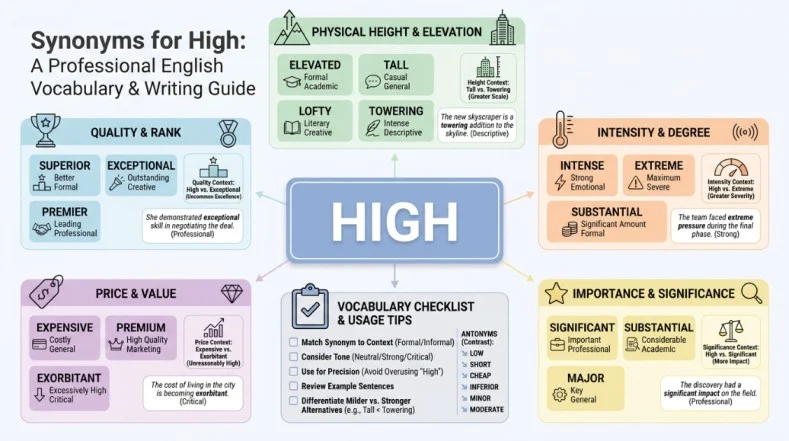
The word “high” appears everywhere. You might describe a high price in an email, a high score in an essay, a high mountain in a caption, or a high level of performance on a resume. Using the same word repeatedly can make otherwise strong writing feel flat.
Learning synonyms for high gives you more control over meaning, tone, and precision. Some alternatives work better in professional writing, while others fit academic work, casual conversation, emotional descriptions, or creative storytelling. The key is choosing a word that matches the exact meaning you want.
What Does “High” Mean?
“High” generally describes something that is far above the ground, greater than usual, elevated in amount or degree, or advanced in position. Depending on context, alternatives include elevated, lofty, intense, extreme, superior, steep, costly, and towering.
Meaning, Tone and Context
Simple Definition
“High” is an adjective that commonly describes something positioned far above the ground or something that reaches a greater than usual level, amount, degree, or position.
For example, “a high building” refers to physical height, while “high demand” refers to a large level of demand.
The meaning changes considerably depending on the noun it describes. This is why selecting a synonym requires attention to context.
Part of Speech
“High” is most commonly an adjective.
It can also function as an adverb, noun, and verb in certain contexts.
Examples include:
“a high wall” uses high as an adjective.
“Fly high” uses high as an adverb.
“The high of success” uses high as a noun.
“The plane began to high” is not standard modern usage, so verb alternatives should usually be chosen carefully.
Tone
“High” is generally neutral.
It can become positive when describing achievement, quality, status, or performance. It can also sound negative when describing excessive prices, risks, temperatures, or costs.
For example:
“She achieved a high score.” This is positive.
“The restaurant has high prices.” This may be negative.
“The patient has a high temperature.” This is factual and potentially concerning.
Formality Level
“High” works in almost every level of communication.
It is natural in everyday speech, academic writing, workplace communication, journalism, and creative writing.
More precise alternatives can make formal writing stronger. For example, “elevated” may work better than “high” in technical or professional contexts.
Common Use Cases
High commonly describes:
Physical position
Height
Amounts
Prices
Temperatures
Scores
Quality
Status
Intensity
Demand
Risk
Performance
Emotional states
Drug or alcohol related states
When and How to Use “High”
Use “high” when the meaning is clear from the surrounding sentence and you do not need a more specific word.
1. Professional Context
“The company reported high demand for its new service.”
2. Personal Context
“My apartment is on a high floor with a great view.”
3. Academic Context
“The study found a high level of student engagement.”
4. Emotional Context
“She was in high spirits after receiving the good news.”
5. Creative Context
“High mountains surrounded the quiet valley.”
6. Social Media Context
“High hopes and a fresh start.”
7. Email Context
“We have received a high number of applications this week.”
Another Word for “High”
The best single replacement depends entirely on what “high” means in your sentence.
Professional Writing
Use “elevated,” “substantial,” “significant,” or “superior” when they accurately express the intended meaning.
Example:
“Customer satisfaction remains high.”
More precise:
“Customer satisfaction remains substantial.”
However, “elevated” may be better when describing a measured level.
Academic Writing
“Elevated,” “substantial,” “considerable,” and “extreme” can work well depending on the subject.
Example:
“The research recorded high levels of stress.”
More precise:
“The research recorded elevated levels of stress.”
Casual Conversation
“Big,” “top,” “great,” and “intense” may work naturally depending on the meaning.
Example:
“That place has high prices.”
Casual alternative:
“That place is really expensive.”
Emotional Writing
“Intense,” “powerful,” “elated,” and “lofty” can add emotional or expressive meaning.
Example:
“She had high hopes for the future.”
Alternative:
“She had lofty hopes for the future.”
Creative Writing
“Lofty,” “towering,” “elevated,” “soaring,” and “majestic” can create stronger imagery.
Example:
“High cliffs surrounded the sea.”
Creative alternative:
“Towering cliffs surrounded the sea.”
Resume or Workplace Use
“Superior,” “advanced,” “substantial,” “significant,” and “exceptional” may provide more professional precision when the context supports them.
Example:
“Maintained a high level of customer satisfaction.”
Stronger professional version:
“Maintained an exceptional level of customer satisfaction.”
Social Media Captions
“Elevated,” “soaring,” “top,” “intense,” and “lofty” can create a more distinctive style.
Example:
“High energy all day.”
Alternative:
“Soaring energy all day.”
Stronger Meaning
Use “extreme,” “intense,” “towering,” or “excessive” when the situation genuinely calls for stronger language.
Softer Meaning
Use “elevated,” “increased,” “substantial,” or “considerable” when you want a measured and less dramatic tone.
When Not to Use “High”
“High” is extremely flexible, but that flexibility can also make it vague.
- Instead of saying “high quality,” use “superior,” “exceptional,” or “excellent” when you can support that judgment.
- Instead of “high price,” use “expensive” or “costly” when the sentence specifically concerns expense.
- Instead of “high mountain,” use “towering” when you want to emphasize dramatic physical height.
- Instead of “high temperature,” use “elevated temperature” in a technical or formal context when appropriate.
Avoid replacing every instance of “high” with an impressive sounding synonym. Precision matters more than variety.
Words Commonly Confused With “High”
High vs. Tall
“High” often describes position, level, or elevation, while “tall” usually describes the vertical height of a person or object.
“A tall building” is natural.
“A high building” is also possible, but the emphasis can differ depending on context.
High vs. Elevated
“Elevated” often sounds more formal and suggests that something has been raised above its normal or expected level.
“High blood pressure” is common.
“Elevated blood pressure” sounds more clinical.
High vs. Lofty
“Lofty” can describe physical height, but it frequently carries a figurative meaning involving ambitious ideas, goals, standards, or ideals.
“She has lofty goals.”
High vs. Upper
“Upper” usually identifies position within a structure or range.
“The upper floor” identifies location.
“The high floor” is less precise.
High vs. Extreme
“Extreme” emphasizes an unusually great degree.
“High temperatures” may simply mean temperatures above normal.
“Extreme temperatures” suggests a much more serious level.
High vs. Top
“Top” often describes the highest position, rank, or level.
“She is at the top of her class.”
“She has a high grade.”
These meanings overlap, but they are not interchangeable in every sentence.
Best Synonym by Context for “High”
| Context | Best Synonym | Why It Works | Example |
|---|---|---|---|
| Formal writing | Elevated | Sounds precise and professional | The report identified elevated costs. |
| Academic writing | Substantial | Clearly communicates a large amount | The study found substantial growth. |
| Professional use | Significant | Emphasizes importance or magnitude | The project achieved significant gains. |
| Resume | Superior | Highlights quality or performance | Delivered superior customer service. |
| Casual conversation | Big | Natural in informal speech | That store has big prices. |
| Creative writing | Lofty | Adds imagery and figurative depth | They pursued lofty dreams. |
| Emotional writing | Intense | Communicates strong emotional force | She felt intense excitement. |
| Strong intensity | Extreme | Indicates an unusually great degree | The region experienced extreme heat. |
| Moderate tone | Elevated | Sounds measured rather than dramatic | The patient showed an elevated reading. |
| Social captions | Soaring | Creates an energetic and expressive feeling | Soaring above the city today. |
| Physical height | Tall | Natural for people and vertical objects | A tall tower dominated the skyline. |
| Physical elevation | Raised | Indicates something positioned upward | The platform was raised above the floor. |
| Cost | Expensive | Directly communicates price | The hotel is expensive. |
| Quality | Superior | Indicates better quality | The product offers superior performance. |
| Status | Prestigious | Communicates high social or professional standing | She joined a prestigious university. |
| Position | Upper | Identifies a higher location | The upper level was closed. |
| Achievement | Exceptional | Highlights unusually strong performance | He delivered exceptional results. |
| Demand | Strong | Natural for market or customer demand | The product has strong demand. |
| Risk | Significant | Communicates meaningful concern | The decision carries significant risk. |
Which Synonym Should You Choose?
Start by identifying what “high” means in your sentence.
- If you mean physical height, consider “tall,” “towering,” or “lofty.”
- If you mean a level above normal, “elevated” or “increased” may be more precise.
- If you mean a large amount, consider “substantial,” “considerable,” or “significant.”
- If you mean strong intensity, “intense” or “extreme” may work better.
- If you mean quality, “superior,” “excellent,” or “exceptional” can be more specific.
- If you mean social or professional status, “prestigious” or “prominent” may fit.
- If you mean price, “expensive” or “costly” is usually clearer than “high.”
Always choose the synonym based on meaning first, then consider tone and formality.
Real Life Examples of “High” in Sentences
School
“The student earned a high score on the final exam.”
A more specific alternative is:
“The student earned an exceptional score on the final exam.”
Workplace
“Our team maintained a high standard of customer service.”
A stronger professional version is:
“Our team maintained superior customer service standards.”
Writing
“The author uses high levels of emotional tension throughout the novel.”
A more descriptive option is:
“The author creates intense emotional tension throughout the novel.”
Conversation
“That coffee shop is too expensive for me. The prices are really high.”
Here, “expensive” is more direct than “high.”
Social Media
“High hopes, clear goals, and a fresh beginning.”
A creative alternative is:
“Lofty hopes, clear goals, and a fresh beginning.”
Resume
“Achieved high customer satisfaction ratings.”
A more professional version is:
“Achieved exceptional customer satisfaction ratings.”
“We are currently experiencing high demand for this service.”
This is natural and professional.
Storytelling
“High cliffs rose above the narrow coastal road.”
For stronger imagery:
“Towering cliffs rose above the narrow coastal road.”
25 Synonyms for “High”
The following words can replace “high” in specific contexts. They are not interchangeable in every sentence because “high” has many different meanings.
| Synonym | Simple Meaning | Best Used For | Example Sentence |
|---|---|---|---|
| Elevated | Above a normal or usual level | Measurements and formal writing | The patient had an elevated temperature. |
| Tall | Great in vertical height | People and objects | A tall building stood near the river. |
| Lofty | Very high or ambitious | Physical height and ideals | She has lofty goals for her career. |
| Towering | Extremely tall and impressive | Physical descriptions | Towering trees surrounded the cabin. |
| Raised | Moved or positioned upward | Physical position | The platform was raised several feet. |
| Upper | Located higher in position | Areas and levels | We live on the upper floor. |
| Top | Highest in position or rank | Rankings and positions | She reached the top of her class. |
| Maximum | Greatest possible level | Limits and measurements | The machine reached its maximum speed. |
| Extreme | Far beyond the ordinary | Intensity and conditions | The hikers faced extreme heat. |
| Intense | Very strong in degree | Feelings and experiences | The competition became intense. |
| Strong | Powerful or substantial | Demand, influence, and effect | The product has strong market demand. |
| Great | Large or considerable | Amounts and general description | The project requires a great deal of effort. |
| Excessive | More than reasonable | Costs, amounts, and behavior | The company faced excessive expenses. |
| Steep | Rising sharply or costing a lot | Slopes and prices | The steep price surprised customers. |
| Costly | Expensive or financially demanding | Money and decisions | The delay became costly for the business. |
| Expensive | Requiring a lot of money | Prices and purchases | That hotel is extremely expensive. |
| Advanced | Highly developed or sophisticated | Technology and skills | The laboratory uses advanced equipment. |
| Superior | Better in quality or performance | Professional writing | The new system provides superior results. |
| Prominent | Important or noticeable | Status and visibility | She is a prominent figure in the field. |
| Prestigious | Highly respected or admired | Institutions and careers | He attended a prestigious university. |
| Exceptional | Unusually good or impressive | Achievement and quality | Her performance was exceptional. |
| Soaring | Rising very high or rapidly | Prices, emotions, and movement | Soaring costs affected the project. |
| Elated | Extremely happy | Emotional states | She felt elated after the victory. |
| Intoxicated | Affected by alcohol or another substance | Formal descriptions of impairment | The driver appeared intoxicated. |
| Euphoric | Extremely happy or excited | Strong emotional states | The crowd was euphoric after the win. |
Synonym Groups and Usage Differences
Professional vs. Personal Synonyms
Professional writing often benefits from precise words such as “elevated,” “significant,” “substantial,” “superior,” and “exceptional.”
Personal writing can use simpler choices such as “big,” “great,” “intense,” or “top,” depending on the meaning.
For example, a business report may say “significant growth,” while a casual conversation may simply say “big growth.”
Formal vs. Conversational Synonyms
Formal contexts favor “elevated,” “substantial,” “considerable,” “significant,” and “superior.”
Casual communication may favor “big,” “great,” “top,” or “strong.”
The most natural choice depends on what “high” describes.
Academic Synonyms
Academic writing should favor precision over unnecessary variety.
“Elevated,” “substantial,” “considerable,” “significant,” and “extreme” can be useful when their meanings accurately match the evidence.
For example:
“The experiment produced high levels of heat.”
A more precise version may be:
“The experiment produced elevated levels of heat.”
Professional and Business Synonyms
Business writing frequently uses “significant,” “substantial,” “elevated,” “strong,” “superior,” and “exceptional.”
For example:
“The company experienced high demand.”
This can become:
“The company experienced strong demand.”
The second sentence is more specific because “strong demand” is a common business expression.
Creative or Literary Synonyms
Creative writing can benefit from “towering,” “lofty,” “soaring,” and “majestic” when physical or emotional imagery is important.
For example:
“High mountains surrounded the village.”
Creative alternative:
“Towering mountains surrounded the village.”
The second version creates a stronger visual impression.
Slang or Modern Synonyms
Some casual expressions can overlap with “high,” especially when discussing excitement, energy, or intoxication.
Words such as “amped” may describe someone who is extremely excited or energized.
However, slang should generally be avoided in academic papers, formal reports, professional resumes, and serious business communication.
Strongest vs. Weaker Synonyms
A useful intensity scale is:
Mild: elevated
Moderate: substantial
Strong: significant
Very strong: intense
Very strong and unusual: extreme
Dramatic physical description: towering
The correct level depends on the situation. “Extreme” should not replace “high” simply because it sounds stronger.
Emotional vs. Neutral Synonyms
Neutral choices include “elevated,” “increased,” “substantial,” and “significant.”
Emotionally expressive choices include “soaring,” “elated,” “euphoric,” and “lofty.”
Compare:
“Consumer confidence remained high.”
“Consumer confidence was soaring.”
The second sentence has more energy and suggests stronger upward movement.
Antonyms of “High”
Because “high” has several meanings, its antonyms also depend on context.
| Antonym | Meaning | Example Sentence |
|---|---|---|
| Low | Not high in level or position | The temperature remained low. |
| Short | Not tall in physical height | The building is relatively short. |
| Lower | At a less elevated position | The lower floor is quieter. |
| Bottom | Lowest position | The box was at the bottom of the shelf. |
| Reduced | Decreased from a previous level | The company reported reduced costs. |
| Decreased | Became smaller in amount | Demand decreased during the winter. |
| Mild | Not intense or extreme | The region experienced mild weather. |
| Weak | Lacking strength or intensity | The signal was weak. |
| Cheap | Low in price | The product is relatively cheap. |
| Inexpensive | Not costly | We found an inexpensive hotel. |
| Ordinary | Not unusually impressive | The restaurant offered ordinary service. |
| Humble | Not elevated in status or attitude | He remained humble after becoming successful. |
| Grounded | Close to the ground or realistic | The aircraft remained grounded. |
| Sober | Not intoxicated | He was sober when he arrived. |
| Downcast | Low in mood or spirits | She looked downcast after the loss. |
Comparison: “High” vs. Similar Words
High vs. Elevated
The main difference is formality and precision.
“High” is broader and more common. “Elevated” often describes a level above normal.
“Elevated” is generally more formal.
Example:
“The patient has high blood pressure.”
“The patient has elevated blood pressure.”
High vs. Tall
“Tall” focuses primarily on vertical height.
“High” can describe position, elevation, amount, degree, or intensity.
“Tall” is more precise for people and vertical objects.
Example:
“She lives in a tall building.”
“The apartment is on a high floor.”
High vs. Lofty
“Lofty” is more expressive and often suggests ambition or ideals.
“High” is more neutral.
“Lofty” is generally more literary.
Example:
“He set high goals.”
“He set lofty goals.”
High vs. Extreme
“Extreme” is stronger than “high.”
It suggests a level far outside what is normal or moderate.
Example:
“The city experienced high temperatures.”
“The city experienced extreme temperatures.”
High vs. Top
“Top” usually indicates the highest position, rank, or point.
“High” is broader and does not necessarily mean the highest.
Example:
“She received a high score.”
“She received the top score.”
High vs. Superior
“Superior” focuses on better quality, ability, or performance.
“High” does not automatically mean better.
“Superior” is more specific and often more formal.
Example:
“The company maintains high standards.”
“The company maintains superior standards.”
Common Phrases and Expressions with “High”
1. High Quality
Meaning:
A level of quality that is very good or above average.
Example sentence:
“This brand is known for high quality products.”
2. High Demand
Meaning:
A situation where many people want or need something.
Example sentence:
“The service remains in high demand.”
3. High Standards
Meaning:
Strong expectations for quality, behavior, or performance.
Example sentence:
“Our team maintains high standards.”
4. High Hopes
Meaning:
Strong expectations or optimism about a future result.
Example sentence:
“She has high hopes for her new business.”
5. High Priority
Meaning:
Something considered especially important.
Example sentence:
“Customer safety remains a high priority.”
6. High Risk
Meaning:
A significant possibility of an undesirable outcome.
Example sentence:
“The investment carries high risk.”
7. High Energy
Meaning:
A strong level of activity, enthusiasm, or excitement.
Example sentence:
“The event had a high energy atmosphere.”
8. High Level
Meaning:
An advanced, significant, or considerable degree.
Example sentence:
“The course requires a high level of concentration.”
Common Mistakes to Avoid
1. Using “High” When a More Precise Word Is Better
“High price” is understandable, but “expensive” or “costly” may communicate the meaning more directly.
2. Confusing “High” With “Tall”
Use “tall” when physical vertical height is the main idea.
Use “high” when discussing elevation, position, amount, degree, or intensity.
3. Using Casual Synonyms in Formal Writing
Words such as “big” may work in conversation but can sound vague in academic or professional writing.
Choose “substantial” or “significant” when those meanings are accurate.
4. Using an Overly Dramatic Synonym
Do not use “extreme” when “high” simply means above average.
Overstating a description can reduce clarity and credibility.
5. Repeating “High” Too Often
Repeated use can make writing feel monotonous.
Replace it selectively with a precise alternative rather than changing every occurrence.
6. Choosing the Wrong Emotional Tone
“Euphoric” is much more emotional than “happy,” while “elevated” is much more neutral.
Make sure the synonym matches the intended feeling.
7. Using Slang in Academic or Professional Writing
Modern informal expressions may sound natural in conversation but can weaken a formal essay, report, resume, or business email.
FAQs
What is the best synonym for “high”?
The best synonym depends on context. “Elevated” works well for levels, “tall” for physical height, “significant” for amounts, and “expensive” for prices.
What is a formal synonym for “high”?
“Elevated” is a useful formal synonym when describing a level above normal. “Substantial” and “significant” work well for large amounts or degrees.
What is an informal synonym for “high”?
“Big,” “top,” and “great” can work informally in certain contexts. The best choice depends on whether high describes size, quality, rank, or degree.
What is another word for “high” in professional writing?
Professional alternatives include “elevated,” “significant,” “substantial,” “superior,” and “exceptional,” depending on the specific meaning.
What is the difference between “high” and “elevated”?
“High” is broader and more common, while “elevated” often suggests a level above normal and sounds more formal or technical.
What is the opposite of “high”?
The most common opposite is “low.” Other context dependent antonyms include short, lower, reduced, mild, weak, inexpensive, and sober.
Conclusion
“High” is a flexible word that can describe physical height, amounts, levels, intensity, quality, status, prices, and emotional states. Because it has so many meanings, the best synonym depends on the exact context.
Use “tall” for physical height, “elevated” for levels above normal, “substantial” for large amounts, “significant” for meaningful degrees, “expensive” for prices, and “superior” for quality.
The most useful vocabulary habit is to choose synonyms for precision rather than variety alone. Before replacing “high,” identify exactly what the word means in your sentence. That simple step will make your writing clearer, more natural, and more effective.
Read More Related Articles:
- 25+ Synonyms for Secret | Meanings, Examples, and Best …
- 25+ Synonyms for Anxiety | Meanings, Examples, and Best …