The word “personality” appears everywhere, from resumes and interviews to essays, social media captions, personal introductions, and everyday conversations. Repeating the same word can make otherwise strong writing feel predictable.
The right alternative adds precision. You might need a professional word such as “character,” a casual choice such as “nature,” or a more expressive term such as “temperament.” Understanding the differences helps you describe people naturally and accurately.
What Does “Personality” Mean?
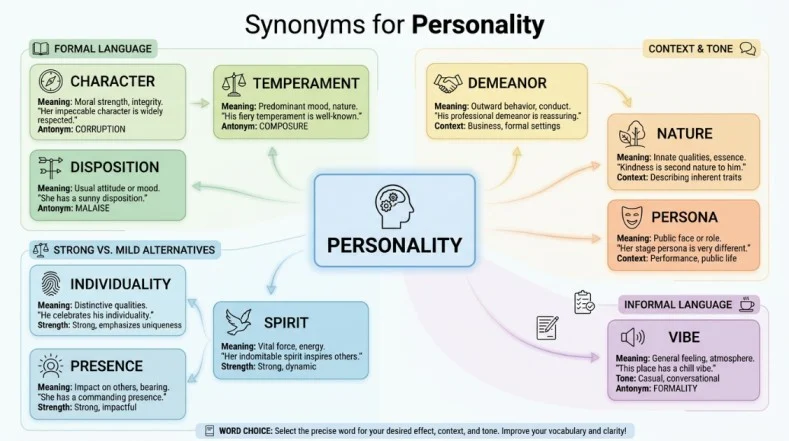
Personality refers to the distinctive combination of qualities, behaviors, attitudes, and emotional tendencies that shape how a person thinks, feels, and interacts with others. Useful alternatives include character, temperament, disposition, persona, nature, individuality, and demeanor.
Meaning, Tone and Context
Simple Definition
Personality is the combination of traits and behavioral patterns that make an individual recognizable as a particular person.
For example, someone may have a warm, confident, thoughtful, humorous, serious, energetic, or reserved personality.
Part of Speech
“Personality” is a noun.
Example: “Her personality makes everyone feel welcome.”
Tone
The word itself is neutral. Its emotional effect depends on the description surrounding it.
For example, “a friendly personality” sounds positive, while “a difficult personality” sounds negative.
Formality Level
“Personality” is suitable for casual conversation, academic writing, workplace communication, resumes, interviews, and professional descriptions.
More precise alternatives may work better when you want to highlight one specific aspect of a person.
Common Use Cases
The word commonly appears when discussing:
- Personal traits
- Behavior
- Social interaction
- Workplace qualities
- Emotional tendencies
- Leadership style
- Communication style
- Character
- Individual differences
- Public image
Related Word Forms
The noun is “personality.”
Related words include “person,” “personal,” “personally,” and “personable.”
“Personable” is especially useful when describing someone who is pleasant, friendly, and easy to interact with.
When and How to Use “Personality”
Use “personality” when you are describing the overall combination of qualities that makes someone distinctive.
It works well when you are discussing a person broadly rather than focusing on only one trait.
1. Professional
“Her confident personality helps her communicate clearly with clients.”
2. Personal
“His personality is quiet at first, but he becomes very talkative around close friends.”
3. Academic
“Researchers often examine how personality influences social behavior.”
4. Emotional
“Her caring personality makes people feel understood.”
5. Creative
“The character has a mysterious personality that keeps the story engaging.”
6. Social Media
“Your personality comes through in every photo and caption you share.”
7. Email
“Alex has a positive personality and works well with different teams.”
Another Word for “Personality”
The best single replacement depends on exactly what you mean.
If you mean a person’s moral qualities, “character” is often the strongest choice. If you mean emotional tendencies, “temperament” is more precise.
For someone’s outward manner, “demeanor” works well. For a distinctive personal identity, “individuality” can be more expressive.
Professional Writing
Best choices include “character,” “demeanor,” “disposition,” and “professional presence.”
Academic Writing
Use “character,” “temperament,” “disposition,” or “behavioral traits” when the context calls for greater precision.
Casual Conversation
“Nature,” “character,” “personality,” and “way of being” sound natural.
Emotional Writing
“Character,” “nature,” “spirit,” and “temperament” can communicate more emotional depth.
Creative Writing
“Persona,” “character,” “nature,” “spirit,” and “individuality” offer more descriptive flexibility.
Resume or Workplace Use
“Character,” “demeanor,” “professional presence,” and specific traits such as “leadership,” “adaptability,” or “confidence” are often more useful than a general reference to personality.
Social Media Captions
“Vibe,” “character,” “energy,” and “spirit” can sound natural in informal captions.
Stronger Meaning
“Character” can be stronger when discussing a person’s underlying qualities and integrity.
Softer Meaning
“Nature” is often a softer way to describe someone’s general disposition.
When Not to Use “Personality”
“Personality” can become vague when you actually mean one specific trait.
Instead of saying:
“Her personality is good.”
Say:
“Her kindness makes people feel comfortable.”
The second sentence gives the reader useful information.
The word can also sound too general in professional writing. A resume is usually stronger when it names measurable or observable qualities such as leadership, communication, reliability, or adaptability.
Avoid using an emotionally loaded alternative when the situation only requires a neutral description.
For example, “spirit” can sound expressive, while “demeanor” is more factual.
Words Commonly Confused With “Personality”
Character
Character usually focuses on a person’s qualities, values, and moral nature.
Temperament
Temperament describes a person’s typical emotional style or natural reaction patterns.
Demeanor
Demeanor refers mainly to the way someone appears or behaves outwardly.
Persona
Persona refers to the identity or image someone presents to other people.
Nature
Nature describes someone’s general disposition or inherent qualities.
Individuality
Individuality emphasizes what makes a person distinct from others.
Best Synonym by Context for “Personality”
| Context | Best Synonym | Why It Works | Example |
|---|---|---|---|
| Formal writing | Character | Sounds precise and mature | Her character became clear during the crisis. |
| Academic writing | Temperament | Focuses on emotional tendencies | The study examined temperament and social behavior. |
| Professional use | Demeanor | Describes outward workplace behavior | His calm demeanor reassured the client. |
| Resume | Character | Highlights personal qualities | Her strong character supports effective leadership. |
| Casual conversation | Nature | Sounds natural and familiar | She has a generous nature. |
| Creative writing | Persona | Highlights a presented identity | The singer created a bold public persona. |
| Emotional tone | Spirit | Adds warmth and emotional depth | Her generous spirit inspired everyone. |
| Strong intensity | Character | Can suggest deeper personal qualities | His character showed under pressure. |
| Soft tone | Nature | Feels gentle and descriptive | Her quiet nature makes her thoughtful. |
| Social media captions | Vibe | Fits informal modern language | His relaxed vibe makes every gathering fun. |
| US usage | Personality | Most familiar and broadly useful | She has an outgoing personality. |
| UK usage | Character | Often works naturally in descriptive contexts | His character is easy to admire. |
Which Synonym Should You Choose?
Start by identifying what part of personality you actually want to describe.
If you mean values and moral qualities, choose “character.” You mean emotional reactions, choose “temperament.”
If you mean outward behavior, choose “demeanor.” You mean a public image, choose “persona.”
For informal social writing, “vibe” or “energy” may work. For academic or professional writing, more precise terms usually produce clearer communication.
Consider emotional intensity as well. “Nature” feels gentle, “character” feels substantial, and “spirit” can sound warm or inspirational.
Real Life Examples of “Personality” in Sentences
School
“Her outgoing personality helped her participate confidently in class discussions.”
Workplace
“His calm demeanor makes him effective during difficult client conversations.”
Writing
“The author gives the main character a thoughtful and complex personality.”
Conversation
“I like her personality because she is honest without being harsh.”
Social Media
“Your personality should come through naturally in your captions.”
Resume
“Her strong character and collaborative nature make her a dependable team member.”
“Jordan’s friendly personality has made communication with our customers much easier.”
Storytelling
“Behind his serious persona was a playful spirit that only his closest friends knew.”
25 Synonyms for “Personality”
| Synonym | Simple Meaning | Best Used For | Example Sentence |
|---|---|---|---|
| Character | A person’s qualities and values | Moral and personal qualities | Her character became clear when she helped a stranger. |
| Temperament | A person’s typical emotional nature | Emotional behavior | His calm temperament helps him handle pressure. |
| Disposition | A person’s usual mood or attitude | Formal descriptions | She has a cheerful disposition. |
| Nature | A person’s general way of being | General descriptions | His thoughtful nature makes him a good listener. |
| Demeanor | Outward behavior and manner | Professional settings | Her professional demeanor impressed the interview panel. |
| Persona | An identity presented to others | Public image and creative work | The performer developed a confident persona on stage. |
| Individuality | Qualities that make someone unique | Personal uniqueness | Her individuality makes her creative work memorable. |
| Characterization | The way qualities are presented | Literature and storytelling | The novel uses vivid characterization to develop its hero. |
| Identity | The sense of who someone is | Personal or social description | Music plays an important role in his identity. |
| Self | A person considered as an individual | Reflective writing | She became more comfortable with her true self. |
| Spirit | Inner energy or emotional quality | Emotional and inspirational writing | His adventurous spirit encouraged the group. |
| Essence | The central quality of someone | Literary or expressive writing | Her kindness captures the essence of her character. |
| Manner | A person’s way of behaving | Behavior and communication | His polite manner made a strong impression. |
| Bearing | The way someone carries themselves | Formal description | Her confident bearing suited the leadership role. |
| Attitude | A person’s way of thinking or feeling | Opinions and behavior | His positive attitude helped the team stay focused. |
| Character traits | Specific qualities of a person | Academic and descriptive writing | The story highlights several admirable character traits. |
| Behavioral style | A person’s typical way of acting | Academic and professional contexts | Her behavioral style is highly collaborative. |
| Personal style | A distinctive way of expressing oneself | Creative and social contexts | Her personal style is bold but approachable. |
| Presence | The impression created by someone | Professional and social settings | His calm presence helped settle the room. |
| Vibe | An informal overall impression | Casual conversation and captions | She has a friendly vibe that puts people at ease. |
| Energy | The feeling someone brings to an interaction | Informal and emotional writing | His positive energy lifted everyone’s mood. |
| Air | An impression or quality someone seems to have | Literary description | She had an air of quiet confidence. |
| Bearing | The way someone presents themselves | Formal descriptions | His dignified bearing suited the occasion. |
| Way of being | A person’s general manner of living and interacting | Reflective writing | Her gentle way of being attracted loyal friends. |
| Personal qualities | Individual characteristics or traits | Professional and academic contexts | Her personal qualities include patience and reliability. |
Synonym Groups and Usage Differences
Professional vs. Personal Synonyms
Professional writing benefits from precise terms.
“Demeanor,” “character,” “disposition,” and “personal qualities” can sound more appropriate in workplace contexts.
Personal writing allows more emotional freedom. “Nature,” “spirit,” “energy,” and “vibe” can make descriptions feel warmer.
Formal vs. Conversational Synonyms
For reports and formal essays, consider “character,” “temperament,” “disposition,” or “demeanor.”
For texts and casual conversation, “nature,” “vibe,” “energy,” and “personality” sound more natural.
Academic Synonyms
Academic writing benefits from terms that identify a specific concept.
“Temperament,” “disposition,” “behavioral style,” and “character traits” can be useful when discussing patterns of behavior or individual differences.
Avoid choosing a complicated word simply because it sounds scholarly. Precision is more important than formality.
Professional and Business Synonyms
In workplace communication, describe observable qualities whenever possible.
Instead of writing “She has a great personality,” consider “She communicates clearly with clients and remains calm under pressure.”
“Demeanor,” “presence,” “character,” and “personal qualities” can also work when the broader personal impression matters.
Creative or Literary Synonyms
Creative writing offers more room for expressive vocabulary.
“Persona,” “spirit,” “essence,” “air,” “nature,” and “individuality” can create more distinctive descriptions.
The best choice depends on whether you want to describe inner qualities, outward presentation, emotional energy, or uniqueness.
Slang or Modern Synonyms
“Vibe” and “energy” are common informal choices.
They work well in texts, social posts, conversations, and lifestyle writing.
They are usually too casual for academic papers, formal reports, and professional documents.
Strongest vs. Weaker Synonyms
A useful intensity scale is:
Nature → disposition → temperament → demeanor → character → essence
This is not a strict scale of dictionary strength. It reflects how substantial or specific the description may feel in context.
“Nature” can sound broad and gentle, while “character” often suggests deeper qualities.
Emotional vs. Neutral Synonyms
Neutral choices include “personality,” “temperament,” “disposition,” and “demeanor.”
More emotional choices include “spirit,” “essence,” “energy,” and “vibe.”
Choose the neutral group when accuracy matters more than emotional effect.
Antonyms of “Personality”
Personality does not have one perfect opposite in every context. The following terms represent conceptual opposites depending on whether you mean individuality, expressiveness, distinctiveness, or personal presence.
| Antonym | Meaning | Example Sentence |
|---|---|---|
| Anonymity | Lack of recognizable personal identity | The writer chose anonymity rather than public recognition. |
| Impersonality | Lack of personal qualities or warmth | The message felt formal because of its impersonality. |
| Blandness | Lack of distinctive or interesting qualities | The description was criticized for its blandness. |
| Dullness | Lack of liveliness or interest | The presentation suffered from dullness. |
| Conformity | Following established patterns instead of standing apart | Excessive conformity can limit creative expression. |
| Uniformity | Lack of meaningful differences | The group showed surprising uniformity in its responses. |
| Sameness | Lack of noticeable individuality | The designs had an unwanted sense of sameness. |
| Facelessness | Lack of a distinct individual identity | The organization was criticized for its facelessness. |
| Anonymity | A condition in which identity is not known | Online anonymity can change how people communicate. |
| Reserve | Limited outward expression | His reserve made him difficult to read at first. |
| Detachment | Lack of emotional involvement | Her emotional detachment was noticeable during the discussion. |
| Inexpressiveness | Difficulty showing feelings or qualities | His inexpressiveness made his reaction difficult to understand. |
| Neutrality | Absence of a strong personal position | The statement maintained complete neutrality. |
| Genericness | Lack of distinctive qualities | The description felt generic because it included few personal details. |
| Bland character | A notably uninteresting personal presence | The fictional figure was criticized as having a bland character. |
Comparison: “Personality” vs. Similar Words
Personality vs. Character
The main difference is focus. Personality covers the broad combination of behavioral and emotional qualities, while character often emphasizes deeper values and moral qualities.
“Character” can feel stronger and more substantial.
Personality: “Her personality is warm and outgoing.”
Character: “Her character was revealed when she admitted her mistake.”
Personality vs. Temperament
Temperament focuses more specifically on natural emotional tendencies and reactions.
“Personality” is broader.
Personality: “He has a friendly personality.”
Temperament: “He has a calm temperament even under pressure.”
Personality vs. Demeanor
Demeanor describes outward behavior and appearance, while personality refers to broader qualities.
Demeanor is often more formal.
Personality: “She has an energetic personality.”
Demeanor: “She maintained a calm demeanor during the meeting.”
Personality vs. Persona
A persona is an identity or image presented to others. It may not represent someone’s complete private personality.
Persona is especially useful for public figures and creative writing.
Personality: “His personality is naturally quiet.”
Persona: “His public persona is confident and outspoken.”
Personality vs. Nature
Nature usually describes a person’s general inherent qualities.
It often sounds softer and less technical than personality.
Personality: “Her personality is outgoing.”
Nature: “Her generous nature makes her easy to trust.”
Personality vs. Individuality
Individuality emphasizes uniqueness rather than the full collection of personal traits.
It is especially useful when discussing creativity or personal expression.
Personality: “His personality is relaxed and friendly.”
Individuality: “His individuality is evident in his unusual artistic style.”
Common Phrases and Expressions with “Personality”
1. Strong Personality
Meaning:
A noticeable or influential set of personal qualities.
Example sentence:
“She has a strong personality and speaks confidently in meetings.”
2. Great Personality
Meaning:
A generally positive and appealing personal character.
Example sentence:
“The new team member has a great personality and quickly connected with everyone.”
3. Outgoing Personality
Meaning:
A friendly, social, and expressive personality.
Example sentence:
“Her outgoing personality makes networking easier.”
4. Quiet Personality
Meaning:
A reserved or less expressive personal style.
Example sentence:
“His quiet personality does not mean he lacks confidence.”
5. Friendly Personality
Meaning:
A warm and approachable way of interacting.
Example sentence:
“Her friendly personality helps customers feel comfortable.”
6. Unique Personality
Meaning:
A distinctive combination of qualities.
Example sentence:
“Every successful character in the novel has a unique personality.”
7. Personality Traits
Meaning:
Specific qualities that describe how someone tends to think, feel, or behave.
Example sentence:
“Patience and curiosity are valuable personality traits.”
Common Mistakes to Avoid
1. Using “Personality” When a Specific Trait Is Better
“Personality” is broad.
Instead of “He has a good personality,” say “He is patient, reliable, and easy to work with” when those qualities are what you actually mean.
2. Confusing Personality With Character
Personality and character overlap, but they are not identical.
Use “character” when values, integrity, or moral qualities are central to the meaning.
3. Using a Casual Synonym in Formal Writing
Words such as “vibe” and “energy” can sound too informal in academic or professional documents.
Use “demeanor,” “disposition,” or a specific trait instead.
4. Using an Overly Dramatic Synonym
“Essence” and “spirit” can sound expressive or literary.
Do not use them when a simple word such as “nature” or “character” communicates the idea more clearly.
5. Repeating “Personality” Too Often
Repeating the same word can make descriptive writing feel flat.
Replace some uses with precise alternatives when the meaning genuinely changes.
6. Choosing the Wrong Emotional Tone
“Demeanor” sounds relatively neutral, while “spirit” often feels warmer.
Always consider the emotional effect of your chosen synonym.
7. Using Slang in Academic or Professional Writing
“Vibe” may sound natural in a social caption but usually does not belong in a formal essay or business report.
FAQs
What is the best synonym for personality?
“Character” is often the best broad synonym when describing a person’s deeper qualities. “Temperament,” “demeanor,” and “nature” are better for specific meanings.
What is a formal synonym for personality?
“Character,” “disposition,” “temperament,” and “demeanor” are useful formal alternatives. The best choice depends on whether you mean values, emotions, or outward behavior.
What is an informal synonym for personality?
“Vibe” and “energy” are common informal alternatives. “Nature” and “character” can also sound natural in everyday conversation.
What is another word for personality in professional writing?
“Character,” “demeanor,” “professional presence,” and “personal qualities” work well. Specific traits such as leadership or reliability are often even clearer.
What is the difference between personality and character?
Personality describes a broad pattern of traits and behavior. Character more often emphasizes values, integrity, and deeper personal qualities.
What is the opposite of personality?
There is no single perfect antonym. Depending on context, useful conceptual opposites include anonymity, impersonality, blandness, sameness, and lack of individuality.
Conclusion
Personality describes the distinctive combination of qualities, behaviors, attitudes, and emotional tendencies that shape how someone interacts with the world.
The best synonym depends on your purpose. Choose “character” for deeper personal qualities, “temperament” for emotional tendencies, “demeanor” for outward behavior, “persona” for presented identity, and “nature” for a broad, gentle description.
For casual communication, “vibe” and “energy” can work naturally. In professional and academic writing, precise words and specific traits usually create stronger descriptions.
The most useful vocabulary habit is simple: do not replace “personality” just for variety. Replace it when another word expresses your exact meaning more clearly.
Read More Related Articles:
- 25+ Synonyms for Secret | Meanings, Examples, and Best …
- 25+ Synonyms for Anxiety | Meanings, Examples, and Best …