Using the word “depression” repeatedly can make an essay, caption, email, story, or personal reflection sound less precise. The right alternative can show whether you mean sadness, hopelessness, discouragement, melancholy, or a more serious emotional condition.
This guide to synonyms for depression explains the differences between similar words so you can choose language that fits the situation. Whether you are writing academically, describing an emotion, improving your vocabulary, or looking for another word for depression, context matters.
What Does “Depression” Mean?
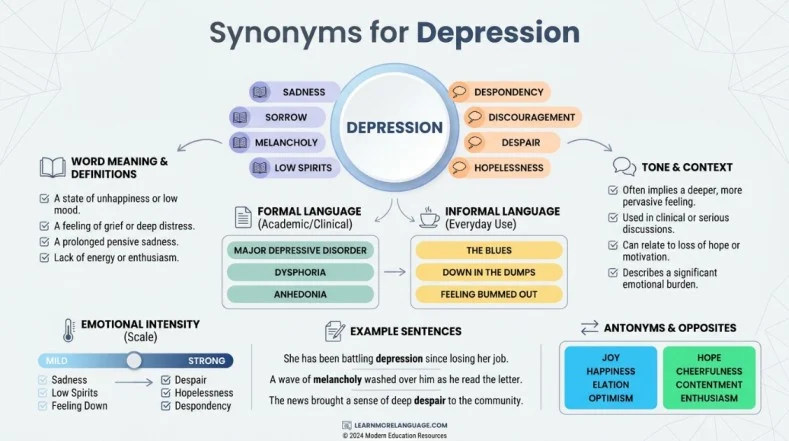
Depression can describe a state of deep sadness, low mood, hopelessness, or emotional heaviness. Common alternatives include sadness in casual contexts, despondency in formal writing, melancholy in creative writing, and hopelessness when emphasizing emotional outlook.
Meaning, Tone and Context
Depression is a noun. In everyday language, it can describe a period of sadness, low spirits, discouragement, or emotional heaviness.
In a mental health context, depression can refer to a serious medical condition involving persistent changes in mood, interest, energy, sleep, concentration, and other areas of functioning. That context, words such as sadness or gloom may not fully communicate the meaning.
The word usually carries a negative and serious tone. Its level of formality is neutral, but its meaning changes significantly depending on whether it is being used casually, emotionally, medically, or academically.
Common uses include personal writing, psychology, health discussions, literature, journalism, essays, conversations, and creative descriptions.
Related Word Forms
Depress: To make someone feel lower or less cheerful, or to reduce something.
Depressed: Feeling very low or, in a clinical context, experiencing symptoms associated with depression.
Depressing: Causing feelings of sadness or low spirits.
Depressingly: In a way that causes sadness or discouragement.
Depression: The noun describing a state of low mood or the clinical condition, depending on context.
When and How to Use “Depression”
Use depression when you need a broad term for a low emotional state or when discussing the clinical condition itself. Choose a more specific word when you want to communicate the exact emotion.
1. Personal Context
“After losing her longtime pet, she experienced a period of deep depression.”
2. Academic Context
“The study examined how prolonged depression can affect concentration and daily functioning.”
3. Emotional Context
“He struggled with depression after several major changes in his life.”
4. Creative Context
“The character’s depression was reflected in the quiet, gray atmosphere of the novel.”
5. Professional Context
“The employee requested support while dealing with depression.”
6. Social Media Context
“Some days feel heavier than others when you are dealing with depression.”
7. Casual Context
“She said the gloomy weather was putting her in a little depression.”
In the last example, sadness, gloom, or low spirits may sound more natural if the speaker means temporary unhappiness rather than a clinical condition.
Another Word for “Depression”
The best single replacement depends on what you actually mean.
| Context | Useful Alternative |
|---|---|
| Professional writing | low mood |
| Academic writing | depressive symptoms |
| Casual conversation | sadness |
| Emotional writing | despair |
| Creative writing | melancholy |
| Workplace communication | emotional distress |
| Social media captions | feeling low |
| Stronger meaning | hopelessness |
| Softer meaning | unhappiness |
There is no single best synonym for depression in every sentence. A good replacement preserves the intended meaning instead of simply changing the word.
When Not to Use “Depression”
Avoid using depression when you only mean ordinary disappointment, temporary sadness, or a bad mood.
For example:
“I’m in depression because my favorite team lost.”
If the feeling is temporary disappointment, this is more precise:
“I’m really disappointed because my favorite team lost.”
Similarly, melancholy may work better in literary writing, while low spirits can sound more natural in everyday conversation.
When discussing a diagnosed or suspected mental health condition, avoid replacing depression with a word that minimizes its seriousness.
Words Commonly Confused With “Depression”
Depression vs. Sadness
Sadness is a normal emotional response to loss, disappointment, or difficult circumstances. Depression can describe a much deeper or more persistent state and can also refer to a clinical condition.
Depression vs. Despair
Despair emphasizes a strong loss of hope. It is usually more intense than ordinary sadness.
Depression vs. Melancholy
Melancholy often describes a quiet, reflective, or poetic sadness. It is especially common in creative and literary writing.
Depression vs. Discouragement
Discouragement usually results from setbacks or difficulties. It often suggests that someone has lost confidence or motivation rather than experiencing a broad depressive state.
Depression vs. Grief
Grief is a response to loss, especially the death of someone or something deeply valued. Depression can occur alongside grief but is not identical to it.
Depression vs. Anxiety
Anxiety centers on fear, worry, nervousness, or anticipation of danger. Depression generally centers more on low mood, hopelessness, loss of interest, or emotional heaviness.
Best Synonym by Context for “Depression”
| Context | Best Synonym | Why It Works | Example |
|---|---|---|---|
| Formal writing | Despondency | Sounds precise and formal | His despondency was evident throughout the memoir. |
| Academic writing | Low mood | Clear and neutral | The research examined persistent low mood. |
| Professional use | Emotional distress | Appropriate for workplace discussions | She sought support for emotional distress. |
| Resume | Discouragement | Useful when describing setbacks | He overcame discouragement after several rejected applications. |
| Casual conversation | Sadness | Familiar and natural | She felt sadness after the news. |
| Creative writing | Melancholy | Adds literary depth | A sense of melancholy filled the room. |
| Emotional tone | Despair | Communicates intense loss of hope | He felt despair after the unexpected loss. |
| Strong intensity | Hopelessness | Focuses on the absence of hope | Hopelessness made the situation feel impossible. |
| Soft or moderate tone | Unhappiness | Less intense than depression | His unhappiness lasted for several days. |
| Social media caption | Feeling low | Natural and conversational | Feeling low today, taking things slowly. |
| US usage | Depression | Common and widely understood | She spoke openly about depression. |
| UK usage | Low spirits | Natural in everyday British English | He was in low spirits after the setback. |
Which Synonym Should You Choose?
Start with the meaning. If you mean ordinary sadness, choose sadness or unhappiness. If you mean a loss of hope, choose despair or hopelessness.
Next, consider formality. Academic and professional writing often benefits from precise terms such as low mood, emotional distress, or despondency.
Consider emotional intensity too. Melancholy can sound reflective, discouragement can sound moderate, and despair can communicate a much stronger emotional state.
Finally, think about your audience and sentence context. A social media caption may sound natural with “feeling low,” while a research paper may require more precise language.
Real Life Examples of “Depression” in Sentences
School
“The student wrote about how depression affected her ability to concentrate.”
Workplace
“His prolonged discouragement made it difficult to stay motivated at work.”
Writing
“The author uses melancholy to create a reflective mood throughout the story.”
Conversation
“I have been feeling low since the difficult conversation with my friend.”
Social Media
“Taking a quiet day to reset when everything feels heavy.”
Resume
“After several setbacks, she overcame discouragement and continued pursuing her career goals.”
“I have been experiencing a difficult period and may need some additional flexibility.”
Storytelling
“Despair slowly replaced the optimism he had carried for years.”
25 Synonyms for “Depression”
Some entries below are close synonyms, while others describe a particular aspect of depression. They should not automatically be substituted in clinical or medical writing.
| Synonym | Simple Meaning | Best Used For | Example Sentence |
|---|---|---|---|
| Sadness | Feeling unhappy | Everyday emotions | Sadness followed the disappointing news. |
| Unhappiness | Lack of happiness | General personal writing | Her unhappiness was difficult to hide. |
| Melancholy | Quiet, thoughtful sadness | Creative writing | The painting has a strong sense of melancholy. |
| Despondency | Loss of hope or confidence | Formal writing | His despondency became clear after repeated failures. |
| Dejection | Feeling low after disappointment | Personal writing | She sat in dejection after hearing the result. |
| Despair | Complete loss of hope | Strong emotional writing | He felt despair when the opportunity disappeared. |
| Hopelessness | Feeling that improvement is impossible | Emotional contexts | Hopelessness can make ordinary problems feel overwhelming. |
| Discouragement | Loss of confidence or motivation | Workplace and school | The rejection caused temporary discouragement. |
| Downheartedness | Feeling sad and discouraged | Personal writing | Her downheartedness faded after speaking with a friend. |
| Low spirits | A subdued, unhappy mood | Conversation | He was in low spirits after the setback. |
| Gloom | A dark or unhappy mood | Descriptive writing | Gloom settled over the house that evening. |
| Misery | Intense unhappiness | Emotional writing | The character lived in misery after the loss. |
| Sorrow | Deep sadness, often after loss | Literary writing | Her sorrow remained long after the funeral. |
| Distress | Severe emotional difficulty | Formal and professional contexts | The incident caused considerable emotional distress. |
| Dispiritedness | Loss of enthusiasm or hope | Formal writing | Dispiritedness affected the team’s motivation. |
| Heaviness | A difficult emotional feeling | Reflective writing | A feeling of heaviness stayed with him throughout the day. |
| Moroseness | A gloomy, unhappy manner | Descriptive writing | His moroseness made conversation difficult. |
| Somberness | Serious and subdued mood | Literary and descriptive writing | The somberness of the scene was unmistakable. |
| Melancholia | Deep or prolonged melancholy | Literary and historical contexts | The poem explores themes of melancholia. |
| The blues | A period of sadness | Informal conversation | She has been feeling the blues lately. |
| Doldrums | A period of low energy or enthusiasm | Informal writing | He was stuck in the doldrums after the project ended. |
| Woe | Great sadness or trouble | Literary writing | The poem is filled with images of woe. |
| Heartache | Emotional pain, often after loss | Personal and romantic writing | The breakup left him with considerable heartache. |
| Grief | Deep sorrow after loss | Bereavement and emotional writing | Grief affected every part of her routine. |
| Emotional suffering | Significant emotional pain | Formal discussion | The experience caused prolonged emotional suffering. |
Synonym Groups and Usage Differences
Professional vs. Personal Synonyms
Professional communication generally benefits from neutral and precise language.
Emotional distress, low mood, and discouragement can work better than dramatic expressions such as misery or despair when the situation does not require strong emotional language.
Personal writing gives you more freedom. Words such as sadness, heartache, melancholy, and sorrow can communicate personal feelings with greater emotional detail.
Formal vs. Conversational Synonyms
For reports, essays, and formal discussions, despondency, distress, and low mood can provide greater precision.
For texts and casual conversations, sadness, feeling low, the blues, and low spirits may sound more natural.
Academic Synonyms
Academic writing should prioritize precision rather than emotional intensity.
Low mood, depressive symptoms, emotional distress, and despondency may be appropriate depending on the subject. When discussing a clinical condition, however, use established clinical terminology rather than substituting a literary synonym.
Professional and Business Synonyms
Workplace writing usually benefits from respectful, neutral language.
For example, emotional distress, low mood, and discouragement can be suitable when discussing wellbeing, performance challenges, or difficult circumstances.
A resume should generally focus on achievements and skills rather than personal mental health information unless there is a specific reason to disclose it.
Creative or Literary Synonyms
Creative writing allows more expressive choices.
Melancholy, sorrow, heartache, woe, gloom, and melancholia can create atmosphere and emotional depth.
The choice should match the character, setting, and intensity of the scene.
Slang or Modern Synonyms
The blues and feeling low are informal expressions rather than precise clinical synonyms.
They work well in casual speech, personal captions, and conversational writing. Avoid them in academic or professional writing when precision is important.
Strongest vs. Weaker Synonyms
A useful intensity scale is:
Unhappiness → sadness → low spirits → discouragement → dejection → melancholy → sorrow → distress → despair → hopelessness
This is not a clinical scale. Emotional intensity depends on the sentence and the person using the word.
Emotional vs. Neutral Synonyms
Emotional choices: despair, sorrow, misery, heartache, woe.
More neutral choices: low mood, sadness, discouragement, emotional distress.
Neutral words are generally better when the goal is clarity. Emotional words are useful when the writing intentionally emphasizes feeling.
Antonyms of “Depression”
These are emotional or contextual opposites rather than exact clinical antonyms.
| Antonym | Meaning | Example Sentence |
|---|---|---|
| Happiness | A positive emotional state | Happiness returned after the good news. |
| Joy | Strong positive emotion | Her joy was obvious when she received the award. |
| Contentment | A peaceful sense of satisfaction | He felt contentment after finishing the project. |
| Optimism | Positive expectation about the future | Her optimism helped the team stay focused. |
| Hopefulness | Belief that things can improve | Hopefulness returned after they found a solution. |
| Cheerfulness | A bright and positive mood | His natural cheerfulness lifted the room. |
| Elation | Intense happiness | She felt elation after hearing the results. |
| Delight | Great pleasure | The children expressed delight at the surprise. |
| Pleasure | Enjoyment or satisfaction | Reading gives him considerable pleasure. |
| Satisfaction | A feeling that something is good or complete | She felt satisfaction after reaching her goal. |
| Confidence | Belief in your ability or prospects | His confidence grew with experience. |
| Enthusiasm | Strong interest or excitement | The students showed enthusiasm for the project. |
| Vitality | Energy and liveliness | Regular activity helped restore his sense of vitality. |
| Wellbeing | A healthy and positive overall state | Sleep can support emotional wellbeing. |
| Buoyancy | A light, positive emotional quality | Her emotional buoyancy returned after the vacation. |
Comparison: “Depression” vs. Similar Words
Depression vs. Sadness
Main difference: Sadness is a normal emotion, while depression can describe a more persistent and serious state or a clinical condition.
Stronger: Depression generally suggests greater seriousness.
More formal: Both are neutral, but depression has a more specific clinical use.
Examples:
“She felt sadness after missing the event.”
“He sought professional help for depression.”
Depression vs. Melancholy
Main difference: Melancholy often suggests reflective or poetic sadness.
Stronger: Depression generally carries greater seriousness.
More formal: Melancholy sounds more literary.
Examples:
“The loss caused deep depression.”
“The old photograph filled her with melancholy.”
Depression vs. Despair
Main difference: Despair focuses specifically on a loss of hope.
Stronger: Despair often sounds more intense.
More formal: Both can work in formal writing, but despair has a stronger emotional quality.
Examples:
“She struggled with depression for months.”
“He felt despair after losing his last opportunity.”
Depression vs. Discouragement
Main difference: Discouragement usually follows setbacks and involves reduced motivation or confidence.
Stronger: Depression generally suggests a broader and potentially more serious state.
More formal: Both are acceptable in formal writing.
Examples:
“The repeated rejection caused discouragement.”
“She received treatment for depression.”
Depression vs. Grief
Main difference: Grief is a response to significant loss, while depression has a broader meaning and may occur without bereavement.
Stronger: Neither is automatically stronger because they describe different experiences.
More formal: Both are widely used in formal contexts.
Examples:
“She experienced grief after her father’s death.”
“He has been struggling with depression.”
Depression vs. Anxiety
Main difference: Depression commonly involves low mood and loss of interest, while anxiety centers on excessive fear, worry, or nervousness.
Stronger: Neither is inherently stronger.
More formal: Both are standard terms in professional and academic contexts.
Examples:
“Depression affected his motivation.”
“Anxiety made it difficult for her to relax.”
Common Phrases and Expressions with “Depression”
1. Clinical depression
Meaning: A mental health condition requiring careful clinical understanding.
Example sentence:
“Clinical depression can affect mood, concentration, sleep, and everyday functioning.”
2. Deep depression
Meaning: A very serious or intense state of emotional low mood.
Example sentence:
“The character fell into deep depression after the loss.”
3. Fight depression
Meaning: Work toward managing or overcoming depression.
Example sentence:
“Many people use professional support and healthy routines to manage depression.”
4. Suffer from depression
Meaning: Experience depression, especially when describing an ongoing condition.
Example sentence:
“He has spoken openly about suffering from depression.”
5. Signs of depression
Meaning: Changes that may indicate depression.
Example sentence:
“Persistent changes in mood and interest can be signs of depression.”
6. Treatment for depression
Meaning: Professional or clinical approaches used to manage depression.
Example sentence:
“She discussed treatment for depression with a qualified professional.”
7. Depression symptoms
Meaning: Experiences or changes associated with depression.
Example sentence:
“Depression symptoms can vary significantly from person to person.”
Common Mistakes to Avoid
1. Using Depression for Ordinary Disappointment
“My favorite show ended, so I have depression.”
A more precise choice is:
“I feel disappointed that my favorite show ended.”
2. Confusing Depression With Sadness
Sadness is a normal emotion. Depression can involve a broader and more persistent pattern of symptoms.
Do not automatically treat the two terms as interchangeable.
3. Using a Casual Synonym in Formal Writing
Expressions such as the blues or feeling low may sound too conversational in academic research or professional reports.
Choose neutral language when precision matters.
4. Using an Overly Dramatic Synonym
Words such as despair and misery can sound excessive if you only mean mild disappointment.
Match emotional intensity to the actual situation.
5. Repeating Depression Too Often
Repeated use can make writing feel flat. Where appropriate, vary the language with precise terms such as sadness, low mood, discouragement, melancholy, or emotional distress.
6. Choosing the Wrong Emotional Tone
Melancholy suggests reflective sadness, while despair suggests an intense loss of hope.
Replacing depression with either word without considering tone can change the meaning.
7. Using Slang in Academic or Professional Writing
Expressions such as the blues are useful conversationally but usually lack the precision expected in formal writing.
FAQs
What is the best synonym for depression?
The best synonym depends on meaning. Sadness works for ordinary unhappiness, melancholy for literary sadness, and despair when the emphasis is intense loss of hope.
What is a formal synonym for depression?
Despondency, emotional distress, and low mood can work in formal contexts, depending on the intended meaning and whether the discussion is clinical.
What is an informal synonym for depression?
Feeling low, the blues, and low spirits are informal alternatives for temporary sadness or reduced mood, but they are not exact clinical equivalents.
What is another word for depression in professional writing?
Low mood, emotional distress, or discouragement may work in professional writing when they accurately describe the situation.
What is the difference between depression and sadness?
Sadness is a normal emotional response, while depression can describe a persistent emotional condition or a clinical disorder involving broader changes in functioning.
What is the opposite of depression?
Common emotional opposites include happiness, joy, contentment, optimism, hopefulness, and cheerfulness, depending on the intended meaning.
Conclusion
The best synonyms for depression depend on the meaning you want to communicate. Sadness is useful for ordinary unhappiness, melancholy works well in creative writing, discouragement fits setbacks, and despair emphasizes an intense loss of hope.
Choosing among synonyms for depression requires more than finding a word with a similar dictionary meaning. Tone, intensity, audience, and context all matter. A useful vocabulary habit is to identify the exact emotion first, then choose the word that describes it most accurately.
When discussing mental health, precision is especially important. Do not replace the clinical term depression with a softer synonym if doing so changes the intended meaning.
Read More Related Articles:
- 25+ Synonyms for Secret | Meanings, Examples, and Best …
- 25+ Synonyms for Anxiety | Meanings, Examples, and Best …