The word analysis appears everywhere, from school essays and research papers to business reports, emails, presentations, resumes, and everyday conversations. Repeating it too often can make otherwise strong writing feel predictable, especially when a more precise word can show exactly what kind of thinking or evaluation you mean.
Learning synonyms for analysis helps you describe examination, investigation, evaluation, interpretation, or review with greater precision. The best replacement depends on your purpose, audience, tone, and level of detail. This guide explains the differences so you can choose vocabulary that sounds natural, accurate, and appropriate in real communication.
What Does “Analysis” Mean?
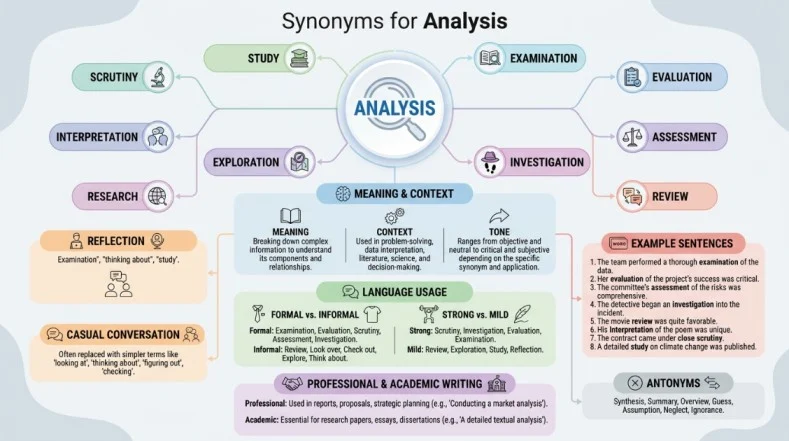
Analysis means a detailed examination of something to understand its parts, meaning, causes, patterns, or significance. Depending on context, useful alternatives include examination, evaluation, assessment, investigation, review, interpretation, scrutiny, study, and research.
Meaning, Tone and Context
Simple Definition
Analysis is the process of examining something carefully by separating it into parts or studying its details to understand how it works, what it means, or why it happened.
For example:
The data analysis revealed a significant change in customer behavior.
Here, analysis refers to a careful examination of information to discover useful findings.
Part of Speech
Analysis is primarily a noun.
Its plural form is analyses.
Related forms include:
| Word Form | Meaning | Example |
|---|---|---|
| Analysis | Detailed examination | The analysis identified several problems. |
| Analyses | More than one examination | The researchers compared several analyses. |
| Analyze | To examine carefully | We need to analyze the results. |
| Analyzes | Examines carefully | She analyzes market trends. |
| Analyzed | Examined carefully | The team analyzed the survey data. |
| Analytical | Related to careful examination | He has strong analytical skills. |
| Analytically | In a logical, detailed manner | The issue was examined analytically. |
Tone
Analysis is generally neutral and professional.
It does not automatically communicate positive or negative emotion. The tone comes from the surrounding language.
For example:
The analysis identified several opportunities.
This sounds positive.
The analysis exposed serious weaknesses.
This sounds negative.
Formality Level
Analysis is suitable for many levels of communication.
It works especially well in academic writing, professional reports, business presentations, research, journalism, technical writing, and formal discussions.
In casual conversation, people may prefer simpler words such as study, look, review, or examination depending on the situation.
Common Use Cases
Analysis is frequently used when discussing:
- Research
- Data
- Business performance
- Financial information
- Literature
- Scientific studies
- Political developments
- Customer behavior
- Problems and causes
- Arguments and ideas
- Trends
- Workplace performance
When and How to Use “Analysis”
Use analysis when you mean a careful examination intended to understand something more deeply.
It is particularly useful when the process involves evidence, details, reasoning, patterns, or interpretation.
1. Professional
The quarterly analysis showed that customer retention had improved.
2. Academic
Her analysis of the novel focuses on identity and social pressure.
3. Business
Our market analysis indicates growing demand for affordable services.
4. Personal
After some analysis, I realized that my original decision was too rushed.
5. Emotional
A deeper analysis of his reaction revealed that fear was influencing his behavior.
6. Social Media
My latest post includes a quick analysis of the trends shaping online content.
7. Email
I have attached the analysis for your review before tomorrow’s meeting.
Another Word for “Analysis”
The best single replacement depends on what you are actually doing.
- If you are looking closely at something, examination is a strong general choice.
- If you are judging quality or value, evaluation or assessment may be better.
- If you are trying to discover facts or causes, investigation is often more precise.
Professional Writing
Best choices include:
evaluation, assessment, review, examination, investigation
Example:
The evaluation identified several areas for improvement.
Academic Writing
Best choices include:
examination, interpretation, investigation, study, critique
Example:
The examination explores how language influences perception.
Casual Conversation
Best choices include:
look, review, study, breakdown
Example:
Let’s take a closer look at the numbers.
Emotional Writing
Best choices include:
examination, exploration, reflection, interpretation
Example:
Her reflection helped her understand why the experience affected her so deeply.
Creative Writing
Best choices include:
exploration, interpretation, examination, dissection
Example:
The story offers a fascinating exploration of memory and loss.
Resume or Workplace Use
Best choices include:
evaluation, assessment, research, review, investigation
Example:
Conducted market research and evaluated customer feedback to improve product strategy.
Social Media Captions
Best choices include:
breakdown, review, insights, examination
Example:
A quick breakdown of the biggest trends from this year.
Stronger Meaning
For a more intense sense of detailed examination, use:
scrutiny, investigation, dissection
Softer Meaning
For a less intense sense of looking at something, use:
review, overview, study, consideration
When Not to Use “Analysis”
Analysis can sometimes sound unnecessarily formal or technical.
If you are simply looking at something briefly, review may be more natural.
Instead of:
I did an analysis of your message.
You could write:
I reviewed your message.
If you are making a judgment about quality, evaluation is usually more precise.
Instead of:
We completed an analysis of the proposal.
You could write:
We evaluated the proposal.
If you are trying to discover what caused a problem, investigation may communicate the purpose more clearly.
Instead of:
The analysis examined the cause of the error.
You could write:
The investigation examined the cause of the error.
Words Commonly Confused With “Analysis”
Analysis vs. Evaluation
Analysis focuses on understanding details, parts, relationships, or meaning.
Evaluation focuses more directly on judging quality, value, effectiveness, or performance.
Analysis vs. Assessment
Assessment usually means measuring or judging something against a particular standard.
Analysis is broader and can focus on understanding without making a final judgment.
Analysis vs. Investigation
Investigation usually involves actively searching for facts, causes, or evidence.
Analysis can happen after information has already been collected.
Analysis vs. Research
Research involves systematically gathering information to answer a question or develop knowledge.
Analysis is often one part of the research process.
Analysis vs. Review
A review usually means examining something again or considering it generally.
Analysis normally suggests deeper and more detailed examination.
Analysis vs. Interpretation
Interpretation focuses on explaining meaning or significance.
Analysis can include interpretation, but it may also examine structure, evidence, patterns, or relationships.
Best Synonym by Context for “Analysis”
| Context | Best Synonym | Why It Works | Example |
|---|---|---|---|
| Formal writing | Examination | Sounds precise and professional | The examination revealed several weaknesses. |
| Academic writing | Analysis | Standard academic term | The analysis examines the author’s argument. |
| Professional use | Evaluation | Emphasizes judgment and performance | The evaluation identified areas for improvement. |
| Business | Assessment | Useful for judging conditions or performance | The assessment considered market risks. |
| Resume | Evaluation | Shows analytical workplace ability | Conducted evaluations of customer performance data. |
| Casual conversation | Review | Natural and easy to understand | I reviewed the results this morning. |
| Creative writing | Exploration | Suggests thoughtful discovery | The novel offers an exploration of identity. |
| Emotional writing | Reflection | Adds a personal and thoughtful quality | Her reflection changed how she viewed the experience. |
| Strong intensity | Scrutiny | Suggests very close examination | The proposal came under intense scrutiny. |
| Moderate tone | Review | Less formal and less intense | The team completed a review of the process. |
| Social media | Breakdown | Clear and approachable | Here is a quick breakdown of the results. |
| Scientific context | Examination | Emphasizes careful study | The examination focused on cellular changes. |
| Research | Investigation | Suggests discovery through evidence | The investigation explored possible causes. |
| Literary criticism | Interpretation | Focuses on meaning | Her interpretation of the poem is compelling. |
| Data context | Evaluation | Useful when judging findings or performance | The evaluation revealed a strong upward trend. |
| Financial context | Assessment | Suitable for financial judgment | The financial assessment identified new risks. |
| Problem solving | Investigation | Focuses on discovering causes | The investigation found the source of the error. |
| Technical writing | Examination | Clear and exact | The examination covered system performance. |
| Presentation | Breakdown | Makes complex information accessible | This breakdown explains the main findings. |
| Personal decision | Reflection | Appropriate for thoughtful consideration | Reflection helped him reconsider his choice. |
Which Synonym Should You Choose?
Choosing the right synonym is less about finding a word that means exactly the same thing and more about identifying the precise purpose of your sentence.
- Use examination when you want to emphasize careful study.
- Use evaluation when you are judging effectiveness, quality, or value.
- Use assessment when you are measuring a situation against expectations, criteria, or standards.
- Use investigation when you are searching for facts, causes, or evidence.
- Use review when the examination is practical, general, or relatively brief.
- Use interpretation when the main goal is explaining meaning.
- Use scrutiny when the examination is extremely careful or critical.
- Use exploration when you want to suggest discovery, depth, or curiosity.
- Use reflection when the process is personal and thoughtful.
- Use breakdown when you want an accessible explanation of complicated information.
Real Life Examples of “Analysis” in Sentences
School
The student’s analysis of the poem explains how imagery supports the central theme.
Workplace
The manager used sales analysis to identify the strongest performing products.
Writing
Her analysis of the article focuses on the author’s use of evidence.
Conversation
After some analysis, I realized that the problem was easier to solve than I expected.
Social Media
This post provides a simple analysis of the latest content trends.
Resume
Performed customer data analysis to identify purchasing patterns and support business decisions.
Please review the attached analysis before the team meeting.
Storytelling
His analysis of the situation changed the direction of the entire investigation.
25 Synonyms for “Analysis”
Not every word below is interchangeable with analysis in every sentence. Each one emphasizes a slightly different purpose or context.
| Synonym | Simple Meaning | Best Used For | Example Sentence |
|---|---|---|---|
| Examination | Careful study of something | Formal and general writing | The examination revealed several important details. |
| Study | Careful learning or consideration | Academic and general contexts | Her study of consumer behavior produced useful insights. |
| Investigation | Search for facts or causes | Problems, events, research | The investigation uncovered the source of the error. |
| Evaluation | Judgment of quality or effectiveness | Business and professional settings | The evaluation showed that the program was effective. |
| Assessment | Measurement or judgment | Education, business, risk | The assessment identified several potential risks. |
| Review | General or detailed consideration | Workplace and everyday communication | The team completed a review of the proposal. |
| Scrutiny | Very close examination | Critical or high attention contexts | The contract received careful scrutiny before approval. |
| Interpretation | Explanation of meaning | Literature, data, ideas | Her interpretation of the results differed from ours. |
| Exploration | Investigation for discovery | Creative and academic contexts | The book offers an exploration of human identity. |
| Inquiry | Investigation or request for information | Formal and institutional settings | The inquiry examined the company’s safety practices. |
| Research | Systematic search for knowledge | Academic and professional work | Their research examined changing consumer preferences. |
| Appraisal | Judgment of value or quality | Formal and professional contexts | The property underwent a professional appraisal. |
| Critique | Detailed evaluation of strengths and weaknesses | Academic and creative work | The professor asked for a critique of the argument. |
| Breakdown | Explanation by separating information into parts | Business, education, social content | The report includes a breakdown of monthly expenses. |
| Dissection | Extremely detailed examination | Figurative and scientific contexts | Her dissection of the argument exposed several flaws. |
| Diagnosis | Identification of the nature or cause of a problem | Medical and problem solving contexts | The technical diagnosis identified the source of the failure. |
| Inspection | Careful checking for condition or problems | Physical and technical contexts | The inspection revealed damage to the equipment. |
| Consideration | Thoughtful examination before deciding | Personal and professional decisions | After careful consideration, we changed the plan. |
| Reflection | Thoughtful examination of experiences or ideas | Personal and emotional writing | His reflection helped him understand the experience. |
| Reviewal | The act of reviewing something | Limited formal usage | The document is pending reviewal by the committee. |
| Audit | Systematic examination of records or accounts | Finance and compliance | The annual audit identified accounting errors. |
| Examination | Detailed consideration | Formal and academic writing | The examination of the evidence supported the conclusion. |
| Inquiry | Organized search for information | Formal investigations | The public inquiry considered several possible causes. |
| Study | Detailed consideration or research | Academic and general use | The study examined how sleep affects concentration. |
| Evaluation | Careful judgment based on evidence | Professional and educational use | The evaluation measured the effectiveness of the training. |
Important accuracy note: Some entries are context based alternatives rather than perfect substitutes in every sentence. For example, audit, diagnosis, appraisal, inspection, and critique have specialized meanings. Also, “reviewal” is uncommon in modern US English, so review is normally the better choice.
Synonym Groups and Usage Differences
Professional vs. Personal Synonyms
Professional writing often benefits from words such as evaluation, assessment, examination, review, investigation, and audit.
Personal writing can sound more natural with reflection, consideration, exploration, or thought.
Compare:
The company conducted an evaluation of employee performance.
With:
I spent some time reflecting on my decision.
The first sentence is objective and professional. The second is personal and thoughtful.
Formal vs. Conversational Synonyms
For reports, academic papers, and formal presentations, use words such as examination, evaluation, assessment, investigation, and scrutiny.
For texts, casual emails, and everyday conversation, review, look, study, and breakdown can sound more natural.
Academic Synonyms
Academic writing values precision.
Useful choices include examination, investigation, interpretation, critique, study, evaluation, and research.
Choose the word according to the specific activity. A critique judges an argument, while an interpretation explains meaning.
Professional and Business Synonyms
Business communication commonly uses analysis, evaluation, assessment, review, research, investigation, audit, and appraisal.
For example:
The market assessment revealed increased demand.
This sounds more specific than:
The market analysis revealed increased demand.
Both can work, but assessment emphasizes judgment about the market.
Creative or Literary Synonyms
Creative writing can benefit from words such as exploration, reflection, interpretation, dissection, and examination.
For example:
The novel explores loneliness through the character’s memories.
The word exploration adds a sense of discovery that a purely technical word may not provide.
Slang or Modern Synonyms
There are few true slang synonyms for analysis.
In informal online communication, people sometimes use breakdown, deep dive, or look at.
For example:
Here is a quick breakdown of the results.
These choices are appropriate for blogs, videos, social posts, and casual explanations, but they may sound less formal in academic research.
Strongest vs. Weaker Synonyms
A useful intensity scale is:
Look → Review → Study → Examination → Evaluation → Investigation → Scrutiny
These words do not form a perfect universal intensity scale because context changes their strength.
Look is broad and informal.
Review is practical and moderate.
Study suggests sustained attention.
Examination suggests careful detail.
Evaluation adds judgment.
Investigation suggests a search for facts or causes.
Scrutiny suggests extremely close or critical attention.
Emotional vs. Neutral Synonyms
- For neutral communication, choose analysis, examination, assessment, evaluation, review, or study.
- For more personal language, use reflection or consideration.
- For a critical emotional tone, scrutiny or dissection can sound stronger.
Compare:
The report provides an analysis of the decision.
With:
Her reflection on the decision was deeply personal.
The first is neutral. The second emphasizes emotion and personal thought.
Antonyms of “Analysis”
Analysis does not have one perfect opposite. Depending on the intended meaning, the conceptual opposite may involve combining information, avoiding detailed examination, relying on assumptions, or considering something only generally.
The following words represent contextual opposites rather than exact dictionary antonyms.
| Antonym | Meaning | Example Sentence |
|---|---|---|
| Synthesis | Combining parts into a whole | The final section focuses on synthesis rather than separate examination. |
| Integration | Combining elements together | The project requires integration of the findings. |
| Combination | Joining things together | The combination of ideas produced a new approach. |
| Overview | General view without extensive detail | The presentation gives an overview of the topic. |
| Summary | Brief statement of main points | The summary presents the key findings. |
| Generalization | Broad conclusion from specific information | The claim was an unsupported generalization. |
| Simplification | Making something less complex | The teacher used simplification to explain the concept. |
| Assumption | Belief accepted without detailed examination | The decision was based on an assumption. |
| Guess | Conclusion without sufficient evidence | His answer was only a guess. |
| Speculation | Idea without firm evidence | The report separates evidence from speculation. |
| Impression | General feeling or understanding | My first impression was positive. |
| Intuition | Understanding without deliberate analysis | She trusted her intuition when making the decision. |
| Neglect | Failure to give proper attention | Neglect of the evidence created problems later. |
| Disregard | Intentional lack of attention | The decision showed disregard for important information. |
| Superficiality | Lack of depth or detail | The superficiality of the review limited its usefulness. |
Comparison: “Analysis” vs. Similar Words
Analysis vs. Examination
Main difference: Analysis often involves breaking information into parts to understand relationships or meaning. Examination simply emphasizes careful study.
Which is stronger: Analysis often suggests more depth, but examination can also be very detailed.
Which is more formal: Both are formal enough for professional and academic writing.
Analysis example:
The analysis identified patterns in customer behavior.
Examination example:
The examination focused on the quality of the evidence.
Analysis vs. Evaluation
Main difference: Analysis seeks understanding, while evaluation usually involves judgment.
Which is stronger: Evaluation can sound more decisive because it implies a conclusion about quality or effectiveness.
Which is more formal: Both are appropriate for formal writing.
Analysis example:
The analysis examined changes in consumer behavior.
Evaluation example:
The evaluation determined whether the campaign was effective.
Analysis vs. Assessment
Main difference: Assessment commonly measures or judges something according to standards, conditions, or risks.
Which is stronger: Assessment may sound more decision focused.
Which is more formal: Both are professional and academic.
Analysis example:
The analysis explored the causes of the decline.
Assessment example:
The assessment measured the financial risk.
Analysis vs. Investigation
Main difference: Investigation emphasizes finding facts, evidence, or causes. Analysis emphasizes examining information.
Which is stronger: Investigation often sounds more active and intensive.
Which is more formal: Both are formal.
Analysis example:
The analysis revealed a pattern in the data.
Investigation example:
The investigation identified the cause of the problem.
Analysis vs. Review
Main difference: Review can be broad or relatively brief, while analysis usually suggests deeper examination.
Which is stronger: Analysis generally suggests more depth.
Which is more formal: Analysis is somewhat more technical, while review works across both professional and everyday communication.
Analysis example:
The analysis identified three major trends.
Review example:
The manager completed a review of the document.
Analysis vs. Interpretation
Main difference: Interpretation explains meaning or significance. Analysis can examine structure, evidence, relationships, and patterns without necessarily explaining meaning.
Which is stronger: Neither is universally stronger. The purpose is different.
Which is more formal: Both work well in academic writing.
Analysis example:
The analysis compared the two arguments.
Interpretation example:
Her interpretation explains what the symbol represents.
Common Phrases and Expressions with “Analysis”
1. Data Analysis
Meaning:
The examination of collected information to identify patterns, relationships, or useful findings.
Example sentence:
Data analysis helped the company understand changing customer preferences.
2. Market Analysis
Meaning:
A detailed examination of a market, including customers, competitors, trends, and opportunities.
Example sentence:
The market analysis revealed strong demand among younger consumers.
3. Financial Analysis
Meaning:
The examination of financial information to understand performance, risks, or opportunities.
Example sentence:
The financial analysis showed that operating costs had increased.
4. Detailed Analysis
Meaning:
A thorough examination that considers many relevant parts or factors.
Example sentence:
The report provides a detailed analysis of the proposed changes.
5. Careful Analysis
Meaning:
A thoughtful examination that avoids rushed conclusions.
Example sentence:
Careful analysis of the evidence changed the researcher’s conclusion.
6. In Depth Analysis
Meaning:
A very thorough examination of a subject.
Example sentence:
The article provides an in depth analysis of current consumer trends.
7. Comparative Analysis
Meaning:
A study that compares two or more subjects to identify similarities and differences.
Example sentence:
The paper presents a comparative analysis of the two economic models.
8. Root Cause Analysis
Meaning:
A structured effort to identify the underlying cause of a problem.
Example sentence:
The engineering team performed a root cause analysis after the system failure.
Common Mistakes to Avoid
1. Using Analysis When a More Precise Word Is Better
Not every careful look is an analysis.
If you are judging quality, evaluation may be more accurate.
2. Confusing Analysis With Assessment
Assessment often involves measurement or judgment against criteria.
Analysis may simply explain what the information shows.
3. Using a Casual Synonym in Formal Writing
Words such as look or breakdown can be useful, but formal reports may require examination, evaluation, or assessment.
4. Using an Overly Dramatic Synonym
Words such as scrutiny and dissection can sound intense.
Do not use them when a simple review is all you mean.
5. Repeating Analysis Too Often
Using the same noun several times in one paragraph can make writing feel repetitive.
Replace it selectively with precise alternatives such as evaluation, examination, review, or assessment.
6. Choosing the Wrong Emotional Tone
Scrutiny can imply criticism.
Reflection can imply personal thought.
Evaluation can imply judgment.
Make sure the replacement communicates the intended tone.
7. Using Informal Language in Academic Writing
Words such as look and deep dive can sound conversational.
For academic work, choose more precise terms such as examination, investigation, interpretation, or evaluation.
FAQs
What is the best synonym for analysis?
The best synonym depends on context. Examination is a strong general alternative, while evaluation, assessment, investigation, review, and interpretation suit more specific purposes.
What is a formal synonym for analysis?
Examination, evaluation, assessment, investigation, scrutiny, and inquiry are formal alternatives. The best choice depends on whether you are studying, judging, or investigating something.
What is an informal synonym for analysis?
In casual communication, review, look, and breakdown can work. For example, “Here is a quick breakdown of the results” sounds approachable.
What is another word for analysis in professional writing?
Useful professional alternatives include evaluation, assessment, examination, review, investigation, and audit. Choose based on the specific business activity being described.
What is the difference between analysis and evaluation?
Analysis focuses on understanding information, while evaluation focuses on judging quality, effectiveness, value, or performance. An evaluation can therefore be one result of analysis.
What is the opposite of analysis?
Analysis has no single perfect opposite. Contextual opposites include synthesis, overview, summary, assumption, speculation, intuition, and superficiality, depending on the intended meaning.
Conclusion
The best alternative depends on your purpose. Choose examination for careful study, evaluation for judgment, assessment for measurement, investigation for finding causes or facts, review for a general examination, and interpretation for explaining meaning.
The most useful vocabulary habit is to avoid replacing a word simply because you want variety. Choose a synonym because it communicates your exact meaning more clearly. That small distinction can make your writing more precise, natural, and professional.
Read More Related Articles:
- 25+ Synonyms for Secret | Meanings, Examples, and Best …
- 25+ Synonyms for Anxiety | Meanings, Examples, and Best …