Strong vocabulary can make sensitive topics clearer, especially when writing about people or communities who face exclusion, limited opportunities, or unequal access. If you repeatedly use the word marginalized in an essay, article, caption, email, resume, or professional discussion, choosing a more precise alternative can improve both clarity and tone.
The best replacement depends on what you actually mean. Words such as disadvantaged, underrepresented, excluded, disenfranchised, and oppressed can describe different aspects of marginalization. This guide explains their meanings, emotional weight, formality, and practical usage so you can choose language that is accurate, respectful, and appropriate for your audience.
What Does “Marginalized” Mean?
Marginalized describes people or groups pushed toward the edge of society, institutions, or opportunities and given less access, influence, recognition, or power. Useful alternatives include disadvantaged, excluded, underrepresented, underserved, disenfranchised, and oppressed.
Meaning, Tone and Context
1. Simple Definition
Marginalized means treated as less important, given fewer opportunities, or pushed away from full participation in society, institutions, or a community.
The word often describes groups affected by social, economic, political, cultural, or institutional barriers.
2. Part of Speech
Marginalized is usually an adjective.
It can also function as the past participle of the verb marginalize.
Examples:
Marginalized communities often face barriers to education.
The policy marginalized rural residents.
Related forms include:
| Word Form | Meaning |
|---|---|
| Marginalize | To push someone or a group toward the edge of society or influence |
| Marginalized | Experiencing exclusion, reduced influence, or limited opportunity |
| Marginalization | The process of excluding or disadvantaging people |
| Margin | An outer edge or less central position |
3. Tone
Marginalized is generally neutral and serious.
It is commonly used in academic writing, journalism, social discussions, public policy, education, and professional communication.
Depending on the sentence, it can also carry emotional weight because it often refers to inequality or unfair treatment.
4. Formality Level
The word is moderately formal.
It works well in:
- Academic essays
- Research writing
- Professional reports
- Policy discussions
- Social commentary
- Educational materials
- Advocacy writing
- Thoughtful personal writing
For casual conversation, simpler words such as left out, excluded, or overlooked may sound more natural.
5. Common Use Cases
You may see marginalized used when discussing:
- Communities with limited social power
- People facing discrimination
- Groups with limited political representation
- People experiencing economic disadvantage
- Communities with limited access to services
- Underrepresented populations
- People excluded from decision making
- Groups whose experiences receive little recognition
6. Important Word Forms
The most useful related forms are:
Marginalize: to push someone toward a less influential position.
Marginalized: pushed toward the edge or denied equal participation.
Marginalization: the process through which exclusion or reduced participation occurs.
Mainstream: the dominant or widely accepted part of society, often used as a contrasting concept.
When and How to Use “Marginalized”
Use marginalized when you want to communicate more than simple exclusion.
The word can suggest that a person or group has been placed in a less powerful or less influential position over time.
Professional Example
The organization is developing programs for marginalized communities with limited access to employment opportunities.
Academic Example
The study examines how marginalized populations experience barriers within the education system.
Personal Example
She wanted to create a welcoming space for people who often feel marginalized in their communities.
Emotional Example
Many residents felt marginalized after their concerns were repeatedly ignored.
Creative Example
The novel gives a voice to characters who exist on the margins of society.
Social Media Example
The campaign highlights the experiences of marginalized communities and encourages more inclusive conversations.
Email Example
Our outreach strategy should consider the needs of marginalized groups that may have limited access to these services.
Another Word for “Marginalized”
The best single replacement depends on the exact meaning.
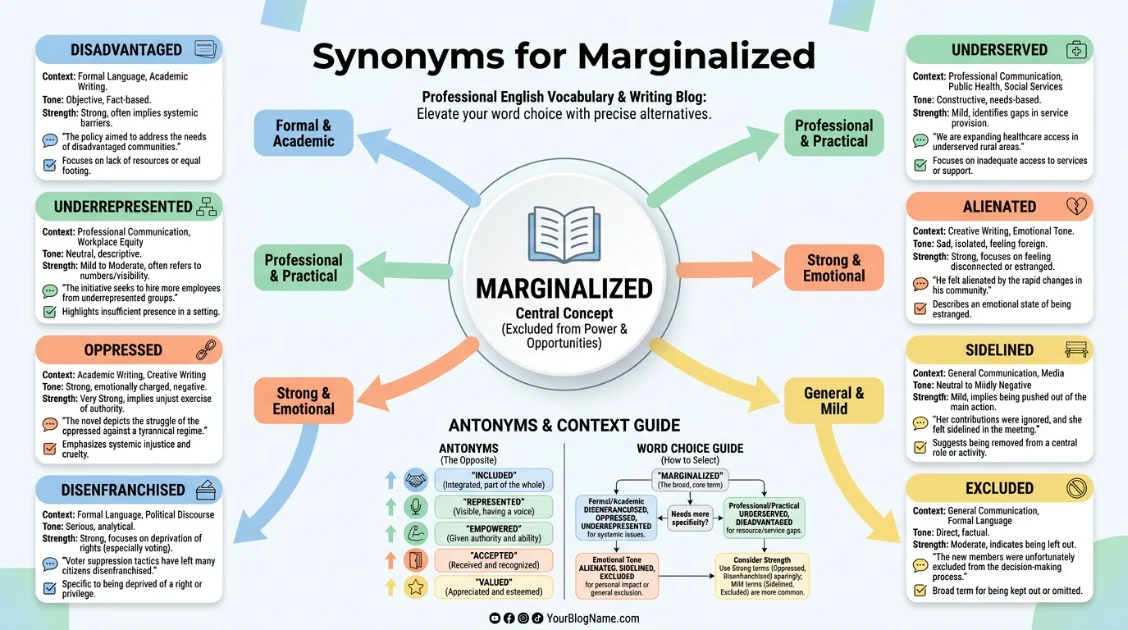
- If you mean lacking advantages, use disadvantaged.
- If you mean not adequately represented, use underrepresented.
- If you mean kept out, use excluded.
- If you mean denied political rights or influence, use disenfranchised.
- If you mean subjected to severe unfair control or treatment, use oppressed.
Professional Writing
Best choice: disadvantaged, underserved, or underrepresented
The program supports disadvantaged communities.
Academic Writing
Best choice: underrepresented, disadvantaged, or socially excluded
The research examines barriers affecting underrepresented populations.
Casual Conversation
Best choice: left out or excluded
Some residents felt left out of the discussion.
Emotional Writing
Best choice: silenced, alienated, or ostracized, depending on the situation.
She felt silenced when her concerns were dismissed.
Creative Writing
Best choice: outcast, alienated, sidelined, or downtrodden, depending on the intended imagery.
The story follows an alienated artist searching for acceptance.
Resume or Workplace Use
Best choice: underrepresented, underserved, or disadvantaged.
Developed outreach programs supporting underrepresented job seekers.
Social Media Captions
Best choice: underrepresented, excluded, or underserved.
These words are usually easier to understand than more academic alternatives.
Stronger Meaning
Use oppressed, subjugated, or disenfranchised when the context clearly involves severe control, rights restrictions, or systematic unfair treatment.
Softer Meaning
Use overlooked, underrepresented, or underserved when you want a less forceful description.
When Not to Use “Marginalized”
Marginalized is useful, but it should not become a universal replacement for every form of exclusion.
- If someone simply was not invited to an event, excluded may be more accurate.
- If a population receives fewer public services, underserved may be more precise.
- If a group has little representation in an industry, underrepresented may be the better choice.
Compare:
Less precise:
The event marginalized several applicants.
More precise:
The application process excluded several qualified applicants.
The second sentence identifies the specific problem instead of implying a broader social condition.
Words Commonly Confused With “Marginalized”
Marginalized vs. Disadvantaged
Marginalized emphasizes reduced social position, influence, participation, or recognition.
Disadvantaged emphasizes fewer resources, opportunities, or favorable circumstances.
Marginalized vs. Underrepresented
Marginalized can involve exclusion and reduced power.
Underrepresented specifically means a group appears less often than expected in a particular setting or institution.
Marginalized vs. Underserved
Marginalized focuses on social position and exclusion.
Underserved focuses on inadequate access to services, resources, or support.
Marginalized vs. Excluded
Marginalized often describes a broader or continuing condition.
Excluded usually describes being kept out of a particular activity, group, place, or opportunity.
Marginalized vs. Oppressed
Marginalized can describe reduced influence or participation.
Oppressed is stronger and suggests severe, sustained, or systematic unfair treatment.
Marginalized vs. Alienated
Marginalized usually describes a social or structural position.
Alienated often describes a feeling of separation, disconnection, or lack of belonging.
Best Synonym by Context for “Marginalized”
| Context | Best Synonym | Why It Works | Example |
|---|---|---|---|
| Formal writing | Disadvantaged | Clear and professional | The policy supports disadvantaged communities. |
| Academic writing | Underrepresented | Precise for representation issues | The study examines underrepresented populations. |
| Professional use | Underserved | Useful for services and access | The clinic serves underserved communities. |
| Resume | Underrepresented | Concise and workplace appropriate | Supported underrepresented candidates through outreach. |
| Casual conversation | Left out | Natural and easy to understand | Some residents felt left out. |
| Creative writing | Alienated | Adds emotional depth | The alienated character struggled to belong. |
| Emotional writing | Silenced | Highlights loss of voice | Her concerns left her feeling silenced. |
| Strong intensity | Oppressed | Indicates severe unfair treatment | The novel portrays an oppressed population. |
| Moderate tone | Overlooked | Softer and less forceful | Several overlooked communities need support. |
| Social media | Underrepresented | Accessible and specific | The campaign features underrepresented voices. |
| Political context | Disenfranchised | Emphasizes loss of political power | Disenfranchised voters demanded greater representation. |
| Social exclusion | Ostracized | Emphasizes rejection by others | He was ostracized by the group. |
| Economic context | Deprived | Highlights lack of basic resources | Deprived communities need greater investment. |
| Literary context | Downtrodden | Strong emotional and literary effect | The story centers on downtrodden workers. |
| Institutional context | Sidelined | Highlights reduced influence | Their concerns were sidelined during planning. |
Which Synonym Should You Choose?
Choosing the best synonym for marginalized starts with identifying the exact problem.
- If the issue is fewer opportunities: choose disadvantaged.
- If the issue is limited representation: choose underrepresented.
- If the issue is poor access to services: choose underserved.
- If the issue is being kept outside a group or process: choose excluded.
- If the issue involves political rights or influence: choose disenfranchised.
- If the issue involves severe domination or unfair control: choose oppressed.
- If the issue is emotional separation: choose alienated.
- If the issue is rejection by a group: choose ostracized.
The most accurate word is usually better than the strongest word. Precision makes sensitive writing clearer and more respectful.
Real Life Examples of “Marginalized” in Sentences
School
The university created scholarships for students from marginalized communities.
Workplace
The company reviewed its hiring practices to improve opportunities for marginalized employees.
Writing
The article explores how marginalized voices have influenced modern literature.
Conversation
Some people feel marginalized when important decisions are made without their input.
Social Media
The campaign aims to amplify marginalized voices in public conversations.
Resume
Led outreach initiatives designed to connect underrepresented job seekers with career resources.
We should make sure the proposed program reaches marginalized communities that may not have access to traditional services.
Storytelling
The novel gives its marginalized characters a central role rather than keeping them at the edge of the story.
25 Synonyms for “Marginalized”
Some words below are close contextual alternatives rather than perfect replacements in every sentence. The most accurate choice depends on whether you mean exclusion, disadvantage, limited representation, social rejection, or severe oppression.
| Synonym | Simple Meaning | Best Used For | Example Sentence |
|---|---|---|---|
| Disadvantaged | Having fewer opportunities or resources | Economic and social contexts | The program supports disadvantaged families. |
| Underrepresented | Present in smaller numbers than expected | Education, employment, and institutions | The company wants to recruit underrepresented candidates. |
| Underserved | Receiving inadequate services or support | Healthcare, education, and public services | The clinic provides care to underserved communities. |
| Excluded | Kept out of something | Groups, activities, and decisions | Several residents were excluded from the meeting. |
| Disenfranchised | Deprived of rights or influence | Political and civic contexts | The reform aims to help disenfranchised voters. |
| Oppressed | Subjected to severe unfair control | Strong social and political contexts | The book describes an oppressed population. |
| Sidelined | Pushed away from participation or influence | Workplace and social contexts | Her concerns were sidelined during the discussion. |
| Overlooked | Not given enough attention or recognition | Softer contexts | The needs of older residents are often overlooked. |
| Neglected | Not given proper care or attention | Services, communities, and needs | The neglected neighborhood received new investment. |
| Alienated | Made to feel separated or disconnected | Emotional and social contexts | He felt alienated from the larger community. |
| Ostracized | Deliberately rejected by a group | Social relationships | She was ostracized after challenging the group. |
| Silenced | Prevented from expressing views or concerns | Voice, speech, and representation | The policy left many residents feeling silenced. |
| Powerless | Lacking control or influence | Personal and social contexts | The community felt powerless during the negotiations. |
| Underprivileged | Having fewer social or economic advantages | Formal social contexts | The charity provides resources for underprivileged children. |
| Deprived | Lacking important resources or opportunities | Economic and social conditions | The program assists children from deprived areas. |
| Subordinated | Placed in a lower position of power | Academic and formal writing | The group was historically subordinated within the institution. |
| Subjugated | Brought under domination or control | Very strong political and historical contexts | The novel portrays a subjugated population. |
| Downtrodden | Treated harshly and kept in a low social position | Literary and emotional writing | The story celebrates the resilience of downtrodden workers. |
| Devalued | Treated as less worthy or important | Social, cultural, and professional contexts | Their contributions were repeatedly devalued. |
| Ignored | Given little or no attention | General situations | Their warnings were ignored for years. |
| Isolated | Separated from others | Social and emotional contexts | The community became increasingly isolated. |
| Dispossessed | Deprived of property, land, or possessions | Historical and political writing | The dispossessed families sought compensation. |
| Outcast | A person rejected by a group or society | Creative and conversational writing | The character is portrayed as an outcast. |
| Deprived of representation | Lacking a meaningful voice in decisions | Civic and institutional contexts | The residents felt deprived of representation. |
| Socially excluded | Kept outside normal social participation | Academic and professional writing | Socially excluded groups may face multiple barriers. |
Synonym Groups and Usage Differences
- Professional vs. Personal Synonyms
- Professional writing usually benefits from precise and neutral words.
- Professional choices: disadvantaged, underrepresented, underserved, socially excluded.
Personal writing can use more emotionally expressive words.
Personal choices: alienated, isolated, sidelined, silenced, ignored.
For example:
Professional:
The organization serves underserved communities.
Personal:
I felt sidelined when my concerns were dismissed.
Formal vs. Conversational Synonyms
Formal writing favors words such as disenfranchised, underrepresented, disadvantaged, and socially excluded.
Conversational English often sounds more natural with left out, excluded, ignored, or overlooked.
A research paper might say:
The study examines socially excluded populations.
A casual conversation might say:
They felt left out of the conversation.
Academic Synonyms
Academic writing requires precision.
Good choices include:
- Disadvantaged
- Underrepresented
- Socially excluded
- Disenfranchised
- Subordinated
- Underserved
Avoid choosing a dramatic word simply because it sounds powerful. The word should describe the evidence accurately.
Professional and Business Synonyms
For emails, reports, presentations, and workplace communication, underrepresented, underserved, and disadvantaged are often useful.
Example:
Our hiring strategy should create better opportunities for underrepresented applicants.
This is more specific than saying:
Our hiring strategy should help marginalized applicants.
The second sentence may be correct, but the first identifies the representation issue more clearly.
Creative or Literary Synonyms
Creative writing allows more emotional and descriptive choices.
Useful options include:
Outcast: emphasizes rejection.
Alienated: emphasizes emotional separation.
Downtrodden: emphasizes harsh treatment and low social position.
Sidelined: emphasizes being pushed away from importance.
Silenced: emphasizes loss of voice.
Slang or Modern Synonyms
There is no single slang word that reliably replaces marginalized across contexts.
Expressions such as left out or shut out are conversational, but they should not automatically be treated as exact synonyms.
Use them in casual speech when the context is simple.
For academic, professional, or policy writing, choose a more precise term.
Strongest vs. Weaker Synonyms
A useful intensity scale is:
Overlooked → Underrepresented → Disadvantaged → Excluded → Disenfranchised → Oppressed → Subjugated
This is not a universal ranking. Each word emphasizes a different type of experience.
Overlooked is relatively soft.
Excluded focuses on being kept out.
Disenfranchised focuses on rights and political influence.
Oppressed and subjugated suggest much more severe conditions.
Emotional vs. Neutral Synonyms
More neutral choices include:
Underrepresented, disadvantaged, underserved, excluded.
More emotional choices include:
Alienated, silenced, ostracized, downtrodden, powerless.
Choose neutral language for factual reporting and emotional language when the purpose and evidence support a stronger human perspective.
Antonyms of “Marginalized”
There is no single perfect opposite of marginalized in every context. These alternatives represent different forms of inclusion, influence, advantage, and social acceptance.
| Antonym | Meaning | Example Sentence |
|---|---|---|
| Included | Given a place within a group or activity | Everyone was included in the discussion. |
| Integrated | Fully brought into a group or system | New students were integrated into campus life. |
| Represented | Given meaningful presence or voice | The community was well represented in the council. |
| Empowered | Given greater power or confidence | The program empowered local residents. |
| Included in decision making | Given a voice in important choices | Residents were included in decision making. |
| Mainstream | Part of the dominant or widely accepted group | Her ideas became part of mainstream discussion. |
| Privileged | Having greater advantages or opportunities | Privileged groups may have easier access to resources. |
| Advantaged | Having favorable opportunities or conditions | Students from advantaged backgrounds often have greater access to support. |
| Accepted | Welcomed or recognized by others | She felt accepted by the community. |
| Valued | Treated as important or worthwhile | Every employee wants to feel valued. |
| Central | Given an important position or role | Community voices became central to the project. |
| Visible | Clearly recognized or represented | Their experiences became more visible in public discussion. |
| Heard | Given attention and consideration | Residents finally felt heard. |
| Respected | Treated with consideration and dignity | The organization made sure every participant felt respected. |
| Included socially | Given meaningful participation in social life | The program promotes socially included communities. |
Comparison: “Marginalized” vs. Similar Words
Marginalized vs. Disadvantaged
Main difference: Marginalized emphasizes reduced social position or influence, while disadvantaged emphasizes fewer opportunities or resources.
Stronger: Marginalized can imply a broader social condition.
More formal: Both are suitable for formal writing.
Marginalized example:
The report examines marginalized communities.
Disadvantaged example:
The program provides support for disadvantaged students.
Marginalized vs. Underrepresented
Main difference: Marginalized describes reduced social participation or power, while underrepresented focuses specifically on insufficient representation.
Stronger: Marginalized usually carries broader implications.
More formal: Both are formal enough for academic writing.
Marginalized example:
The project centers marginalized voices.
Underrepresented example:
The university wants to increase enrollment among underrepresented students.
Marginalized vs. Underserved
Main difference: Marginalized concerns social position and exclusion, while underserved concerns inadequate access to services or resources.
Stronger: Marginalized can be stronger depending on the situation.
More formal: Both work well in professional communication.
Marginalized example:
The study focuses on marginalized populations.
Underserved example:
The hospital expanded services for underserved communities.
Marginalized vs. Excluded
Main difference: Marginalized often describes a broader condition, while excluded usually describes being kept out of something specific.
Stronger: Marginalized may suggest a continuing social pattern.
More formal: Both are appropriate in formal contexts.
Marginalized example:
The initiative supports marginalized workers.
Excluded example:
Several qualified applicants were excluded from the final selection.
Marginalized vs. Oppressed
Main difference: Marginalized describes reduced participation, status, access, or influence. Oppressed describes severe and often systematic unfair control.
Stronger: Oppressed is considerably stronger.
More formal: Both are used in academic and social analysis.
Marginalized example:
The organization works with marginalized communities.
Oppressed example:
The historical account describes an oppressed population.
Marginalized vs. Alienated
Main difference: Marginalized usually concerns social or institutional position, while alienated often describes emotional or social disconnection.
Stronger: Neither is universally stronger. They describe different experiences.
More formal: Marginalized is generally more suitable for institutional analysis.
Marginalized example:
The policy affected marginalized residents.
Alienated example:
He felt alienated from his classmates.
Common Phrases and Expressions with “Marginalized”
1. Marginalized Communities
Meaning: Groups experiencing social, economic, political, or institutional disadvantage.
Example sentence:
The nonprofit provides educational resources to marginalized communities.
2. Marginalized Groups
Meaning: Groups that experience reduced access, influence, representation, or participation.
Example sentence:
The report examines barriers affecting marginalized groups.
3. Marginalized Voices
Meaning: Perspectives that receive limited attention or influence.
Example sentence:
The publication aims to amplify marginalized voices.
4. Marginalized Populations
Meaning: Populations facing social or institutional barriers.
Example sentence:
The research focuses on marginalized populations in urban areas.
5. Marginalized People
Meaning: Individuals who experience exclusion or reduced social power.
Example sentence:
The program was designed with marginalized people in mind.
6. Historically Marginalized Communities
Meaning: Communities that have experienced long term exclusion or disadvantage.
Example sentence:
The scholarship supports students from historically marginalized communities.
7. Marginalized Voices in Society
Meaning: Perspectives that have traditionally received less recognition.
Example sentence:
The documentary highlights marginalized voices in society.
Common Mistakes to Avoid
1. Using “Marginalized” When a More Precise Word Is Better
Do not use marginalized when you specifically mean limited representation, poor services, or simple exclusion.
Instead, consider underrepresented, underserved, or excluded.
2. Confusing Marginalized With Underrepresented
A group can be underrepresented without necessarily being marginalized.
For example, a profession may have low representation from a particular population. Underrepresented may be the most precise description.
3. Using a Casual Synonym in Formal Writing
Words such as left out can work in conversation but may sound too informal in a research paper.
Use excluded, underrepresented, or another precise term when appropriate.
4. Using an Overly Dramatic Synonym
Do not replace marginalized with oppressed unless the evidence supports that stronger meaning.
A dramatic word can change the seriousness of your claim.
5. Repeating “Marginalized” Too Often
Repetition can make writing feel mechanical.
Where the meaning changes, use alternatives such as underrepresented, underserved, disadvantaged, or excluded.
6. Choosing the Wrong Emotional Tone
Alienated, silenced, and ostracized have emotional meanings that underrepresented does not.
Choose the word according to the experience you want to describe.
7. Using Slang in Academic or Professional Writing
Conversational expressions such as shut out may work in informal speech.
For professional and academic writing, choose precise language that clearly communicates the specific situation.
FAQs
What is the best synonym for marginalized?
The best synonym depends on context. Disadvantaged works broadly, while underrepresented, underserved, excluded, and disenfranchised offer greater precision.
What is a formal synonym for marginalized?
Disadvantaged, underrepresented, socially excluded, and disenfranchised are useful formal alternatives, depending on the specific meaning of the sentence.
What is an informal synonym for marginalized?
In casual conversation, left out, excluded, or ignored can work when they accurately describe the situation without suggesting broader structural conditions.
What is another word for marginalized in professional writing?
Underrepresented, underserved, and disadvantaged are strong professional choices because each can describe a specific type of limited access or participation.
What is the difference between marginalized and underrepresented?
Marginalized suggests reduced social position, influence, or participation. Underrepresented specifically describes insufficient representation within a particular group or setting.
What is the opposite of marginalized?
Common opposites include included, represented, empowered, accepted, valued, integrated, and advantaged, depending on the context.
Conclusion
The word marginalized describes people or groups pushed toward the edge of social, institutional, economic, or political participation. Its best alternatives depend on the specific issue you want to communicate.
Use disadvantaged for limited opportunities, underrepresented for representation, underserved for limited services, excluded for being kept out, and disenfranchised for reduced political rights or influence. Reserve stronger words such as oppressed or subjugated for situations that genuinely support those meanings.
The most useful vocabulary tip is simple: choose the synonym that explains the exact situation, not merely the synonym that sounds strongest. That approach makes your writing clearer, more respectful, and more effective.
Discover More Post:
- 25+ Synonyms for Affect | Meanings, Examples, and Best …
- 25+ Synonyms for Achieve | Meanings, Examples, and Best …
- 25+ Synonyms for Real | Meanings, Examples, and Best …