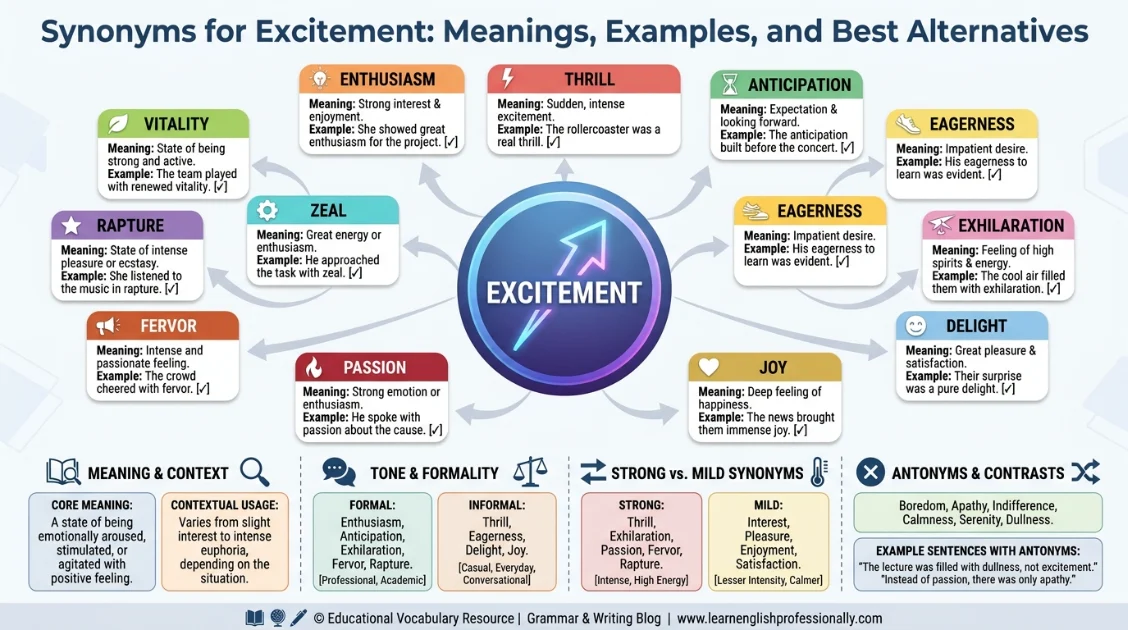
The word excitement can describe almost anything from the anticipation of a big event to the energy of a great conversation. However, repeating the same word in essays, captions, emails, stories, or everyday speech can make your writing feel predictable. Choosing a more precise alternative helps your message sound clearer and more expressive.
The best synonyms for excitement depend on the feeling you want to communicate. A professional email may need enthusiasm, a personal story may call for thrill or exhilaration, while a creative sentence may sound stronger with rapture or fervor. This guide explains the differences so you can choose naturally and confidently.
What Does “Excitement” Mean?
Excitement means a strong feeling of enthusiasm, anticipation, pleasure, or emotional energy. Common alternatives include enthusiasm in formal writing, thrill in casual speech, eagerness for anticipation, exhilaration for intense pleasure, and fervor for passionate expression.
Meaning, Tone and Context
Simple Definition
Excitement is a feeling of strong emotional energy caused by something enjoyable, interesting, surprising, important, or anticipated.
For example, someone may feel excitement before a vacation, a sports game, a graduation ceremony, a job interview, or an important announcement.
Part of Speech
Excitement is a noun.
Example:
“Her excitement was obvious when she opened the gift.”
The related adjective is excited.
Example:
“He was excited about the upcoming concert.”
The related verb is excite.
Example:
“The announcement excited the entire audience.”
The related adjective exciting describes something that creates excitement.
Example:
“It was an exciting opportunity.”
Tone
Excitement usually has a positive and energetic tone. It communicates enthusiasm, anticipation, pleasure, or emotional intensity.
However, context can change the feeling. In some situations, excitement can suggest nervous energy, agitation, or emotional disturbance.
Formality Level
Excitement is a neutral word that works well in both casual and professional communication.
More precise alternatives may sound better in specific situations. For example, enthusiasm works well in professional writing, while thrill is more natural in casual conversation.
Common Use Cases
Excitement commonly appears when discussing:
- Special events
- Personal achievements
- Travel
- Entertainment
- Sports
- Career opportunities
- Academic experiences
- Celebrations
- Romantic experiences
- Creative storytelling
- Social media captions
- Major life changes
When and How to Use “Excitement”
Use excitement when you want to describe a general feeling of strong emotional energy, anticipation, or enthusiasm.
1. Professional Context
“Our team shared a sense of excitement about the new project.”
2. Personal Context
“I could barely contain my excitement when my family surprised me.”
3. Academic Context
“The students showed excitement about the upcoming science competition.”
4. Emotional Context
“She felt genuine excitement when she received the acceptance letter.”
5. Creative Context
“The crowd erupted with excitement as the lights came on.”
6. Social Media Context
“Nothing compares with the excitement of finally reaching this goal.”
7. Casual Conversation
“I am full of excitement for the weekend.”
Another Word for “Excitement”
The best single replacement depends on the exact feeling.
If you need a broadly useful synonym, enthusiasm is one of the strongest choices because it communicates positive energy and interest without sounding overly dramatic.
Here are useful choices by situation:
| Situation | Recommended Word |
|---|---|
| Professional writing | Enthusiasm |
| Academic writing | Eagerness |
| Casual conversation | Thrill |
| Emotional writing | Exhilaration |
| Creative writing | Rapture |
| Resume or workplace use | Enthusiasm |
| Social media captions | Thrill |
| Stronger meaning | Ecstasy |
| Softer meaning | Anticipation |
Professional Writing
Use enthusiasm when describing motivation, interest, or positive energy.
Example:
“I approached the new responsibility with enthusiasm.”
Academic Writing
Use eagerness, interest, or enthusiasm when discussing motivation toward learning or participation.
Example:
“The students demonstrated eagerness to participate in the research project.”
Casual Conversation
Use thrill, buzz, or anticipation depending on the situation.
Example:
“The thrill of seeing the team play live was unforgettable.”
Emotional Writing
Use exhilaration, elation, or delight when you want to express a specific emotional response.
Creative Writing
Use rapture, fervor, or ecstasy when the emotion is unusually intense.
Resume or Workplace Use
Enthusiasm, eagerness, and passion are usually more appropriate than highly emotional words.
Example:
“I bring enthusiasm for collaborative problem solving and continuous learning.”
Social Media Captions
Thrill, joy, buzz, and anticipation can make captions feel more natural and expressive.
Stronger Meaning
Use ecstasy, rapture, or exhilaration when the emotion is exceptionally intense.
Softer Meaning
Use interest, anticipation, eagerness, or pleasure when you want a calmer expression.
When Not to Use “Excitement”
Excitement is useful, but it can sometimes be too broad.
If you specifically mean professional motivation, enthusiasm may be clearer.
Instead of:
“I showed excitement about the position.”
Try:
“I showed enthusiasm for the position.”
If you mean anticipation before an event, anticipation is more precise.
Instead of:
“There was excitement before the announcement.”
Try:
“There was strong anticipation before the announcement.”
If you mean intense happiness after success, elation may communicate the emotion more accurately.
Instead of:
“She felt excitement after winning.”
Try:
“She felt tremendous elation after winning.”
Avoid using highly dramatic words such as ecstasy when the situation involves only mild interest.
Words Commonly Confused With “Excitement”
- Excitement vs. Enthusiasm
Excitement often focuses on emotional energy, while enthusiasm usually emphasizes strong interest or positive motivation.
Excitement vs. Anticipation
Anticipation is the feeling of expecting something. Excitement can include anticipation but may also happen during or after an event.
Excitement vs. Thrill
Thrill usually suggests a strong, pleasurable emotional reaction, often caused by something adventurous, surprising, or intense.
Excitement vs. Exhilaration
Exhilaration is stronger and often describes an intense feeling of happiness, energy, or freedom.
Excitement vs. Eagerness
Eagerness focuses on a strong desire to do or experience something. Excitement focuses more broadly on emotional energy.
Excitement vs. Nervousness
Nervousness involves worry, tension, or uncertainty. Excitement is usually positive, although the two feelings can occur together.
Best Synonym by Context for “Excitement”
| Context | Best Synonym | Why It Works | Example |
|---|---|---|---|
| Formal writing | Enthusiasm | Professional and positive | Her enthusiasm was evident throughout the presentation. |
| Academic writing | Eagerness | Shows motivation to participate or learn | His eagerness to learn improved his performance. |
| Professional use | Enthusiasm | Communicates positive motivation | She brings enthusiasm to every project. |
| Resume | Passion | Shows strong personal commitment | His passion for technology drives his career goals. |
| Casual conversation | Thrill | Natural and expressive | The thrill of the ride was unforgettable. |
| Creative writing | Rapture | Creates intense emotional imagery | She experienced rapture when she heard the music. |
| Emotional writing | Exhilaration | Expresses intense positive emotion | He felt exhilaration after crossing the finish line. |
| Strong intensity | Ecstasy | Indicates an extremely intense feeling | The victory brought the fans to a state of ecstasy. |
| Moderate intensity | Anticipation | Expresses expected pleasure or interest | We waited with anticipation for the results. |
| Social media | Buzz | Sounds lively and conversational | There is a lot of buzz around the new event. |
| Personal writing | Delight | Warm and positive | She opened the package with delight. |
| Business presentation | Fervor | Shows passionate energy | The speaker discussed the initiative with fervor. |
| Storytelling | Thrill | Adds energy and movement | The chase gave the story a thrilling sense of danger. |
| Workplace communication | Eagerness | Shows willingness and motivation | His eagerness to contribute impressed the manager. |
| Celebration | Joy | Simple and emotionally positive | The room was filled with joy. |
| Adventure | Exhilaration | Suggests intense energetic pleasure | Skydiving gave her a feeling of exhilaration. |
Which Synonym Should You Choose?
- Choosing the right synonym is easier when you identify the exact emotion first.
- Choose enthusiasm when you mean strong interest or positive motivation.
- Choose anticipation when someone is looking forward to something that has not happened yet.
- Choose eagerness when the person strongly wants to participate or act.
- Choose thrill when the experience feels exciting, adventurous, surprising, or intensely enjoyable.
- Choose exhilaration when the emotional energy is powerful and uplifting.
- Choose delight when the feeling is warm, pleasant, and joyful.
- Choose fervor when the emotion includes passionate commitment.
- Choose rapture or ecstasy only when the emotional intensity is exceptionally high.
For professional communication, favor precise and credible words such as enthusiasm, eagerness, interest, and passion.
For creative writing, stronger words can add emotional color, but they should match the actual intensity of the scene.
Real Life Examples of “Excitement” in Sentences
School
“The students expressed excitement about the upcoming field trip.”
Workplace
“The announcement created excitement across the entire department.”
Writing
“The author builds excitement by revealing small details throughout the story.”
Conversation
“I cannot hide my excitement about the trip.”
Social Media
“Sharing this achievement with everyone fills me with excitement.”
Resume
“Her enthusiasm for customer service helped strengthen team performance.”
“We are excited to share the latest update with our clients.”
Storytelling
“A sudden wave of excitement swept through the crowd when the performer appeared.”
25 Synonyms for “Excitement”
| Synonym | Simple Meaning | Best Used For | Example Sentence |
|---|---|---|---|
| Enthusiasm | Strong interest and positive energy | Professional and general use | Her enthusiasm for the project inspired the team. |
| Thrill | Strong pleasurable excitement | Casual and adventurous situations | The thrill of the competition kept everyone engaged. |
| Exhilaration | Intense happiness and energy | Emotional and adventurous writing | He felt exhilaration as he reached the summit. |
| Eagerness | Strong desire to do something | Academic and professional contexts | Her eagerness to contribute was clear. |
| Anticipation | Expectation of something enjoyable | Events and future experiences | The audience waited in anticipation. |
| Elation | Very strong happiness | Achievement and success | She felt elation after receiving the award. |
| Delight | Great pleasure or happiness | Personal and warm writing | His face showed genuine delight. |
| Joy | Deep happiness or pleasure | Emotional and general writing | The celebration was filled with joy. |
| Fervor | Intense passion or enthusiasm | Formal and passionate contexts | The supporters spoke with fervor. |
| Zeal | Strong energy and dedication | Professional and purposeful writing | She approached the assignment with zeal. |
| Passion | Strong enthusiasm or devotion | Careers and personal interests | His passion for teaching is obvious. |
| Ardor | Intense enthusiasm or passion | Literary and formal writing | She pursued the goal with ardor. |
| Animation | Lively energy or expression | Speech and personality | He spoke with remarkable animation. |
| Vivacity | Lively and energetic spirit | Descriptive and literary writing | Her vivacity made the gathering more enjoyable. |
| Zest | Energetic enjoyment of life | Personal and positive writing | He approaches every challenge with zest. |
| Keenness | Strong interest or eagerness | Formal and professional contexts | Her keenness to learn impressed the instructor. |
| Gusto | Energetic enjoyment | Informal and expressive writing | They tackled the project with gusto. |
| Rapture | Intense pleasure or delight | Creative and emotional writing | The performance left the audience in rapture. |
| Ecstasy | Extremely intense happiness | Very strong emotional situations | The victory brought the fans to ecstasy. |
| Fascination | Strong interest or attraction | Ideas, subjects, and experiences | Her fascination with astronomy began early. |
| Interest | Curiosity or attention | Neutral and academic contexts | His interest in history grew over time. |
| Buzz | Lively excitement or public interest | Casual and modern communication | There is plenty of buzz around the new product. |
| Stimulation | Something that creates mental or emotional activity | Academic and professional contexts | The discussion provided valuable intellectual stimulation. |
| Arousal | A state of increased emotional or physical activation | Technical and psychological contexts | The music produced emotional arousal in the audience. |
| Stir | A feeling of excitement or public activity | Literary and descriptive contexts | The announcement caused a stir throughout the community. |
Synonym Groups and Usage Differences
Professional vs. Personal Synonyms
Professional writing generally benefits from words such as enthusiasm, eagerness, passion, zeal, and interest.
Personal writing can use more expressive words such as thrill, delight, joy, exhilaration, and anticipation.
The best choice depends on whether the sentence needs credibility, emotional warmth, or dramatic energy.
Formal vs. Conversational Synonyms
For reports, essays, presentations, and formal emails, enthusiasm, eagerness, fervor, and interest can work well.
For texts, conversations, captions, and informal posts, thrill, buzz, joy, zest, and gusto often sound more natural.
Academic Synonyms
Academic writing usually benefits from precision rather than emotional exaggeration.
Use interest, eagerness, enthusiasm, anticipation, or stimulation when discussing learning, research, participation, or intellectual engagement.
Example:
“The students showed strong interest in the research topic.”
This sounds more precise than using a highly emotional word such as ecstasy.
Professional and Business Synonyms
Enthusiasm is usually the safest professional alternative.
Passion can work well when discussing careers, products, missions, or personal commitment.
Eagerness is useful when describing willingness to participate or learn.
Example:
“She demonstrated enthusiasm for developing new client relationships.”
Creative or Literary Synonyms
Creative writing gives you more freedom to choose expressive vocabulary.
Words such as rapture, ardor, exhilaration, vivacity, fervor, and ecstasy can create stronger imagery.
Use these words carefully. A dramatic synonym can make a simple situation sound unrealistic.
Slang or Modern Synonyms
Buzz is a useful modern conversational alternative.
Example:
“There is a lot of buzz surrounding the upcoming concert.”
It works well in social media, marketing, entertainment, and casual conversation.
Avoid using buzz in academic essays or highly formal documents unless you are discussing public attention as a specific concept.
Strongest vs. Weaker Synonyms
A useful intensity scale looks like this:
Mild: Interest, anticipation
Moderate: Eagerness, enthusiasm, delight, joy
Strong: Thrill, passion, fervor, exhilaration
Very strong: Rapture, ecstasy
Intensity should match the situation. Saying that someone felt ecstasy about receiving a routine email would usually sound exaggerated.
Emotional vs. Neutral Synonyms
More emotional choices include joy, delight, thrill, exhilaration, rapture, and ecstasy.
More neutral choices include interest, anticipation, eagerness, and enthusiasm.
Choose emotional words for personal writing and storytelling. Choose neutral words when clarity and professionalism matter most.
Antonyms of “Excitement”
Some opposites are direct emotional contrasts, while others represent a calm or inactive state.
| Antonym | Meaning | Example Sentence |
|---|---|---|
| Boredom | Lack of interest or stimulation | The long lecture caused boredom. |
| Apathy | Lack of interest or concern | His apathy surprised everyone. |
| Indifference | Lack of emotional interest | She responded with indifference. |
| Listlessness | Lack of energy or enthusiasm | The heat left him feeling listlessness. |
| Lethargy | Lack of energy or activity | The illness caused unusual lethargy. |
| Dullness | Lack of interest or liveliness | The presentation suffered from dullness. |
| Ennui | A feeling of boredom and dissatisfaction | He struggled with ennui during the quiet afternoon. |
| Disinterest | Lack of interest | Her disinterest was obvious during the discussion. |
| Calmness | A peaceful emotional state | She maintained calmness before the interview. |
| Serenity | A deeply peaceful state | The quiet garden gave him a sense of serenity. |
| Tranquility | A state of peace and quiet | The lake offered complete tranquility. |
| Stillness | Lack of movement or activity | The room fell into stillness after the announcement. |
| Passivity | Lack of active involvement | His passivity limited his participation. |
| Composure | Calm control of emotions | She maintained her composure under pressure. |
| Unconcern | Lack of worry or emotional involvement | His unconcern seemed surprising given the circumstances. |
Comparison: “Excitement” vs. Similar Words
Excitement vs. Enthusiasm
Main difference: Excitement focuses on emotional energy, while enthusiasm emphasizes strong interest or positive motivation.
Stronger: Excitement can be stronger emotionally.
More formal: Enthusiasm is often more suitable for professional writing.
Examples:
“The children showed excitement before the trip.”
“She approached the project with enthusiasm.”
Excitement vs. Anticipation
Main difference: Anticipation focuses on expecting something, while excitement can occur before, during, or after an event.
Stronger: Excitement is generally more emotionally intense.
More formal: Anticipation often sounds slightly more polished in formal writing.
Examples:
“We waited with anticipation for the results.”
“The announcement created excitement throughout the office.”
Excitement vs. Thrill
Main difference: Thrill suggests a particularly strong and pleasurable reaction.
Stronger: Thrill is often stronger than ordinary excitement.
More formal: Excitement is more neutral.
Examples:
“The children felt excitement about the celebration.”
“The roller coaster gave everyone a powerful thrill.”
Excitement vs. Exhilaration
Main difference: Exhilaration describes an intense feeling of happiness, energy, and freedom.
Stronger: Exhilaration is usually stronger.
More formal: Exhilaration can sound more sophisticated in descriptive writing.
Examples:
“She felt excitement before the race.”
“She felt exhilaration after completing the race.”
Excitement vs. Eagerness
Main difference: Eagerness emphasizes a strong desire to do something, while excitement describes emotional energy more generally.
Stronger: Excitement is usually more emotionally expressive.
More formal: Eagerness works especially well in professional and academic contexts.
Examples:
“He showed excitement about the opportunity.”
“He showed eagerness to take on the responsibility.”
Excitement vs. Joy
Main difference: Joy describes happiness, while excitement emphasizes energy, anticipation, or stimulation.
Stronger: Either can be stronger depending on context.
More formal: Both are neutral, but joy often feels more emotional.
Examples:
“She felt excitement before the ceremony.”
“She felt deep joy after seeing her family.”
Common Phrases and Expressions with “Excitement”
1. A Sense of Excitement
Meaning:
A general feeling of anticipation, energy, or emotional enthusiasm.
Example sentence:
“There was a strong sense of excitement throughout the stadium.”
2. Full of Excitement
Meaning:
Feeling extremely enthusiastic or emotionally energized.
Example sentence:
“The children were full of excitement before the holiday.”
3. A Wave of Excitement
Meaning:
A sudden or powerful feeling of excitement.
Example sentence:
“A wave of excitement swept through the audience.”
4. Build Excitement
Meaning:
To gradually increase interest and anticipation.
Example sentence:
“The campaign was designed to build excitement before the launch.”
5. Create Excitement
Meaning:
To cause people to feel interested, enthusiastic, or energized.
Example sentence:
“The announcement created excitement among customers.”
6. Contain Your Excitement
Meaning:
To control or hide a strong feeling of enthusiasm.
Example sentence:
“She could hardly contain her excitement after hearing the news.”
7. With Excitement
Meaning:
In an enthusiastic or emotionally energized manner.
Example sentence:
“He opened the package with excitement.”
8. Excitement Builds
Meaning:
The feeling of anticipation becomes stronger over time.
Example sentence:
“As the concert date approached, the excitement built among fans.”
Common Mistakes to Avoid
1. Using Excitement When a More Precise Word Works Better
“Excitement” is broad. If you specifically mean anticipation, enthusiasm, or joy, use that more precise word.
2. Confusing Excitement With Anticipation
Anticipation usually happens while waiting for something. Excitement can happen at many stages of an experience.
3. Using Casual Vocabulary in Formal Writing
Words such as buzz may work in marketing or casual communication but can sound inappropriate in formal academic writing.
4. Using an Overly Dramatic Synonym
Words such as ecstasy and rapture are extremely strong. Avoid them when describing ordinary positive experiences.
5. Repeating Excitement Too Often
If the same word appears repeatedly, vary it with appropriate choices such as enthusiasm, anticipation, thrill, eagerness, or delight.
6. Choosing the Wrong Emotional Tone
Thrill suggests intensity, while interest is much calmer. Make sure the synonym matches the actual feeling.
7. Using Slang in Academic or Professional Writing
Modern expressions can make a sentence sound casual. Choose conventional vocabulary when writing essays, reports, resumes, or formal emails.
FAQs
What is the best synonym for excitement?
The best synonym depends on context. Enthusiasm works well professionally, anticipation fits future events, while thrill and exhilaration express stronger emotional energy.
What is a formal synonym for excitement?
Enthusiasm is one of the best formal alternatives. Eagerness, anticipation, interest, and fervor can also work when their specific meanings fit.
What is an informal synonym for excitement?
Thrill and buzz are useful informal choices. Joy and zest can also work naturally in casual conversations and social media captions.
What is another word for excitement in professional writing?
Enthusiasm is usually the strongest professional choice. Eagerness, passion, and interest may work when describing motivation, commitment, or engagement.
What is the difference between excitement and anticipation?
Anticipation describes the feeling of expecting something, while excitement is broader and can describe emotional energy before, during, or after an event.
What is the opposite of excitement?
Common opposites include boredom, apathy, indifference, listlessness, dullness, and calmness. The best choice depends on whether you mean low interest or peaceful emotion.
Conclusion
Excitement describes a strong feeling of enthusiasm, anticipation, pleasure, or emotional energy. The best synonym changes with the situation. Use enthusiasm for professional communication, anticipation for expected events, eagerness for motivation, thrill for intense enjoyment, and exhilaration for powerful positive emotion.
The key is precision. A good synonym should match both the meaning and the emotional intensity of your sentence. Before replacing excitement, identify what you actually want the reader to feel.
For everyday writing, start with simple choices such as enthusiasm, anticipation, eagerness, delight, and thrill. For creative writing, stronger options such as fervor, rapture, or exhilaration can add depth when the situation truly deserves them.
A practical vocabulary tip is to avoid choosing synonyms only because they sound impressive. Choose the word that communicates your exact meaning most naturally.
Discover More Post:
- 25+ Synonyms for Affect | Meanings, Examples, and Best …
- 25+ Synonyms for Achieve | Meanings, Examples, and Best …
- 25+ Synonyms for Real | Meanings, Examples, and Best …