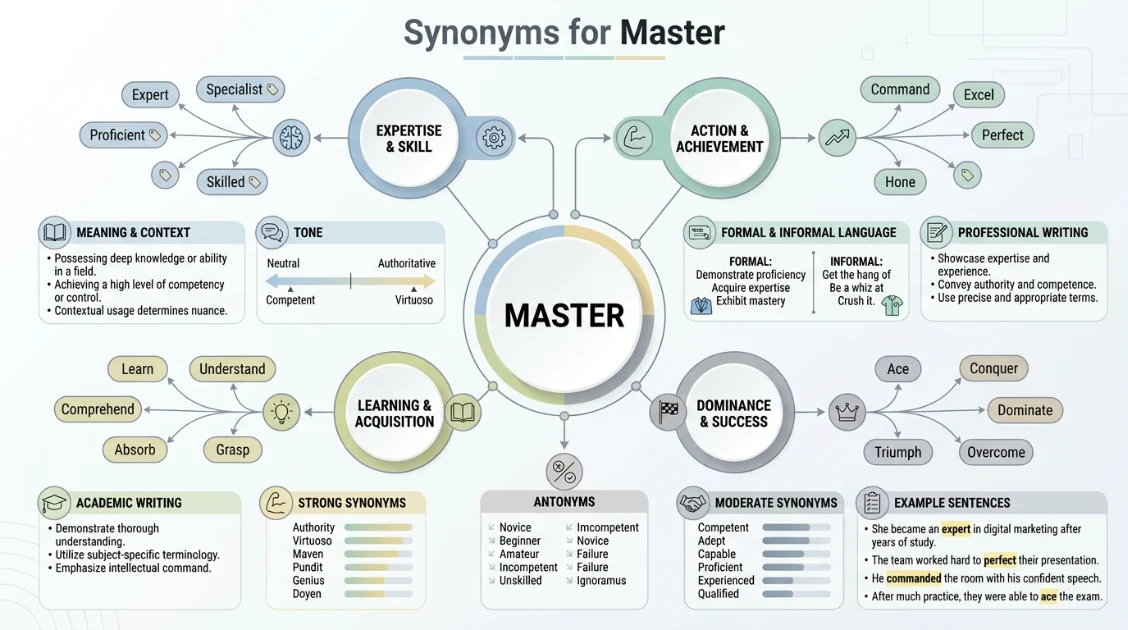
The word master can make your writing sound powerful, but repeating it in an essay, resume, email, caption, or conversation can make your vocabulary feel limited. A person can master a skill, become a master of a craft, or gain complete control over something.
The best replacement depends on what you actually mean. Words such as expert, specialist, learn, command, excel, conquer, ace, and perfect can create a more precise message. This guide explains synonyms for master by meaning, tone, formality, intensity, and real world usage so you can choose the right word naturally.
What Does “Master” Mean?
Master can mean to become highly skilled at something, understand it completely, or gain control over it. Depending on context, strong alternatives include expert, specialist, command, excel, learn, perfect, ace, and conquer.
Meaning, Tone and Context
Simple Definition
The word master has several important meanings.
As a verb, master means to learn or understand something extremely well. It can also mean to gain control over a difficult task, subject, skill, or situation.
Example:
She mastered the piano after years of dedicated practice.
As a noun, master can describe a person with exceptional skill or knowledge in a particular field.
Example:
He is a master of classical photography.
The word can also refer to someone who has authority or control in certain historical, social, or technical contexts.
Part of Speech
Master can function as a verb, noun, adjective, and occasionally part of a compound expression.
- As a verb:
She mastered the technique quickly.
- As a noun:
He became a master of woodworking.
- As an adjective:
She prepared a master copy of the document.
Tone and Formality
The tone of master depends heavily on the context.
When describing skill, it usually sounds positive and complimentary.
When describing control or authority, the tone can be neutral, historical, technical, or sensitive depending on the situation.
In professional writing, master can be useful, but words such as expert, specialist, proficient, or highly skilled may sound more precise.
Common Use Cases
You commonly see master when discussing:
- Skills and abilities
- Academic subjects
- Art and creative work
- Technology
- Professional expertise
- Personal development
- Leadership and control
- Crafts and traditional disciplines
Related Word Forms
Common related forms include:
Mastery: exceptional knowledge or skill.
Masterful: showing great skill or expertise.
Masterfully: in a highly skilled manner.
Expert: a person with advanced knowledge or ability.
Novice: a person who has limited experience.
When and How to Use “Master”
Use master when you want to emphasize a high level of knowledge, ability, control, or accomplishment.
It works especially well when the subject requires significant practice or learning.
1. Professional
She mastered the new software within a few weeks.
2. Personal
He finally mastered the art of making homemade pasta.
3. Academic
The students worked hard to master the concepts before the final exam.
4. Emotional
Learning to master his frustration helped him communicate more calmly.
5. Creative
The painter mastered the use of light and shadow.
6. Social Media
Finally mastered this recipe after three attempts.
7. Email
I have mastered the basic reporting process and can now handle the task independently.
Another Word for “Master”
The best single replacement depends on the meaning of master.
- If you mean a highly skilled person, expert is usually the clearest choice.
- If you mean learning something thoroughly, learn or perfect may work better.
- If you mean having strong control or understanding, command is often more precise.
Here are useful choices by context:
| Context | Recommended Word |
|---|---|
| Professional writing | Expert |
| Academic writing | Comprehend |
| Casual conversation | Learn |
| Emotional writing | Overcome |
| Creative writing | Perfect |
| Resume or workplace use | Proficient |
| Social media captions | Ace |
| Stronger meaning | Conquer |
| Softer meaning | Understand |
When Not to Use “Master”
Avoid master when it makes a sentence sound unnecessarily dramatic or vague.
For example:
She mastered the basic email system.
This is possible, but learned may be more natural if the system is simple.
A more precise version is:
She learned the basic email system.
Similarly, saying someone mastered a skill after one short lesson can exaggerate their actual ability.
Use master when the person has achieved a genuinely high level of skill, understanding, or control.
Words Commonly Confused With “Master”
- Master vs. Expert
Master can describe exceptional skill, while expert usually describes someone with extensive knowledge or ability.
She mastered the technique.
She is an expert in the technique.
Master vs. Learn
Learn means gaining knowledge or ability. Master suggests a much higher level of competence.
He learned Spanish in college.
He mastered Spanish after years of study.
Master vs. Understand
Understand focuses on comprehension. Master suggests deep understanding combined with effective ability.
I understand the concept.
I mastered the concept through extensive practice.
Master vs. Perfect
Perfect means making something as complete, accurate, or polished as possible. Master emphasizes exceptional skill or command.
She perfected her presentation.
She mastered public speaking.
Master vs. Control
Control means directing or managing something. Master can suggest gaining strong control through knowledge or skill.
He controls the machine.
He mastered the machine’s advanced functions.
Master vs. Excel
Excel means performing exceptionally well. Master emphasizes complete or advanced command.
She excels at mathematics.
She mastered advanced mathematics.
Best Synonym by Context for “Master”
| Context | Best Synonym | Why It Works | Example |
|---|---|---|---|
| Formal writing | Command | Shows strong knowledge or control | She commands a deep understanding of the subject. |
| Academic writing | Comprehend | Emphasizes complete understanding | Students must comprehend the core concepts. |
| Professional use | Expert | Clearly communicates advanced ability | He is an expert in data analysis. |
| Resume | Proficient | Sounds precise and professional | Proficient in several design programs. |
| Casual conversation | Learn | Natural and conversational | I am still learning how to cook. |
| Creative writing | Perfect | Highlights refined skill | She perfected her technique over time. |
| Emotional writing | Overcome | Suggests defeating a personal challenge | He overcame his fear of public speaking. |
| Strong intensity | Conquer | Suggests overcoming something difficult | She conquered one of her biggest challenges. |
| Moderate tone | Develop | Suggests gradual improvement | He developed strong communication skills. |
| Social media | Ace | Informal and energetic | I finally aced this recipe. |
| Business | Specialize | Highlights focused professional ability | She specializes in financial planning. |
| Technical writing | Command | Communicates advanced technical knowledge | The engineer commands extensive technical knowledge. |
| Education | Understand | Clear and accessible | Students need to understand the material. |
| Leadership | Direct | Emphasizes authority and management | She directs the team effectively. |
| Skill development | Hone | Emphasizes improvement through practice | He honed his writing skills. |
| Art | Excel | Highlights exceptional performance | She excels in portrait painting. |
| Craft | Perfect | Highlights refinement | He perfected his woodworking technique. |
| US usage | Expert | Common and widely understood | She is an expert in marketing. |
| UK usage | Expert | Equally natural and widely understood | He is an expert in engineering. |
Which Synonym Should You Choose?
Choosing the best synonym for master starts with identifying the exact meaning.
- If you are describing a person with exceptional knowledge, choose expert or specialist.
- If you are describing learning, choose learn, understand, or comprehend, depending on how advanced the learning is.
- If you want to emphasize improvement, hone, develop, or perfect may be better.
- If you want to communicate exceptional performance, choose excel or ace.
- For professional writing, prioritize precise words such as expert, proficient, specialist, command, and specialize.
- For casual communication, learn, ace, and get the hang of can sound more natural.
- For emotional or motivational writing, overcome and conquer can create stronger energy, but use them only when the situation truly involves a challenge.
Real Life Examples of “Master” in Sentences
School
Maya worked consistently to master the difficult algebra concepts.
Workplace
Daniel mastered the company’s reporting system after several training sessions.
Writing
The author mastered the art of creating realistic dialogue.
Conversation
I am trying to master conversational French before my trip.
Social Media
After months of practice, I finally mastered this recipe.
Resume
Mastered advanced spreadsheet functions to improve monthly reporting efficiency.
I have mastered the basic process and am ready to take on more complex assignments.
Storytelling
Years of patience allowed the young artist to master a technique once considered impossible.
25 Synonyms for “Master”
| Synonym | Simple Meaning | Best Used For | Example Sentence |
|---|---|---|---|
| Expert | A highly skilled person | Professional ability | She is an expert in digital marketing. |
| Specialist | Someone focused on a particular field | Professional and technical contexts | He is a specialist in cybersecurity. |
| Proficient | Skilled and capable | Resumes and professional writing | She is proficient in advanced Excel functions. |
| Skilled | Having strong ability | General professional use | He is highly skilled at repairing complex equipment. |
| Accomplished | Very successful or capable | Formal and professional writing | She is an accomplished pianist. |
| Adept | Highly capable at something | Formal writing | He is adept at solving difficult problems. |
| Talented | Naturally capable or gifted | Creative and personal contexts | She is a talented photographer. |
| Learn | To gain knowledge or ability | General learning | He learned the software quickly. |
| Understand | To grasp meaning or concepts | Academic and everyday use | Students must understand the core principles. |
| Comprehend | To understand thoroughly | Academic and formal writing | Researchers must comprehend the available evidence. |
| Command | To possess strong knowledge or control | Formal and professional use | She commands an impressive knowledge of finance. |
| Perfect | To improve something until highly polished | Skills and creative work | He perfected his presentation style. |
| Hone | To improve through practice | Skills and professional development | She honed her leadership skills. |
| Excel | To perform exceptionally well | Academic and professional contexts | He excels at strategic planning. |
| Specialize | To focus deeply on one field | Career and professional writing | She specializes in pediatric nutrition. |
| Develop | To build ability over time | Learning and professional growth | He developed strong negotiation skills. |
| Cultivate | To deliberately develop a quality or ability | Formal and creative writing | She cultivated a deep understanding of classical literature. |
| Acquire | To gain knowledge or skill | Academic and formal contexts | Students acquire new skills through practice. |
| Attain | To reach a desired level | Formal writing | He attained a high level of technical expertise. |
| Achieve | To successfully reach a goal | Professional and general writing | She achieved advanced proficiency in French. |
| Conquer | To overcome something difficult | Motivational and emotional writing | He conquered his fear of public speaking. |
| Overcome | To successfully deal with a challenge | Emotional and personal writing | She overcame her uncertainty and presented confidently. |
| Ace | To perform extremely well | Informal and conversational use | I aced the certification exam. |
| Dominate | To perform far better than others or control something | Competitive contexts | The team dominated the competition. |
| Handle | To manage something successfully | Casual and professional contexts | She can handle complex customer requests with confidence. |
Synonym Groups and Usage Differences
Professional vs. Personal Synonyms
Professional writing usually benefits from precise terms such as expert, specialist, proficient, adept, command, and specialize.
Personal writing can be more flexible. Words such as learn, develop, improve, perfect, and overcome often sound natural when describing personal growth.
Compare:
She mastered data analysis.
She became proficient in data analysis.
The second version may be more suitable for a resume because it communicates ability without sounding exaggerated.
Formal vs. Conversational Synonyms
Formal writing favors words such as comprehend, attain, acquire, command, and cultivate.
Conversational writing usually sounds more natural with learn, understand, handle, ace, or get the hang of.
For example:
Students must comprehend the underlying principles.
A casual alternative is:
Students need to understand the main ideas.
Academic Synonyms
Academic writing should favor precision over dramatic language.
Useful choices include comprehend, acquire, attain, command, develop, and understand.
Instead of:
Students must master every detail.
Consider:
Students must demonstrate a thorough understanding of the key concepts.
The second sentence makes a more specific academic claim.
Professional and Business Synonyms
For workplace communication, expert, proficient, specialist, skilled, adept, command, and specialize are particularly useful.
Resume writing should focus on measurable ability whenever possible.
Instead of:
Mastered customer service.
Try:
Developed advanced customer service skills and consistently handled complex client requests.
This gives the reader more information about the actual ability.
Creative or Literary Synonyms
Creative writing allows stronger and more expressive choices.
Perfect, conquer, cultivate, hone, excel, and accomplished can add depth depending on the sentence.
For example:
Years of practice honed her ability to capture emotion through color.
This sounds more descriptive than simply saying:
She mastered painting.
Slang or Modern Synonyms
Ace is an informal alternative that works well in casual speech, social media, and friendly writing.
Example:
I totally aced the interview.
It is usually too casual for academic essays, formal reports, and many professional documents.
Strongest vs. Weaker Synonyms
A useful intensity scale can help you choose the right word.
Mild: Learn
Mild to moderate: Understand
Moderate: Develop
Moderate to strong: Become proficient
Strong: Excel
Very strong: Perfect
Very strong and dramatic: Master
Strong and motivational: Conquer
The best choice depends on what actually happened. Stronger language should reflect stronger evidence.
Emotional vs. Neutral Synonyms
Neutral terms include learn, understand, develop, acquire, and proficient.
More emotional choices include overcome, conquer, perfect, and ace.
For factual professional communication, neutral vocabulary is usually safer.
For motivational writing, emotional vocabulary can create more energy.
Antonyms of “Master”
Because master has several meanings, its opposites vary by context.
| Antonym | Meaning | Example Sentence |
|---|---|---|
| Beginner | Someone new to a skill | She is still a beginner at photography. |
| Novice | A person with little experience | He is a novice programmer. |
| Amateur | Someone without professional level expertise | She is an amateur painter. |
| Learner | Someone still gaining knowledge | He is a language learner. |
| Student | A person receiving instruction | She is a student of classical music. |
| Unskilled | Lacking developed ability | The worker was unskilled in the procedure. |
| Inexperienced | Having limited practical experience | He is inexperienced with the software. |
| Ignorant | Lacking knowledge about something | He was ignorant of the technical requirements. |
| Unfamiliar | Not knowing or recognizing something well | I am unfamiliar with that system. |
| Misunderstand | To understand incorrectly | They misunderstood the instructions. |
| Fail | To not succeed at a task | She failed to complete the challenge. |
| Surrender | To give up control | The leader surrendered control of the project. |
| Submit | To yield to authority or control | The organization submitted to outside oversight. |
| Neglect | To fail to give proper attention | He neglected his training for several months. |
| Abandon | To give up completely | She abandoned the skill before developing confidence. |
Comparison: “Master” vs. Similar Words
Master vs. Expert
Main difference: Master can describe exceptional skill or the process of gaining it. Expert usually describes a person with advanced knowledge.
Stronger: Master often suggests a higher degree of achievement.
More formal: Expert is generally straightforward and professional.
Examples:
She mastered advanced statistics.
She is an expert in statistics.
Master vs. Proficient
Main difference: Proficient means capable and skilled. Master often suggests exceptional or complete command.
Stronger: Master.
More professional for resumes: Proficient.
Examples:
He mastered the software.
He is proficient in the software.
Master vs. Skilled
Main difference: Skilled simply means having developed ability.
Stronger: Master.
More general: Skilled.
Examples:
She is skilled at negotiation.
She mastered advanced negotiation techniques.
Master vs. Learn
Main difference: Learn describes the process of gaining knowledge or ability. Master suggests reaching a very high level.
Stronger: Master.
More basic: Learn.
Examples:
He learned the program quickly.
He mastered the program after extensive practice.
Master vs. Excel
Main difference: Excel means performing exceptionally well. Master emphasizes complete knowledge or command.
Stronger for expertise: Master.
Stronger for performance: Excel.
Examples:
She excels at public speaking.
She mastered the techniques of public speaking.
Master vs. Perfect
Main difference: Perfect emphasizes refinement and improvement. Master emphasizes high level skill or command.
Stronger for refinement: Perfect.
Stronger for expertise: Master.
Examples:
He perfected his presentation.
He mastered public speaking.
Common Phrases and Expressions with “Master”
1. Master a Skill
Meaning:
To become highly skilled at a particular ability.
Example sentence:
She practiced every morning to master the skill.
2. Master the Art of Something
Meaning:
To become extremely skilled at a creative or specialized activity.
Example sentence:
He spent years mastering the art of storytelling.
3. Master the Basics
Meaning:
To become comfortable with fundamental principles before progressing.
Example sentence:
Beginners should master the basics before attempting advanced techniques.
4. Master the Technique
Meaning:
To become highly capable at using a particular method.
Example sentence:
The dancer practiced daily to master the technique.
5. Master the Subject
Meaning:
To gain extensive knowledge of a particular academic subject.
Example sentence:
Consistent study helped her master the subject.
6. Master Your Emotions
Meaning:
To develop strong control over emotional reactions.
Example sentence:
Meditation helped him master his emotions during stressful situations.
7. Master the Process
Meaning:
To become highly capable of completing a process correctly.
Example sentence:
After several weeks of training, she mastered the process.
Common Mistakes to Avoid
1. Using “Master” When a More Precise Word Is Better
Not every learning experience requires master.
Instead of:
I mastered the new software yesterday.
Use:
I learned the new software yesterday.
The second sentence is more believable if you only became familiar with the basics.
2. Confusing Master With Expert
Master can describe a level of skill, while expert usually describes a person.
Instead of:
She is a master in accounting.
A natural professional choice is:
She is an expert in accounting.
3. Using a Casual Synonym in Formal Writing
Words such as ace can sound too informal in academic or professional contexts.
Instead of:
He aced the presentation.
Use:
He delivered an excellent presentation.
4. Using an Overly Dramatic Synonym
Conquer can sound exaggerated when the challenge is ordinary.
Instead of:
She conquered the spreadsheet.
Use:
She became proficient with the spreadsheet.
5. Repeating “Master” Too Often
Repeated use can make your writing sound predictable.
Instead of:
He mastered coding, mastered design, and mastered marketing.
Use:
He developed strong coding, design, and marketing skills.
6. Choosing the Wrong Emotional Tone
Conquer and overcome carry emotional energy.
They may be inappropriate when you simply want to describe ordinary learning.
Choose neutral terms such as learn, understand, develop, or acquire when emotional emphasis is unnecessary.
7. Using Slang in Academic or Professional Writing
Ace works well in casual communication but may weaken the tone of a formal essay or business document.
Choose excel, perform well, achieve, or demonstrate proficiency instead.
FAQs
What is the best synonym for “master”?
The best synonym depends on meaning. Expert works for a highly skilled person, while perfect, command, excel, and proficient work for different skill related contexts.
What is a formal synonym for “master”?
Command, comprehend, attain, acquire, proficient, and specialist can provide formal alternatives, depending on whether you mean knowledge, ability, or expertise.
What is an informal synonym for “master”?
Ace is a useful informal synonym when someone performs extremely well. Learn and get the hang of can also work in casual conversations.
What is another word for “master” in professional writing?
Expert, specialist, proficient, adept, and skilled are strong professional alternatives. Choose the word that accurately reflects the person’s actual level of ability.
What is the difference between “master” and “expert”?
Master often emphasizes an exceptional level of skill or the process of achieving it. Expert usually describes someone recognized for advanced knowledge or ability.
What is the opposite of “master”?
Depending on the meaning, opposites include beginner, novice, amateur, learner, unskilled, inexperienced, and unfamiliar. The correct choice depends on the sentence.
Conclusion
The word master can describe exceptional skill, deep understanding, or strong control. However, the best alternative depends on what you want your sentence to communicate.
For professional writing, choose expert, specialist, proficient, adept, or skilled. For academic contexts, understand, comprehend, acquire, and command can offer greater precision. Creative or emotional writing, perfect, hone, overcome, and conquer can add stronger expression.
When choosing among synonyms for master, focus on meaning first and tone second. A precise synonym is usually more effective than simply choosing a stronger sounding word.
Discover More Post:
- 25+ Synonyms for Affect | Meanings, Examples, and Best …
- 25+ Synonyms for Achieve | Meanings, Examples, and Best …
- 25+ Synonyms for Real | Meanings, Examples, and Best …