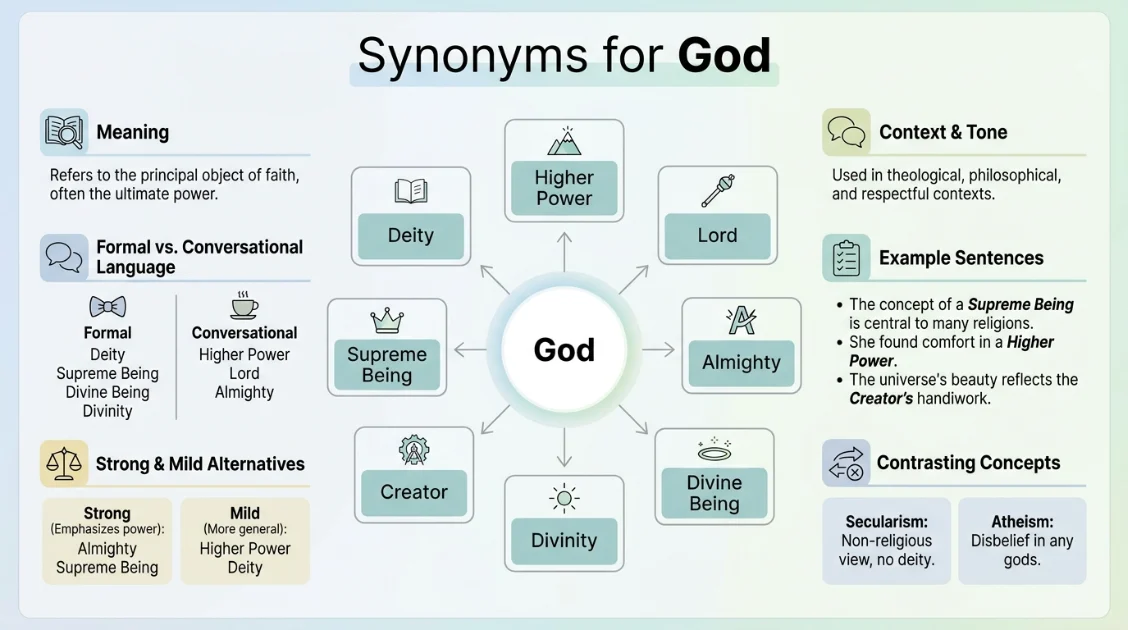
The word God carries enormous meaning, but repeating it throughout an essay, speech, story, caption, or personal reflection can make your writing feel limited. The right alternative can add precision, respect, emotion, or a specific theological meaning.
This guide to synonyms for God explains which words are genuinely interchangeable and which are better understood as titles, descriptions, or names used within particular religious traditions. You will also find practical examples, context based recommendations, comparisons, and common mistakes.
What Does “God” Mean?
God generally refers to a supreme divine being, especially the one worshiped in monotheistic traditions. Depending on context, useful alternatives include deity, Supreme Being, Creator, Lord, Almighty, Divine Being, and Higher Power.
Meaning, Tone and Context
1. Simple Definition
God commonly refers to a supreme being believed to have divine power, authority, knowledge, or creative ability.
In monotheistic religions, God generally refers to one supreme deity. In other contexts, the word can refer to a particular deity within a polytheistic or mythological tradition.
2. Part of Speech
God is primarily a noun.
Example:
Many people pray to God for guidance.
The word can also appear in compounds and expressions, depending on the context.
3. Tone
The tone depends heavily on capitalization and context.
God with a capital G commonly refers to the one supreme deity in a monotheistic religious context. god with a lowercase g can refer to a deity in general or a specific deity in mythology or polytheistic traditions.
4. Formality Level
God is a standard word rather than an inherently formal or informal term.
Words such as Supreme Being, Deity, and Divine Being may sound more formal or academic. Words such as Higher Power can sound more general or conversational.
5. Common Use Cases
God commonly appears in:
- Religious writing
- Theology
- Personal reflections
- Prayers
- Literature
- Poetry
- Speeches
- Philosophy
- Historical writing
- Everyday expressions
6. Related Word Forms
There is no simple adjective, noun, and verb family that works exactly like many ordinary vocabulary words.
Related terms include divine, divinity, godly, godhood, and deity. Their meanings and grammatical uses differ, so they should not automatically replace God.
When and How to Use “God”
The word God is appropriate when you are directly discussing the supreme deity in a religious, philosophical, literary, or personal context.
Professional or Academic
The paper examines how different cultures understand God and divine authority.
Personal
She believes that God gives her strength during difficult times.
Religious
The prayer asks God for wisdom and peace.
Emotional
He turned to God during one of the hardest periods of his life.
Creative
In the poem, God represents hope beyond human understanding.
Social Media
Grateful to God for another beautiful day.
Casual Conversation
Thank God everything worked out.
Another Word for “God”
There is no single replacement that works perfectly in every sentence. The best choice depends on whether you mean a supreme deity, a specific religious name, a theological title, or a general spiritual concept.
| Context | Recommended Alternative |
|---|---|
| Professional writing | Supreme Being |
| Academic writing | Deity |
| Casual conversation | Higher Power |
| Emotional writing | Lord |
| Creative writing | Divine |
| Workplace or formal reflection | Creator |
| Social media captions | Higher Power |
| Strong theological meaning | Almighty |
| Softer spiritual meaning | Higher Power |
Best General Replacement
Deity is often the safest general alternative when you mean a divine being. However, it does not always carry exactly the same meaning as the capitalized God used in monotheistic theology.
When Not to Use “God”
Using God may be inappropriate when you need a more precise theological or academic term.
For example:
The ancient people worshiped God.
This can be vague if the discussion concerns several different deities.
A more precise sentence would be:
The ancient people worshiped a particular deity associated with fertility.
Likewise, using a tradition specific name without knowing the religious context can create an inaccurate or insensitive statement.
Words Commonly Confused With “God”
Deity
Deity is a broad term for a god or divine being. It is useful in academic, historical, and comparative religious writing.
Divine
Divine is usually an adjective or noun referring to something associated with a god or divinity. It does not always function as a direct replacement for God.
Lord
Lord can be a religious title for God, but it can also refer to a human nobleman or ruler. Context determines its meaning.
Creator
Creator emphasizes the belief that God created the universe or existence. It highlights a specific attribute rather than simply naming God.
Higher Power
Higher Power is a broad spiritual expression. It can refer to God, another conception of divinity, or a spiritual force without specifying a particular theology.
Divinity
Divinity can refer to the state or nature of being divine, or to a divine being. It is more abstract than God in many contexts.
Best Synonym by Context for “God”
| Context | Best Synonym | Why It Works | Example |
|---|---|---|---|
| Formal writing | Supreme Being | Clearly expresses supreme divine status | The philosopher discusses belief in a Supreme Being. |
| Academic writing | Deity | Neutral and widely useful in religious studies | The text describes the deity as a creator figure. |
| Professional use | Creator | Respectful and clear in suitable contexts | Many traditions describe God as the Creator. |
| Resume or workplace | Higher Power | Useful only when personal spirituality is relevant | She credits a Higher Power for helping her persevere. |
| Casual conversation | Higher Power | Broad and conversational | He believes a Higher Power guided him. |
| Creative writing | Divine | Adds literary and spiritual depth | The character searched for a sign of the Divine. |
| Emotional writing | Lord | Can convey devotion and reverence | She prayed to the Lord for strength. |
| Strong intensity | Almighty | Emphasizes unlimited power | The prayer praises the Almighty. |
| Soft or moderate tone | Higher Power | Avoids specifying a particular theology | He placed his trust in a Higher Power. |
| Social media captions | Creator | Short and expressive | Thankful to the Creator for this beautiful morning. |
| Comparative religion | Deity | Helps distinguish among religious beings | Each culture described the deity differently. |
| Theology | Godhead | Refers to divine nature or essence in specific theological contexts | The discussion examines the nature of the Godhead. |
Which Synonym Should You Choose?
Start with the exact meaning you want to communicate.
If you mean a divine being in general, use deity. If you want to emphasize creation, Creator may be more appropriate.
- For academic or comparative religious writing, deity is usually more neutral. For devotional writing, words such as Lord or Almighty may communicate reverence more effectively.
- For broad spiritual language, Higher Power can work well because it does not necessarily identify a particular religious tradition.
- For creative writing, Divine, Maker, or Sovereign can create a more literary tone, depending on the sentence.
Always consider the religious tradition involved. Names and titles that appear similar are not necessarily interchangeable.
Real Life Examples of “God” in Sentences
School
The essay explains how different cultures understand God and creation.
Workplace
Her personal faith in God helped her remain hopeful during a difficult period.
Writing
The author presents God as a symbol of justice and mercy.
Conversation
She said that she trusts God to guide her decisions.
Social Media
Thankful to God for every blessing in my life.
I am grateful to God and to everyone who supported my family.
Storytelling
The character prayed to God before making the difficult journey.
Creative Writing
He looked toward the sky and wondered whether God had heard his prayer.
25 Synonyms for “God”
The following list includes direct general alternatives, theological titles, descriptive terms, and tradition specific names. They should not all be treated as interchangeable in every religious context.
| Synonym | Simple Meaning | Best Used For | Example Sentence |
|---|---|---|---|
| Deity | A divine being | Academic and general writing | The ancient deity was associated with the sea. |
| Supreme Being | The highest divine being | Formal and philosophical writing | The philosopher argued for belief in a Supreme Being. |
| Divine Being | A being considered divine | Formal religious discussion | The text describes a Divine Being who creates life. |
| Creator | One who creates existence | Religious and philosophical writing | Many believers refer to God as the Creator. |
| Lord | A title expressing divine authority | Devotional and religious writing | She prayed to the Lord for guidance. |
| Almighty | One possessing unlimited power | Religious and devotional writing | The prayer praises the Almighty. |
| Maker | One who makes or creates | Literary and religious writing | The poem calls God the Maker of all things. |
| Sovereign | Supreme ruler or authority | Theological and literary writing | The hymn describes God as the divine Sovereign. |
| Divine | Relating to God or divinity | Literary and spiritual writing | The story explores the mystery of the Divine. |
| Divinity | Divine nature or a divine being | Academic and theological writing | The book examines ideas about divinity. |
| Higher Power | A greater spiritual power | General spiritual language | She placed her trust in a Higher Power. |
| Godhead | Divine nature or essence | Specific theological contexts | The theologian wrote about the nature of the Godhead. |
| Providence | Divine guidance or care | Religious and philosophical writing | He believed that Providence guided his life. |
| Father | A title for God in some traditions | Christian devotional contexts | The prayer addresses God as Father. |
| Yahweh | A Hebrew name associated with God | Biblical and Jewish studies | The passage discusses the name Yahweh. |
| Jehovah | A traditional English form associated with the divine name | Some Christian contexts | The hymn uses the name Jehovah. |
| Elohim | A Hebrew term used for God in the Hebrew Bible | Biblical studies | The scholar examined the use of Elohim in the passage. |
| Adonai | A Hebrew title meaning Lord | Jewish religious and biblical contexts | The prayer uses Adonai as a respectful title. |
| Allah | Arabic word for God | Islamic contexts and Arabic usage | Muslims worship Allah as the one God. |
| Brahman | Ultimate reality in many Hindu philosophical traditions | Hindu philosophy | The text explores Brahman as ultimate reality. |
| Ishvara | A term for a personal or supreme divine being in some Hindu traditions | Hindu philosophy | The discussion considers Ishvara within Hindu thought. |
| Supreme Deity | Highest divine being | Comparative religion | The myth presents the figure as the supreme deity. |
| Divine Creator | A creator understood as divine | Religious and philosophical writing | The passage describes a Divine Creator. |
| Heavenly Father | A devotional title for God | Christian devotional contexts | The prayer addresses the Heavenly Father. |
| Universal Spirit | A spiritual concept associated with an all encompassing divine presence | Spiritual and philosophical writing | The poem describes a Universal Spirit connecting all life. |
Important Accuracy Note
Several entries above are not exact synonyms for God. Some are names, titles, attributes, or concepts associated with God in particular traditions.
For example, Allah is the Arabic word for God and is used especially in Islamic contexts. Yahweh, Jehovah, Elohim, and Adonai have specific historical and theological contexts. Brahman and Ishvara belong to particular Hindu philosophical traditions.
This distinction matters when writing about religion because replacing one term with another can unintentionally change the theological meaning.
Synonym Groups and Usage Differences
Professional vs. Personal Synonyms
There is no universally appropriate professional synonym for God because religious language is personal and context dependent.
In workplace or formal communication, Higher Power, Creator, or Supreme Being may work when spirituality is relevant. However, avoid inserting religious terminology into professional writing when it is unrelated to the subject.
Formal vs. Conversational Synonyms
Supreme Being, Deity, Divine Being, and Divinity generally fit formal or academic discussions.
Higher Power, Lord, and Creator may sound more natural in personal or devotional contexts.
Academic Synonyms
For academic writing, deity, divinity, Supreme Being, and Divine Being can provide useful precision.
When discussing a particular religion, use the tradition’s established terminology rather than replacing every reference with a generic synonym.
Professional and Business Synonyms
Professional writing rarely requires a synonym for God unless religion, philosophy, culture, history, or personal belief is directly relevant.
When it is relevant, Creator, Higher Power, or Supreme Being may be appropriate depending on the intended meaning.
Creative or Literary Synonyms
Creative writing gives you more freedom.
Words such as Maker, Sovereign, Divine, and Almighty can create a reverent or elevated tone. Choose based on the character, setting, and religious tradition represented in the story.
Slang or Modern Synonyms
There are no universally accepted slang synonyms for God that can safely replace the word across contexts.
Expressions such as Higher Power are better understood as broad spiritual language rather than slang.
Strongest vs. Weaker Synonyms
An intensity scale is useful, but it should not imply that these words are exact equivalents.
General: Deity
Broad spiritual: Higher Power
Creation focused: Creator
Authority focused: Lord
Power focused: Almighty
Theologically specific: Godhead
The strongest choice depends on the specific attribute you want to emphasize.
Emotional vs. Neutral Synonyms
Deity tends to sound neutral and academic.
Supreme Being sounds formal and philosophical.
Lord, Father, Heavenly Father, and Almighty can carry stronger devotional or emotional associations.
Higher Power is comparatively broad and can be useful when the writer does not want to specify a particular religious tradition.
Antonyms of “God”
Strictly speaking, God does not have 15 direct antonyms in standard English. An antonym normally expresses the opposite meaning of a word, while God is a theological concept rather than a simple descriptive adjective.
The following table therefore lists concepts that can contrast with belief in God or divine existence, not literal dictionary antonyms.
| Contrasting Concept | Meaning | Example Sentence |
|---|---|---|
| Atheism | Lack of belief in God or gods | The book discusses atheism and religious belief. |
| Atheist | A person who does not believe in God or gods | The author identifies as an atheist. |
| Godlessness | Absence of belief in or reference to God | The novel explores a world marked by godlessness. |
| Nonbelief | Absence of religious belief | Nonbelief can have many philosophical foundations. |
| Disbelief | Lack of belief in something | His disbelief concerned the claim rather than religion itself. |
| Secularism | Separation of religious influence from certain public institutions | The discussion examines secularism in modern society. |
| Secular | Not specifically religious | The ceremony had a secular character. |
| Irreligion | Lack of religious belief or practice | The study examines patterns of irreligion. |
| Agnosticism | View that the existence of God is unknown or unknowable | Her agnosticism led her to avoid firm conclusions. |
| Agnostic | A person who does not claim knowledge about God’s existence | He describes himself as agnostic. |
| Materialism | Philosophical view emphasizing matter or physical reality | The philosopher’s materialism shaped his view of consciousness. |
| Naturalism | View that natural causes explain reality without requiring supernatural causes | Naturalism is common in some philosophical discussions. |
| Secular humanism | Human centered worldview that does not depend on religious belief | The essay examines secular humanism and ethics. |
| Skepticism | Doubt toward claims or beliefs | His skepticism made him examine the evidence carefully. |
| God denial | Rejection of God’s existence | The novel presents a character who embraces God denial. |
Comparison: God vs. Similar Words
God vs. Deity
Main difference: God commonly refers to the supreme divine being in monotheistic contexts, while deity is a general term for a god or divine being.
Stronger: God can carry stronger theological specificity.
More formal: Deity is often more suitable for academic writing.
Example:
She prayed to God for guidance.
The ancient deity was associated with harvests.
God vs. Divine
Main difference: God is primarily a noun, while divine is commonly an adjective describing something related to a god or divinity.
Stronger: God is more direct when naming a divine being.
More formal: Divine can sound more literary or formal.
Example:
They believe in God.
The poem describes a divine presence.
God vs. Creator
Main difference: Creator emphasizes God’s role as the source or maker of creation.
Stronger: Creator emphasizes creation rather than every aspect of divinity.
More formal: Both can work formally depending on context.
Example:
She prayed to God.
The text describes God as the Creator.
God vs. Lord
Main difference: Lord can function as a religious title expressing authority, but it also has secular meanings.
Stronger: Lord can emphasize authority and sovereignty.
More formal: Lord often sounds elevated or devotional.
Example:
He believes in God.
The prayer asks the Lord for mercy.
God vs. Higher Power
Main difference: God usually identifies a deity, while Higher Power is intentionally broader.
Stronger: God is more specific.
More formal: Supreme Being is generally more formal than Higher Power.
Example:
She believes in God.
She trusts in a Higher Power.
God vs. Divinity
Main difference: God identifies a divine being, while divinity can describe divine nature or refer to a divine being more abstractly.
Stronger: God is usually more direct.
More formal: Divinity often sounds more academic or philosophical.
Example:
The prayer is addressed to God.
The essay explores concepts of divinity.
God vs. Brahman
Main difference: Brahman is a specific concept in Hindu philosophy concerning ultimate reality. It should not automatically be treated as a direct equivalent of the God of monotheistic traditions.
Stronger: Neither is inherently stronger. They represent different theological frameworks.
More formal: Brahman is appropriate when discussing Hindu philosophy.
Example:
The Christian text discusses God.
The philosophical text discusses Brahman.
Common Phrases and Expressions with “God”
1. Thank God
Meaning: An expression of relief or gratitude.
Example sentence:
Thank God everyone arrived safely.
2. God willing
Meaning: Expresses hope that something will happen if circumstances permit.
Example sentence:
God willing, we will complete the project tomorrow.
3. For God’s sake
Meaning: An emotional expression of frustration, urgency, or emphasis.
Example sentence:
For God’s sake, please remember to lock the door.
4. God bless you
Meaning: A traditional expression of goodwill or blessing.
Example sentence:
God bless you for helping the family.
5. Oh my God
Meaning: An expression of surprise, shock, excitement, or disbelief.
Example sentence:
Oh my God, that concert was incredible.
6. Act of God
Meaning: A traditional legal or insurance expression referring to an event caused by natural forces beyond human control.
Example sentence:
The contract included provisions concerning an act of God.
7. God knows
Meaning: An expression indicating uncertainty or that only God knows the answer.
Example sentence:
God knows how long the repair will take.
8. In God’s hands
Meaning: To trust that the outcome is under divine care or control.
Example sentence:
After doing everything possible, she left the outcome in God’s hands.
Common Mistakes to Avoid
1. Treating Every Alternative as an Exact Synonym
Deity, Creator, Lord, and Higher Power have different meanings and associations.
Choose the term that matches the intended theological idea.
2. Confusing a Name With a Generic Term
Yahweh, Allah, and Elohim have specific linguistic and religious contexts.
Do not use them as interchangeable stylistic replacements without considering the tradition.
3. Using Religious Titles Without Context
A title such as Lord can have a devotional meaning, but it can also have an ordinary historical or social meaning.
Always consider the surrounding sentence.
4. Using an Overly Dramatic Alternative
Words such as Almighty or Sovereign may sound inappropriate in a simple academic sentence.
Use them when their emphasis on power or authority is relevant.
5. Repeating God Too Often
Repetition is not always a problem in religious writing, especially when precision is important.
When repetition genuinely affects style, carefully chosen terms such as Creator, Deity, or Higher Power may help.
6. Choosing the Wrong Emotional Tone
Deity can sound detached and academic, while Lord can sound devotional.
Choose according to the intended audience and purpose.
7. Using Slang in Formal Religious or Academic Writing
Informal expressions may work in conversation but can weaken an essay, research paper, or formal publication.
FAQs
What is the best synonym for God?
Deity is one of the best general alternatives, while Supreme Being, Creator, Lord, and Higher Power may work better depending on the intended meaning.
What is a formal synonym for God?
Supreme Being, Deity, and Divine Being are useful formal alternatives, especially in academic, philosophical, and comparative religious writing.
What is an informal synonym for God?
There is no universal informal synonym. Higher Power can sound conversational, while Lord may feel natural in personal or devotional language.
What is another word for God in professional writing?
When religion is relevant, Supreme Being, Creator, or Higher Power can work. The best choice depends on the subject and intended meaning.
What is the difference between God and deity?
God often refers to the supreme divine being in monotheistic contexts. Deity is a broader term that can refer to any god or divine being.
What is the opposite of God?
God has no direct linguistic antonym. Concepts such as atheism, agnosticism, nonbelief, and secularism can contrast with belief in God, but they are not literal antonyms.
Conclusion
Understanding synonyms for God requires more than replacing one word with another. God can refer to a supreme deity, while alternatives such as Deity, Creator, Lord, Almighty, and Higher Power emphasize different meanings.
For academic writing, deity is often a useful neutral choice. For spiritual writing, Lord, Creator, or Almighty may provide greater emotional or theological precision. Broad spiritual discussion, Higher Power can avoid unnecessarily narrow terminology.
The most useful vocabulary habit is to choose the word that preserves your intended meaning, tone, and religious context. When discussing a specific faith, verify terminology with trusted sources such as Cambridge, Oxford, Merriam Webster, Collins, or Britannica before publishing.
Discover More Post:
- 25+ Synonyms for Affect | Meanings, Examples, and Best …
- 25+ Synonyms for Achieve | Meanings, Examples, and Best …
- 25+ Synonyms for Real | Meanings, Examples, and Best …