Repeating the word “similarly” can make an essay, email, article, or professional explanation sound predictable. A well chosen alternative can make the same comparison feel clearer, smoother, and more precise.
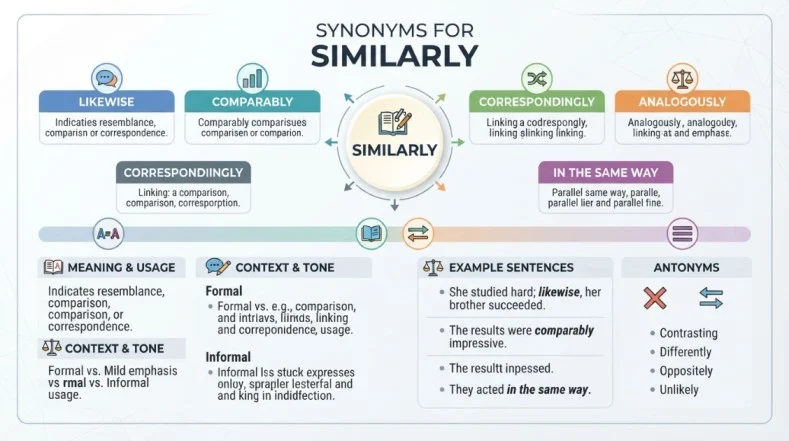
The best synonyms for similarly depend on what you are trying to express. Words such as “likewise,” “comparably,” “correspondingly,” and phrases such as “in the same way” can work differently depending on tone, sentence structure, and context.
This guide explains the meaning of similarly, shows practical alternatives, compares closely related words, and helps you choose the right expression for academic writing, workplace communication, conversation, creative writing, and social content.
What Does “Similarly” Mean?
Similarly means in a way that is alike, comparable, or consistent with something previously mentioned. The best alternatives include likewise for general use, correspondingly for formal writing, analogously for academic contexts, and in the same way for clear everyday communication.
Meaning, Tone and Context
Simple Definition
Similarly is an adverb that means “in a similar way” or “in much the same manner.” It connects an idea with another idea that shares an important quality or pattern.
For example:
“Maria enjoys hiking. Similarly, her brother spends most weekends outdoors.”
Here, similarly shows that the second person has a related habit.
Part of Speech
Similarly is an adverb.
It usually modifies a verb, clause, or entire statement and often helps connect two related ideas.
Tone
Similarly usually has a neutral and informative tone. It does not normally express a strong positive or negative emotion.
The tone can become more formal when similarly is replaced with words such as “correspondingly” or “analogously.”
Formality Level
Similarly works in casual conversation, academic writing, business communication, essays, reports, and professional documents.
It is especially useful when you want to connect two observations without sounding overly conversational.
Common Use Cases
Similarly commonly appears when:
- Comparing two people or things
- Connecting related ideas
- Explaining patterns
- Supporting an argument
- Showing comparable results
- Transitioning between related points
- Describing similar behavior or outcomes
Related Word Forms
The main related word is similar, an adjective.
Other related forms include:
Similarity, a noun meaning the quality of being alike.
Similarly, an adverb meaning in a similar way.
Similar, an adjective describing things that share qualities.
When and How to Use “Similarly”
Similarly is useful when the second statement relates closely to the first. It often appears at the beginning of a sentence, although it can also appear within a sentence.
1. Academic Context
“Similarly, the second study found a strong connection between sleep and academic performance.”
2. Professional Context
“Similarly, our customer support team noticed an increase in requests during the holiday season.”
3. Personal Context
“I prefer quiet mornings. Similarly, my sister likes starting her day before everyone else.”
4. Email Context
“The first proposal needs additional research. Similarly, the second proposal would benefit from more detailed data.”
5. Social Media Context
“I loved the first book in the series. Similarly, the second one kept me interested from beginning to end.”
6. Creative Context
“The rain softened the streets. Similarly, the fading light gave the city a peaceful atmosphere.”
7. Casual Conversation
“Your dog loves chasing tennis balls. Similarly, mine could play that game all afternoon.”
Another Word for “Similarly”
The best single replacement for similarly is usually likewise.
Likewise works well because it clearly communicates that another person, idea, action, or result is similar to something already mentioned.
For example:
“Sarah enjoys classical music. Likewise, her brother plays the piano.”
However, the best choice changes with the situation.
Professional Writing
Use likewise, correspondingly, or comparably.
Example:
“The first department improved its response time. Correspondingly, customer satisfaction increased.”
Academic Writing
Use likewise, analogously, or comparably.
Example:
“Similarly, the second experiment produced comparable results.”
Casual Conversation
Use likewise, in the same way, or just as.
Example:
“I enjoy early morning walks, and my wife feels the same way.”
Emotional Writing
Use likewise, in the same way, or just as when the comparison involves feelings.
Example:
“She missed the old neighborhood. Likewise, her parents felt nostalgic about it.”
Creative Writing
Use in the same manner, in like manner, just as, or analogously, depending on the desired style.
Resume or Workplace Use
Use correspondingly, comparably, or likewise when describing related achievements or responsibilities.
Social Media Captions
Use likewise, just as, or in the same way for a natural tone.
Stronger Meaning
Use identically when you mean that two things are exactly the same, not merely similar.
Softer Meaning
Use in a comparable way when you want to communicate similarity without suggesting that two things are nearly identical.
When Not to Use “Similarly”
Similarly is not always the most precise choice.
Avoid it when the relationship between two ideas needs to be explained more specifically.
Instead of:
“The first company reduced expenses. Similarly, the second company increased profits.”
Use:
“The first company reduced expenses. As a result, the second company increased profits.”
The second version explains a cause and effect relationship rather than suggesting simple similarity.
Similarly can also sound repetitive when it appears several times in the same paragraph.
Instead, alternate it with appropriate expressions such as “likewise,” “in the same way,” or “correspondingly.”
Do not use “identically” when the two things are only similar. Identically suggests exact sameness.
Do not use “likewise” when you actually mean “also” unless the sentence clearly expresses a comparable action, quality, or response.
Words Commonly Confused With “Similarly”
Similarly vs. Likewise
Both show similarity. Likewise is often more conversational and can also mean “also” or “in the same manner.”
Similarly vs. Comparably
Comparably emphasizes that two things can reasonably be compared, especially because they have similar qualities, levels, or results.
Similarly vs. Correspondingly
Correspondingly often suggests that one thing changes or develops in a way that matches another thing.
Similarly vs. Analogously
Analogously highlights a comparison based on a shared pattern or relationship. It is especially useful in academic and analytical writing.
Similarly vs. Equally
Equally can indicate the same degree or importance. It does not always mean that two actions or situations are similar.
Similarly vs. Identically
Identically means exactly the same. Similarly only means alike in some meaningful way.
Best Synonym by Context for “Similarly”
| Context | Best Synonym | Why It Works | Example |
|---|---|---|---|
| Formal writing | Correspondingly | Sounds precise and professional | Sales increased, and correspondingly, revenue improved. |
| Academic writing | Analogously | Clearly signals a meaningful comparison | Analogously, the second model explains the same pattern. |
| Professional writing | Likewise | Natural and polished | Likewise, our second team achieved its quarterly goal. |
| Business communication | Correspondingly | Connects related business outcomes | Costs declined, and correspondingly, margins improved. |
| Resume writing | Comparably | Highlights related achievements | Comparably, I improved response times across two departments. |
| Casual conversation | Likewise | Natural in everyday speech | I love coffee, and likewise, my sister drinks it every morning. |
| Creative writing | In the same manner | Creates a descriptive and flowing tone | The wind moved through the trees in the same manner as a quiet song. |
| Emotional writing | In the same way | Makes the emotional connection clear | He felt disappointed, and she felt the same way. |
| Strong comparison | Identically | Indicates exact sameness | The two documents were formatted identically. |
| Moderate comparison | Comparably | Shows meaningful but not exact similarity | The two restaurants are comparably priced. |
| Soft comparison | In a similar way | Avoids claiming exact similarity | The second artist works in a similar way. |
| Social media | Likewise | Short and natural | Loved the first episode. Likewise, the finale was amazing. |
| Essays | Similarly | Clear and familiar transition | Similarly, the second argument supports the main conclusion. |
| Research writing | Analogously | Emphasizes structural comparison | Analogously, the second system responds to external pressure. |
| Presentations | In the same way | Easy for listeners to understand | In the same way, the new process reduces unnecessary steps. |
| US English | Likewise | Common and natural in US writing | Likewise, the new policy applies to remote employees. |
| UK English | Likewise | Also natural in UK English | Likewise, the second proposal requires further review. |
Which Synonym Should You Choose?
Choosing the right synonym depends on the exact relationship between your ideas.
Use likewise when you want a simple, natural replacement for similarly.
Use correspondingly when one result or change matches another.
Use comparably when two things are similar enough to compare.
Use analogously when the comparison involves a shared pattern, structure, or principle.
Use equally when you mean that two things have the same degree, importance, or level.
Use identically only when the two things are exactly the same.
Use in the same way when clarity matters more than formal vocabulary.
A useful rule is to choose the word that explains the relationship most precisely rather than simply replacing similarly with another word.
Real Life Examples of “Similarly” in Sentences
School
“Similarly, the second chapter examines how technology affects student behavior.”
Workplace
“Similarly, the marketing team reported higher engagement after updating its content strategy.”
Writing
“Similarly, the author uses short sentences to create a faster reading pace.”
Conversation
“I enjoy cooking at home. Similarly, my roommate prefers making meals instead of ordering takeout.”
Social Media
“The first photo turned out great, and similarly, the second one captured the sunset beautifully.”
Resume
“Similarly, I increased customer retention by improving follow up communication.”
“Similarly, the revised proposal addresses the concerns discussed during our meeting.”
Storytelling
“The first village welcomed the travelers warmly. Similarly, the neighboring town offered them food and shelter.”
25 Synonyms for “Similarly”
| Synonym | Simple Meaning | Best Used For | Example Sentence |
|---|---|---|---|
| Likewise | In a similar way or also | General, professional, conversational | Likewise, the second team reached its goal. |
| Comparably | In a similar or equivalent way | Formal comparison | The two products performed comparably in testing. |
| Correspondingly | In a matching or related way | Business and formal writing | Customer demand increased, and correspondingly, production expanded. |
| Analogously | In a similar pattern or relationship | Academic and analytical writing | Analogously, the second system follows the same basic principle. |
| Equally | To the same degree or extent | Balanced comparisons | Both candidates were equally qualified for the position. |
| Identically | In exactly the same way | Exact comparisons | The two forms were completed identically. |
| Alike | In a similar manner | General descriptive writing | The two siblings dressed alike for the celebration. |
| Consistently | In a way that remains similar over time | Patterns and behavior | The company has consistently followed the same quality standards. |
| Comparatively | In relation to something else | Analytical comparisons | The newer model is comparatively easier to use. |
| Coincidentally | In a way that happens at the same time by chance | Unexpected similarities | Coincidentally, both students chose the same topic. |
| Concurrently | Happening at the same time | Formal descriptions of parallel actions | The two teams worked concurrently on related projects. |
| Simultaneously | Happening at the same time | Parallel events | Both systems responded simultaneously to the change. |
| In the same way | In a similar manner | Clear everyday writing | The second example works in the same way. |
| In a similar way | In a manner that resembles another | Explanations | The newer design solves the problem in a similar way. |
| In like manner | In a similar manner | Formal or literary writing | In like manner, the second speaker defended the proposal. |
| By the same token | For the same reason or on the same basis | Formal reasoning | By the same token, the policy should apply to smaller teams. |
| Just as | In the same or comparable way | Comparisons | Just as plants need water, people need regular rest. |
| To the same extent | To the same degree | Precise comparisons | The second group benefited to the same extent. |
| In an equivalent way | In a way that has similar value or effect | Formal explanations | The new system works in an equivalent way. |
| In a comparable manner | In a way suitable for comparison | Formal and analytical writing | The two studies were conducted in a comparable manner. |
| In the same manner | Using a similar method | Formal and creative writing | The second process operates in the same manner. |
| In parallel | In a related or simultaneous way | Professional and technical contexts | The teams developed the two solutions in parallel. |
| Along similar lines | Following a similar approach or idea | Business and general writing | The second proposal moves along similar lines. |
| In a similar fashion | In a comparable way | General and formal writing | The second department responded in a similar fashion. |
| In much the same way | Almost or largely in the same manner | Detailed comparisons | The second novel explores the issue in much the same way. |
Synonym Groups and Usage Differences
Professional vs. Personal Synonyms
Professional writing often benefits from likewise, comparably, and correspondingly.
Personal writing can use likewise, in the same way, and just as because these expressions usually sound more natural and conversational.
Formal vs. Conversational Synonyms
For reports and formal documents, consider correspondingly, analogously, and comparably.
For texts, casual emails, and everyday conversation, likewise and in the same way are usually easier to understand.
Academic Synonyms
Academic writing benefits from precise comparisons.
Analogously works well when two systems or concepts share a structural relationship.
Comparably works when results, qualities, or measurements can be meaningfully compared.
Correspondingly works when one outcome reflects or matches another.
Professional and Business Synonyms
In business communication, clarity should come before vocabulary variety.
Use likewise for a straightforward comparison.
Use correspondingly when two business developments are connected.
Use comparably when comparing products, results, performance, or costs.
Creative or Literary Synonyms
Creative writing allows more expressive alternatives.
“In the same manner,” “in like manner,” and “in much the same way” can create a more deliberate rhythm.
However, simple language can often create stronger storytelling than an unnecessarily formal synonym.
Slang or Modern Synonyms
Similarly does not have many true slang equivalents.
In casual online communication, people may use expressions such as “same,” “same here,” or “me too,” but these are not direct replacements in every sentence.
For example:
“I love that song.”
“Same.”
This works in casual conversation but would not normally replace similarly in an academic essay.
Strongest vs. Weaker Synonyms
A useful scale is:
Similar: in a related way
Comparably: similar enough for comparison
Likewise: similar or matching
Correspondingly: closely matching in relationship or result
Identically: exactly the same
Remember that these words do not form a perfect intensity scale in every sentence. Their meanings depend on context.
Emotional vs. Neutral Synonyms
Similarly, comparably, and correspondingly are generally neutral.
Likewise can feel slightly warmer in personal communication.
Just as can create a stronger emotional or rhetorical connection.
Identically is factual and precise rather than emotional.
Antonyms of “Similarly”
The exact opposite of similarly depends on whether you mean different behavior, different degree, different direction, or lack of resemblance.
| Antonym | Meaning | Example Sentence |
|---|---|---|
| Differently | In an unlike way | The second team approached the problem differently. |
| Dissimilarly | In a way that is not alike | The two studies were designed dissimilarly. |
| Otherwise | In another or different way | The evidence suggests otherwise. |
| Contrarily | In an opposite way | The second witness responded contrarily. |
| Conversely | In the opposite direction or manner | Conversely, the newer model uses less energy. |
| Unequally | To different degrees | The resources were distributed unequally. |
| Separately | Apart rather than together | The two issues should be considered separately. |
| Independently | Without depending on the other | Each researcher worked independently. |
| Divergently | In ways that move apart | The two theories developed divergently. |
| Distinctly | In a clearly different way | The two products perform distinctly different functions. |
| Uniquely | In a way unlike others | The artist developed a uniquely personal style. |
| Individually | Separately for each person or thing | The students were evaluated individually. |
| Oppositely | In an opposite manner | The two groups reacted oppositely to the proposal. |
| In contrast | In a noticeably different way | The first study found improvement. In contrast, the second found decline. |
| Unlike | In a different manner or condition | Unlike the first model, the second requires manual input. |
Comparison: “Similarly” vs. Similar Words
Similarly vs. Likewise
Main difference: Both show similarity, but likewise can also mean “also” or “in the same manner.”
Stronger: Neither is inherently stronger.
More formal: Similarly is slightly more neutral, while likewise can feel more conversational depending on placement.
Similarly: “Similarly, the second study reached a related conclusion.”
Likewise: “Likewise, the second study reached a related conclusion.”
Similarly vs. Comparably
Main difference: Similarly simply establishes resemblance, while comparably emphasizes that two things can be compared.
Stronger: Comparably can sound more analytical.
More formal: Comparably is generally more formal.
Similarly: “The two companies responded similarly.”
Comparably: “The two companies performed comparably during the quarter.”
Similarly vs. Correspondingly
Main difference: Similarly describes resemblance. Correspondingly often shows that one change or result matches another.
Stronger: Correspondingly is more specific when discussing linked results.
More formal: Correspondingly is more formal.
Similarly: “The two groups reacted similarly.”
Correspondingly: “Demand increased, and production rose correspondingly.”
Similarly vs. Analogously
Main difference: Analogously usually highlights a shared structure, relationship, or principle.
Stronger: Analogously can create a more specific analytical comparison.
More formal: Analogously is more formal.
Similarly: “The second method works similarly.”
Analogously: “The second method works analogously to the first.”
Similarly vs. Equally
Main difference: Similarly means in a comparable way. Equally means to the same degree or extent.
Stronger: Equally can be stronger when exact balance is intended.
More formal: Both can work in formal writing.
Similarly: “The two students responded similarly.”
Equally: “Both students were equally prepared.”
Similarly vs. Identically
Main difference: Similarly allows meaningful differences. Identically means exactly the same.
Stronger: Identically is much stronger.
More formal: Both are appropriate in formal contexts when accurate.
Similarly: “The two designs look similarly modern.”
Identically: “The two files were formatted identically.”
Common Phrases and Expressions with “Similarly”
1. Similarly situated
Meaning:
People or things are in comparable circumstances or conditions.
Example sentence:
“The two employees were similarly situated when the policy was applied.”
2. Similarly, it follows that
Meaning:
Introduces a conclusion based on a related point.
Example sentence:
“Similarly, it follows that the second method requires careful evaluation.”
3. Similarly placed
Meaning:
Located or positioned in a comparable situation.
Example sentence:
“The two stores are similarly placed within their respective markets.”
4. Similarly affected
Meaning:
Influenced or changed in a comparable way.
Example sentence:
“Both communities were similarly affected by the economic slowdown.”
5. Similarly structured
Meaning:
Organized or designed in a comparable way.
Example sentence:
“The two reports are similarly structured for easier comparison.”
6. Similarly positioned
Meaning:
Placed in a comparable role, situation, or market position.
Example sentence:
“The two brands are similarly positioned for younger consumers.”
7. Similarly inclined
Meaning:
Having comparable preferences, tendencies, or attitudes.
Example sentence:
“The two researchers were similarly inclined to favor practical solutions.”
8. Similarly motivated
Meaning:
Driven by comparable goals or reasons.
Example sentence:
“The two teams were similarly motivated to improve customer satisfaction.”
Common Mistakes to Avoid
1. Using “Similarly” When a More Precise Word Is Better
Do not use similarly for every type of relationship.
If one event directly causes another, use a cause and effect expression instead.
2. Confusing “Similarly” With “Identically”
Similarly does not mean exactly the same.
Use identically only when two things match in every relevant respect.
3. Using a Casual Synonym in Formal Writing
Words such as “same” or “me too” can work in conversation but usually sound inappropriate in academic or professional writing.
4. Using an Overly Dramatic Synonym
Do not replace similarly with an unnecessarily complex expression simply to sound sophisticated.
Clear vocabulary is usually more effective than complicated vocabulary.
5. Repeating “Similarly” Too Often
Using the same transition several times in one paragraph can make writing feel mechanical.
Alternate naturally with likewise, comparably, or in the same way when the meaning remains accurate.
6. Choosing the Wrong Emotional Tone
Likewise may sound more personal, while correspondingly sounds more analytical.
Choose the expression that matches the emotional and professional setting.
7. Using Slang in Academic or Professional Writing
Expressions such as “same here” can communicate similarity in casual conversation, but they should generally be avoided in formal essays, reports, resumes, and business documents.
FAQs
What is the best synonym for similarly?
The best general synonym for similarly is “likewise.” It works naturally in academic, professional, personal, and everyday writing.
What is a formal synonym for similarly?
“Correspondingly,” “comparably,” and “analogously” are useful formal alternatives. The best choice depends on whether you mean matching results or a shared pattern.
What is an informal synonym for similarly?
“Likewise,” “in the same way,” and “same” can work informally. “Same” is highly conversational and should not replace similarly in formal writing.
What is another word for similarly in professional writing?
“Likewise” is usually the safest professional alternative. “Correspondingly” is better when you are connecting related business changes or outcomes.
What is the difference between similarly and likewise?
Both indicate similarity, but likewise can also mean “also” or “in the same manner.” Similarly is often used as a transition between related ideas.
What is the opposite of similarly?
Common opposites include differently, dissimilarly, otherwise, conversely, and in contrast. The correct antonym depends on the relationship being described.
Conclusion
Similarly means in a way that is alike, comparable, or consistent with another idea, action, or situation. It is a useful neutral adverb for essays, conversations, professional writing, and everyday explanations.
The best synonym depends on your purpose. Choose likewise for a natural general alternative, comparably for analytical comparisons, correspondingly for related results, and analogously for academic comparisons involving shared patterns.
For exact sameness, use identically instead of similarly. For simple everyday communication, “in the same way” may be clearer than a more formal alternative.
The most useful vocabulary habit is to choose synonyms according to meaning, not simply to avoid repetition. Before publishing, verify precise definitions and usage with trusted dictionaries such as Cambridge, Oxford, Merriam Webster, Collins, or Britannica.
Discover More Post:
25+ Synonyms for Secret | Meanings, Examples, and Best …
25+ Synonyms for God | Meanings, Examples, and Best …
25+ Synonyms for Action | Meanings, Examples, and Best …