The word “strategy” appears everywhere. You may use it in a business email, school essay, presentation, resume, marketing plan, social media caption, or everyday conversation. Repeating the same word can make otherwise strong writing feel predictable.
Choosing the right alternative is not simply about finding a word that looks similar in a thesaurus. A strategy can be a detailed plan, a practical approach, a specific tactic, or a carefully designed course of action. The best replacement depends on what you actually mean.
This guide explains synonyms for strategy by tone, purpose, and context. You will find professional, academic, casual, creative, and practical alternatives, along with examples that show how each word works in real communication.
What Does “Strategy” Mean?
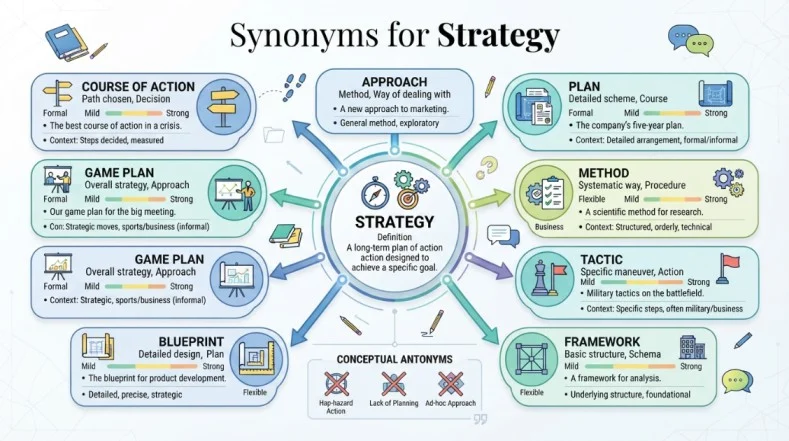
A strategy is a planned approach for achieving a goal or responding to a situation. Useful alternatives include approach for general use, plan for casual contexts, method for practical contexts, and framework for academic or professional writing.
Meaning, Tone and Context
Simple Definition
Strategy means a carefully considered plan or approach designed to achieve a particular goal.
For example:
The company developed a strategy to increase customer retention.
The sentence suggests more than a simple idea. It implies deliberate planning and a desired result.
Part of Speech
“Strategy” is a noun.
Its plural form is strategies.
Related words include:
Strategic: relating to a strategy or important to achieving a long term objective.
Strategically: in a way that supports a particular goal or plan.
Strategist: a person who develops or evaluates strategies.
Tone
Strategy usually has a neutral to professional tone.
It often sounds thoughtful, organized, and purposeful. In business, education, politics, sports, marketing, and personal planning, it can suggest deliberate decision making.
Formality Level
Strategy works comfortably in both formal and everyday English.
For formal writing, words such as framework, approach, policy, doctrine, or course of action may sometimes provide greater precision.
For casual conversation, plan, game plan, or approach can sound more natural.
Common Use Cases
You will commonly see strategy used in:
- Business planning
- Marketing
- Education
- Sports
- Finance
- Leadership
- Career development
- Personal development
- Politics
- Negotiation
- Writing and communication
- Competitive decision making
When and How to Use “Strategy”
Use “strategy” when you are describing an intentional approach designed to accomplish an objective.
Professional
Our marketing strategy focuses on building long term customer relationships.
Academic
The study examines the strategy used by students to manage competing academic demands.
Personal
My strategy for saving money is to automate a portion of every paycheck.
Emotional
Her strategy for handling stressful conversations was to listen before responding.
Creative
The author used a subtle storytelling strategy to reveal the character’s secret.
Social Media
A simple content strategy can make your social media efforts more consistent.
I would like to discuss our strategy for improving the client onboarding process.
Another Word for “Strategy”
The best single replacement depends on the intended meaning.
Professional writing: approach, framework, course of action
Academic writing: approach, framework, method
Casual conversation: plan, game plan
Emotional writing: approach, way of handling things
Creative writing: design, approach, scheme
Resume or workplace use: strategy, approach, plan
Social media captions: plan, approach, game plan
Stronger meaning: game plan, blueprint, strategic approach
Softer meaning: approach, idea, way forward
If you need one broadly useful alternative, approach is usually the safest choice. It works in professional, academic, and everyday contexts without changing the meaning too dramatically.
When Not to Use “Strategy”
“Strategy” is not always the most precise word.
- If you mean a simple intention, plan may sound more natural.
Less precise: My strategy is to call her tomorrow.
More natural: My plan is to call her tomorrow.
- If you mean one specific action within a larger strategy, tactic is better.
Strategy: We need a customer retention strategy.
Tactic: Offering a loyalty discount is one tactic within that strategy.
- If you mean a repeatable way of doing something, method may be more accurate.
The researcher used a different method to analyze the results.
Using “strategy” for every kind of plan can make your writing less precise. Choose the word that reflects the size, purpose, and complexity of the idea.
Words Commonly Confused With “Strategy”
Strategy vs. Plan
A plan describes what you intend to do. A strategy usually emphasizes the overall thinking behind achieving a goal.
Strategy vs. Tactic
A strategy is the broader approach. A tactic is a specific action used to support that approach.
Strategy vs. Method
A method describes how something is done. A strategy focuses more strongly on achieving an objective.
Strategy vs. Approach
Approach is broader and often more flexible. Strategy usually suggests more deliberate planning around a goal.
Strategy vs. Policy
A policy is a rule or guiding principle. A strategy is a course of action designed to accomplish an objective.
Strategy vs. Framework
A framework provides a structure for organizing decisions or actions. A strategy explains the intended direction and goal.
Best Synonym by Context for “Strategy”
| Context | Best Synonym | Why It Works | Example |
|---|---|---|---|
| Formal writing | Approach | Professional and flexible | The organization adopted a new approach to resource management. |
| Academic writing | Framework | Suggests an organized conceptual structure | The framework guides the analysis of consumer behavior. |
| Professional use | Approach | Natural and precise | Our approach emphasizes customer satisfaction. |
| Business planning | Game plan | Clearly communicates intended action | The team agreed on a game plan for the product launch. |
| Resume | Approach | Shows thoughtful problem solving | Developed a data driven approach to improve workflow. |
| Casual conversation | Plan | Simple and natural | My plan is to finish the project tonight. |
| Creative writing | Design | Highlights deliberate construction | The story’s design gradually reveals the central conflict. |
| Emotional writing | Approach | Works well for handling situations | Her approach to conflict was calm and thoughtful. |
| Strong intensity | Blueprint | Suggests a detailed guiding plan | The proposal became a blueprint for future expansion. |
| Mild tone | Way | Sounds relaxed and conversational | We need a better way to reach new customers. |
| Social media | Game plan | Friendly and engaging | Here is my game plan for growing the account. |
| Academic research | Method | Focuses on how something is carried out | The researchers selected a new method for collecting data. |
| Leadership | Course of action | Emphasizes a deliberate decision | Leaders must choose the right course of action. |
| Marketing | Plan | Familiar and practical | The marketing plan targets first time buyers. |
| Competitive setting | Tactic | Useful for individual moves | The discount was an effective tactic. |
Which Synonym Should You Choose?
Start by identifying what you mean by “strategy.”
- If you mean a general plan, use plan.
- If you mean a broad way of approaching a problem, use approach.
- If you mean a specific action, use tactic.
- If you mean a structured system for thinking or organizing, use framework.
- If you mean a detailed guide for execution, use blueprint.
- If you mean a practical way of doing something, use method.
- If you are writing professionally and want a safe, polished alternative, approach is often the strongest choice.
- If you want a more conversational expression, game plan can work well when the context is informal.
Real Life Examples of “Strategy” in Sentences
School
Her study strategy helped her divide a difficult subject into manageable sections.
Workplace
The management team created a strategy for improving employee communication.
Writing
The writer changed her storytelling strategy to create a stronger emotional effect.
Conversation
My strategy is to finish the difficult tasks first.
Social Media
Consistency is an important part of our social media strategy.
Resume
Developed a customer engagement strategy that improved communication across multiple channels.
Let’s review the strategy before we move forward with the campaign.
Storytelling
The character’s strategy was to remain silent until she understood everyone’s motives.
25 Synonyms for “Strategy”
Some alternatives below are close synonyms, while others apply to specific meanings of strategy. Choosing accurately requires attention to context.
| Synonym | Simple Meaning | Best Used For | Example Sentence |
|---|---|---|---|
| Approach | A way of dealing with something | General, professional, academic | We need a more flexible approach to customer service. |
| Plan | An intended set of actions | Everyday and professional use | She created a plan for completing the project. |
| Method | A particular way of doing something | Practical and academic contexts | The team tested a new method for solving the problem. |
| Tactic | A specific action supporting a larger goal | Business, sports, competition | The discount was a useful tactic for attracting new buyers. |
| Game plan | A clear plan for reaching an objective | Casual and business conversation | We have a solid game plan for the weekend event. |
| Blueprint | A detailed guide for achieving something | Business, projects, creative work | The proposal became a blueprint for expansion. |
| Framework | A structure used to organize ideas or actions | Academic and professional writing | The framework helps managers evaluate strategic decisions. |
| Course of action | A chosen way forward | Formal and professional writing | The committee selected a practical course of action. |
| Scheme | An organized plan, sometimes with a negative suggestion | Formal or critical contexts | The group developed a scheme to reorganize the department. |
| Design | The deliberate arrangement of parts toward a purpose | Creative and conceptual contexts | The campaign’s design encouraged stronger audience engagement. |
| Policy | A guiding principle or official approach | Government and organizational contexts | The company introduced a new policy for remote work. |
| Program | An organized set of activities intended to achieve a purpose | Organizations and institutions | The training program supports professional development. |
| Playbook | A collection of recommended actions or practices | Business, sports, leadership | The sales team created a playbook for new representatives. |
| Stratagem | A clever plan designed to achieve an advantage | Formal and literary contexts | The commander used a clever stratagem to gain an advantage. |
| Maneuver | A calculated action intended to produce a result | Competition and strategic situations | The company made a careful maneuver to enter the new market. |
| Ploy | A deliberate action intended to influence someone | Persuasion and competitive situations | The offer appeared to be a ploy to attract attention. |
| Positioning | The way something is presented or placed for advantage | Marketing and business | Strong brand positioning helped the company stand out. |
| Doctrine | A set of guiding principles or beliefs | Military, political, organizational contexts | The organization developed a doctrine for responsible leadership. |
| Course | A chosen direction or way forward | Formal and conceptual contexts | The company changed course after reviewing the results. |
| Direction | The general path toward an objective | Business and personal planning | The new leadership gave the team clear direction. |
| Initiative | A planned effort intended to accomplish something | Business and organizational use | The company launched an initiative to improve accessibility. |
| Program of action | An organized set of intended actions | Formal contexts | The committee proposed a program of action for reform. |
| Way forward | A practical route toward resolving a situation | Professional and conversational use | We need to agree on a way forward. |
| Mode of operation | A characteristic way of functioning | Formal and analytical writing | The organization changed its mode of operation. |
| Course of planning | A structured direction for future action | Formal planning contexts | The department established a clear course of planning for the coming year. |
Synonym Groups and Usage Differences
Professional vs. Personal Synonyms
Professional writing often benefits from approach, framework, course of action, positioning, policy, and plan.
Personal communication usually sounds more natural with plan, approach, way, game plan, or direction.
For example:
Professional: The company adopted a new approach to customer retention.
Personal: My approach is to finish one task before starting another.
The word “approach” works in both settings because it is flexible without sounding overly technical.
Formal vs. Conversational Synonyms
For reports, essays, presentations, and formal communication, consider:
Framework, approach, course of action, method, policy, doctrine
For casual conversations and texts, consider:
Plan, game plan, way, approach
Avoid using highly formal terms when a simple word communicates the idea more clearly.
Academic Synonyms
Academic writing values precision.
Approach, framework, method, course of action, and model can sometimes replace strategy depending on the intended meaning.
For example:
The researchers used a comparative approach to examine the two groups.
“Approach” is appropriate because the sentence describes the way the researchers handled the investigation.
Professional and Business Synonyms
Business communication frequently uses:
Strategy, approach, plan, framework, positioning, playbook, tactic, and course of action
Each word carries a slightly different meaning.
- Use strategy for broad direction.
- Use tactic for a specific action.
- Use playbook for a repeatable set of recommended practices.
- Use positioning when discussing how a brand, product, or organization is presented in a market.
Creative or Literary Synonyms
Creative writing can use:
Design, scheme, stratagem, maneuver, approach, course, and plan
The best choice depends on the mood.
“Stratagem” can suggest cleverness.
“Scheme” can suggest secrecy or questionable motives.
“Maneuver” can suggest calculated movement.
“Design” can emphasize careful construction.
Slang or Modern Synonyms
There are no universally accepted slang synonyms for strategy that work in every context.
Game plan is the most useful conversational alternative.
Playbook is common in business and sports, especially when referring to a repeatable set of actions or practices.
These expressions are generally acceptable in casual professional communication, but formal academic writing usually benefits from more precise vocabulary.
Strongest vs. Weaker Synonyms
A useful intensity scale is:
Way → Plan → Approach → Course of action → Strategy → Blueprint → Stratagem
This is not a strict dictionary scale. The words differ in meaning, not simply strength.
“Blueprint” suggests detail.
“Stratagem” suggests cleverness.
“Strategy” emphasizes deliberate planning around an objective.
Emotional vs. Neutral Synonyms
Most strategy synonyms are neutral.
Approach is neutral and flexible.
Plan is neutral and direct.
Game plan is energetic and conversational.
Stratagem can suggest cleverness or manipulation.
Ploy can carry a skeptical or negative tone.
Scheme can also sound negative when it suggests secrecy or questionable intent.
Antonyms of “Strategy”
Strategy does not have 15 exact dictionary antonyms. The following are useful conceptual opposites that describe a lack of planning, direction, or deliberate action.
| Antonym | Meaning | Example Sentence |
|---|---|---|
| Improvisation | Acting without a prepared plan | The team relied on improvisation when the schedule changed. |
| Spontaneity | Acting naturally without prior planning | Her spontaneity made the presentation feel genuine. |
| Aimlessness | Lack of a clear objective | The project suffered from aimlessness after leadership changed. |
| Disorganization | Lack of structure or order | Disorganization made the process difficult to manage. |
| Disorder | Lack of organization or control | The sudden changes created disorder within the team. |
| Randomness | Absence of a deliberate pattern | The decisions appeared driven by randomness rather than evidence. |
| Indecision | Inability to choose a direction | Indecision delayed the launch. |
| Inaction | Failure to take action | Inaction allowed the problem to grow. |
| Passivity | Lack of active involvement | Passivity can prevent a team from responding quickly. |
| Drift | Gradual movement without a clear direction | Without leadership, the organization began to drift. |
| Neglect | Failure to give something proper attention | Neglect of planning created unnecessary problems. |
| Impulsiveness | Acting without careful thought | Impulsiveness can lead to poor business decisions. |
| Shortsightedness | Focus on immediate results without considering the future | Shortsightedness can undermine long term growth. |
| Confusion | Lack of clear understanding or direction | Confusion spread when the instructions changed repeatedly. |
| Unpreparedness | Lack of preparation | Unpreparedness made the negotiation more difficult. |
Comparison: Strategy vs. Similar Words
Strategy vs. Plan
Main difference: A plan describes intended actions, while strategy emphasizes the thinking and direction behind achieving an objective.
Stronger: Strategy usually suggests more deliberate long range thinking.
More formal: Strategy often sounds slightly more professional.
Strategy example:
The company developed a strategy for entering new markets.
Plan example:
The company created a plan for launching the product.
Strategy vs. Tactic
Main difference: Strategy is broad. Tactic is specific.
Stronger: Neither is universally stronger. Strategy covers the larger direction.
More formal: Strategy generally sounds more formal.
Strategy example:
Our strategy focuses on customer loyalty.
Tactic example:
Offering a discount is one tactic for increasing purchases.
Strategy vs. Approach
Main difference: Approach means a way of dealing with something. Strategy more strongly suggests deliberate planning toward an objective.
Stronger: Strategy usually implies more planning.
More formal: Both work well in professional writing.
Strategy example:
The company created a strategy to increase market share.
Approach example:
The company adopted a customer focused approach.
Strategy vs. Method
Main difference: Method explains how something is done. Strategy explains how an objective will be pursued.
Stronger: Strategy usually has a broader scope.
More formal: Method is especially common in academic and technical writing.
Strategy example:
The team developed a strategy for improving retention.
Method example:
Researchers used a new method to analyze the data.
Strategy vs. Framework
Main difference: A framework provides structure for thinking or organizing. A strategy establishes direction toward a goal.
Stronger: Strategy usually communicates greater emphasis on action.
More formal: Framework often sounds more academic or analytical.
Strategy example:
The organization created a strategy for sustainable growth.
Framework example:
The framework helps managers evaluate growth opportunities.
Strategy vs. Policy
Main difference: A policy establishes a rule or guiding principle. A strategy explains how an objective will be pursued.
Stronger: Strategy is generally more action oriented.
More formal: Policy often has a more official tone.
Strategy example:
The company developed a strategy for reducing operating costs.
Policy example:
The company introduced a policy requiring expense approvals.
Common Phrases and Expressions with “Strategy”
1. Business Strategy
Meaning:
A broad plan for achieving business goals.
Example sentence:
The leadership team reviewed its business strategy before entering the new market.
2. Marketing Strategy
Meaning:
A planned approach for promoting a product, service, or brand.
Example sentence:
Our marketing strategy combines useful content with targeted advertising.
3. Growth Strategy
Meaning:
A plan designed to expand an organization, product, audience, or business.
Example sentence:
The company created a growth strategy focused on reaching new customers.
4. Long Term Strategy
Meaning:
A plan designed to support goals over an extended period.
Example sentence:
The organization needs a long term strategy for sustainable expansion.
5. Competitive Strategy
Meaning:
An approach designed to help an organization compete effectively.
Example sentence:
The company changed its competitive strategy after studying customer preferences.
6. Communication Strategy
Meaning:
A planned approach for delivering information to a particular audience.
Example sentence:
The team developed a communication strategy for the product announcement.
7. Winning Strategy
Meaning:
An approach believed to provide a strong chance of success.
Example sentence:
Consistent preparation became their winning strategy.
8. Strategy for Success
Meaning:
A planned approach intended to improve the likelihood of achieving a goal.
Example sentence:
Building strong habits can become an effective strategy for success.
Common Mistakes to Avoid
1. Using “Strategy” for Every Type of Plan
Not every plan is a strategy.
If you mean a simple intention, use plan.
2. Confusing Strategy With Tactic
A tactic is usually one action within a broader strategy.
Calling a single action a strategy can make the sentence less precise.
3. Using Casual Expressions in Formal Writing
“Game plan” can work in conversation, but “approach” or “strategy” may be better for an academic paper.
4. Using an Overly Dramatic Synonym
Words such as “stratagem” or “ploy” can sound dramatic when discussing ordinary planning.
Use them only when their specific meaning fits.
5. Repeating “Strategy” Too Often
Repeated use can make business reports and essays sound monotonous.
Replace some instances with approach, plan, framework, method, or course of action when the meaning remains accurate.
6. Choosing the Wrong Emotional Tone
“Ploy” can sound manipulative.
“Scheme” can suggest questionable behavior.
“Approach” usually remains neutral.
7. Using Slang in Academic Writing
“Game plan” and “playbook” can be useful conversational expressions, but formal academic writing usually requires more precise terminology.
FAQs
What is the best synonym for “strategy”?
The best general synonym is approach because it works in professional, academic, and everyday contexts while preserving the idea of a deliberate way of achieving a goal.
What is a formal synonym for “strategy”?
Framework or course of action can serve as formal alternatives when the context emphasizes structure or deliberate decision making.
What is an informal synonym for “strategy”?
Plan and game plan are natural informal alternatives. “Game plan” is especially useful when discussing practical steps toward a goal.
What is another word for “strategy” in professional writing?
Approach is one of the safest professional alternatives. Depending on context, framework, plan, tactic, or course of action may be more precise.
What is the difference between strategy and plan?
A plan describes intended actions, while strategy usually describes the broader thinking and direction used to achieve an important objective.
What is the opposite of strategy?
There is no single perfect antonym in every context. Conceptual opposites include improvisation, aimlessness, inaction, randomness, and disorganization.
Conclusion
Strategy means a deliberate approach for achieving a goal. The best alternative depends on the exact meaning you want to communicate.
Use approach for a flexible professional alternative, plan for simple intentions, tactic for a specific action, method for a way of doing something, and framework for an organized structure.
The most useful vocabulary habit is to avoid replacing a word simply because you want variety. Choose a synonym because it expresses your intended meaning more precisely.
When looking for synonyms for strategy, always consider the goal, context, formality, and emotional tone before making the substitution. That small choice can make an essay clearer, a resume stronger, an email more professional, and everyday communication more natural.
Discover More Post:
- 25+ Synonyms for Secret | Meanings, Examples, and Best …
- 25+ Synonyms for God | Meanings, Examples, and Best …
- 25+ Synonyms for Action | Meanings, Examples, and Best …