The pronoun they appears everywhere, from everyday conversations and social media captions to emails, essays, workplace documents, and professional writing. Repeating it too often can make a sentence feel vague, especially when the reader needs to know exactly who you mean.
Finding alternatives to they is not simply about replacing one word with another. Because they is a pronoun, the best replacement often depends on the people or group being discussed. This guide explains natural alternatives, grammatical differences, tone, context, and practical examples so you can choose clearer wording.
What Does “They” Mean?
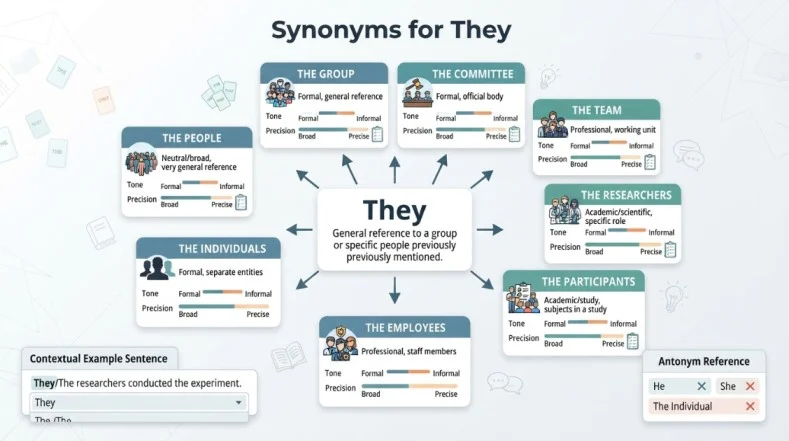
They is a third person pronoun used for two or more people, and also for one person when gender is unknown or intentionally unspecified. Contextual alternatives include those people, the individuals, the group, the team, and the participants.
Meaning, Tone and Context
1. Simple Definition
They refers to people or other beings already mentioned, understood from context, or identified elsewhere in a sentence or conversation.
For example:
The students finished their project because they worked together.
Here, they refers to the students.
2. Part of Speech
They is a pronoun. More specifically, it is a third person personal pronoun that commonly functions as the subject of a sentence.
Example:
They arrived early.
Other forms related to they include them, their, and theirs. These forms perform different grammatical jobs, so they should not automatically be treated as synonyms for they.
3. Tone
They is normally neutral. It does not automatically communicate approval, criticism, formality, or emotion.
The tone comes largely from the surrounding sentence.
They solved the problem.
This sounds neutral.
Those careless employees ignored the instructions.
This sounds critical because of the descriptive language surrounding the reference.
4. Formality Level
They works in almost every level of communication. It is natural in casual speech, academic writing, business communication, journalism, and professional documents.
However, a specific noun can sometimes be clearer than they.
Instead of:
They reviewed the application.
You could write:
The hiring committee reviewed the application.
The second sentence identifies exactly who performed the action.
5. Common Use Cases
They commonly appears when referring to:
- Multiple people
- A group
- A person whose gender is unknown
- A person who uses they as a pronoun
- People previously mentioned
- People understood from context
- Groups in professional or academic settings
6. Important Related Forms
The related forms are:
| Form | Grammatical Function | Example |
|---|---|---|
| They | Subject | They arrived early. |
| Them | Object | We invited them. |
| Their | Possessive determiner | Their report was excellent. |
| Theirs | Possessive pronoun | The final decision was theirs. |
These forms are related, but them, their, and theirs are not interchangeable synonyms for they.
When and How to Use “They”
Use they when the person or people have already been identified and repeating the full noun would sound unnecessary.
1. Casual Conversation
I spoke with Jordan yesterday, and they said the meeting went well.
2. Professional Communication
The managers reviewed the proposal before they approved the budget.
3. Academic Writing
Researchers collected the responses before they analyzed the results.
4. Personal Writing
My friends called me because they wanted to celebrate.
5. Social Media
The artists released a new collection, and they shared the details online.
6. Email
The clients confirmed the appointment, so they should arrive around noon.
7. Storytelling
The travelers reached the village after sunset, where they found a quiet place to rest.
Another Word for “They”
There is no single replacement that works naturally in every sentence. Since they is a pronoun, the strongest alternative usually identifies the specific people or group.
Here are useful choices by context:
| Context | Recommended Alternative |
|---|---|
| Professional writing | The team, the staff, the employees |
| Academic writing | The researchers, the participants, the students |
| Casual conversation | Those people, the group |
| Emotional writing | Those individuals, the people involved |
| Creative writing | The travelers, the strangers, the characters |
| Resume or workplace use | The team, the department, colleagues |
| Social media captions | The creators, the artists, the group |
| Stronger specificity | The individuals involved |
| Softer, general reference | The people involved |
Professional Writing
Use the team, the staff, the department, or another specific group when clarity matters.
They completed the project.
Better when the identity matters:
The design team completed the project.
Academic Writing
Use the researchers, the participants, or the students when the group is known.
They reported significant findings.
More precise:
The researchers reported significant findings.
Casual Conversation
Those people or the group may work when the context is already clear.
They were waiting outside.
The group was waiting outside.
Emotional Writing
Those individuals or the people involved can add distance or emphasis.
They ignored her concerns.
The people involved ignored her concerns.
Creative Writing
A descriptive noun can make storytelling more vivid.
They entered the forest.
The travelers entered the forest.
Resume or Workplace Use
A specific department, team, or role is usually more useful than a pronoun.
They improved customer satisfaction.
The customer service team improved customer satisfaction.
Social Media Captions
Short, specific nouns can make captions clearer.
They created something amazing.
The artists created something amazing.
Stronger Meaning
Use the individuals involved when you want a more deliberate or formal reference.
Softer Meaning
Use the people involved when you want a natural and neutral expression.
When Not to Use “They”
There are situations where they is grammatically correct but less effective stylistically.
When the Reference Is Unclear
They approved the proposal.
The reader may wonder who they are.
A clearer version is:
The board approved the proposal.
When a Specific Noun Adds Important Information
They conducted the experiment.
Better:
The researchers conducted the experiment.
When Repetition Makes the Writing Vague
Several sentences containing they can make it difficult to track different groups.
Naming the group can improve clarity.
When the Reader Needs a Professional Role
They contacted the applicant.
More informative:
The hiring manager contacted the applicant.
When a More Precise Description Improves the Sentence
They attended the event.
More specific:
The conference organizers attended the event.
The goal is not to eliminate they. The goal is to use the clearest reference for the situation.
Words Commonly Confused With “They”
- They vs. Them
- They usually functions as a subject, while them usually functions as an object.
They invited us.
We invited them.
- They vs. Their
- They identifies the subject.
- Their indicates possession.
They submitted the report.
Their report was complete.
They vs. Theirs
Theirs is a possessive pronoun.
They chose the design.
The final design was theirs.
They vs. Those
They is a personal pronoun.
Those is commonly a demonstrative determiner or pronoun that points to specific people or things.
They are waiting.
Those people are waiting.
They vs. Themself and Themselves
They is a subject form.
Themselves is a reflexive form commonly used with plural they, and also with singular they in many contemporary contexts.
They prepared themselves.
They vs. People
They is a pronoun.
People is a noun.
They arrived early.
The people arrived early.
Best Synonym by Context for “They”
Because they is a pronoun, many alternatives below are best understood as contextual replacements, not perfect dictionary synonyms.
| Context | Best Synonym | Why It Works | Example |
|---|---|---|---|
| Formal writing | The individuals | Precise and formal | The individuals submitted their statements. |
| Academic writing | The researchers | Identifies the academic group | The researchers examined the evidence. |
| Professional use | The team | Natural for workplace groups | The team completed the assignment. |
| Business use | The company representatives | Identifies professional actors | The company representatives approved the proposal. |
| Resume writing | The team | Clear when describing collaborative work | The team increased customer retention. |
| Casual conversation | Those people | Natural when the people are understood | Those people live nearby. |
| Creative writing | The travelers | Adds descriptive detail | The travelers crossed the valley. |
| Emotional tone | The people involved | Gives emphasis without exaggeration | The people involved expressed concern. |
| Strong specificity | The individuals involved | Makes the reference deliberate | The individuals involved received notices. |
| Soft, neutral tone | The people | Simple and natural | The people agreed with the decision. |
| Social media | The creators | Useful for online content | The creators shared a new video. |
| School | The students | More specific than a pronoun | The students completed the assignment. |
| Research | The participants | Identifies study subjects | The participants answered every question. |
| Workplace | The employees | Identifies workers | The employees attended training. |
| Team activity | The group | Useful for a defined collection | The group reached an agreement. |
US and UK Usage
The pronoun they is standard in both US and UK English. Its use for a single person whose gender is unknown or unspecified is also well established in contemporary English.
The main difference is usually not regional. It is whether the sentence needs a pronoun or a more specific noun.
Which Synonym Should You Choose?
Choosing an alternative to they begins with one question: Who exactly does they refer to?
If the answer is already obvious and repeating the noun would sound awkward, keep they.
If the identity matters, replace the pronoun with a specific noun.
Choose a More Specific Noun When:
- The reader may not know who they means.
- Several groups appear in the same paragraph.
- You are writing a formal or professional document.
- The person’s role is important.
- You want to avoid repetition across several sentences.
Consider Formality
Use the individuals in formal contexts, the researchers in academic contexts, and the team in workplace communication.
Consider Emotional Intensity
The people involved sounds neutral.
Those individuals can sound more distant or deliberate.
Consider Professional Value
Specific nouns often make workplace writing stronger because they show exactly who performed an action.
Consider Sentence Context
Do not replace they simply to avoid repetition. If the replacement makes the sentence longer or less natural, the original pronoun may be the better choice.
Real Life Examples of “They” in Sentences
School
The students submitted their essays before they left the classroom.
A more specific version:
The students submitted their essays before leaving the classroom.
Workplace
The marketing team presented the results after they reviewed the latest data.
Writing
Writers often revise their work after they read it aloud.
Conversation
My neighbors said they would stop by this evening.
Social Media
The creators announced that they are releasing a new series.
Resume
They improved customer satisfaction through a new support process.
A stronger professional version:
The customer service team improved customer satisfaction through a new support process.
The clients confirmed that they received the documents.
Storytelling
The travelers reached the coast before they realized the storm was approaching.
25 Synonyms for “They”
A crucial vocabulary point comes first: they has no set of 25 perfect synonyms because it is a grammatical pronoun. The following are accurate contextual replacements that can replace they when the intended group is known.
| Synonym | Simple Meaning | Best Used For | Example Sentence |
|---|---|---|---|
| Those people | Specific people already understood from context | Casual reference | Those people are waiting near the entrance. |
| The people | A general group of people | Neutral writing | The people agreed with the proposal. |
| The individuals | Separate or specific people | Formal writing | The individuals provided written statements. |
| The people involved | People connected to a situation | Neutral and professional writing | The people involved discussed the issue. |
| The individuals involved | Specific people connected to an event | Formal contexts | The individuals involved received further instructions. |
| The group | A collection of people | General group reference | The group arrived before noon. |
| The team | People working together | Workplace and sports contexts | The team completed the project early. |
| The staff | Employees working for an organization | Workplace writing | The staff attended the training session. |
| The employees | People employed by an organization | Business writing | The employees completed the survey. |
| The workers | People performing work | General workplace contexts | The workers finished the repairs. |
| The students | People attending an educational institution | School and academic writing | The students presented their findings. |
| The researchers | People conducting research | Academic writing | The researchers analyzed the results. |
| The participants | People taking part in an activity or study | Research and events | The participants completed the questionnaire. |
| The applicants | People applying for something | Hiring and admissions | The applicants submitted their documents. |
| The candidates | People being considered for a position or role | Elections and hiring | The candidates answered questions from the panel. |
| The customers | People purchasing or using a service | Business writing | The customers received confirmation emails. |
| The clients | People receiving professional services | Business communication | The clients approved the revised plan. |
| The members | People belonging to an organization or group | Organizations and clubs | The members voted on the proposal. |
| The committee | A group appointed to make decisions | Formal and professional writing | The committee reviewed the application. |
| The board | A governing group | Corporate and organizational writing | The board approved the budget. |
| The organizers | People arranging an event or activity | Events and projects | The organizers announced the schedule. |
| The creators | People producing content or creative work | Digital and creative contexts | The creators released their latest project. |
| The authors | People who wrote a work | Books and academic writing | The authors explained their research methods. |
| The characters | People represented in a story | Literary and creative writing | The characters traveled through the mountains. |
| The travelers | People traveling from one place to another | Storytelling and travel writing | The travelers reached the village at sunset. |
Synonym Groups and Usage Differences
Professional vs. Personal Synonyms
Professional writing benefits from specific nouns such as the team, the employees, the committee, the clients, and the board.
Personal communication can usually rely on they because the people involved are already known.
They called me last night.
This is natural when the listener already knows who they refers to.
Formal vs. Conversational Synonyms
The individuals sounds more formal than those people.
The group can work in both casual and professional contexts.
In a formal report:
The individuals completed the assessment.
In casual conversation:
Those people left early.
Academic Synonyms
Academic writing often benefits from terms that identify the participants accurately.
Useful choices include:
The researchers
The participants
The students
The authors
For example:
The participants completed the survey.
This is more informative than:
They completed the survey.
Professional and Business Synonyms
Workplace writing becomes clearer when you identify the responsible group.
Useful choices include:
The team
The staff
The employees
The clients
The committee
The board
For example:
The committee approved the revised policy.
This immediately tells the reader who made the decision.
Creative or Literary Synonyms
Creative writing can benefit from descriptive nouns.
Instead of:
They entered the old house.
A writer might say:
The travelers entered the old house.
The noun creates additional context without requiring a longer explanation.
Slang or Modern Synonyms
There are no reliable slang synonyms that can universally replace they. Informal expressions such as those folks may work in some conversations, but they can sound regional, overly casual, or stylistically specific.
For most readers, they remains the safest conversational choice.
Strongest vs. Weaker Synonyms
Because these alternatives identify different kinds of groups, strength is better understood as specificity, rather than intensity.
Mild and general:
They
The people
The group
More specific:
The individuals
The people involved
The individuals involved
Highly specific:
The researchers
The participants
The committee
The board
The most specific choice is not always the best choice. Use only the information that matters to the sentence.
Emotional vs. Neutral Synonyms
They is generally neutral.
The people involved can remain neutral while adding emphasis.
Those individuals can create emotional distance depending on the surrounding language.
Compare:
They caused the problem.
The individuals involved caused the problem.
The second version feels more deliberate and formal.
Antonyms of “They”
Strictly speaking, they does not have true antonyms because it is a pronoun rather than a word describing a quality or concept.
For search and vocabulary purposes, the following expressions can represent contrasting grammatical or referential choices. They are not strict dictionary antonyms.
| Antonym | Meaning | Example Sentence |
|---|---|---|
| I | The speaker | I completed the assignment. |
| Me | The speaker as object | The teacher called me. |
| You | The person being addressed | You completed the task. |
| We | The speaker and others | We finished the project. |
| Us | The speaker and others as object | The manager invited us. |
| He | One male person | He submitted the form. |
| Him | One male person as object | We called him. |
| She | One female person | She completed the report. |
| Her | One female person as object | We invited her. |
| It | A thing, animal, or nonhuman reference depending on context | It arrived this morning. |
| This person | One specific person nearby or under discussion | This person submitted the application. |
| That person | One specific person already identified | That person called earlier. |
| This group | One identified group being indicated | This group completed the survey. |
| That group | One identified group being indicated | That group won the competition. |
| One person | A single individual | One person answered the question. |
Comparison: “They” vs. Similar Words
They vs. Them
The main difference is grammatical function.
They is generally the subject.
Them is generally the object.
They completed the project.
We congratulated them.
Neither is more formal than the other.
They vs. Their
They refers to the subject.
Their shows possession.
They submitted the proposal.
Their proposal was approved.
They vs. Those
They is a personal pronoun.
Those usually points to specific people or things.
They are waiting outside.
Those people are waiting outside.
Those can sound more demonstrative and can create greater distance.
They vs. People
They is a pronoun.
People is a noun.
They arrived early.
The people arrived early.
People is more specific only when the context already makes the relevant group clear.
They vs. Individuals
They is neutral and conversational.
Individuals sounds more formal and emphasizes separate people.
They completed the forms.
The individuals completed the forms.
The second sentence is more formal.
They vs. Group
They can refer to multiple people without describing their relationship.
The group specifically presents them as one collective unit.
They agreed on the plan.
The group agreed on the plan.
The second sentence emphasizes collective action.
Common Phrases and Expressions with “They”
1. They say
Meaning:
Used to refer generally to people who express a commonly repeated opinion.
Example sentence:
They say that regular practice improves writing skills.
2. They think
Meaning:
Used when referring to the opinions of previously identified people.
Example sentence:
They think the new schedule will work better.
3. They believe
Meaning:
Used for an opinion, assumption, or belief held by a known group.
Example sentence:
They believe the proposal deserves further review.
4. They agreed
Meaning:
Indicates that two or more people reached the same decision or accepted a proposal.
Example sentence:
They agreed to meet again next week.
5. They decided
Meaning:
Shows that a group or people made a choice.
Example sentence:
They decided to postpone the event.
6. They are working on it
Meaning:
Indicates that people are currently handling a task or problem.
Example sentence:
The support team said they are working on it.
7. They told me
Meaning:
Shows that someone or a group communicated information to the speaker.
Example sentence:
They told me the office would close early.
Common Mistakes to Avoid
1. Using “They” When a More Precise Noun Is Better
They approved the budget.
If the board made the decision, write:
The board approved the budget.
2. Confusing “They” With “Them”
Use they as the subject and them as the object in standard constructions.
They contacted us.
We contacted them.
3. Confusing “They” With “Their”
Use their for possession.
They submitted their report.
4. Repeating “They” Too Often
A paragraph with many instances of they can become vague.
Replace selected instances with precise nouns when the identity adds useful information.
5. Using an Overly Formal Replacement
Replacing every instance of they with the individuals involved can make ordinary writing unnecessarily stiff.
Natural writing usually balances pronouns with specific nouns.
6. Choosing the Wrong Emotional Tone
Those individuals may sound more distant than the people involved.
Choose the expression that matches the intended relationship and tone.
7. Treating Every Contextual Alternative as a Perfect Synonym
The team, the students, and the researchers are not universal synonyms for they.
They work only when the context identifies the people as a team, students, or researchers.
FAQs
What is the best synonym for “they”?
The best alternative depends on context. The people, the individuals, the group, the team, the researchers, or the participants can provide greater specificity.
What is a formal synonym for “they”?
The individuals is a useful formal alternative when referring to specific people. The individuals involved can provide additional precision in reports.
What is an informal synonym for “they”?
There is no universal informal synonym. Those people or the group can work in casual conversation when the reference is already clear.
What is another word for “they” in professional writing?
Use a precise workplace noun such as the team, the employees, the committee, the board, or the clients, depending on who they refers to.
What is the difference between “they” and “them”?
They normally functions as a subject, while them normally functions as an object. For example, they called us and we called them.
What is the opposite of “they”?
They has no true dictionary antonym because it is a pronoun. Contrasting pronouns include I, you, we, he, and she, depending on the intended reference.
Conclusion
They is a flexible, neutral pronoun that works naturally in casual conversation, academic writing, professional communication, and creative work. The best alternative depends on who the pronoun represents and how much detail the reader needs.
- For formal writing, consider the individuals. For business communication, the team, employees, committee, or board may be clearer. For academic writing, the researchers or participants can add useful precision.
The key lesson from this guide to synonyms for they is simple: do not replace a pronoun merely to sound sophisticated. Replace it when a specific noun makes your meaning clearer, more precise, or more useful to the reader.
A practical vocabulary tip is to ask yourself, “Who does this pronoun refer to?” If naming that group improves clarity, use the specific noun. If the reference is already obvious, they may be the most natural choice.
Discover More Post:
- 25+ Synonyms for Secret | Meanings, Examples, and Best …
- 25+ Synonyms for God | Meanings, Examples, and Best …
- 25+ Synonyms for Action | Meanings, Examples, and Best …