When the same word appears repeatedly in an essay, email, report, caption, or presentation, your writing can quickly sound predictable. Emphasizes is useful, but replacing it with a more precise word can make your message clearer and more engaging.
The best alternative depends on what you want to communicate. A report may need underscores, an academic essay may use highlights, while creative writing may benefit from accentuates or brings into focus. Understanding these differences helps you choose words with greater accuracy.
What Does “Emphasizes” Mean?
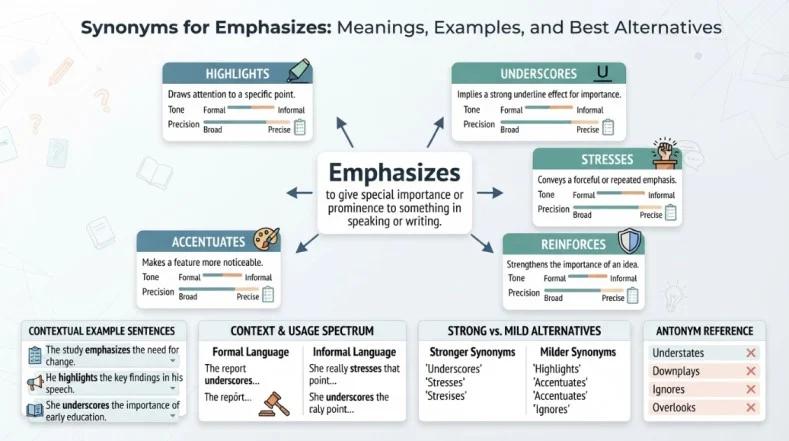
Emphasizes means gives special importance, attention, or prominence to something. Common alternatives include highlights for general writing, underscores for formal contexts, stresses for strong importance, and accentuates for descriptive or creative writing.
Meaning, Tone and Context
Simple Definition
Emphasizes means to give extra importance or attention to a particular idea, fact, quality, detail, or point.
For example:
The report emphasizes the importance of customer satisfaction.
Here, emphasizes tells readers that customer satisfaction receives particular attention.
Part of Speech
Emphasizes is a verb.
It is the third person singular present form of emphasize.
Related forms include:
• Emphasize
• Emphasizes
• Emphasized
• Emphasizing
• Emphasis
Tone
The word emphasizes is generally neutral. It can appear in positive, negative, academic, professional, personal, and descriptive contexts.
Its tone depends mainly on the surrounding sentence.
Formality Level
Emphasizes is moderately formal and works well in everyday writing as well as professional and academic communication.
It is especially common in essays, reports, presentations, articles, business documents, and analytical writing.
Common Use Cases
You can use emphasizes when discussing:
• Important ideas
• Key findings
• Main arguments
• Significant details
• Personal qualities
• Business priorities
• Academic conclusions
• Visual features
• Emotional qualities
• Important differences
When and How to Use “Emphasizes”
Use emphasizes when a person, document, image, action, or situation gives particular importance to something.
1. Academic Context
The study emphasizes the importance of regular reading for language development.
2. Professional Context
The manager emphasizes the need for clear communication among team members.
3. Personal Context
Her thoughtful response emphasizes how much she values the friendship.
4. Emotional Context
The final scene emphasizes the character’s sense of loneliness.
5. Creative Context
The soft lighting emphasizes the warmth of the room.
6. Social Media Context
This caption emphasizes the simple moments that make a weekend memorable.
7. Email Context
The updated proposal emphasizes our commitment to meeting the client’s goals.
Another Word for “Emphasizes”
The best single replacement for emphasizes is often highlights because it works naturally in many general, academic, and professional situations.
However, context matters.
Professional Writing
Use underscores, highlights, or reinforces when discussing an important business point.
Academic Writing
Use highlights, underscores, stresses, or foregrounds when presenting an important finding or argument.
Casual Conversation
Use points out, stresses, or draws attention to.
Emotional Writing
Use underscores, accentuates, or reinforces when the sentence involves feelings or emotional significance.
Creative Writing
Use accentuates, foregrounds, brings into focus, or showcases depending on the imagery.
Resume or Workplace Use
Use demonstrates, highlights, or showcases when describing skills, achievements, or professional strengths.
Social Media Captions
Use highlights, showcases, or draws attention to for a natural, accessible style.
Stronger Meaning
Use stresses, underscores, or insists on when you want to communicate stronger importance.
Softer Meaning
Use notes, mentions, points to, or draws attention to when the emphasis is more moderate.
When Not to Use “Emphasizes”
Although emphasizes is versatile, it is not always the most precise choice.
- If the sentence describes someone physically directing attention toward something, points to or draws attention to may be clearer.
- If the sentence describes visual prominence, accentuates may work better.
- If the sentence communicates strong importance, underscores or stresses may provide greater impact.
For example:
The report emphasizes the financial risk.
This is correct, but:
The report underscores the financial risk.
sounds stronger and more deliberate.
Words Commonly Confused With “Emphasizes”
Emphasizes vs. Highlights
Emphasizes means gives particular importance. Highlights means draws attention to something important or noticeable.
Both are often interchangeable, but highlights can sound slightly more visual or reader friendly.
Emphasizes vs. Stresses
Stresses usually communicates stronger importance or urgency.
The report emphasizes safety.
The report stresses safety.
The second sentence can suggest that safety deserves especially serious attention.
Emphasizes vs. Mentions
Mentions simply means refers to something.
It does not necessarily suggest that the subject is especially important.
Emphasizes vs. Demonstrates
Demonstrates means shows or proves something through evidence, behavior, or results.
A report can emphasize a point without demonstrating it.
Emphasizes vs. Explains
Explains means makes something understandable by providing information or reasons.
A writer can explain an idea without emphasizing it.
Emphasizes vs. Illustrates
Illustrates means makes an idea clearer through an example, image, comparison, or demonstration.
It focuses on clarity rather than importance.
Best Synonym by Context for “Emphasizes”
| Context | Best Synonym | Why It Works | Example |
|---|---|---|---|
| Formal writing | Underscores | Sounds precise and authoritative | The report underscores the need for reform. |
| Academic writing | Highlights | Clearly identifies an important finding | The study highlights several important trends. |
| Professional use | Reinforces | Shows that an idea is strengthened | The policy reinforces our commitment to quality. |
| Resume writing | Showcases | Presents a strength effectively | The portfolio showcases her design skills. |
| Casual conversation | Points out | Sounds natural and conversational | She points out the main problem. |
| Creative writing | Accentuates | Adds descriptive or visual depth | The lighting accentuates the character’s expression. |
| Emotional writing | Underscores | Adds weight to an emotional idea | The silence underscores his sadness. |
| Strong intensity | Stresses | Communicates greater urgency | The doctor stresses the importance of rest. |
| Soft intensity | Notes | Gives attention without strong force | The author notes a change in public opinion. |
| Social media captions | Highlights | Friendly and easy to understand | This photo highlights the beauty of the sunset. |
| Business presentations | Reinforces | Connects a point with an existing message | The example reinforces our central argument. |
| Visual description | Accentuates | Suggests increased visual prominence | The color accentuates the architectural details. |
| Research writing | Underscores | Gives an analytical point greater weight | The evidence underscores the value of early intervention. |
| Storytelling | Brings into focus | Creates a descriptive effect | The scene brings the character’s conflict into focus. |
| General writing | Draws attention to | Clearly describes directing attention | The article draws attention to a growing concern. |
Which Synonym Should You Choose?
Start by identifying what emphasizes means in your sentence.
- If you simply want to identify something important, highlights is usually the safest choice.
- If the point is especially significant, use underscores or stresses.
- If the sentence describes strengthening an existing message, choose reinforces.
- If you are describing appearance, design, or visual impact, accentuates can be more precise.
For professional documents, choose words that sound clear and measured. For creative writing, you have more freedom to choose descriptive alternatives.
The best synonym is not necessarily the most sophisticated word. It is the word that expresses the intended meaning most accurately.
Real Life Examples of “Emphasizes” in Sentences
School
The teacher emphasizes the importance of supporting every argument with evidence.
Workplace
The presentation emphasizes the company’s commitment to customer service.
Writing
The final paragraph emphasizes the main lesson of the article.
Conversation
She emphasizes that the decision should be based on facts.
Social Media
The image emphasizes the natural beauty of the landscape.
Resume
The candidate’s experience emphasizes her ability to manage complex projects.
Our revised proposal emphasizes flexibility and long term customer support.
Storytelling
The character’s quiet reaction emphasizes the seriousness of the situation.
25 Synonyms for “Emphasizes”
| Synonym | Simple Meaning | Best Used For | Example Sentence |
|---|---|---|---|
| Highlights | Gives attention to something important | General and professional writing | The article highlights the value of preparation. |
| Underscores | Gives strong importance to a point | Formal and academic writing | The evidence underscores the need for change. |
| Stresses | Shows that something is especially important | Strong or urgent contexts | The instructor stresses the importance of accuracy. |
| Accentuates | Makes a quality or feature more noticeable | Visual and creative writing | The lighting accentuates the room’s elegant design. |
| Reinforces | Makes an existing idea stronger | Business and analytical writing | The example reinforces the central argument. |
| Points out | Directs attention toward something | Conversation and accessible writing | The guide points out several common errors. |
| Draws attention to | Makes people notice something | General and explanatory writing | The campaign draws attention to environmental issues. |
| Spotlights | Gives special public attention | Media and modern writing | The article spotlights emerging local businesses. |
| Foregrounds | Places something in a prominent position | Literary and academic analysis | The novel foregrounds the effects of isolation. |
| Showcases | Presents something in an impressive way | Resumes, portfolios, marketing | Her portfolio showcases her strongest work. |
| Notes | Calls attention to a fact | Academic and professional writing | The researcher notes a significant difference. |
| Reiterates | Repeats an important point | Formal and professional communication | The director reiterates the company’s commitment to safety. |
| Magnifies | Makes something appear more significant or noticeable | Descriptive contexts | The close up view magnifies the smallest details. |
| Amplifies | Increases the strength or effect of something | Media, communication, and analysis | The interview amplifies concerns about the proposal. |
| Elevates | Raises the importance or status of something | Professional and creative writing | The design elevates the overall presentation. |
| Gives prominence to | Gives special importance or visibility | Formal writing | The report gives prominence to employee development. |
| Brings into focus | Makes something clearer or more noticeable | Analysis and storytelling | The discussion brings the central issue into focus. |
| Calls attention to | Directly makes something noticeable | General and professional use | The warning calls attention to a potential problem. |
| Accentuates | Makes a particular feature stand out | Descriptive writing | The contrast accentuates the painting’s central figure. |
| Underlines | Gives additional importance to an idea | Formal and general writing | The result underlines the importance of careful planning. |
| Marks | Shows or identifies something as significant | Analytical contexts | The decision marks a major change in company policy. |
| Reflects | Shows or expresses an underlying quality or idea | General and analytical writing | The result reflects the importance of teamwork. |
| Demonstrates | Shows something clearly through evidence or action | Academic and professional writing | The achievement demonstrates her leadership ability. |
| Illustrates | Makes an idea clearer through an example | Teaching and academic writing | The example illustrates the importance of preparation. |
| Calls out | Directly identifies something for attention | Modern workplace communication | The manager calls out the strongest parts of the proposal. |
Synonym Groups and Usage Differences
Professional vs. Personal Synonyms
Professional writing often benefits from words such as underscores, highlights, reinforces, and demonstrates.
Personal writing can use points out, draws attention to, stresses, or highlights without sounding overly formal.
For example, a business report may say:
The data underscores the need for improvement.
A personal message may say:
Her reaction points out how important the moment was.
Formal vs. Conversational Synonyms
For formal reports and essays, underscores, reiterates, foregrounds, and reinforces can work well.
For texts, conversations, and casual emails, points out, calls attention to, and highlights are usually more natural.
Academic Synonyms
Academic writing benefits from precision.
Highlights, underscores, foregrounds, demonstrates, and illustrates are useful when discussing research, evidence, arguments, or themes.
Choose demonstrates only when the evidence actually shows something. Do not use it merely as a sophisticated replacement for emphasizes.
Professional and Business Synonyms
For workplace communication, highlights, underscores, reinforces, showcases, and reiterates are strong choices.
For example:
The presentation highlights our strongest results.
The message reinforces our commitment to customer satisfaction.
Creative or Literary Synonyms
Creative writing gives you more room for descriptive language.
Accentuates, foregrounds, brings into focus, and amplifies can create a stronger sense of imagery or interpretation.
Use these words only when their specific meaning fits the scene.
Slang or Modern Synonyms
There is no true slang equivalent of emphasizes that works naturally across all situations.
Expressions such as calls out can sound modern and conversational, particularly in workplace communication.
However, calls out can sometimes mean publicly criticizing someone, so context matters.
Strongest vs. Weaker Synonyms
A useful intensity scale is:
Notes → Highlights → Draws attention to → Reinforces → Underscores → Stresses
This is not an absolute ranking because context changes the strength of each word.
Notes usually feels mild and factual.
Highlights gives clear importance.
Underscores and stresses generally communicate stronger significance.
Emotional vs. Neutral Synonyms
For neutral writing, use highlights, notes, or draws attention to.
For emotional or dramatic writing, underscores, accentuates, or amplifies can communicate greater weight.
Choose the emotional option carefully. A dramatic synonym can make an ordinary situation sound more serious than intended.
Antonyms of “Emphasizes”
| Antonym | Meaning | Example Sentence |
|---|---|---|
| Downplays | Makes something seem less important | The report downplays the potential risks. |
| Minimizes | Presents something as less significant | The statement minimizes the impact of the problem. |
| Understates | Describes something as less important or serious than it is | The summary understates the scale of the challenge. |
| Ignores | Gives no attention to something | The article ignores the financial consequences. |
| Overlooks | Fails to notice or consider something | The analysis overlooks an important detail. |
| Neglects | Fails to give proper attention | The plan neglects the needs of smaller communities. |
| Dismisses | Treats something as unimportant or unworthy of consideration | The reviewer dismisses the concern too quickly. |
| Obscures | Makes something less clear or noticeable | The complicated language obscures the main point. |
| Conceals | Keeps something from being noticed or known | The report conceals several important details. |
| Suppresses | Prevents something from receiving attention or expression | The policy suppresses discussion of the issue. |
| Sidelines | Pushes something away from primary attention | The new plan sidelines environmental concerns. |
| Trivializes | Makes something seem less serious or important | The comment trivializes a difficult experience. |
| Deemphasizes | Reduces the importance given to something | The revised strategy deemphasizes short term gains. |
| Disregards | Fails to consider something properly | The decision disregards important evidence. |
| Devalues | Treats something as having less worth or importance | The policy devalues creative contributions. |
Comparison: “Emphasizes” vs. Similar Words
“Emphasizes” vs. “Highlights”
Main difference: Both give attention to something, but highlights often sounds more accessible and visual.
Stronger: Usually similar, although emphasizes can sound more deliberate.
More formal: Both are suitable for formal writing.
Examples:
The report emphasizes employee safety.
The report highlights employee safety.
“Emphasizes” vs. “Underscores”
Main difference: Underscores often suggests that an idea deserves particular weight or significance.
Stronger: Underscores often feels stronger.
More formal: Underscores generally sounds more formal.
Examples:
The study emphasizes the importance of exercise.
The study underscores the importance of exercise.
“Emphasizes” vs. “Stresses”
Main difference: Stresses communicates particularly strong importance or urgency.
Stronger: Stresses is often stronger.
More formal: Both can work in formal contexts.
Examples:
The doctor emphasizes regular exercise.
The doctor stresses regular exercise.
“Emphasizes” vs. “Reinforces”
Main difference: Reinforces means strengthens an existing idea, belief, message, or conclusion.
Stronger: Neither is always stronger.
More formal: Both work well in professional writing.
Examples:
The example emphasizes the main point.
The example reinforces the main point.
“Emphasizes” vs. “Demonstrates”
Main difference: Demonstrates means shows something through evidence, action, or results.
Stronger: Demonstrates can make a claim sound more evidence based.
More formal: Demonstrates is common in academic and professional writing.
Examples:
The report emphasizes her leadership skills.
Her results demonstrate her leadership skills.
“Emphasizes” vs. “Accentuates”
Main difference: Accentuates makes a feature more noticeable or pronounced.
Stronger: Accentuates can create a stronger descriptive effect.
More formal: Accentuates often sounds more literary or polished.
Examples:
The design emphasizes the building’s shape.
The lighting accentuates the building’s shape.
Common Phrases and Expressions with “Emphasizes”
1. Emphasizes the Importance
Meaning: Gives special attention to why something matters.
Example sentence:
The course emphasizes the importance of clear writing.
2. Emphasizes the Need
Meaning: Shows that something is necessary or important.
Example sentence:
The report emphasizes the need for better communication.
3. Emphasizes a Point
Meaning: Gives extra importance to a particular idea.
Example sentence:
The speaker emphasizes a key point near the end of the presentation.
4. Emphasizes the Value
Meaning: Gives special attention to the usefulness or importance of something.
Example sentence:
The program emphasizes the value of practical experience.
5. Emphasizes the Difference
Meaning: Makes a distinction between two things more noticeable.
Example sentence:
The comparison emphasizes the difference between the two approaches.
6. Emphasizes Key Findings
Meaning: Gives particular attention to important results.
Example sentence:
The conclusion emphasizes the key findings from the research.
7. Emphasizes Quality
Meaning: Gives special importance to maintaining a high standard.
Example sentence:
The company emphasizes quality throughout its production process.
8. Emphasizes Personal Growth
Meaning: Gives particular importance to improvement and development.
Example sentence:
The program emphasizes personal growth through practical experience.
Common Mistakes to Avoid
1. Using “Emphasizes” When a More Precise Word Is Better
Not every situation requires the general word emphasizes.
If you mean that evidence proves something, demonstrates may be more accurate.
2. Confusing “Emphasizes” With “Mentions”
Mentioning something does not necessarily mean giving it special importance.
Use emphasizes when the subject receives noticeable attention.
3. Using a Casual Synonym in Formal Writing
Expressions such as calls out may sound conversational.
For an academic essay or formal report, highlights or underscores is usually safer.
4. Using an Overly Dramatic Synonym
Words such as stresses, amplifies, or underscores can sound too strong when the point is minor.
Match the strength of the synonym to the importance of the idea.
5. Repeating “Emphasizes” Too Often
Using the same word throughout an essay can make the prose feel repetitive.
Replace it with an accurate alternative such as highlights, underscores, reinforces, or draws attention to when the meaning remains correct.
6. Choosing the Wrong Emotional Tone
Accentuates can sound descriptive, while underscores can sound serious.
Think about the feeling you want the sentence to create before selecting a synonym.
7. Using Slang in Academic or Professional Writing
Modern expressions may work in conversation but sound inappropriate in research papers or formal reports.
Always consider the audience and purpose before choosing a casual alternative.
FAQs
What is the best synonym for “emphasizes”?
Highlights is often the best general synonym because it naturally communicates importance and works well in academic, professional, and everyday writing.
What is a formal synonym for “emphasizes”?
Underscores is a strong formal synonym for emphasizes. It works particularly well in reports, essays, research writing, presentations, and professional communication.
What is an informal synonym for “emphasizes”?
Points out is a natural conversational alternative. It directs attention toward an idea without sounding overly formal or technical.
What is another word for “emphasizes” in professional writing?
Highlights, underscores, and reinforces are excellent professional choices. The best option depends on whether you are identifying, strengthening, or stressing a point.
What is the difference between “emphasizes” and “highlights”?
Both words give special attention to something. Highlights often sounds more accessible, while emphasizes can suggest a more deliberate act of giving importance.
What is the opposite of “emphasizes”?
Common opposites include downplays, minimizes, understates, ignores, overlooks, and dismisses, depending on the intended meaning.
Conclusion
Emphasizes means gives special importance or attention to an idea, detail, quality, or point. It is a flexible verb that works in academic writing, business communication, everyday conversation, and creative contexts.
The best synonym for emphasizes depends on your purpose. Choose highlights for general use, underscores for stronger formal writing, stresses for urgency, reinforces for strengthening an existing idea, and accentuates for descriptive language.
The key vocabulary skill is not simply knowing more synonyms. It is knowing when each word fits. Before replacing emphasizes, consider the meaning, strength, tone, audience, and sentence context.
A practical tip is to read the entire sentence after choosing a synonym. If the replacement sounds natural and expresses exactly what you mean, you have probably made the right choice.
Discover More Post:
- 25+ Synonyms for Secret | Meanings, Examples, and Best …
- 25+ Synonyms for God | Meanings, Examples, and Best …
- 25+ Synonyms for Action | Meanings, Examples, and Best …