The word “manipulate” can be useful, but repeating it in essays, emails, workplace writing, captions, or everyday conversations can make your language feel predictable. The better choice depends on whether you mean influence, control, deceive, pressure, alter, or skillfully handle something.
This guide explains synonyms for manipulate with clear meanings, realistic examples, tone differences, and context based recommendations. You will learn which alternatives work best in academic writing, professional communication, emotional situations, creative writing, and casual conversation.
What Does “Manipulate” Mean?
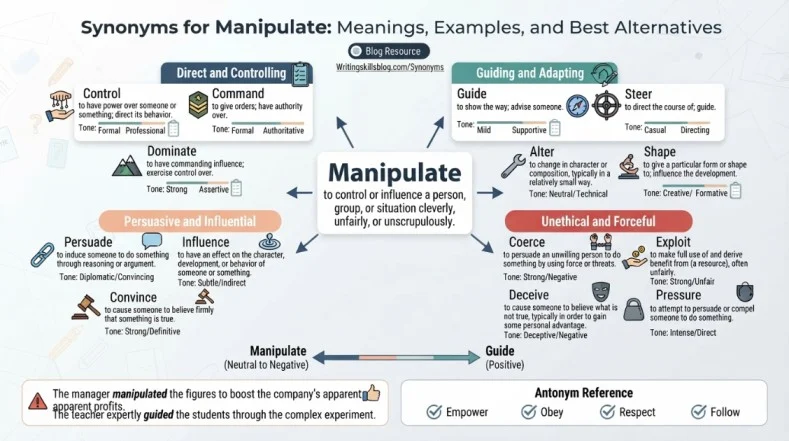
To manipulate means to control, influence, alter, or handle someone or something, often in a deliberate way. Depending on context, strong alternatives include influence, control, steer, persuade, exploit, alter, engineer, distort, pressure, and maneuver.
Meaning, Tone and Context
Simple Definition
“Manipulate” generally means to control or influence a person, situation, object, or result through deliberate action.
When used with people, the word often suggests unfair, indirect, or self serving influence. For example, someone may manipulate another person by using guilt or fear.
When used with objects, data, or systems, the meaning can be more neutral. A scientist may manipulate variables during an experiment, while an editor may manipulate an image.
Part of Speech
“Manipulate” is a verb.
Common forms include:
• Manipulate
• Manipulates
• Manipulated
• Manipulating
• Manipulation
• Manipulator
• Manipulative
Tone
The tone of “manipulate” depends strongly on context.
When describing a person controlling another person unfairly, it usually has a negative tone.
When describing technical work, the word can be neutral. For example, researchers manipulate variables to test a hypothesis.
Formality Level
“Manipulate” is suitable for formal, academic, professional, and everyday English.
However, it can sound accusatory when applied to a person. In sensitive situations, a more precise word such as influence, persuade, pressure, or guide may communicate the intended meaning more fairly.
Common Use Cases
The word commonly appears when discussing:
• Relationships
• Workplace behavior
• Marketing
• Politics
• Psychology
• Social interactions
• Research
• Data
• Images
• Technology
• Business strategy
• Negotiation
• Public communication
Important Word Forms
Manipulation: The act or process of manipulating.
Example: “The report revealed an attempt at data manipulation.”
Manipulator: A person who deliberately controls or influences others.
Example: “The manipulator used guilt to get what he wanted.”
Manipulative: Describing behavior intended to control or influence someone unfairly.
Example: “Her manipulative behavior damaged their friendship.”
When and How to Use “Manipulate”
Use “manipulate” when you want to communicate deliberate control, influence, alteration, or handling.
It is especially useful when the action involves changing something to produce a particular result.
1. Professional Context
“The manager was accused of trying to manipulate the performance data.”
Here, “manipulate” suggests that the data may have been changed or presented unfairly.
2. Personal Context
“He tried to manipulate his friend by making her feel guilty.”
The word clearly communicates emotional control.
3. Academic Context
“Researchers manipulated the temperature to observe changes in the reaction.”
This usage is neutral because the researchers intentionally changed a variable for experimental purposes.
4. Emotional Context
“She felt that her partner was manipulating her emotions.”
The sentence suggests intentional psychological influence.
5. Creative Context
“The artist manipulated light and shadow to create a dramatic effect.”
Here, “manipulate” describes skillful control rather than unethical behavior.
6. Social Media Context
“Edited images can manipulate how people perceive reality.”
The word suggests that visual changes can influence perception.
7. Email Context
“The figures appear to have been manipulated before the report was submitted.”
This is appropriate when discussing potentially altered information in a professional setting.
Another Word for “Manipulate”
The best single replacement depends on what you mean by “manipulate.”
- For professional writing, influence or control is often appropriate when the situation does not clearly involve deception.
- For academic writing, alter, modify, or control can be more precise, especially when discussing experiments, data, or variables.
- For casual conversation, control, play, or steer may sound more natural.
- For emotional writing, pressure, exploit, or coerce may be more precise when describing harmful behavior.
- For creative writing, maneuver, orchestrate, or shape can add descriptive depth.
- For resumes and workplace writing, influenced, guided, coordinated, or optimized may be better choices when the action was positive and ethical.
- For social media captions, steer, shape, influence, or control can provide a shorter and clearer expression.
- For a stronger meaning, consider coerce, exploit, dominate, or distort, depending on the situation.
- For a softer meaning, consider influence, guide, persuade, or steer.
When Not to Use “Manipulate”
“Manipulate” is not always the most precise word.
If you simply mean convincing someone, persuade may be better.
Instead of saying:
“She manipulated him into joining the project.”
You could write:
“She persuaded him to join the project.”
The second sentence sounds less accusatory.
If you mean changing something without implying dishonesty, modify or alter may be more suitable.
Instead of:
“The technician manipulated the settings.”
You might write:
“The technician adjusted the settings.”
If you mean unfair pressure, coerce may be more precise.
Instead of:
“He manipulated her into signing the agreement.”
You could write:
“He pressured her into signing the agreement.”
If you mean dishonest changes to information, distort, doctor, or falsify may communicate the problem more clearly, depending on the facts.
Words Commonly Confused With “Manipulate”
Manipulate vs. Influence
Influence means affecting someone’s thoughts, decisions, or behavior. It does not necessarily involve deception or unfairness.
Manipulate usually suggests more deliberate control and can carry a negative implication when people are involved.
Manipulate vs. Persuade
Persuade means convincing someone through reasoning, communication, or appeal.
Manipulate can involve persuasion, but it often suggests hidden motives or unfair emotional pressure.
Manipulate vs. Control
Control means having power over something or directing how it operates.
Manipulate often focuses on the methods used to create a desired result.
Manipulate vs. Coerce
Coerce means forcing someone to do something through threats, intimidation, or serious pressure.
Manipulate can be subtle, while coercion involves a much clearer form of force.
Manipulate vs. Deceive
Deceive means causing someone to believe something untrue.
Manipulation can involve deception, but manipulation does not always require lying.
Manipulate vs. Modify
Modify means changing something, usually to improve it, adapt it, or make it suitable for another purpose.
Manipulate can also mean change, but it often highlights deliberate control or handling.
Best Synonym by Context for “Manipulate”
| Context | Best Synonym | Why It Works | Example |
|---|---|---|---|
| Formal writing | Influence | Professional and broad | The campaign influenced public opinion. |
| Academic writing | Alter | Precise for intentional changes | Researchers altered the conditions of the experiment. |
| Professional use | Influence | Neutral and appropriate | Her presentation influenced the team’s decision. |
| Resume | Guided | Positive and achievement focused | Guided a team through a major process improvement. |
| Business | Steer | Suggests directing an outcome | The director steered the company toward a new market. |
| Casual conversation | Control | Simple and familiar | He likes to control every part of the project. |
| Creative writing | Orchestrate | Suggests carefully arranging events | She orchestrated the entire scene. |
| Emotional context | Exploit | Highlights unfair use of vulnerability | He exploited her trust for personal gain. |
| Strong intensity | Coerce | Clearly communicates force | They coerced him into accepting the deal. |
| Soft or moderate tone | Guide | Less accusatory | She guided the discussion toward a solution. |
| Social media | Shape | Concise and flexible | Media can shape how people see an issue. |
| Data or information | Alter | Focuses on changing information | Someone altered the original figures. |
| Images | Edit | Natural for visual changes | The photographer edited the image. |
| Negotiation | Maneuver | Suggests strategic movement | The company maneuvered around the restriction. |
| Persuasion | Persuade | Focuses on convincing someone | She persuaded him to reconsider. |
| Deceptive behavior | Deceive | Directly identifies dishonesty | The seller deceived customers about the product. |
Which Synonym Should You Choose?
Start by identifying the exact action behind “manipulate.”
- If someone is simply affecting another person’s decision, choose influence.
- If someone is convincing another person through communication, choose persuade.
- If someone is directing a process, choose control, guide, or steer.
- If someone is using another person’s weakness for personal benefit, choose exploit.
- If someone is forcing another person through serious pressure or threats, choose coerce.
- If someone is changing information, choose alter, modify, distort, or doctor, depending on what actually happened.
- If the situation involves carefully arranging events, orchestrate may be the strongest creative or strategic choice.
The safest approach is to choose the word that describes the specific behavior rather than automatically selecting the most negative synonym.
Real Life Examples of “Manipulate” in Sentences
School
“The student manipulated the experimental conditions to test how temperature affected growth.”
Workplace
“The supervisor was criticized for manipulating the numbers in the monthly report.”
Writing
“The author manipulates the reader’s expectations before revealing the truth.”
Conversation
“Don’t try to manipulate me into changing my decision.”
Social Media
“Carefully edited photos can manipulate viewers’ perceptions.”
Resume
“Guided cross functional teams through a complex organizational change.”
“We should review the figures to determine whether any data was manipulated.”
Storytelling
“The director skillfully manipulated suspense to keep the audience engaged.”
25 Synonyms for “Manipulate”
| Synonym | Simple Meaning | Best Used For | Example Sentence |
|---|---|---|---|
| Influence | Affect someone’s thoughts or actions | Neutral influence | Her research influenced the final decision. |
| Control | Direct or govern something | Power and authority | He tried to control the entire process. |
| Persuade | Convince someone | Communication | She persuaded her colleague to reconsider. |
| Steer | Direct something toward a result | Decisions and direction | The manager steered the discussion toward a practical solution. |
| Guide | Help direct someone or something | Softer professional tone | The mentor guided the team through the transition. |
| Alter | Change something | Data, conditions, or objects | The technician altered the settings before testing the device. |
| Modify | Make changes to something | Technical and academic writing | The researcher modified the procedure for the second trial. |
| Shape | Influence how something develops | Opinions, behavior, or outcomes | Early experiences can shape a person’s worldview. |
| Maneuver | Move or act strategically | Business and strategy | The company maneuvered carefully through the changing market. |
| Orchestrate | Arrange events carefully | Complex plans and creative contexts | She orchestrated the event from beginning to end. |
| Exploit | Use someone or something unfairly | Vulnerability or opportunity | The company exploited a gap in the regulations. |
| Coerce | Force someone through pressure | Serious pressure | They coerced the witness into changing his statement. |
| Pressure | Push someone toward a decision | Emotional or social situations | He pressured his friend to accept the offer. |
| Deceive | Make someone believe something false | Dishonesty | The advertisement deceived customers about the product’s features. |
| Distort | Change something so it becomes misleading | Facts and information | The article distorted the original findings. |
| Doctor | Secretly alter information | Informal discussions of dishonest changes | Someone appeared to have doctored the documents. |
| Rig | Arrange something unfairly | Competitions, systems, or outcomes | Critics claimed that the selection process was rigged. |
| Stage | Arrange an event to create an impression | Public appearances or scenes | The company staged the demonstration for reporters. |
| Contrive | Create or arrange something deliberately | Formal or literary writing | The plot felt carefully contrived. |
| Dominate | Exercise strong control or power | Relationships, competition, or systems | One company dominates the local market. |
| Finesse | Handle something skillfully | Negotiation and difficult situations | She finessed the negotiation without creating conflict. |
| Play | Use someone or a situation for personal advantage | Informal conversation | He knew exactly how to play the situation to his advantage. |
| Tamper | Interfere with something improperly | Equipment, evidence, or records | Someone had tampered with the security system. |
| Shape | Influence development or perception | Ideas and outcomes | Advertising can shape consumer preferences. |
| Handle | Deal with or manage something | Practical situations | She handled the difficult conversation with confidence. |
Synonym Groups and Usage Differences
Professional vs. Personal Synonyms
Professional communication usually benefits from neutral words such as influence, guide, steer, shape, and manage.
These choices describe an action without automatically accusing someone of unethical behavior.
Personal situations often require stronger vocabulary. Words such as pressure, exploit, coerce, and deceive can identify specific harmful behaviors.
For example, “She influenced the decision” is neutral, while “She exploited his insecurity” clearly communicates an unfair action.
Formal vs. Conversational Synonyms
Formal writing favors words such as alter, modify, distort, influence, orchestrate, and contrive.
Casual conversation often sounds more natural with control, play, pressure, steer, or handle.
Choose based on the audience. A research paper should not sound like a text message, and a casual conversation does not need unnecessarily technical vocabulary.
Academic Synonyms
Academic writing requires precision.
- Use alter when something is intentionally changed.
- Use modify when an existing method, system, or procedure is adjusted.
- Use control when researchers manage variables or conditions.
- Use influence when one factor affects another.
- Use distort when information becomes misleading or inaccurate.
- For example:
“Researchers altered the temperature.”
This is more precise than simply saying:
“Researchers manipulated the temperature.”
The original word is not wrong, but the specific alternative tells readers exactly what happened.
Professional and Business Synonyms
Business writing often benefits from neutral language.
Instead of saying that a manager “manipulated” employees, consider whether the actual action was to guide, persuade, influence, pressure, or coerce.
The distinction matters because these words communicate different levels of intent and ethical concern.
For resumes, positive alternatives are often better. Guided, influenced, coordinated, managed, and steered can communicate leadership without suggesting unethical behavior.
Creative or Literary Synonyms
Creative writing gives you more freedom to choose words based on emotional effect.
Orchestrate suggests careful planning.
Maneuver suggests strategy.
Shape suggests gradual influence.
Distort suggests a change that creates an inaccurate impression.
Contrive can suggest something artificial or overly planned.
These words can make descriptions more specific and vivid.
Slang or Modern Synonyms
Some informal expressions can communicate manipulation in everyday speech.
Play someone can mean taking advantage of someone’s emotions or expectations.
Work someone can describe deliberately using charm or persuasion to get a result.
These expressions are conversational rather than academic. They should generally be avoided in formal reports, research papers, resumes, and professional documents.
Strongest vs. Weaker Synonyms
A useful intensity scale is:
Guide: mild and supportive.
Influence: mild to moderate and generally neutral.
Persuade: moderate and focused on convincing.
Steer: moderate and focused on direction.
Pressure: stronger and suggests unwanted influence.
Exploit: strong and suggests unfair use of a weakness or opportunity.
Deceive: strong and specifically involves misleading someone.
Coerce: very strong and implies force, threats, or serious pressure.
Dominate: very strong when describing sustained power or control.
The strongest word is not always the best word. Accuracy matters more than intensity.
Emotional vs. Neutral Synonyms
Neutral choices include influence, guide, alter, modify, and shape.
Emotionally stronger choices include exploit, deceive, pressure, coerce, and dominate.
Compare:
- “She influenced his decision.”
- “She manipulated his decision.”
- “She coerced him into accepting the decision.”
- Each sentence creates a different impression of intent and pressure.
Antonyms of “Manipulate”
Because “manipulate” has several meanings, its antonyms depend on the context. The following words represent accurate opposites in common situations.
| Antonym | Meaning | Example Sentence |
|---|---|---|
| Release | Stop controlling or holding | She released control of the project. |
| Free | Remove control or restriction | The policy freed employees to make their own decisions. |
| Trust | Allow someone to act independently | The manager trusted her team to handle the task. |
| Respect | Honor another person’s autonomy | Good leaders respect individual choices. |
| Accept | Allow something without trying to change it | He accepted the result without interference. |
| Preserve | Keep something unchanged | The editor preserved the original meaning. |
| Maintain | Keep something in its existing state | The technician maintained the original settings. |
| Stabilize | Keep something steady | The treatment helped stabilize the system. |
| Clarify | Make something easier to understand | The report clarified the confusing information. |
| Inform | Give accurate information | The organization informed customers about the change. |
| Empower | Give someone greater independence or authority | The program empowered students to make decisions. |
| Encourage | Support someone positively | Her teacher encouraged her to speak confidently. |
| Liberate | Free from control or restriction | The reform helped liberate workers from unfair restrictions. |
| Disclose | Reveal information openly | The company disclosed the relevant financial information. |
| Surrender | Give up control | He surrendered control of the project to the new director. |
Comparison: “Manipulate” vs. Similar Words
Manipulate vs. Influence
The main difference is implication.
Manipulate often suggests deliberate control, hidden motives, or unfair influence when people are involved.
Influence is broader and can be completely positive or neutral.
Manipulate is usually stronger and more negative.
Influence is more neutral and suitable for professional communication.
Example:
“He manipulated his colleague into agreeing.”
“Her research influenced the committee’s decision.”
Manipulate vs. Persuade
Persuade focuses on convincing someone.
Manipulate suggests that the method of influence may be indirect, unfair, or self serving.
Manipulate is usually more negative.
Persuade is more neutral and commonly used in formal writing.
Example:
“She persuaded the client to reconsider.”
“She manipulated the client by using his fears.”
Manipulate vs. Control
Control focuses on power, authority, or direction.
Manipulate focuses more on the deliberate method used to affect a person, object, or result.
Manipulate can be more subtle.
Control can be more direct.
Example:
“The supervisor controls the budget.”
“He manipulated the figures to make the results look better.”
Manipulate vs. Coerce
Coerce is much more specific.
It means forcing someone through threats, intimidation, or serious pressure.
Manipulate can happen without direct force.
Coerce is stronger when force is involved.
Example:
“She manipulated him through guilt.”
“They coerced him through threats.”
Manipulate vs. Deceive
Deceive means deliberately causing someone to believe something false.
Manipulation can involve deception, but it can also involve pressure, guilt, emotional tactics, or strategic influence.
Deceive is more specific when lying or misleading is central.
Example:
“The seller deceived the customer about the product.”
“The seller manipulated the customer into buying more than necessary.”
Manipulate vs. Alter
Alter simply means to change something.
Manipulate can mean to alter something, but it can also refer to influencing people or controlling situations.
Alter is more neutral.
Manipulate can imply deliberate interference.
Example:
“The editor altered the sentence.”
“The editor manipulated the wording to create a misleading impression.”
Common Phrases and Expressions with “Manipulate”
1. Manipulate the data
Meaning:
To deliberately change or present data in a way that affects its interpretation.
Example sentence:
“The analyst was accused of manipulating the data to support the conclusion.”
2. Manipulate public opinion
Meaning:
To deliberately influence how people think about an issue.
Example sentence:
“Political advertising can sometimes manipulate public opinion.”
3. Manipulate emotions
Meaning:
To use someone’s feelings to influence their behavior.
Example sentence:
“He tried to manipulate her emotions by repeatedly bringing up the past.”
4. Manipulate the situation
Meaning:
To arrange or influence circumstances to achieve a desired outcome.
Example sentence:
“She manipulated the situation so that she would receive most of the credit.”
5. Manipulate someone into doing something
Meaning:
To influence someone until they do something they might not otherwise choose to do.
Example sentence:
“He manipulated his friend into paying for the entire meal.”
6. Manipulate the results
Meaning:
To alter or influence results in a potentially unfair or misleading way.
Example sentence:
“The investigation examined whether anyone had manipulated the results.”
7. Manipulate an image
Meaning:
To digitally or physically alter an image.
Example sentence:
“The designer manipulated the image to improve its composition.”
Common Mistakes to Avoid
1. Using “Manipulate” When a More Precise Synonym Is Better
Not every form of influence is manipulation.
If someone simply convinces another person, persuade may be more accurate.
2. Confusing Manipulation With Influence
Influence can be ethical, supportive, accidental, or neutral.
Manipulation often suggests intentional control and can imply questionable motives.
3. Using a Casual Synonym in Formal Writing
Expressions such as play someone may sound natural in conversation but are inappropriate in most academic or professional writing.
Use influence, persuade, pressure, or another precise term instead.
4. Choosing an Overly Dramatic Synonym
Calling ordinary persuasion “coercion” can exaggerate the situation.
Use coerce only when the circumstances genuinely involve force, threats, or serious pressure.
5. Repeating “Manipulate” Too Often
Repetition can make writing feel flat.
Replace repeated uses with accurate alternatives such as influence, alter, shape, steer, or persuade.
6. Choosing the Wrong Emotional Tone
Words such as exploit, deceive, and coerce carry serious negative meanings.
Do not use them when you only mean ordinary influence.
7. Using Slang in Academic or Professional Writing
Informal phrases can be effective in conversation but may weaken formal writing.
Choose precise standard English for essays, reports, resumes, and workplace communication.
FAQs
What is the best synonym for manipulate?
The best synonym depends on context. Influence is a strong general alternative, while control, persuade, alter, exploit, or coerce may be better for specific meanings.
What is a formal synonym for manipulate?
Formal alternatives include influence, alter, modify, orchestrate, distort, and maneuver. The correct choice depends on whether you mean control, change, or strategy.
What is an informal synonym for manipulate?
In casual conversation, people may use play, work, pressure, or steer. These choices vary in meaning and should match the situation.
What is another word for manipulate in professional writing?
Influence, guide, steer, manage, and shape are useful professional alternatives when the action is not clearly deceptive or unethical.
What is the difference between manipulate and influence?
Influence simply means affecting a person, decision, or outcome. Manipulate often suggests deliberate, indirect, or unfair control, especially when people are involved.
What is the opposite of manipulate?
Possible opposites include respect, trust, empower, accept, preserve, inform, and release, depending on whether manipulation involves people, information, or control.
Conclusion
“Manipulate” can describe controlling a person, influencing an outcome, changing information, or skillfully handling something. Its meaning changes considerably with context, so choosing a precise synonym is more useful than simply finding a word that looks similar.
For neutral situations, consider influence, guide, shape, or steer. Changes to information or systems, alter and modify may be better. For harmful behavior, exploit, deceive, pressure, and coerce communicate increasingly specific meanings.
The best synonym for manipulate is the one that accurately reflects your intended meaning, tone, and audience. A practical vocabulary habit is to ask yourself what actually happened before replacing the word. Did someone influence, persuade, pressure, deceive, change, or control something? That small distinction can make your writing much clearer and more precise
Discover More Post:
- 25+ Synonyms for Secret | Meanings, Examples, and Best …
- 25+ Synonyms for God | Meanings, Examples, and Best …
- 25+ Synonyms for Action | Meanings, Examples, and Best …