Do you keep using the word “potential” in resumes, emails, essays, captions, or everyday conversations? It is useful, but repeating it can make your writing sound vague.
The best synonym depends on what you mean. A person may have ability or aptitude, a business may have promise or opportunity, while an uncertain outcome may be a possibility or prospect.
This guide explains synonyms for potential by meaning, tone, intensity, and context. You will learn which alternatives sound natural in professional writing, academic work, casual conversation, creative writing, and resumes.
What Does “Potential” Mean?
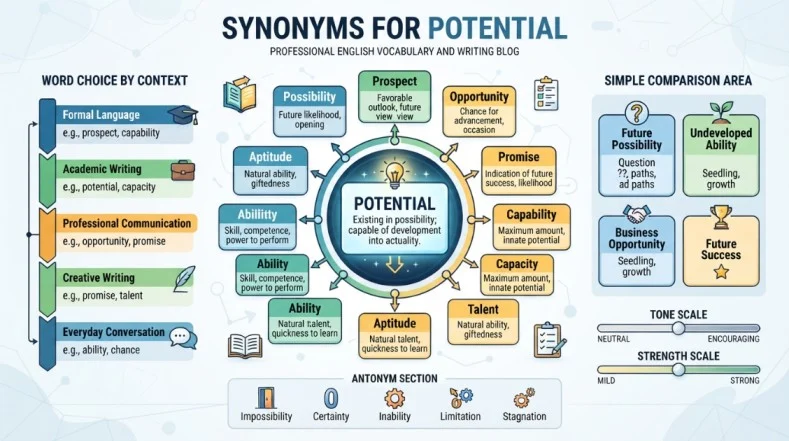
Potential means having the ability, capacity, or possibility to develop into something in the future. Depending on context, useful synonyms include possibility, prospect, capability, capacity, promise, opportunity, ability, and aptitude.
Meaning, Tone and Context
Simple Definition
Potential refers to something that could happen, develop, or become successful in the future. It can describe a possibility or an existing ability that has not yet been fully developed.
For example, “The project has potential” means the project could become successful or valuable.
When you say, “She has great potential,” you mean she has abilities or qualities that could lead to strong future results.
Part of Speech
Potential can function as both a noun and an adjective.
As a noun:
“The student has enormous potential.”
Here, potential refers to an ability or capacity that could develop.
As an adjective:
“We identified a potential customer.”
Here, potential means possible or likely in the future.
Tone
Potential is usually neutral to positive.
When describing a person, it often suggests encouragement, talent, or future growth.
When describing a problem, however, it can introduce a possible negative outcome.
“The software has potential.”
“The storm presents a potential risk.”
Formality Level
Potential is suitable for casual conversation, academic writing, professional communication, resumes, business reports, and formal presentations.
It is a versatile word, but it can become vague when used repeatedly without explaining what the expected ability, opportunity, or outcome actually is.
Common Use Cases
Potential commonly appears when discussing:
- Future success
- Ability or talent
- Business opportunities
- Career development
- Possible outcomes
- Future customers
- New products
- Risks and problems
- Academic performance
- Personal growth
Important Word Forms
Potential, noun and adjective
Potentially, adverb
Potentiality, noun, used mainly in formal or philosophical contexts
Related concepts include ability, capacity, possibility, opportunity, development, growth, and future success.
When and How to Use “Potential”
Use potential when you want to emphasize something that exists now but could become more significant, successful, capable, or developed in the future.
1. Professional Context
“The new marketing strategy has significant potential for increasing customer engagement.”
Here, potential refers to a possible future benefit.
2. Personal Context
“She has the potential to become an excellent leader.”
The sentence focuses on an ability that may develop with experience.
3. Academic Context
“The research findings have potential applications in environmental science.”
Potential describes possible future uses.
4. Emotional Context
“He saw potential in a young musician who had never performed publicly.”
Here, potential expresses belief in someone’s developing ability.
5. Creative Context
“The empty building had the potential to become a beautiful community space.”
The word highlights an unrealized possibility.
6. Social Media Context
“This little project has so much potential.”
This casual sentence suggests excitement about future possibilities.
7. Email Context
“I believe this partnership has strong potential for both organizations.”
Potential sounds professional while leaving room for future development.
Another Word for “Potential”
The best single replacement depends on the intended meaning.
- If you mean something that could happen, use possibility.
- If you mean future opportunity, use prospect or opportunity.
- If you mean ability that has not been fully developed, use capacity, ability, or aptitude.
- If you mean signs of future success, use promise.
Professional Writing
Use prospect, opportunity, capacity, capability, or promise.
“The company has strong growth prospects.”
Academic Writing
Use possibility, capacity, capability, feasibility, or scope, depending on the sentence.
“The technology has considerable potential for further research.”
Casual Conversation
Use chance, possibility, opportunity, or simply ability.
“I think this idea has a real chance of working.”
Emotional Writing
Use promise, possibility, talent, or ability.
“Everyone could see the promise in her early work.”
Creative Writing
Use promise, possibility, scope, future, or capacity.
“The quiet village held the promise of a completely different life.”
Resume or Workplace Use
Use capability, capacity, ability, aptitude, promise, or a specific achievement instead of vague potential.
“Demonstrated ability to manage competing priorities.”
This is usually more concrete than saying, “Demonstrated great potential.”
Social Media Captions
Use possibility, promise, chance, future, or opportunity.
“So much promise in this little project.”
Stronger Meaning
Use exceptional ability, strong capability, considerable capacity, or great promise when the context supports a stronger claim.
Softer Meaning
Use possibility, prospect, or room for growth when you want to avoid making a strong prediction.
When Not to Use “Potential”
Potential is not always the most precise choice.
When You Mean a Specific Ability
Instead of:
“She has potential in mathematics.”
Consider:
“She has strong mathematical ability.”
Ability tells the reader exactly what you mean.
When You Mean a Business Opportunity
Instead of:
“There is potential in this market.”
Consider:
“There is a significant opportunity in this market.”
Opportunity emphasizes a practical opening for action.
When You Mean a Possible Event
Instead of:
“There is potential for rain.”
Consider:
“There is a possibility of rain.”
Possibility is clearer when you are discussing whether something may happen.
When You Mean Expected Success
Instead of:
“The product has potential.”
Consider:
“The product shows strong promise.”
Promise suggests evidence that future success may be possible.
When You Need Precision
Potential can sometimes hide the exact reason something may succeed.
Instead of:
“He has potential.”
You could write:
“He demonstrates strong analytical ability and learns new systems quickly.”
The second sentence gives the reader useful evidence.
Words Commonly Confused With “Potential”
Potential vs. Possibility
Potential often suggests capacity or future development. Possibility usually means that something may happen.
“The athlete has potential.”
“There is a possibility that the athlete will compete.”
Potential vs. Probability
Potential does not necessarily indicate how likely something is. Probability specifically concerns likelihood.
“The project has potential.”
“The probability of success is high.”
Potential vs. Opportunity
Potential describes possible development or future value. Opportunity describes a favorable situation or opening for action.
“The business has potential.”
“The new market offers an opportunity for expansion.”
Potential vs. Capability
Potential can refer to undeveloped ability. Capability refers more directly to the ability to do something.
“The employee has potential.”
“The employee has the capability to manage the project.”
Potential vs. Prospect
Prospect can refer to a future possibility, expected outcome, or promising opportunity.
“The project has potential.”
“The project has promising prospects.”
Potential vs. Promise
Promise emphasizes signs that something or someone may become successful or valuable.
“The young writer has potential.”
“The young writer shows great promise.”
Best Synonym by Context for “Potential”
| Context | Best Synonym | Why It Works | Example |
|---|---|---|---|
| Formal writing | Prospect | Sounds polished when discussing future outcomes | “The proposal has promising prospects.” |
| Academic writing | Possibility | Clearly expresses something that may occur | “The findings raise the possibility of further research.” |
| Professional or business use | Opportunity | Emphasizes an opening for action or growth | “The market presents a major opportunity.” |
| Resume | Capability | Focuses on demonstrated ability | “Demonstrated capability in project coordination.” |
| Casual conversation | Chance | Natural and conversational | “There is a good chance this idea will work.” |
| Creative writing | Promise | Suggests future value or success | “The young artist showed remarkable promise.” |
| Emotional tone | Promise | Adds warmth and encouragement | “Her early work showed real promise.” |
| Strong intensity | Capacity | Highlights substantial ability or room for development | “The organization has considerable capacity for growth.” |
| Soft or moderate tone | Possibility | Avoids making a strong prediction | “There is a possibility of further improvement.” |
| Social media captions | Possibility | Simple and accessible | “So many possibilities ahead.” |
| Future success | Promise | Suggests signs of future achievement | “The new product shows strong promise.” |
| Human ability | Ability | Direct and easy to understand | “He has exceptional ability in mathematics.” |
| Learning or development | Aptitude | Highlights natural ability to learn or perform | “She has a strong aptitude for languages.” |
| Business growth | Opportunity | Connects potential with practical action | “The expansion creates a new opportunity.” |
| Technical work | Capability | Describes what a system or person can do | “The platform has advanced analytical capabilities.” |
| Feasibility discussions | Feasibility | Focuses on whether something can realistically work | “The study examines the feasibility of the proposal.” |
| Scope of development | Scope | Highlights room for expansion | “The project has considerable scope for improvement.” |
| Future customers | Prospect | Common in sales and business contexts | “The team contacted several prospective clients.” |
| Possible risk | Possibility | Clearly communicates an uncertain outcome | “There is a possibility of supply delays.” |
| US and UK usage | Potential | Common and widely understood in both varieties | “The candidate has considerable potential.” |
Which Synonym Should You Choose?
Start by identifying what potential means in your sentence.
- If you are talking about something that may happen, choose possibility.
- If you are discussing a favorable opening, choose opportunity.
- If you are describing future success, choose promise or prospect.
- If you are discussing a person’s ability, choose ability, capacity, capability, or aptitude.
- If you are writing for a professional audience, prefer a word that explains the specific idea rather than simply replacing potential with another broad term.
Consider formality as well. Chance sounds conversational, while feasibility sounds more technical and formal.
Emotional intensity also matters. Promise can sound encouraging, while possibility is more neutral.
The best synonym is therefore the word that preserves both the original meaning and the intended tone.
Real Life Examples of “Potential” in Sentences
School
“The teacher recognized the student’s potential in science.”
A more precise alternative could be:
“The teacher recognized the student’s aptitude for science.”
Workplace
“The manager sees potential in the new employee.”
A stronger professional version could be:
“The manager sees strong leadership capability in the new employee.”
General Writing
“The technology has potential to change how people access information.”
A more precise version could be:
“The technology has significant potential to improve access to information.”
Conversation
“I think this restaurant has potential.”
A casual alternative is:
“I think this restaurant has a good chance of becoming popular.”
Social Media
“This little project has so much potential.”
A more expressive alternative is:
“This little project has so much promise.”
Resume
“I have the potential to lead complex projects.”
A stronger resume statement is:
“I have demonstrated the ability to lead complex projects.”
“I believe this collaboration has strong potential.”
A more specific version is:
“I believe this collaboration offers a strong opportunity for mutual growth.”
Storytelling
“The abandoned house had potential.”
A more creative version could be:
“The abandoned house held the promise of becoming a beautiful home.”
25 Synonyms for “Potential”
| Synonym | Simple Meaning | Best Used For | Example Sentence |
|---|---|---|---|
| Possibility | Something that may happen or exist | Future events and outcomes | “There is a possibility that the plan will succeed.” |
| Prospect | A possible future result or opportunity | Business and future outcomes | “The company has promising prospects for expansion.” |
| Chance | An opportunity or likelihood | Casual conversation | “There is a good chance that the team will finish early.” |
| Opportunity | A favorable situation for action or growth | Business, careers, and practical situations | “The new position offers an opportunity to develop leadership skills.” |
| Promise | Signs of future success or value | People, products, creative work | “The young designer shows considerable promise.” |
| Likelihood | The degree to which something may happen | Formal and analytical writing | “The analysis considers the likelihood of further growth.” |
| Probability | The measurable likelihood of an event | Academic, scientific, and technical contexts | “The model estimates the probability of failure.” |
| Feasibility | The practicality of achieving something | Projects and technical planning | “The team studied the feasibility of the proposed system.” |
| Capability | The ability to perform a task | Professional and technical contexts | “The software has the capability to process large datasets.” |
| Capacity | The amount of ability or room available | People, organizations, and systems | “The organization has the capacity to support more clients.” |
| Ability | The skill or power to do something | People and general writing | “She has the ability to solve complex problems.” |
| Aptitude | A natural ability to learn or perform well | Education and careers | “His aptitude for languages became clear during high school.” |
| Talent | Natural skill or exceptional ability | People and creative fields | “The student has remarkable talent as a musician.” |
| Scope | The amount of room for development or expansion | Projects, research, and business | “There is plenty of scope for improvement.” |
| Room | Space or opportunity for development | Informal and professional writing | “The design still has room for improvement.” |
| Potentiality | The state of being possible or capable of development | Formal or philosophical discussion | “The theory considers the potentiality of future change.” |
| Outlook | The expected future situation | Business and general forecasting | “The industry’s outlook remains positive.” |
| Future | A later state or stage that may develop | Personal and creative contexts | “The program could shape the future of digital education.” |
| Expectancy | An expectation about a future outcome | Formal or specialized contexts | “The policy was introduced with the expectancy of greater efficiency.” |
| Capacity for growth | Ability to develop further | Organizations and individuals | “The team has a strong capacity for growth.” |
| Untapped ability | Ability that has not yet been fully used | People and personal development | “The coach recognized her untapped ability.” |
| Latent ability | Hidden or undeveloped skill | Academic and professional discussion | “The training helped reveal his latent ability.” |
| Future possibility | Something that may develop later | General and explanatory writing | “Relocation remains a future possibility.” |
| Growth opportunity | A situation that allows development | Business and career contexts | “The program provides a valuable growth opportunity.” |
| Emerging capability | A developing ability | Technology and professional contexts | “The platform is gaining an emerging capability in automated analysis.” |
Synonym Groups and Usage Differences
Professional vs. Personal Synonyms
Professional writing benefits from specific words such as capability, capacity, opportunity, prospect, and feasibility.
Personal writing can use warmer alternatives such as promise, talent, ability, and possibility.
For example:
“The candidate has leadership potential.”
A more professional version could be:
“The candidate demonstrates strong leadership capability.”
For personal encouragement:
“She has enormous potential as an artist.”
You could also say:
“She shows enormous promise as an artist.”
Formal vs. Conversational Synonyms
For formal reports and academic writing, probability, likelihood, feasibility, capacity, and possibility can provide greater precision.
For casual conversation, chance, opportunity, ability, and promise usually sound more natural.
Compare:
“There is a high probability of success.”
With:
“There is a good chance it will work.”
Both communicate uncertainty, but their tones are different.
Academic Synonyms
Academic writing often requires precision.
- Use possibility when discussing an outcome that may occur.
- Use probability when discussing measurable likelihood.
- Use feasibility when evaluating whether something can realistically be done.
- Use capacity when discussing an ability or capability.
For example:
“The research examines the feasibility of using solar energy in rural communities.”
That is more precise than simply saying:
“The research examines the potential of solar energy.”
Professional and Business Synonyms
Business writing frequently uses opportunity, prospect, capability, capacity, and outlook.
- Choose opportunity when there is an actionable opening.
- Choose prospect when discussing a possible future result or business relationship.
- Choose capability when describing what a person, system, or organization can do.
- Choose outlook when discussing expected future conditions.
Creative or Literary Synonyms
Creative writing can benefit from promise, possibility, future, and scope.
For example:
“The empty studio held endless possibilities.”
Or:
“The young painter’s work carried a quiet promise.”
These alternatives can create more atmosphere than the broad word potential.
Slang or Modern Synonyms
There is no single widely accepted slang synonym for potential that works across contexts.
Casual expressions such as a real shot, a good chance, or something big may communicate similar ideas in conversation.
For example:
“This idea has a real shot.”
This is casual and should generally be avoided in academic papers, formal reports, and professional documents unless the tone intentionally allows conversational language.
Strongest vs. Weaker Synonyms
An intensity scale depends on context, but a useful progression is:
Possibility
A neutral indication that something may happen.
Prospect
A somewhat more focused future possibility.
Opportunity
A possibility that may offer a useful opening.
Promise
Evidence or signs that future success may occur.
Strong capability
A more direct statement about actual ability.
Exceptional ability
A strong claim about demonstrated skill.
Remember that stronger wording should be supported by evidence. Do not use an intense synonym simply to make a sentence sound impressive.
Emotional vs. Neutral Synonyms
Possibility, likelihood, and probability tend to be neutral.
Promise, talent, and hope can sound more emotional or encouraging.
For example:
“There is a possibility of improvement.”
This is factual and neutral.
“The young athlete shows great promise.”
This sounds more positive and encouraging.
Antonyms of “Potential”
The appropriate opposite depends on whether potential means future possibility, undeveloped ability, or possible future development.
| Antonym | Meaning | Example Sentence |
|---|---|---|
| Impossibility | Something that cannot happen | “Under these conditions, success is an impossibility.” |
| Certainty | Something that is definitely known or expected | “The result is now a certainty.” |
| Actuality | The state of existing in reality | “The discussion moved from potential to actuality.” |
| Completion | The state of being fully finished | “The project moved from potential development to completion.” |
| Fulfillment | The realization of an ability or possibility | “Training helped turn potential into fulfillment.” |
| Realization | The point at which an idea or possibility becomes real | “The plan moved toward realization.” |
| Inability | Lack of ability to do something | “His inability to adapt created difficulties.” |
| Incapacity | Lack of capacity or ability | “The system’s incapacity limited its usefulness.” |
| Limitation | A condition that restricts development or action | “Limited funding became a major limitation.” |
| Restriction | A rule or condition that prevents further action | “The restriction reduced the project’s possibilities.” |
| Failure | Lack of success | “The proposal ended in failure.” |
| Ineffectiveness | Lack of ability to produce the desired result | “The strategy’s ineffectiveness became clear.” |
| Inactivity | Lack of action or development | “Extended inactivity slowed the team’s progress.” |
| Stagnation | Lack of growth or development | “The company struggled with years of stagnation.” |
| Decline | A movement toward a lower level or condition | “The industry experienced a gradual decline.” |
Comparison: “Potential” vs. Similar Words
Potential vs. Possibility
Main difference: Potential can describe future ability or future possibility, while possibility mainly describes something that may happen.
Which one is stronger: Neither is automatically stronger. Potential often carries a sense of development or capacity.
Which one is more formal: Both work in formal writing.
Examples:
“The student has potential.”
“There is a possibility that the student will receive the scholarship.”
Potential vs. Prospect
Main difference: Prospect usually emphasizes a future result, opportunity, or expected development.
Which one is stronger: Prospect can sound more focused on a future outcome.
Which one is more formal: Prospect is especially useful in professional and business writing.
Examples:
“The company has potential.”
“The company has promising prospects for expansion.”
Potential vs. Opportunity
Main difference: Potential describes what could develop, while opportunity usually suggests a situation that can be acted upon.
Which one is stronger: Opportunity can be more action oriented.
Which one is more formal: Both are appropriate for professional writing.
Examples:
“The market has significant potential.”
“The market offers a significant opportunity.”
Potential vs. Capability
Main difference: Capability refers directly to the ability to perform or achieve something.
Which one is stronger: Capability is more concrete when actual ability can be demonstrated.
Which one is more formal: Capability is common in professional and technical writing.
Examples:
“The system has potential.”
“The system has the capability to process large datasets.”
Potential vs. Ability
Main difference: Ability describes what someone can do, while potential often suggests what someone could develop into or achieve.
Which one is stronger: Ability is more direct and usually requires less interpretation.
Which one is more formal: Both are suitable, depending on context.
Examples:
“She has potential as a leader.”
“She has the ability to lead a large team.”
Potential vs. Promise
Main difference: Promise suggests signs of future success or value.
Which one is stronger: Promise can sound more encouraging and positive.
Which one is more formal: Both can work in formal writing, although promise is especially natural when discussing people, creative work, and products.
Examples:
“The young writer has potential.”
“The young writer shows considerable promise.”
Common Phrases and Expressions with “Potential”
1. Have potential
Meaning:
To have qualities or abilities that could lead to future success or development.
Example sentence:
“The new employee has considerable potential.”
2. Show potential
Meaning:
To demonstrate early signs of ability, usefulness, or future success.
Example sentence:
“The research team has shown potential in developing new methods.”
3. Reach your potential
Meaning:
To develop your abilities as fully as possible.
Example sentence:
“Consistent practice can help athletes reach their potential.”
4. Fulfill your potential
Meaning:
To successfully develop and use your abilities.
Example sentence:
“The scholarship gave her the support she needed to fulfill her potential.”
5. Potential customer
Meaning:
A person or organization that may become a customer.
Example sentence:
“The sales team contacted several potential customers.”
6. Potential problem
Meaning:
A problem that may occur in the future.
Example sentence:
“The engineer identified a potential problem with the design.”
7. Potential risk
Meaning:
A risk that could occur under certain circumstances.
Example sentence:
“The report identifies several potential risks.”
8. Full potential
Meaning:
The highest level of ability, development, or achievement that something or someone could reach.
Example sentence:
“The updated training program helped employees reach their full potential.”
Common Mistakes to Avoid
1. Using “Potential” When a More Precise Word Is Better
“Potential” can be broad.
Instead of:
“She has potential.”
Try:
“She has strong analytical ability.”
The second sentence tells the reader what the person can actually do.
2. Confusing Potential With Possibility
Potential can refer to ability or future development, while possibility generally refers to something that may happen.
“He has potential as a writer.”
“There is a possibility that he will publish a book.”
3. Using a Casual Synonym in Formal Writing
Words such as chance can sound conversational.
In an academic report, probability, possibility, or likelihood may be more appropriate, depending on the intended meaning.
4. Using an Overly Dramatic Synonym
Do not replace potential with an unusually strong expression when the evidence does not support it.
For example, calling ordinary progress exceptional ability can exaggerate the meaning.
5. Repeating “Potential” Too Often
Repeated use can make professional writing feel vague.
Instead of writing “potential” several times, identify whether you mean ability, opportunity, possibility, capacity, or future success.
6. Choosing the Wrong Emotional Tone
Promise sounds encouraging.
Probability sounds analytical.
Opportunity sounds action oriented.
Choose the word that matches the feeling and purpose of the sentence.
7. Using Slang in Academic or Professional Writing
Expressions such as “a real shot” can work in casual conversation but may sound too informal in a research paper, business report, or resume.
FAQs
What is the best synonym for “potential”?
The best synonym depends on meaning. Use possibility for something that may happen, capability for ability, opportunity for an opening, and promise for future success.
What is a formal synonym for “potential”?
Formal alternatives include prospect, possibility, capacity, capability, likelihood, and feasibility. The correct choice depends on the sentence and intended meaning.
What is an informal synonym for “potential”?
In casual conversation, chance is often a natural alternative. You can also use possibility or opportunity, depending on what you mean.
What is another word for “potential” in professional writing?
Professional alternatives include capability, capacity, opportunity, prospect, promise, and feasibility. Choose the word that expresses the specific business idea.
What is the difference between “potential” and “possibility”?
Potential can describe an undeveloped ability or future value, while possibility usually describes something that may happen. The two overlap when discussing uncertain future events.
What is the opposite of “potential”?
The opposite depends on the meaning. Common conceptual opposites include impossibility, certainty, actuality, inability, incapacity, limitation, and stagnation.
Conclusion
Potential describes an ability, capacity, quality, or possibility that may develop or become significant in the future. It is useful across professional, academic, personal, and creative communication.
The best synonyms for potential depend on context. Use possibility for something that may happen, opportunity for an opening, capability for ability, prospect for a future outcome, and promise for signs of future success.
When writing a resume or professional message, avoid replacing potential with another vague word unless it improves precision. Whenever possible, explain the actual skill, opportunity, result, or evidence behind the idea.
If you remember one vocabulary tip, make it this: do not choose a synonym merely because it sounds different. Choose the word that expresses exactly what you mean.
The article is structured for both traditional search and AI answer extraction, with concise definitions, context based synonym selection, comparison tables, and practical examples.
Discover More Post:
- 25+ Synonyms for God | Meanings, Examples, and Best …
- 25+ Synonyms for Action | Meanings, Examples, and Best …
- 25+ Synonyms for Anxiety | Meanings, Examples, and Best …