Have you ever used the word lie several times in an essay, email, conversation, or social media caption? Repeating the same word can make your writing feel dull. Choosing a more precise alternative can help you explain dishonesty, false claims, misleading statements, or broken trust more clearly.
The best synonym for lie depends on what happened and how you want to describe it. A false statement may be a fib in a casual conversation, a deception in a personal relationship, or a misrepresentation in a business report. Some words sound mild and playful, while others suggest serious wrongdoing. This guide explores synonyms for lie with simple meanings, natural examples, useful comparisons, and practical advice for choosing the right word in everyday American English.
What Does Lie Mean?
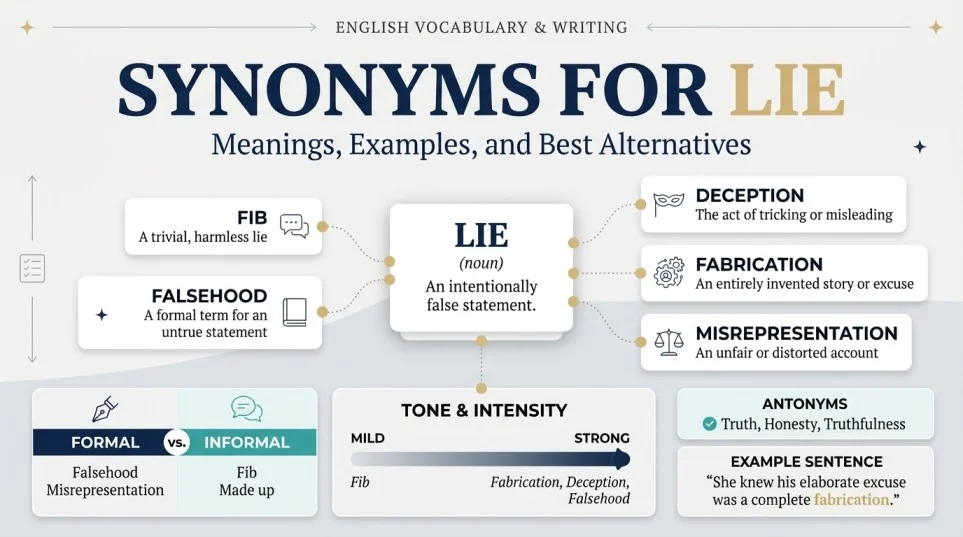
A lie is a false statement made intentionally to deceive someone. Common synonyms include falsehood, untruth, fib, fabrication, deception, and misrepresentation. Use fib in casual conversation, falsehood in formal writing, and misrepresentation in professional or legal contexts when accurate.
Meaning, Tone and Context
The word lie has several meanings, but when discussing honesty, it usually refers to a statement someone deliberately makes to mislead another person.
1. Simple Definition
A lie is something someone says or writes that they know is untrue and intend another person to believe.
For example, saying you completed an assignment when you have not started it is a lie if you knowingly intend to mislead your teacher.
Not every incorrect statement is a lie. Someone who shares false information because they genuinely believe it is true may be mistaken rather than dishonest.
2. Part of Speech
Lie is both a noun and a verb.
As a noun, it refers to a false statement.
Example: His explanation was a lie.
As a verb, it describes the act of intentionally saying something false.
Example: She lied about where she had been.
The verb forms are lie, lied, and lying. The related noun liar describes someone who tells lies.
3. Tone and Connotation
Lie generally has a negative tone because it suggests dishonesty and a possible loss of trust.
However, its seriousness depends on the situation. A small fib about a surprise birthday party is different from a deliberate lie about financial records.
4. Formality Level
Lie is a common word that works in casual conversation, journalism, storytelling, and professional communication.
More formal alternatives include falsehood, misrepresentation, and deliberate deception. These words can sound more precise in reports, essays, and business discussions.
5. Common Use Cases
People use lie when discussing:
- Personal relationships and broken trust.
- False claims in news or public statements.
- Dishonest answers at school or work.
- Misleading advertisements and business practices.
- Fictional characters who hide the truth.
- Social media posts that contain knowingly false information.
6. Important Word Forms
| Word | Meaning | Example |
|---|---|---|
| Lie | A false statement or the act of deceiving | The lie damaged their friendship. |
| Lied | Past tense of lie | He lied about the results. |
| Lying | The act of telling lies | Lying can damage trust. |
| Liar | A person who tells lies | Nobody wanted to trust the liar. |
| Truth | What is accurate or real | She finally told the truth. |
| Dishonest | Not truthful or fair | The report contained dishonest claims. |
One important distinction: lie can also mean to recline or rest in a position. In that sense, lie is not related to dishonesty. For example, I like to lie on the sofa after work.
When and How to Use Lie
Use lie when you want to describe a knowingly false statement or an intentional attempt to mislead someone. Choose a synonym when you need to communicate a more specific type of dishonesty.

Professional context
The manager lied about the figures in the report.
A more precise version might be: The manager falsified the figures in the report, if the numbers were deliberately altered.

Personal context
He lied about meeting his old friend.
Alternative: He deceived his partner about the meeting. This emphasizes the misleading effect on the relationship.

Academic context
The student lied about finishing the research paper.
Alternative: The student made a false claim about completing the research paper.

Casual conversation and social media
That story about winning the contest was a lie.
Alternative: That story was a fabrication. This sounds stronger and suggests the story was invented.
Another Word for Lie
The best single replacement for lie is usually falsehood when you want a formal noun, or deceive when you want to describe the act of misleading someone. The right choice depends on the sentence.
| Context | Best alternative | Example |
|---|---|---|
| Professional writing | Misrepresentation | The report contained a serious misrepresentation. |
| Academic writing | Falsehood | The article repeated a demonstrable falsehood. |
| Casual conversation | Fib | He told a little fib about the gift. |
| Emotional writing | Deception | Her deception left him feeling betrayed. |
| Creative writing | Fabrication | The detective uncovered the entire fabrication. |
| Resume or workplace | Falsification | The audit revealed falsification of records. |
| Social media captions | Fake story | That viral story turned out to be fake. |
| Stronger meaning | Fraudulent claim | The claim was part of a fraudulent scheme. |
| Softer meaning | Fib | She told a harmless fib to preserve the surprise. |
These alternatives are not interchangeable in every sentence. For example, falsification usually involves altering or inventing records, while deception can include actions and omissions as well as false statements.
When Not to Use Lie
Although lie is useful, it can sometimes be too general, too strong, or less precise than another word.
When the facts are simply incorrect: Use mistake or error if there is no evidence of intentional dishonesty.
Example: The report contained an error because the writer used outdated figures.
When someone deliberately changes a document: Use falsification if the person intentionally alters records or evidence.
Example: The audit revealed falsification of financial records.
When someone hides the truth through actions: Use deception if the misleading behavior goes beyond a spoken or written statement.
Example: The company used deception to hide important fees from customers.
When the situation is lighthearted: Use fib for a small, relatively harmless lie.
Example: I told a little fib about the surprise party.
When discussing a serious allegation: Avoid labeling a statement a lie unless you have a reasonable basis for claiming that it was knowingly false. False statement or disputed claim may be more appropriate when intent has not been established.
Words Commonly Confused With Lie
Several words are related to dishonesty, but each describes a different situation.
| Word | Main difference | When to use it |
|---|---|---|
| Mistake | An incorrect belief or action that may be unintentional | When someone gets a fact wrong |
| Falsehood | A statement that is untrue, often with a formal tone | In essays, reports, and discussions |
| Deception | The act of misleading someone through words or actions | When the method of misleading matters |
| Fabrication | An invented story, detail, or piece of information | When someone makes information up |
| Misrepresentation | An inaccurate or misleading presentation of facts | In business, contracts, and formal reports |
| Exaggeration | Making something seem greater or more serious than it is | When someone stretches the truth |
For example, a mistaken date is not necessarily a lie. An invented excuse is a fabrication, while an exaggerated achievement may involve making a real accomplishment sound more impressive than it was.
Best Synonym by Context for Lie
The most effective synonym describes both the type of dishonesty and the situation in which it occurs.
| Context | Best synonym | Why it works | Example |
|---|---|---|---|
| Formal writing | Falsehood | Sounds precise and serious | The statement was a deliberate falsehood. |
| Academic writing | Untruth | Fits discussions of inaccurate claims | The essay repeated an untruth about the experiment. |
| Professional communication | Misrepresentation | Emphasizes an inaccurate presentation of facts | The proposal contained a misrepresentation of costs. |
| Workplace records | Falsification | Suggests records or information were deliberately altered | The investigation uncovered falsification of records. |
| Casual conversation | Fib | Sounds mild and conversational | I told a fib about my weekend plans. |
| Creative writing | Fabrication | Suggests an invented story or account | Her entire account was a fabrication. |
| Emotional writing | Deception | Highlights broken trust | His deception changed their relationship. |
| Strong accusation | Fraudulent claim | Suggests a claim connected to fraud | The investigation examined the fraudulent claim. |
| Softer expression | Little fib | Makes the dishonesty sound minor | She told a little fib to protect the surprise. |
| Social media | Fake story | Is easy for a general audience to understand | The post turned out to be a fake story. |
| Journalism | False claim | Focuses on a statement that is not true | The article repeated a false claim. |
| Legal discussion | False statement | Describes a statement that is untrue without automatically proving intent | The complaint alleged that the form contained a false statement. |
| Personal relationships | Betrayal | Emphasizes broken trust rather than the false words alone | The deception felt like a betrayal. |
| Public statements | Disinformation | Refers to false information deliberately spread to mislead | The campaign spread disinformation online. |
| Everyday mistakes | Inaccuracy | Focuses on incorrect information without assuming intent | The presentation contained an inaccuracy. |
Legal terms such as fraud and falsification can have specific requirements. Use them carefully, particularly when describing real people, companies, or disputed events.
Which Synonym Should You Choose?
Follow these five practical steps to find the right word.
1. Identify the exact meaning
Ask whether someone told a false statement, invented a story, changed a record, or misled another person through actions. Use falsehood, fabrication, falsification, or deception accordingly.
2. Match the level of formality
Use fib in friendly conversation, falsehood in formal writing, and misrepresentation in a professional discussion when it fits the facts.
3. Consider emotional intensity
A fib sounds mild. Deception suggests a more serious breach of trust. A serious allegation may require more precise wording and stronger evidence.
4. Think about professional impact
In a workplace report, describe what happened rather than using an emotional label. For example, say that an employee knowingly submitted false figures if the evidence supports that description.
5. Read the full sentence
The best synonym should fit naturally with the words around it. You tell a lie, commit fraud, fabricate a story, or misrepresent facts.
Real Life Examples of Lie in Sentences
Here are practical examples that show how alternative words work in everyday American English.
| Situation | Example sentence |
|---|---|
| School | The student admitted that his excuse was a fabrication. |
| Workplace | The supervisor corrected a misrepresentation in the report. |
| Writing | The author removed a falsehood from the revised article. |
| Conversation | I told a small fib because I wanted the gift to remain a surprise. |
| Social media | The viral post spread a false claim about the event. |
| Resume | The applicant avoided exaggeration and described actual achievements. |
| Please correct the inaccurate statement before sending the report. | |
| Storytelling | The detective discovered that the witness had invented the entire story. |
| Friendship | Her deception made it difficult for her friend to trust her again. |
| Business | The review identified a misleading description of the product. |
For resumes and job applications, avoid using words such as fraud or falsification unless they accurately describe the facts. Neutral, specific wording is usually more helpful than an emotional accusation.
18 Synonyms for Lie
The following 18 alternatives cover common, formal, professional, academic, emotional, and creative uses. Some describe the false statement itself, while others describe the act or method of deception.
| Synonym | Simple meaning | Best used for | Example sentence |
|---|---|---|---|
| 1. Falsehood | A statement that is not true | Formal writing | The report repeated a serious falsehood. |
| 2. Untruth | Something that is not true | Essays and careful discussion | She corrected the untruth in the article. |
| 3. Fib | A small or relatively harmless lie | Casual conversation | He told a fib about being late. |
| 4. Fabrication | An invented story or detail | Fiction and false accounts | The witness admitted that the story was a fabrication. |
| 5. Deception | The act of misleading someone | Relationships and serious discussions | Their deception damaged years of trust. |
| 6. Misrepresentation | An inaccurate or misleading presentation | Business and formal communication | The brochure contained a misrepresentation of the product. |
| 7. False statement | A statement that is untrue | Reports and formal complaints | The application included a false statement. |
| 8. Falsification | Deliberately altering or inventing information or records | Audits and investigations | The audit uncovered falsification of the records. |
| 9. Dishonesty | A lack of truthfulness or integrity | General behavior | His dishonesty created problems for the team. |
| 10. Prevarication | Avoiding a direct answer or speaking evasively | Formal writing and debate | Her prevarication frustrated the interview panel. |
| 11. Deceit | Deliberate dishonesty or misleading behavior | Emotional and literary writing | The story revealed a pattern of deceit. |
| 12. Fraud | Deception used to gain an improper benefit, often financial | Business and legal contexts | Investigators examined the alleged fraud. |
| 13. Disinformation | False information deliberately spread to mislead | Media and public communication | The campaign was criticized for spreading disinformation. |
| 14. Misinformation | False or inaccurate information, whether intentional or not | News and online discussions | The correction helped stop the spread of misinformation. |
| 15. Exaggeration | A description that makes something seem greater than it is | Casual speech and storytelling | Calling the short wait an hour was an exaggeration. |
| 16. Tall tale | An implausible or greatly exaggerated story | Humor and informal storytelling | Grandpa entertained everyone with a tall tale. |
| 17. Fake story | A story presented as real but invented or untrue | Social media and casual speech | The supposed eyewitness account was a fake story. |
| 18. Sham | Something presented as genuine but actually false or misleading | Criticism and formal commentary | The investigation exposed the event as a sham. |
Important usage note: These words have overlapping meanings, but they are not exact substitutes in every sentence. Misinformation does not necessarily involve an intention to deceive, whereas disinformation does. Fraud usually involves more than simply making a false statement.
Synonym Groups and Usage Differences
Professional vs. Personal Synonyms
Professional writing benefits from specific, evidence based language. Words such as misrepresentation, falsification, and false statement can explain what went wrong without relying on emotional judgment.
Personal writing often focuses on trust and feelings. Deception, deceit, and betrayal may communicate the emotional impact of dishonesty more clearly.
Compare these examples:
- Professional: The report contained a misrepresentation of the sales figures.
- Personal: His deception left her feeling betrayed.
The first describes a problem with information. The second emphasizes its effect on a relationship.
Formal vs. Conversational Synonyms
Formal and conversational alternatives serve different purposes.
| Style | Recommended word | Example |
|---|---|---|
| Formal report | Falsehood | The statement was a deliberate falsehood. |
| Academic essay | Untruth | The author challenged the untruth. |
| Business email | Misrepresentation | The proposal requires correction because of a misrepresentation. |
| Casual conversation | Fib | I told a fib about the surprise. |
| Text message | Fake story | That whole story was fake. |
| Public speech | Deception | The public deserves an explanation of the deception. |
In professional emails, describe the specific inaccurate statement whenever possible. Direct language is usually clearer and more constructive than calling someone a liar.
Academic Synonyms
Academic writing requires accurate distinctions between false information, deliberate deception, and ordinary mistakes.
- Falsehood: Best when referring to a statement that is not true.
- Misinformation: Useful when inaccurate information circulates, regardless of intent.
- Disinformation: Appropriate when false information is deliberately spread to mislead.
- Misrepresentation: Useful when evidence, research, or findings are presented inaccurately.
- Fabrication: Appropriate when someone invents evidence, details, or an account.
Example: The researcher identified a misrepresentation of the study findings.
This is more informative than simply saying that the report contained a lie, particularly when the exact problem concerns how research was presented.
Professional and Business Synonyms
In business communication, choose language that explains the behavior rather than making an unsupported accusation.
| Situation | Preferred wording | Example |
|---|---|---|
| Incorrect information | Inaccuracy | The presentation contains an inaccuracy. |
| Misleading product description | Misrepresentation | The description misrepresents the product’s features. |
| Altered company records | Falsification | The audit identified falsification of records. |
| Intentional misleading conduct | Deception | The review examined possible deception. |
| Suspected financial wrongdoing | Alleged fraud | The complaint alleges fraud in the transaction. |
For resumes and job applications, these words are more useful for describing ethical concerns than for describing your own accomplishments. Focus on truthful achievements and verifiable results instead of using dishonesty related language unnecessarily.
Creative or Literary Synonyms
Creative writing often uses words that carry emotional weight or create a vivid impression.
- Deceit: Suggests deliberate dishonesty, often over time.
- Fabrication: Implies an invented account or elaborate story.
- Betrayal: Emphasizes broken loyalty or trust.
- Tall tale: Suggests an exaggerated story, often told for entertainment.
- Sham: Suggests that something presented as genuine is actually false or misleading.
Example: Beneath his charming stories lay a web of deceit.
This sentence creates a stronger mood than saying he told several lies. Use expressive language when it supports the tone of the story.
Slang or Modern Synonyms
Modern conversational English includes expressions such as fake story, made up, and cap.
| Expression | Meaning | Best use |
|---|---|---|
| Made up | Invented rather than true | Casual speech |
| Cap | Slang for a lie or false claim | Informal conversation and some social media settings |
| Fake story | An invented or untrue account | Online discussions |
| Tall tale | An exaggerated or implausible story | Humorous storytelling |
Examples:
- That excuse sounds made up.
- No way, that is cap.
- The viral story turned out to be fake.
Cap is highly informal and may not be understood by every audience. Avoid it in academic papers, formal emails, and business reports. In professional writing, false claim or inaccurate statement is usually clearer.
Strongest vs. Weaker Synonyms
The seriousness of dishonesty depends on intent, consequences, and context. The following scale is a practical guide to tone, not a universal ranking of legal or moral severity.
Mild
Little apparent harm
Fib
Little fib
Tall tale
Moderate
Clear inaccuracy or dishonesty
Falsehood
Untruth
Exaggeration
Serious
Intentional misleading behavior
Deception
Deceit
Falsification
Potentially very serious
Depends on evidence and circumstances
Fraud
Deliberate fabrication
Disinformation
A fib may be harmless, but not always. Similarly, a falsehood can cause serious harm even when it is not legally fraudulent. Choose a word based on the actual facts, not merely how forceful you want to sound.
Emotional vs. Neutral Synonyms
Neutral words describe the problem without adding much emotional judgment. Emotional words highlight the damage caused by dishonesty.
| Tone | Word | Example |
|---|---|---|
| Neutral | False statement | The form contains a false statement. |
| Neutral | Inaccuracy | The article includes an inaccuracy. |
| Formal | Misrepresentation | The report contains a misrepresentation. |
| Emotional | Deceit | She could no longer tolerate his deceit. |
| Emotional | Betrayal | The discovery felt like a betrayal. |
| Critical | Sham | The investigation exposed the event as a sham. |
If you are explaining a disagreement, neutral wording may help readers understand the facts. If you are writing a personal story, emotional wording may better express the experience.
Antonyms of Lie
The opposite of lie is generally truth or truthfulness. The best antonym depends on whether you mean a false statement, dishonest behavior, or an attempt to mislead.
Some words in the table are direct opposites, while others describe related qualities or actions that support honesty.
| Antonym | Meaning | Example sentence |
|---|---|---|
| 1. Truth | What is real or accurate | She finally told the truth. |
| 2. Truthfulness | The quality of being truthful | His truthfulness earned the team’s trust. |
| 3. Honesty | The quality of being honest | Honesty matters in every relationship. |
| 4. Veracity | The quality of being truthful or accurate | The reporter questioned the veracity of the claim. |
| 5. Candor | Open and honest expression | Her candor helped resolve the disagreement. |
| 6. Sincerity | Genuine feelings or intentions | He spoke with sincerity. |
| 7. Frankness | Direct and open communication | Her frankness made the meeting more productive. |
| 8. Integrity | Strong moral principles and honesty | The manager acted with integrity. |
| 9. Accuracy | Correctness of information | Accuracy is essential in the final report. |
| 10. Authenticity | The quality of being genuine | The letter’s authenticity was confirmed. |
| 11. Transparency | Openness about information and actions | The company promised greater transparency. |
| 12. Disclosure | The act of revealing relevant information | The disclosure clarified the financial arrangement. |
| 13. Admission | Acknowledgment of a fact or action | His admission resolved the dispute. |
| 14. Confession | An acknowledgment of wrongdoing or a concealed fact | Her confession explained what had happened. |
| 15. Verity | A truth or fact | The researcher searched for the verity behind the claim. |
For everyday writing, truth, honesty, and truthfulness are the most natural opposites of lie. Words such as transparency and integrity describe broader qualities rather than direct opposites in every sentence.
Comparison: Lie vs. Similar Words
Understanding the difference between related words helps you choose a more accurate expression.
Lie vs. Falsehood
Main difference: Lie often suggests intentional dishonesty, while falsehood refers to a statement that is untrue and can sound more formal.
Which is stronger? Lie often sounds more direct and personal.
Which is more formal? Falsehood is generally more formal.
Examples:
- Lie: He told a lie about the missing money.
- Falsehood: The article contained a falsehood about the financial results.
Lie vs. Fib
Main difference: A fib usually refers to a small or relatively harmless lie.
Which is stronger? Lie generally sounds more serious.
Which is more formal? Lie is more suitable for general and formal communication.
Examples:
- Lie: She lied about submitting the assignment.
- Fib: I told a little fib about the birthday surprise.
Lie vs. Deception
Main difference: A lie is often a false statement, while deception can involve words, actions, or omissions that mislead someone.
Which is stronger? Deception can suggest a broader or more deliberate pattern of misleading behavior.
Which is more formal? Both work in formal writing, but deception is useful when describing the overall conduct.
Examples:
- Lie: He lied about the meeting.
- Deception: His deception continued for several months.
Lie vs. Fabrication
Main difference: A lie may involve a single false statement, while fabrication often involves inventing a story, detail, or account.
Which is stronger? Fabrication can sound more elaborate, depending on the situation.
Which is more formal? Fabrication is common in investigative, academic, and professional contexts.
Examples:
- Lie: She lied about seeing the manager.
- Fabrication: She invented an entire story about meeting the manager.
Lie vs. Misrepresentation
Main difference: Lie emphasizes dishonesty, while misrepresentation focuses on presenting information in an inaccurate or misleading way.
Which is stronger? Neither is automatically stronger. The context determines the seriousness.
Which is more formal? Misrepresentation is especially useful in business and legal discussions.
Examples:
- Lie: He lied about the product’s quality.
- Misrepresentation: The advertisement misrepresented the product’s capabilities.
Lie vs. Misinformation
Main difference: A lie usually suggests deliberate dishonesty. Misinformation is false or inaccurate information that may be shared without an intention to deceive.
Which is stronger? Lie is more direct when deliberate dishonesty is established.
Which is more formal? Both are suitable for formal writing, depending on the subject.
Examples:
- Lie: He knowingly lied about the results.
- Misinformation: The website accidentally published misinformation about the event.
Common Phrases and Expressions with Lie
These expressions appear in everyday conversation, storytelling, and formal communication.
1. Tell a lie
Meaning: To say something that is not true, usually with the intention of misleading someone.
Example sentence: He told a lie to avoid explaining why he was late.
2. White lie
Meaning: A small lie told to avoid hurting someone’s feelings or to handle a delicate situation.
Example sentence: She told a white lie about liking the gift because she appreciated the thought behind it.
A white lie may seem harmless, but its effect depends on the circumstances.
3. Lie through your teeth
Meaning: To tell a lie confidently or shamelessly.
Example sentence: He looked directly at the interviewer and lied through his teeth about the missing documents.
This expression is informal and strongly critical.
4. Catch someone in a lie
Meaning: To discover that someone has told a lie.
Example sentence: The teacher caught the student in a lie when she checked the assignment records.
5. Live a lie
Meaning: To live in a way that hides the truth about your circumstances or identity.
Example sentence: After years of pretending to be happy, he realized he was living a lie.
6. A web of lies
Meaning: A complicated collection of connected lies.
Example sentence: One false explanation led to a web of lies that became difficult to maintain.
7. The lie falls apart
Meaning: A lie becomes impossible to maintain because the facts reveal the truth.
Example sentence: The story fell apart when investigators compared the messages with the timeline.
8. Call someone out on a lie
Meaning: To challenge someone about something they have said that you believe is false.
Example sentence: She called him out on his lie during the meeting.
This expression is conversational and can sound confrontational.
Common Mistakes to Avoid
Choosing a synonym is not just about finding a similar word. The meaning, tone, and evidence must also fit.
1. Calling Every Mistake a Lie
An incorrect statement is not automatically a lie. Intent matters.
Incorrect: The student lied because he gave the wrong answer.
Better: The student made a mistake because he misunderstood the question.
Use lie when there is a reasonable basis for believing the person knowingly made a false statement to deceive someone.
2. Confusing Misinformation With Disinformation
Misinformation can spread without deliberate deception. Disinformation involves intentionally spreading false information to mislead.
Incorrect: The person deliberately spread misinformation, when the intended meaning is that the person knowingly created and distributed false claims.
Better: The person deliberately spread disinformation.
3. Using Casual Language in Formal Writing
Words such as fib and cap may sound out of place in academic papers and business reports.
Instead of writing, The employee told a fib about the figures, consider writing, The employee provided inaccurate information, or The employee knowingly made a false statement, depending on the evidence.
4. Using an Overly Dramatic Synonym
Words such as fraud, betrayal, and falsification can imply serious wrongdoing.
Do not use them simply to make a sentence sound stronger. Choose a term that accurately describes the conduct.
5. Repeating Lie Too Often
Repeated wording can make an article or essay feel monotonous.
Instead of writing, He told a lie, repeated the lie, and defended the lie, you could write, He made a false statement, repeated it, and continued to defend his account.
Make sure each replacement preserves the intended meaning.
6. Choosing the Wrong Emotional Tone
A fib sounds mild, while deceit can suggest deliberate dishonesty and broken trust.
In a serious workplace investigation, a precise term such as false statement may be more appropriate than an emotionally charged accusation.
FAQs
1. What is the best synonym for lie?
Falsehood is a strong general choice for formal writing. Fib suits casual situations, while deception works when someone misleads another person through words or actions.
2. What is a formal synonym for lie?
Falsehood, misrepresentation, and falsification are useful formal alternatives. Choose misrepresentation for misleading presentations and falsification for deliberately altered or invented records.
3. What is an informal synonym for lie?
Fib is a common informal synonym for a small lie. Made up and cap are also used in casual conversation, although cap is slang.
4. What is another word for lie in professional writing?
Misrepresentation or false statement often works well in professional writing. Falsification may be appropriate when records or information have been deliberately altered.
5. What is the difference between a lie and a falsehood?
A lie generally suggests that someone knowingly made a false statement to deceive. Falsehood is a more formal term for an untrue statement.
6. What is the opposite of lie?
Truth is the most direct opposite of lie. Honesty and truthfulness are also useful antonyms when discussing someone’s behavior or character.
Conclusion
The best synonyms for lie depend on the meaning, tone, and situation. Falsehood works well in formal writing, fib suits casual conversation, fabrication describes invented stories, and misrepresentation is useful in professional communication.
Remember that not every incorrect statement is a lie. Words such as misinformation, mistake, and deception describe different situations, so choosing carefully makes your writing clearer and more trustworthy.
A practical vocabulary tip: Before replacing lie with another word, ask yourself two questions: Was the statement intentionally false, and what exactly happened? Those answers will help you select a precise synonym that fits your sentence. appropriate alternatives before publication.
Discover More Post:
- 25+ Synonyms for Superior | Meanings, Examples, and Best …
- 25+ Synonyms for Anxious | Meanings, Examples, and Best …
- 25+ Synonyms for Potential | Meanings and Examples