The word nose is easy to use, but repeating it in stories, essays, conversations, or social media captions can make your writing feel less interesting. Choosing another word for nose can help you describe a person’s appearance, explain a sense of smell, or create a more vivid image.
The best replacement depends on what you want to say. Some alternatives describe the nose’s shape or position, while others are playful expressions or literary descriptions. This guide explains synonyms for nose, their meanings, and how to use them naturally in American English. You will also learn which words fit formal writing, casual conversations, creative work, and everyday expressions, so you can choose words that sound clear and appropriate.
What Does Nose Mean?
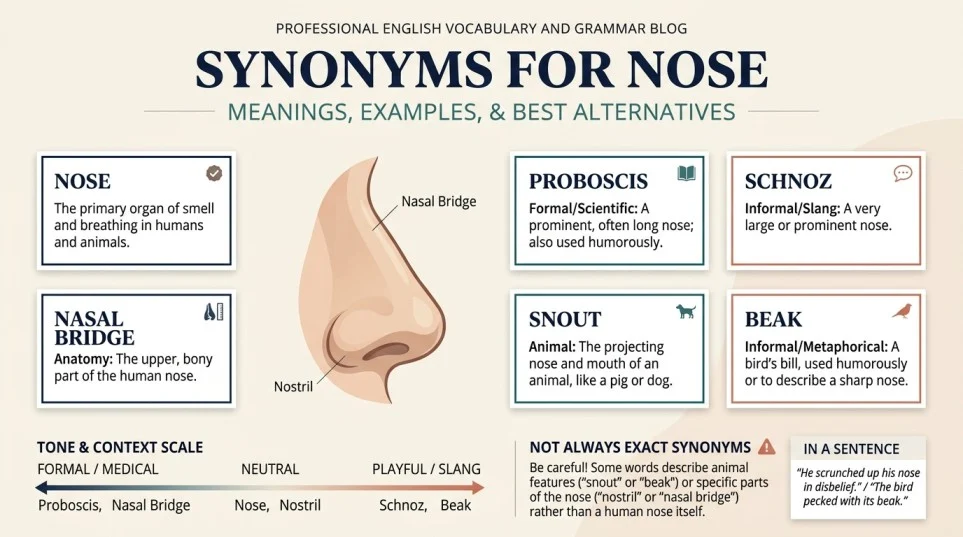
A nose is the part of the face used for breathing and smelling. Common alternatives include snout for certain animals, proboscis for a long projecting nose, and schnoz as an informal term. The best choice depends on the subject, tone, and context.
Meaning, Tone and Context
The word nose refers to the part of the face that contains the nostrils and helps people breathe and smell. It is also used for similar structures in many animals.
Simple definition: The body part above the mouth that allows breathing and helps detect smells.
Part of speech: Nose is mainly a noun. It can also be a verb, as in nose around, which means to investigate something, often out of curiosity.
Tone: The word is neutral in ordinary use. However, phrases involving the nose can sound humorous, critical, affectionate, or intrusive.
Formality: Nose is suitable for almost every situation, including conversations, school assignments, workplace communication, and general writing.
Common uses:
- Describing facial features and appearance.
- Talking about breathing and the sense of smell.
- Describing animal features.
- Creating imagery in stories and poems.
- Using expressions such as nose to nose or keep your nose out of it.
Related word forms:
- Noun: nose.
- Verb: nose, as in nose around.
- Adjective: nasal, meaning related to the nose.
- Related noun: nostril, one of the two openings in the nose.
- Related adjective: nosy, meaning overly curious about other people’s private affairs.
A key distinction is that related words are not always exact synonyms. A nostril is part of the nose, while nasal describes something associated with it.
When and How to Use Nose
Use nose when you want a clear, natural, and widely understood word. Choose a more specific alternative when the subject, shape, or tone calls for it.
1. Personal description
Her nose had a gentle curve that suited her face.
2. Academic writing
The human nose helps filter, warm, and humidify the air we breathe.
3. Creative writing
The puppy pushed its snout into the open bag and sniffed excitedly.
4. Casual conversation
He wrinkled his schnoz when he smelled the burnt toast.
These examples show why context matters. Snout is suitable for many animals, while schnoz is playful and informal when describing a person.
Another Word for Nose
The best single replacement for nose in general writing is usually still nose. It is clear, accurate, and appropriate across a wide range of situations. When you need a different word, select one that describes the specific feature or tone you intend.
| Context | Suggested alternative | Why it works |
|---|---|---|
| Professional writing | Nasal structure | More technical and descriptive |
| Academic writing | Nasal anatomy | Suitable for discussing the structure of the nose |
| Casual conversation | Schnoz | Playful and informal |
| Emotional writing | Nose | Clear and direct without adding unintended emotion |
| Creative writing | Proboscis | Can add a humorous or literary tone |
| Animal descriptions | Snout | Refers to the projecting nose and mouth area of an animal |
| Medical writing | External nose | More specific anatomical wording |
| Social media captions | Schnoz | Works for a lighthearted caption |
| Strong visual description | Prominent nose | Clearly describes a noticeable feature |
| Gentle description | Small nose | Gives a simple, neutral detail |
For a resume or business document, nose is rarely a word that needs replacing. If the topic is health, anatomy, or safety, accurate terminology matters more than variety.
When Not to Use Nose
Although nose is useful in everyday language, it may be too general when you need to describe a particular shape, animal feature, or anatomical structure.
Here are some examples of when a more precise word works better.
* Too general: The animal had a long nose. More precise: The elephant had a long trunk.
* Too informal: The doctor examined his schnoz. More appropriate: The doctor examined his nose.
* Too vague: The bird injured its nose. More precise: The bird injured its beak.
* Too technical: She touched her nasal structure. More natural: She touched her nose.
The goal is not to replace nose every time. It is to choose the word that describes the subject accurately and sounds natural to your reader.
Words Commonly Confused With Nose
Several words refer to the nose or nearby facial features, but their meanings differ.
| Word | Meaning | Difference from nose |
|---|---|---|
| Nostril | An opening in the nose | Refers to one of the two openings, not the whole nose |
| Snout | The projecting nose and mouth area of an animal | Usually describes animals |
| Muzzle | The projecting nose and mouth area of an animal | Often emphasizes the front of an animal’s face |
| Proboscis | An elongated or projecting nose or feeding organ | More specialized or formal |
| Beak | A bird’s hard, projecting mouth structure | Not a human nose |
| Nasal | Related to the nose | An adjective, not a direct replacement for the noun |
These distinctions are important in educational writing and storytelling. For example, a bird has a beak, a dog has a snout or muzzle, and a person has a nose.
Best Synonym by Context for Nose
The most useful alternative depends on what you are describing. Some words refer to the entire feature, while others identify a specific part or a particular animal structure.
| Context | Best synonym or alternative | Why it works | Example |
|---|---|---|---|
| Formal writing | Nasal structure | Adds a technical tone | The nasal structure varies among individuals. |
| Academic writing | Nasal anatomy | Fits a discussion of body structure | The class studied nasal anatomy. |
| Professional or medical use | External nose | Identifies the visible structure | The examination focused on the external nose. |
| Resume writing | Nose | Direct and accurate when relevant | The artist created realistic nose studies. |
| Casual conversation | Schnoz | Sounds playful | He bumped his schnoz on the cabinet. |
| Creative writing | Proboscis | Adds a distinctive or humorous effect | The character’s enormous proboscis made everyone laugh. |
| Emotional description | Nose | Keeps the emotion in the surrounding sentence | Her nose reddened in the cold. |
| Strong visual description | Prominent nose | Highlights a noticeable feature | His prominent nose gave his profile a distinct look. |
| Soft description | Small nose | Gives a gentle, neutral detail | The portrait showed a small nose. |
| Social media captions | Schnoz | Adds humor to a playful caption | A little sunshine for this silly schnoz. |
| Animal descriptions | Snout | Fits many mammals | The pig lowered its snout to the ground. |
| Bird descriptions | Beak | Names the correct body part | The robin tapped its beak against the window. |
Which Synonym Should You Choose?
Use these five checks to find the right word.
1. Meaning: Are you describing the whole nose, a specific part, or an animal feature? Choose nose, nostril, snout, or beak accordingly.
2. Formality: Use nose in ordinary writing. Choose nasal structure or another anatomical term when technical precision is necessary.
3. Emotional tone: Use schnoz or snoot for humor. Avoid playful terms when the situation requires respect or seriousness.
4. Professional value: In medical and scientific writing, accuracy matters more than stylistic variety. Use established anatomical terms.
5. Sentence context: Read the complete sentence aloud. The right word should sound natural and preserve the intended meaning.
Real Life Examples of Nose in Sentences
The following examples show how to use nose and its related alternatives in everyday situations.
School: The students labeled the nostrils, nasal cavity, and other parts of the respiratory system.
Workplace: The product designer adjusted the nose piece of the protective mask.
Writing: The author described the character’s prominent nose to make the portrait more memorable.
Conversation: My nose gets stuffy whenever the weather changes.
Social media: That puppy has the cutest little snoot.
Resume: Created detailed portrait illustrations with careful attention to facial proportions, including the nose.
Email: Please make sure the protective mask fits securely around the nose.
Storytelling: The curious puppy pressed its snout against the fence and sniffed the air.
Notice that some examples use related terms rather than direct synonyms. That is important because many nose alternatives refer to a particular part, species, or descriptive quality.
18 Synonyms for Nose
The following table includes direct alternatives, informal names, technical expressions, and closely related terms. They are not all interchangeable, so check the usage notes before substituting one for nose.
| Synonym or related term | Simple meaning | Best used for | Example sentence |
|---|---|---|---|
| 1. Proboscis | A long or projecting nose or feeding organ | Technical or humorous descriptions | The cartoon character had an oversized proboscis. |
| 2. Schnoz | An informal name for a nose | Playful conversation | He rubbed his schnoz after sneezing. |
| 3. Snoot | A playful term for a nose or snout | Informal and humorous writing | The dog pushed its snoot into my hand. |
| 4. Honker | Slang for a large or noticeable nose | Casual humor | He joked about his big honker. |
| 5. Snout | The projecting nose and mouth area of an animal | Animal descriptions | The fox lowered its snout. |
| 6. Muzzle | The nose and mouth area of an animal | Animal care and descriptions | The horse rested its muzzle against the fence. |
| 7. Beak | A bird’s hard mouth structure | Bird descriptions | The parrot cleaned its beak. |
| 8. Bill | The beak of certain birds | Ornithology and everyday descriptions | The duck dipped its bill into the water. |
| 9. Trunk | An elephant’s long, flexible nose and upper lip | Elephant descriptions | The elephant lifted its trunk. |
| 10. Nasal structure | The anatomical structure of the nose | Technical writing | The study examined the nasal structure. |
| 11. Nasal organ | The organ involved in breathing and smell | Educational descriptions | The nasal organ helps detect odors. |
| 12. Olfactory organ | A structure involved in the sense of smell | Scientific explanations | The olfactory organ helps the animal identify scents. |
| 13. External nose | The visible part of the nose | Anatomy and medical writing | The doctor examined the external nose. |
| 14. Nasal feature | A characteristic of the nose | Portrait and appearance descriptions | The artist carefully shaped each nasal feature. |
| 15. Nasal appendage | A projecting structure associated with the nose | Specialized descriptions | The researcher documented the unusual nasal appendage. |
| 16. Nostril | One of the two openings in the nose | Anatomy and detailed descriptions | A drop of water entered one nostril. |
| 17. Nasal bridge | The upper ridge of the nose | Facial anatomy and portraiture | The glasses rested on the nasal bridge. |
| 18. Nasal tip | The end of the nose | Facial descriptions and anatomy | The cold air reddened the nasal tip. |
Important usage note: Proboscis, schnoz, snoot, and honker can serve as alternatives in particular contexts. Terms such as nostril, nasal bridge, and nasal tip describe parts of the nose, while beak, bill, snout, muzzle, and trunk refer to structures associated with particular animals. The remaining expressions are descriptive or technical phrases rather than exact everyday synonyms.
For most general writing, nose remains the clearest choice.
Synonym Groups and Usage Differences
Professional vs. Personal Synonyms
In professional writing, use nose when discussing general appearance, breathing, safety equipment, or health. Use precise terms such as nasal bridge, nasal tip, or nostril when the specific feature matters.
In personal conversations, words such as schnoz and snoot can add humor. However, these expressions may sound rude if used to comment on someone’s appearance without permission.
Formal vs. Conversational Synonyms
Formal and technical language is useful when precision matters. Conversational language is better when the goal is to sound relaxed and friendly.
| Style | Suitable word | Example |
|---|---|---|
| Formal | Nasal structure | The report describes the nasal structure. |
| Academic | Nasal anatomy | Students examined nasal anatomy. |
| Conversational | Nose | My nose feels cold. |
| Playful | Schnoz | His schnoz turned red in the wind. |
| Humorous | Honker | He made a joke about his honker. |
Academic Synonyms
Academic writing usually benefits from established anatomical terms rather than creative replacements. Nose, nostril, nasal cavity, nasal bridge, and nasal tip each refer to identifiable structures.
Choose the exact term that matches the subject. Do not use proboscis as a general scientific replacement when the intended structure is specifically the human nose.
Professional and Business Synonyms
In workplace communication, clarity is more useful than variety. Nose is appropriate in instructions about protective equipment, facial recognition systems, product design, and other relevant topics.
For example, a safety instruction might say, Please position the mask securely over your nose and mouth. Replacing nose with schnoz would make the instruction less professional.
Creative or Literary Synonyms
Creative writing offers more room for descriptive language. Words such as proboscis, snoot, and honker can give a character a humorous or memorable voice.
You can also describe the feature directly. A sharply curved nose, a narrow nasal bridge, or a rounded nose tip often gives readers a clearer picture than an unusual synonym alone.
Slang or Modern Synonyms
Schnoz, snoot, and honker are informal expressions. They work well in jokes, lighthearted dialogue, playful pet captions, and casual conversations.
These words are not equally suitable in every setting. Avoid them in medical reports, academic essays, formal presentations, and sensitive discussions about someone’s appearance.
Strongest vs. Weaker Synonyms
Nose words do not have a single scale of intensity because they describe different features rather than different levels of the same quality. However, you can arrange some descriptive expressions by how strongly they emphasize appearance.
Neutral
Nose, nasal feature
Simple, factual descriptions.
Descriptive
Prominent nose, long proboscis
Draw attention to size, shape, or projection.
Playful
Honker, schnoz
Add humor and an informal tone.
A word that sounds stronger is not necessarily more accurate. Choose it for the effect you want, not simply to make the sentence more dramatic.
Emotional vs. Neutral Synonyms
The word nose is generally neutral. The emotion comes from the surrounding description or the way the word is used.
For example, her delicate nose suggests a gentle description, while his enormous honker sounds humorous and may feel insulting. A prominent nose is more factual, although it still emphasizes appearance.
When writing about real people, especially in professional or sensitive situations, use neutral and respectful language.
Antonyms of Nose
The noun nose has no direct antonym in standard English. It names a body part, and there is no single word that means the opposite of a nose.
To help with vocabulary building, the table below gives 15 contextual contrasts. These are not true antonyms. They describe different body parts, functions, or facial features that may be contrasted with the nose in a particular sentence.
| Contextual contrast | Meaning | Example sentence |
|---|---|---|
| 1. Mouth | Opening used for eating and speaking | The mouth is below the nose. |
| 2. Ear | Organ used for hearing | The ear is on the side of the head. |
| 3. Eye | Organ used for vision | Her eyes were bright, and her nose was small. |
| 4. Chin | Lower part of the face | His chin was narrow beneath his nose. |
| 5. Forehead | Upper part of the face | A wrinkle appeared on her forehead. |
| 6. Cheek | Side area of the face | The baby rested against her cheek. |
| 7. Jaw | Structure that supports the teeth | The jaw moves during chewing. |
| 8. Lip | Soft edge of the mouth | She pressed her lips together. |
| 9. Tongue | Muscular organ used in taste and speech | The tongue helps detect flavors. |
| 10. Hand | Body part used for grasping | He covered his nose with his hand. |
| 11. Foot | Body part used for standing and walking | The sand covered his foot. |
| 12. Neck | Part connecting the head and torso | A scarf covered her neck. |
| 13. Back | Rear part of the torso | He turned his back toward the window. |
| 14. Skin | Outer covering of the body | Her skin became red in the cold. |
| 15. Hair | Filaments growing from the skin | A strand of hair fell across his nose. |
If you are looking for the opposite of a related word, the answer may be different. For example, the opposite of nosy in some contexts is respectful of privacy, not a body part.
Comparison: Nose vs. Similar Words
Nose vs. Nostril
The nose is the entire external feature and associated structures. A nostril is one of the two openings at the front of the nose.
Neither word is stronger or more formal. Nostril is simply more specific.
Example: She touched her nose. She covered one nostril.
Nose vs. Snout
A nose is the usual term for a human facial feature. A snout describes the projecting nose and mouth area of many animals.
Snout is more specific to animal anatomy, not a stronger version of nose.
Example: His nose was cold. The pig’s snout was muddy.
Nose vs. Muzzle
A muzzle refers to the front part of an animal’s face, including its nose and mouth. It can also mean a device fitted over an animal’s mouth.
Muzzle is more specific when the full front of an animal’s face or a restraint is intended.
Example: The dog rubbed its nose against the door. The veterinarian checked the dog’s muzzle.
Nose vs. Proboscis
Nose is the everyday word. Proboscis is a more specialized term for an elongated or projecting organ, and it can also be used humorously for a person’s nose.
Proboscis sounds more technical or literary, depending on context.
Example: He had a small nose. The fictional character had an exaggerated proboscis.
Nose vs. Beak
A nose is a facial feature used for breathing and smelling. A beak is the hard mouth structure found in birds and certain other animals.
Beak is the correct term for a bird’s projecting mouth structure.
Example: She rubbed her nose. The parrot tapped its beak against the cage.
Nose vs. Nasal
Nose is a noun that names the body part. Nasal is an adjective describing something related to the nose.
Nasal is more technical in many medical or scientific contexts, but it cannot usually replace nose directly.
Example: His nose was blocked. He had nasal congestion.
Common Phrases and Expressions with Nose
These expressions use nose in familiar ways. Their meanings often differ from the literal meaning of the body part.
1. Keep your nose out of it
Meaning: Avoid interfering in someone else’s business.
Example sentence: Please keep your nose out of their personal disagreement.
2. Turn up your nose
Meaning: Show dislike or act as if something is beneath you.
Example sentence: She turned up her nose at the simple meal.
3. Nose to nose
Meaning: Very close to another person or facing them directly.
Example sentence: The two players stood nose to nose during the argument.
4. Follow your nose
Meaning: Follow your sense of smell or trust your instincts.
Example sentence: We followed our noses toward the bakery.
5. Pay through the nose
Meaning: Pay an unusually high price.
Example sentence: We paid through the nose for last minute concert tickets.
6. Have a nose for something
Meaning: Have a natural ability to notice or find something.
Example sentence: She has a nose for finding excellent books.
7. Stick your nose into something
Meaning: Interfere in a matter that does not concern you.
Example sentence: He always sticks his nose into other people’s conversations.
8. Keep your nose to the grindstone
Meaning: Continue working hard and stay focused.
Example sentence: She kept her nose to the grindstone and finished the project on time.
Common Mistakes to Avoid
1. Treating every related word as a synonym. A nostril is part of the nose, while a beak is a bird’s mouth structure. Check the meaning before replacing a word.
2. Using slang in formal writing. Schnoz and honker may work in humorous dialogue, but nose is better for reports, essays, and professional communication.
3. Using technical language unnecessarily. Nasal structure may be appropriate in an anatomy discussion, but nose sounds more natural in everyday conversation.
4. Choosing a word that changes the subject. A dog’s snout includes more than its nose. If you mean only the nose, be precise about the feature you are describing.
5. Repeating nose too often. Improve the writing by varying sentence structure and adding relevant details, rather than replacing every occurrence with a different word.
6. Assuming nose has a direct opposite. Nose has no standard antonym. Use a genuine contrast only when the sentence provides a clear reason for it.
FAQs
1. What is the best synonym for nose?
Nose is usually the best word because it is clear and natural. Snout works for many animals, while schnoz adds a playful, informal tone.
2. What is a formal synonym for nose?
Nasal structure is a formal descriptive phrase, especially in anatomy. Nasal bridge and nasal tip are more precise when referring to specific parts of the nose.
3. What is an informal synonym for nose?
Schnoz is a common informal alternative for a person’s nose. Snoot and honker are also playful choices, although their tone can sound teasing or humorous.
4. What is another word for nose in professional writing?
Use nose for general communication. In technical or medical writing, choose a precise term such as nostril, nasal bridge, or external nose when appropriate.
5. What is the difference between nose and snout?
A nose usually refers to the facial feature in humans and animals. A snout describes the projecting nose and mouth area of many animals.
6. What is the opposite of nose?
Nose has no direct antonym because it names a body part. Words such as mouth, ear, and eye describe other body parts, not true opposites.
Conclusion
Nose is a simple, useful word with a wide range of applications. The best alternatives depend on your subject and purpose. Snout suits many animal descriptions, proboscis can add a specialized or humorous effect, and schnoz works in playful conversation.
When choosing synonyms for nose, focus on meaning, accuracy, and tone rather than variety alone. Use precise anatomical terms when needed, informal expressions when the setting allows them, and straightforward language when clarity matters most.
A practical vocabulary tip is to ask yourself one question before changing a word: does this alternative describe exactly what I mean? That small habit can make your writing more natural, accurate, and engaging.
Discover More Post:
- 25+ Synonyms for Feeling | Meanings, Examples, and Best …
- 25+ Synonyms for Superior | Meanings, Examples, and Best …
- 25+ Synonyms for Anxious | Meanings, Examples, and Best …