Sometimes “feeling” is exactly the right word. Other times, it can make your sentence sound vague, especially when you are writing an essay, email, caption, resume, story, or professional message.
Choosing a more precise word can show whether you mean an emotion, physical sensation, personal reaction, belief, mood, or intuition.
This guide explains 25 useful synonyms for feeling and shows how their meanings and tones differ. You will also learn which alternatives work best in academic, professional, emotional, creative, and casual contexts.
What Does “Feeling” Mean?
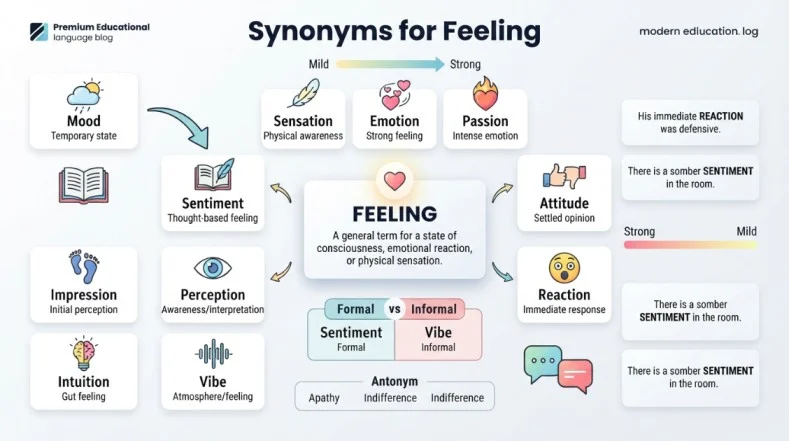
A feeling is an emotional response, physical sensation, personal impression, or inner reaction. Depending on context, useful alternatives include emotion, sensation, sentiment, mood, reaction, impression, intuition, concern, attitude, and perception.
Meaning, Tone and Context
Simple Definition
“Feeling” can describe an emotion or an internal experience caused by a person, event, thought, or physical condition.
For example, happiness, sadness, excitement, fear, discomfort, and affection can all be described as feelings.
The word can also describe a physical sensation.
For example:
“I have a strange feeling in my shoulder.”
Here, “feeling” refers to a physical sensation rather than an emotion.
Part of Speech
“Feeling” can function as a noun or as the present participle of the verb “feel.”
As a noun:
“Her feeling of relief was obvious.”
As part of a verb:
“I am feeling much better today.”
Tone
“Feeling” is generally neutral. Its emotional tone depends on the surrounding words.
For example, “a feeling of joy” is positive, while “a feeling of fear” is negative.
“A feeling of uncertainty” is more neutral because it describes an emotional state without automatically judging it.
Formality Level
“Feeling” works in casual conversation, personal writing, professional communication, and academic writing.
However, a more specific word can often improve formal writing.
For example:
“I had a feeling that the plan would fail.”
A more precise version is:
“I had a concern that the plan would fail.”
Common Use Cases
You may use “feeling” when discussing:
- Emotions
- Physical sensations
- Personal reactions
- Opinions or impressions
- Intuition
- Relationships
- Moods
- Concerns
- Creative experiences
- Personal experiences
Important Word Forms
Related forms include:
“Feel” is the verb.
“Felt” is the past form of the verb.
“Feeling” can be a noun or a verb form.
“Feelings” is the plural noun.
“Felt” can also refer to a type of fabric, depending on context.
When and How to Use “Feeling”
“Feeling” is useful when you want to describe an internal experience without specifying exactly what caused it or how intense it is.
1. Professional Context
“I had a feeling that the client needed more information before making a decision.”
2. Personal Context
“I have a strong feeling that we should talk about what happened.”
3. Academic Context
“The study examined participants’ feelings about the proposed changes.”
4. Emotional Context
“She could not hide her feelings of disappointment.”
5. Creative Context
“The story creates a feeling of mystery from the opening scene.”
6. Social Media Context
“That sunset gave me such a peaceful feeling.”
7. Email Context
“I wanted to share my feelings about the recent changes.”
Another Word for “Feeling”
The best replacement depends on what “feeling” means in your sentence.
| Context | Recommended Word |
|---|---|
| Professional writing | sentiment |
| Academic writing | perception |
| Casual conversation | vibe |
| Emotional writing | emotion |
| Creative writing | sensation |
| Resume or workplace use | attitude |
| Social media captions | vibe |
| Strong meaning | passion |
| Softer meaning | impression |
Professional Writing
Use sentiment when discussing general attitudes or opinions.
Example:
“Customer sentiment toward the new service remains positive.”
Academic Writing
Use perception when discussing how people understand or interpret something.
Example:
“The research examined public perception of the policy.”
Casual Conversation
Use vibe when talking about the general atmosphere or impression of a person or place.
Example:
“This restaurant has a relaxed vibe.”
Emotional Writing
Use emotion when you specifically mean an emotional response.
Example:
“Her voice revealed genuine emotion.”
Creative Writing
Use sensation when you want to describe an experience that may be physical or intensely perceptual.
Example:
“A strange sensation moved through him as the lights went out.”
Resume or Workplace Use
Use attitude when discussing someone’s approach or outlook.
Example:
“She brings a positive attitude to challenging projects.”
Social Media Captions
Use vibe for short, informal descriptions.
Example:
“Weekend energy and good vibes.”
Stronger Meaning
Use passion when the feeling involves strong enthusiasm, commitment, or love.
Example:
“Her passion for teaching is obvious.”
Softer Meaning
Use impression when you want to describe a less definite personal response.
Example:
“My first impression was very positive.”
When Not to Use “Feeling”
“Feeling” is not always the most precise choice.
When the Emotion Is Specific
Instead of:
“I had a feeling of happiness.”
Use:
“I felt joyful.”
Or:
“I experienced a sense of happiness.”
When You Mean an Opinion
Instead of:
“My feeling is that the proposal needs revision.”
Use:
“My view is that the proposal needs revision.”
When You Mean an Intuition
Instead of:
“I had a feeling something was wrong.”
Use:
“I had a strong intuition that something was wrong.”
When You Mean a Physical Experience
Instead of:
“I had a strange feeling in my hand.”
Use:
“I experienced an unusual sensation in my hand.”
When You Mean a General Attitude
Instead of:
“The public has mixed feelings about the decision.”
You could use:
“The public has mixed opinions about the decision.”
The best choice depends on whether you are describing emotion, opinion, sensation, or attitude.
Words Commonly Confused With “Feeling”
Feeling vs. Emotion
An emotion is a specific psychological response, such as anger, happiness, fear, or sadness.
Feeling is broader and can include emotions, sensations, impressions, and intuitions.
Feeling vs. Sensation
A sensation is usually connected to physical or sensory experience.
Feeling can describe both physical sensations and emotions.
Feeling vs. Mood
A mood is a relatively lasting emotional state.
A feeling can be brief and connected to a particular event.
Feeling vs. Sentiment
Sentiment often describes an attitude or emotional opinion toward something.
It is particularly useful in discussions about public opinion, customers, markets, and social attitudes.
Feeling vs. Intuition
Intuition is an immediate sense or understanding that may occur without conscious reasoning.
A feeling can be emotional, physical, or intuitive.
Feeling vs. Perception
Perception concerns how someone interprets or understands something.
A feeling is more closely connected to an internal emotional or sensory experience.
Best Synonym by Context for “Feeling”
| Context | Best Synonym | Why It Works | Example |
|---|---|---|---|
| Formal writing | sentiment | Sounds precise when discussing attitudes | Public sentiment changed after the announcement. |
| Academic writing | perception | Focuses on interpretation | The study examined public perception. |
| Professional use | sentiment | Works well for opinions and attitudes | Customer sentiment remained positive. |
| Resume use | attitude | Describes approach and outlook | Demonstrated a positive attitude toward teamwork. |
| Casual conversation | vibe | Natural and informal | This place has a friendly vibe. |
| Creative writing | sensation | Adds sensory detail | A strange sensation filled the room. |
| Emotional writing | emotion | Clearly identifies an emotional response | Her emotion was difficult to hide. |
| Strong intensity | passion | Communicates powerful enthusiasm | His passion for music inspired others. |
| Mild intensity | impression | Suggests a less definite response | My first impression was favorable. |
| Social media | vibe | Short and conversational | The whole trip had a peaceful vibe. |
| Personal reflection | sentiment | Expresses a considered emotional view | I understand your sentiment. |
| Physical experience | sensation | Identifies a bodily experience | She noticed a burning sensation. |
| Intuitive response | intuition | Suggests instinctive understanding | My intuition told me to wait. |
| Concern | apprehension | Communicates uneasiness | He approached the decision with apprehension. |
| Positive affection | affection | Shows warmth or fondness | She has deep affection for her hometown. |
Which Synonym Should You Choose?
Start by asking what kind of “feeling” you actually mean.
- If you mean a specific emotional response, choose emotion.
- If you mean a physical experience, choose sensation.
- If you mean a general attitude, choose sentiment.
- If you mean how someone understands something, choose perception.
- If you mean instinctive understanding, choose intuition.
- If you mean a strong positive attachment, choose passion or affection.
- If you mean a casual atmosphere or impression, choose vibe.
For formal or academic writing, precision usually matters more than simply replacing a repeated word.
Real Life Examples of “Feeling” in Sentences
School
“The essay explains the students’ feelings about moving to a new school.”
A more precise academic version could use “perceptions” if the essay focuses on how students interpret the change.
Workplace
“I had a feeling that the meeting would require more preparation.”
A more professional version could be:
“I had an impression that the meeting would require additional preparation.”
Writing
“The author creates a feeling of suspense throughout the chapter.”
A literary alternative is:
“The author creates a sense of suspense throughout the chapter.”
Conversation
“I have a strange feeling about this situation.”
For a stronger intuitive meaning:
“I have a strange intuition about this situation.”
Social Media
“This beach gives me the best feeling.”
A more natural casual caption might be:
“This beach has such a peaceful vibe.”
Resume
“I bring positive feelings to every project.”
This sounds less natural than:
“I bring a positive attitude to every project.”
“I appreciate your understanding of my feelings about the situation.”
A more professional version might be:
“I appreciate your understanding of my concerns about the situation.”
Storytelling
“A feeling of fear spread through the room.”
A stronger literary choice could be:
“A sense of fear spread through the room.”
25 Synonyms for “Feeling”
| Synonym | Simple Meaning | Best Used For | Example Sentence |
|---|---|---|---|
| Emotion | A strong internal response | Emotional writing and psychology | Her emotion was visible in her expression. |
| Sensation | A physical or sensory experience | Physical experiences and descriptive writing | He noticed a strange sensation in his hand. |
| Sentiment | An attitude or emotional opinion | Formal and professional writing | Public sentiment shifted after the announcement. |
| Mood | A temporary emotional state | Personal and descriptive writing | Her mood improved after the conversation. |
| Reaction | A response to something | Professional, personal, and academic contexts | His reaction surprised everyone in the room. |
| Impression | An idea or response formed by experience | Professional and personal writing | My first impression of the company was positive. |
| Perception | The way something is understood or interpreted | Academic and professional writing | Public perception changed over time. |
| Intuition | An instinctive sense or understanding | Personal and reflective writing | My intuition told me to reconsider the offer. |
| Instinct | A natural or immediate response | Personal and behavioral contexts | Her instinct was to help the injured animal. |
| Attitude | A person’s outlook or approach | Workplace and professional communication | His positive attitude helped the team. |
| Concern | A feeling of worry about something | Business, personal, and formal writing | She expressed concern about the deadline. |
| Apprehension | Uneasiness about something that may happen | Formal and emotional writing | He felt apprehension before the interview. |
| Affection | Warmth or fondness toward someone or something | Relationships and personal writing | She has great affection for her childhood home. |
| Passion | Very strong enthusiasm or emotional commitment | Creative, professional, and personal contexts | His passion for photography is obvious. |
| Sympathy | Understanding or concern for another person’s difficulty | Personal and formal communication | She expressed sympathy after hearing the news. |
| Empathy | Understanding another person’s experience or emotions | Professional, personal, and social contexts | Good leaders often demonstrate empathy. |
| Vibe | A general atmosphere or impression | Casual speech and social media | The café has a relaxed vibe. |
| State | A person’s current emotional condition | Formal and descriptive contexts | He was in a calm emotional state. |
| Sense | An internal awareness or impression | General and literary writing | I had a sense that something had changed. |
| Belief | Acceptance of something as true | Opinions and personal views | She has a strong belief in fairness. |
| Conviction | A firmly held belief | Formal and persuasive writing | He spoke with conviction about the issue. |
| Desire | A strong wish for something | Personal and emotional writing | She felt a strong desire to travel. |
| Affinity | A natural liking or connection | Formal and professional writing | He has an affinity for creative work. |
| Response | An emotional or physical reaction | Academic and professional contexts | The treatment produced a positive response. |
| Experience | Something personally felt or encountered | General and reflective writing | The experience left a lasting impression. |
Synonym Groups and Usage Differences
Professional vs. Personal Synonyms
Professional writing often benefits from precise words such as sentiment, perception, attitude, concern, response, and impression.
Personal writing can use warmer words such as emotion, affection, passion, intuition, and vibe.
The right word depends on whether you are describing an objective situation or a personal experience.
Formal vs. Conversational Synonyms
Formal writing often favors sentiment, perception, apprehension, conviction, affinity, and response.
Conversational English commonly uses feeling, vibe, sense, mood, and reaction.
For example:
Formal:
“The findings indicate a change in public sentiment.”
Conversational:
“I have a strange feeling about it.”
Academic Synonyms
Academic writing usually benefits from precise terminology.
Useful choices include perception, sentiment, response, reaction, sensation, and emotion.
Choose the word that accurately describes what the research or argument is discussing rather than replacing “feeling” simply for variety.
Professional and Business Synonyms
Business communication often uses sentiment, attitude, perception, concern, and response.
For example:
“Customer sentiment was generally positive.”
This sounds more precise in a business report than:
“Customers had good feelings.”
Creative or Literary Synonyms
Creative writing gives you more freedom.
Words such as sensation, emotion, intuition, apprehension, passion, affection, and sense can add depth and atmosphere.
For example:
“A sense of dread settled over the house.”
This creates more atmosphere than:
“A feeling of fear was in the house.”
Slang or Modern Synonyms
Vibe is the clearest informal modern alternative.
It is common in casual speech, texts, social media, and lifestyle writing.
For example:
“The room has a cozy vibe.”
Avoid it in formal academic papers, official reports, and highly professional documents unless the context specifically calls for conversational language.
Strongest vs. Weaker Synonyms
A simple intensity scale can look like this:
Impression → sense → feeling → emotion → passion
This is only a general guide because intensity depends heavily on context.
“Passion” usually suggests stronger emotional involvement than “impression.”
Emotional vs. Neutral Synonyms
More emotionally expressive words include passion, affection, apprehension, sympathy, and emotion.
More neutral or analytical choices include perception, response, reaction, sentiment, and impression.
Choose the neutral options when you want your writing to sound factual and measured.
Antonyms of “Feeling”
“Feeling” does not have one universal opposite because it can refer to emotion, sensation, intuition, or opinion. The following are contextual opposites.
| Antonym | Meaning | Example Sentence |
|---|---|---|
| Indifference | Lack of emotional concern | She showed indifference toward the criticism. |
| Apathy | Lack of interest or emotional involvement | His apathy made it difficult to motivate him. |
| Detachment | Emotional separation | She maintained professional detachment during the discussion. |
| Insensitivity | Lack of awareness of others’ feelings | His comment was criticized for its insensitivity. |
| Numbness | Lack of physical or emotional sensation | The medicine caused temporary numbness. |
| Unconcern | Lack of worry or interest | He showed complete unconcern about the delay. |
| Impassivity | Lack of visible emotion | Her impassivity made her reaction difficult to read. |
| Dispassion | Lack of strong emotion | The issue was considered with dispassion. |
| Objectivity | Judgment without personal emotion | The researcher aimed for objectivity. |
| Neutrality | Absence of a strong position or preference | The mediator maintained neutrality. |
| Calmness | A state without agitation | She responded with remarkable calmness. |
| Composure | Control over emotional reactions | He maintained his composure during the interview. |
| Unawareness | Lack of conscious recognition | His unawareness of the problem was obvious. |
| Obliviousness | Lack of awareness of something | His obliviousness surprised everyone. |
| Stoicism | Endurance without openly expressing emotion | Her stoicism helped her remain focused. |
Comparison: “Feeling” vs. Similar Words
Feeling vs. Emotion
The main difference is scope.
“Feeling” is broader and can describe emotions, sensations, impressions, and intuitions.
“Emotion” is more specific and normally refers to a psychological response.
Neither is automatically stronger or more formal.
Feeling:
“I had a strange feeling.”
Emotion:
“Fear is a powerful emotion.”
Feeling vs. Sensation
“Sensation” usually refers to something experienced through the body or senses.
“Feeling” can include physical sensations but also covers emotions and personal impressions.
Sensation is more precise for physical experiences.
Feeling:
“I have a strange feeling in my arm.”
Sensation:
“I noticed a tingling sensation in my arm.”
Feeling vs. Mood
“Mood” usually describes a broader emotional state that can last for some time.
A feeling can be brief and connected to a specific event.
Mood is not necessarily stronger.
Feeling:
“I felt nervous before the interview.”
Mood:
“I was in a nervous mood all morning.”
Feeling vs. Sentiment
“Sentiment” often refers to an attitude, opinion, or general emotional response.
It sounds more formal than “feeling.”
Feeling:
“People had mixed feelings about the decision.”
Sentiment:
“Public sentiment toward the decision was mixed.”
Feeling vs. Intuition
“Intuition” refers to an instinctive understanding that may happen without conscious reasoning.
It is more specific than “feeling.”
Feeling:
“I had a feeling that she would call.”
Intuition:
“My intuition told me she would call.”
Feeling vs. Perception
“Perception” concerns how someone interprets or understands something.
It is generally more analytical and formal than “feeling.”
Feeling:
“I have a good feeling about the company.”
Perception:
“My perception of the company changed after the meeting.”
Common Phrases and Expressions with “Feeling”
1. A Feeling of Relief
Meaning:
An emotional response that occurs when worry or pressure decreases.
Example sentence:
“After the exam ended, she experienced a strong feeling of relief.”
2. A Feeling of Joy
Meaning:
A strong sense of happiness or pleasure.
Example sentence:
“The reunion created a wonderful feeling of joy.”
3. Mixed Feelings
Meaning:
Different positive and negative emotions about the same situation.
Example sentence:
“I have mixed feelings about moving to another city.”
4. Gut Feeling
Meaning:
An instinctive belief or reaction that does not come from deliberate reasoning.
Example sentence:
“My gut feeling told me to wait before signing the contract.”
5. Hurt Feelings
Meaning:
Emotional pain caused by someone’s words or actions.
Example sentence:
“Her careless comment hurt his feelings.”
6. A Feeling of Uncertainty
Meaning:
A sense that the outcome or situation is unclear.
Example sentence:
“The sudden change created a feeling of uncertainty.”
7. A Feeling of Belonging
Meaning:
A sense of being accepted and connected to a group or place.
Example sentence:
“The welcoming community gave her a strong feeling of belonging.”
8. A Feeling of Connection
Meaning:
A sense of emotional or personal closeness.
Example sentence:
“The conversation created a genuine feeling of connection.”
Common Mistakes to Avoid
1. Using “Feeling” When a More Precise Word Is Better
“Feeling” can be vague.
Instead of:
“I had a feeling about the proposal.”
Try:
“I had a concern about the proposal.”
2. Confusing Feeling With Emotion
Not every feeling is a specific emotion.
A feeling can also be a physical sensation, impression, or intuition.
3. Using a Casual Synonym in Formal Writing
“Vibe” works well in casual conversation but usually sounds too informal in an academic essay.
Use “impression,” “atmosphere,” or another precise term when appropriate.
4. Using an Overly Dramatic Synonym
Do not use “passion” when you simply mean “interest.”
For example:
“I have a passion for organizing files.”
This may sound exaggerated unless you genuinely have strong enthusiasm for the activity.
5. Repeating “Feeling” Too Often
Repeated use can make writing sound vague.
Instead of:
“I had a feeling, and that feeling made me think about my feelings.”
Use:
“I had an uneasy impression, which made me reconsider my reaction.”
6. Choosing the Wrong Emotional Tone
“Apprehension” suggests uneasiness.
“Affection” suggests warmth.
“Passion” suggests strong emotional involvement.
“Indifference” suggests a lack of concern.
Make sure the replacement matches your intended meaning.
7. Using Slang in Academic or Professional Writing
Words such as “vibe” may sound natural in conversation but can weaken formal writing.
Choose precise alternatives such as “perception,” “sentiment,” “impression,” or “attitude.”
FAQs
What is the best synonym for “feeling”?
The best synonym depends on meaning. “Emotion” works for emotional responses, “sensation” for physical experiences, “sentiment” for attitudes, and “intuition” for instinctive understanding.
What is a formal synonym for “feeling”?
“Sentiment,” “perception,” “apprehension,” “impression,” and “response” can work as formal alternatives when their specific meanings match the sentence.
What is an informal synonym for “feeling”?
“Vibe” is a common informal alternative when you mean a general atmosphere or impression. “Sense” is also natural in everyday conversation.
What is another word for “feeling” in professional writing?
Useful professional alternatives include “sentiment,” “perception,” “attitude,” “concern,” “response,” and “impression,” depending on the intended meaning.
What is the difference between “feeling” and “emotion”?
“Feeling” is broader and can describe emotions, sensations, impressions, or intuitions. “Emotion” specifically refers to an emotional response.
What is the opposite of “feeling”?
There is no single universal opposite. Depending on context, possible opposites include indifference, apathy, detachment, numbness, neutrality, and emotional composure.
Conclusion
“Feeling” is a flexible word that can describe an emotion, physical sensation, personal impression, intuition, mood, or internal response.
The best synonym depends on exactly what you mean. Use emotion for a specific emotional response, sensation for physical experience, sentiment for attitudes, perception for interpretation, and intuition for instinctive understanding.
For casual communication, vibe can sound natural. For professional and academic writing, more precise words such as sentiment, perception, attitude, and response often communicate your meaning more clearly.
The most useful vocabulary habit is simple: do not replace a word just to sound sophisticated. First identify the exact meaning, emotional intensity, and context, then choose the word that communicates that meaning naturally.
Source verification note: Before publishing dictionary based definitions, verify wording and usage with trusted references such as Cambridge, Oxford, Merriam Webster, Collins, or Britannica.
Discover More Post:
- 25+ Synonyms for Secret | Meanings, Examples, and Best …
- 25 Synonyms for Saw | Meanings, Examples, and Best …
- 25+ Synonyms for Dream | Meanings, Examples, and Best …