The word honor carries a strong meaning, but using it repeatedly can make your writing feel less expressive. You might use it in a school essay, a professional email, a graduation speech, a social media caption, or a resume. Choosing a more precise word can help you communicate respect, honesty, recognition, or personal values more clearly.
Understanding synonyms for honor is about more than replacing one word with another. Some alternatives describe good character, while others express admiration, public recognition, or a commitment to a promise. This guide explains their meanings, differences, and practical uses. You will learn which words work best in formal writing, everyday conversation, professional communication, and creative expression.
What Does Honor Mean?
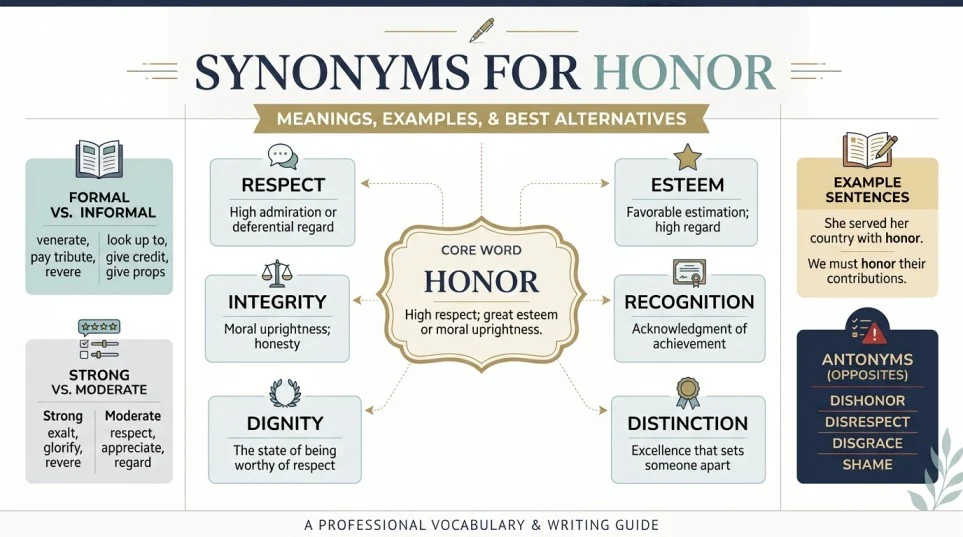
Honor means showing respect, maintaining strong moral principles, or recognizing someone’s achievements. The best synonyms include respect, integrity, dignity, esteem, recognition, prestige, and distinction. Choose the word that matches your intended meaning, whether you are describing character, admiration, achievement, or a formal privilege.
Meaning, Tone and Context
What Does Honor Mean?
Honor refers to respect, good moral character, or recognition given to a person for their actions, achievements, or qualities. It can also mean fulfilling a promise or treating an obligation as important.
For example, honoring a commitment means keeping your promise. Receiving an honor means being recognized for an achievement or contribution.
Part of Speech
Honor can function as both a noun and a verb.
- Noun: Honor can mean respect, integrity, or an award. Example: Her honesty earned the honor of leading the team.
- Verb: To honor someone means to respect, recognize, or celebrate them. Example: The school will honor its outstanding teachers.
Tone and Formality
Honor generally has a positive tone. It often suggests respect, responsibility, honesty, or high standards.
The word works in formal, academic, professional, personal, and ceremonial contexts. In everyday American English, honor is the standard US spelling, while honour is the usual British spelling.
Common Uses of Honor
Honor appears in many situations:
- Personal values, such as acting with integrity.
- Professional recognition, such as receiving an award.
- Relationships, such as honoring a family tradition.
- Commitments, such as honoring an agreement.
- Ceremonies, such as honoring veterans or community leaders.
Related Word Forms
| Word | Meaning | Example |
|---|---|---|
| Honor | Respect, integrity, or recognition | The award was a great honor. |
| Honorable | Worthy of respect | She made an honorable decision. |
| Honorably | In an honest or respectable way | He served honorably. |
| Honored | Feeling respected or recognized | I feel honored to be invited. |
| Honorary | Given as recognition, without the usual requirements of a position | She received an honorary degree. |
| Dishonor | Loss or absence of respect | His actions brought dishonor to the organization. |
When and How to Use Honor
Use honor when you want to communicate respect, moral responsibility, recognition, or the importance of a commitment. The best meaning depends on the sentence.
Professional context: The company will honor its agreement with the supplier.
Academic context: The university honored the researcher for her important work.
Personal context: We honor our grandparents by keeping their traditions alive.
Emotional context: It was an honor to support my friend during a difficult time.
Each example uses the same word differently. The first describes a commitment, the second recognizes achievement, the third expresses respect for family, and the fourth communicates gratitude.
Another Word for Honor
The best single replacement for honor is usually respect when you mean admiration or regard. However, integrity is more accurate when describing honest character, and recognition works better when referring to an achievement.
Choose the alternative that expresses your intended meaning rather than simply replacing the word.
| Context | Best Alternative | Example |
|---|---|---|
| Professional writing | Integrity | Integrity guides our business decisions. |
| Academic writing | Esteem | The scholar earned the esteem of her peers. |
| Casual conversation | Respect | I have a lot of respect for her. |
| Emotional writing | Reverence | He spoke of his grandmother with reverence. |
| Creative writing | Dignity | She faced every challenge with dignity. |
| Resume or workplace | Recognition | I received recognition for improving team performance. |
| Social media captions | Proud privilege | It was a privilege to celebrate this achievement. |
| Stronger moral meaning | Uprightness | His uprightness earned the community’s trust. |
| Softer, moderate meaning | Regard | I have great regard for your opinion. |
Best Synonyms by Specific Purpose
- For professional writing: Use integrity for ethical behavior, esteem for professional respect, and recognition for accomplishments.
- For academic writing: Use distinction for exceptional achievement, credibility for trustworthiness, and esteem when discussing a scholar’s reputation.
- For casual conversation: Use respect, admiration, or appreciation. These words sound natural and are easy to understand.
- For emotional writing: Use reverence for deep respect, dignity for self worth, and devotion when describing loyalty or commitment.
- For creative writing: Use nobility, prestige, or reverence when the meaning fits the scene and tone.
- For resumes: Use recognition, distinction, or integrity. Describe the actual accomplishment instead of relying on vague claims about being honorable.
For captions: Use respect, gratitude, privilege, or pride, depending on whether you are celebrating a person, achievement, or opportunity.
When Not to Use Honor
Honor is meaningful, but it is not always the clearest choice. If a sentence describes a specific action, a more precise word may communicate the idea better.
| Less Precise Sentence | Better Sentence | Why It Works |
|---|---|---|
| She showed honor by telling the truth. | She showed integrity by telling the truth. | Integrity directly describes honest conduct. |
| He received honor for his research. | He received recognition for his research. | Recognition focuses on acknowledgment of achievement. |
| I honor your opinion. | I respect your opinion. | Respect sounds more natural in conversation. |
| The school gave her a great honor. | The school awarded her a distinction. | Distinction emphasizes exceptional achievement. |
| He honored the contract. | He fulfilled the contract. | Fulfilled clearly describes completing an obligation. |
Avoid choosing a dramatic word when a simple one works better. For example, reverence suggests deep respect and may sound excessive when you simply mean that you admire a coworker.
Words Commonly Confused With Honor
Several words overlap with honor, but each has a distinct meaning.
| Word | Main Difference | Best Use |
|---|---|---|
| Respect | Positive regard for a person or their qualities | Everyday relationships and professional communication |
| Integrity | Strong moral principles and honesty | Character, ethics, and leadership |
| Dignity | A sense of worth and self respect | Personal conduct and human worth |
| Prestige | High status or public reputation | Institutions, careers, and achievements |
| Recognition | Acknowledgment of a person’s work or qualities | Awards, accomplishments, and contributions |
| Esteem | A high opinion of someone | Formal writing and professional relationships |
For example, a person may have integrity because they act honestly, earn respect because others value them, and receive recognition because of an achievement. These meanings are related, but they are not interchangeable in every sentence.
Best Synonym by Context for Honor
The most suitable synonym depends on the message you want to convey. Use this table to find an alternative for common writing situations.
| Context | Best Synonym | Why It Works | Example |
|---|---|---|---|
| Formal writing | Esteem | Communicates high regard | The leader earned the esteem of colleagues. |
| Academic writing | Distinction | Highlights exceptional achievement | She graduated with distinction. |
| Business communication | Integrity | Emphasizes ethical conduct | Integrity remains central to our policy. |
| Resume | Recognition | Shows acknowledgment of work | Earned recognition for outstanding service. |
| Casual conversation | Respect | Sounds natural and direct | I respect the way you handled that. |
| Creative writing | Nobility | Suggests moral greatness | His nobility became clear in difficult times. |
| Emotional expression | Reverence | Communicates deep respect | They remembered her with reverence. |
| Strong moral meaning | Uprightness | Highlights honest character | His uprightness never wavered. |
| Moderate appreciation | Regard | Expresses a favorable opinion | I have great regard for your judgment. |
| Social media caption | Privilege | Expresses gratitude for an opportunity | It was a privilege to join this team. |
| Awards and achievements | Recognition | Focuses on acknowledgment | Her work received national recognition. |
| Keeping a promise | Fulfill | Emphasizes meeting an obligation | We will fulfill our commitment. |
| Respecting a tradition | Preserve | Focuses on keeping something alive | They preserve their family’s traditions. |
| Public reputation | Prestige | Describes status and standing | The award brought prestige to the institution. |
| Personal self worth | Dignity | Emphasizes worth and self respect | She responded with dignity. |
US and UK Usage
American English generally uses honor, while British English usually uses honour. The same distinction applies to honorable and honourable, as well as honoring and honouring.
The meaning and most synonym choices remain the same in both varieties of English. Use the spelling that matches your audience, publication, or organization’s style guide.
Which Synonym Should You Choose?
Before replacing honor, ask yourself what the sentence is really describing.
- Meaning: Are you describing moral character, respect, public recognition, or a promise? Choose integrity, respect, recognition, or fulfillment accordingly.
- Formality: For academic or professional writing, esteem, distinction, and integrity may be appropriate. For casual conversation, respect is often clearer.
- Emotional intensity: Reverence expresses deeper respect than ordinary regard. Use it when the emotion is genuinely strong.
- Professional value: On a resume, recognition and distinction can communicate achievements. Support them with specific results or awards.
- Sentence context: If someone keeps a promise, use fulfill. If someone receives an award, use recognition or distinction. If someone behaves ethically, use integrity.
A useful rule is to select the word that tells the reader exactly what happened, rather than the word that sounds most impressive.
Real Life Examples of Honor in Sentences
These examples show how to use honor and related words in everyday situations.
School: The principal honored the students who volunteered in their community.
Workplace: Her integrity helped build trust across the department.
Writing: The author wrote about the dignity of ordinary people.
Conversation: I really respect how you stood up for your friend.
Social media: Grateful for the privilege of working with such a talented team.
Resume: Received recognition for improving customer satisfaction and team performance.
Email: It would be a privilege to contribute to this important project.
Storytelling: Even when faced with danger, the knight acted with nobility.
Family: We preserve our family’s traditions to honor those who came before us.
Community: The town held a ceremony to pay tribute to its volunteers.
18 Synonyms for Honor
The following 18 words cover different meanings of honor, including moral character, respect, public recognition, and fulfilling obligations. Some are close synonyms, while others are suitable replacements only in specific contexts.
| Synonym | Simple Meaning | Best Used For | Example Sentence |
|---|---|---|---|
| 1. Respect | High regard for someone | Daily conversation and relationships | I respect her commitment to fairness. |
| 2. Esteem | A high opinion of someone | Formal and professional writing | The doctor earned the esteem of her peers. |
| 3. Integrity | Honesty and strong moral principles | Ethics and character | Integrity is essential in public service. |
| 4. Dignity | A sense of worth and self respect | Personal conduct | He handled the criticism with dignity. |
| 5. Reverence | Deep respect | Religious, historical, or emotional contexts | The community treated the memorial with reverence. |
| 6. Prestige | High status or reputation | Institutions and achievements | The award added prestige to the university. |
| 7. Recognition | Acknowledgment of achievement | Work and awards | Her research received national recognition. |
| 8. Distinction | Excellence that sets someone apart | Academic or professional success | He graduated with distinction. |
| 9. Admiration | Respect mixed with approval | Personal appreciation | I have great admiration for her courage. |
| 10. Regard | A favorable opinion | Polite and professional communication | We hold the teacher in high regard. |
| 11. Nobility | Moral greatness or honorable character | Literature and character descriptions | Her nobility showed through her generous actions. |
| 12. Uprightness | Honest and ethical behavior | Moral character | His uprightness made him a trusted leader. |
| 13. Tribute | An expression of respect or praise | Ceremonies and remembrance | The speech was a tribute to her service. |
| 14. Appreciation | Recognition of value or effort | Gratitude and teamwork | The manager expressed appreciation for everyone’s work. |
| 15. Glory | Great praise or fame | Grand achievements and storytelling | The team celebrated its victory in glory. |
| 16. Privilege | A special opportunity or benefit | Invitations and personal gratitude | It was a privilege to speak at the event. |
| 17. Fulfill | To carry out a duty or promise | Commitments and obligations | We must fulfill our promises. |
| 18. Uphold | To maintain a principle, standard, or law | Rules, values, and professional ethics | The organization works to uphold fairness. |
Important distinction: Fulfill and uphold are verbs, while many other words in this list are nouns. They work as alternatives only when honor refers to keeping a promise, maintaining a value, or meeting an obligation.
Synonym Groups and Usage Differences
Professional vs. Personal Synonyms
Professional writing often focuses on ethical behavior, achievements, and reputation. Integrity, recognition, esteem, and distinction are useful choices.
Personal writing often expresses feelings or relationships. Respect, admiration, reverence, and appreciation can communicate warmth and sincerity.
For example, a manager might praise an employee’s integrity, while a friend might express admiration for someone’s courage.
Formal vs. Conversational Synonyms
Formal language is useful in reports, academic essays, speeches, and official emails. Words such as esteem, distinction, and integrity can fit these situations.
Conversational language favors clear and familiar expressions. Respect, appreciation, and admiration usually sound natural in texts, discussions, and everyday emails.
Choose a formal word only when it fits the meaning. A simple word often sounds more confident than an unnecessarily elaborate one.
Academic Synonyms
Academic writing benefits from precision. Use distinction for exceptional performance, recognition for acknowledged contributions, and integrity when discussing ethical behavior.
For example, instead of writing that a researcher received honor, explain that the researcher received recognition for the study or earned distinction for academic achievement.
When discussing research ethics, academic integrity is more precise than a general reference to honor.
Professional and Business Synonyms
In the workplace, the right word depends on whether you are discussing conduct, achievement, or a commitment.
- Integrity: Ethical choices and honest conduct.
- Recognition: Acknowledgment of performance or contribution.
- Esteem: Professional regard for a colleague.
- Uphold: Maintaining a standard, principle, or policy.
- Fulfill: Meeting a promise or obligation.
In a business email, write that the company will fulfill its commitment rather than saying it will honor its commitment if you want a more direct statement about completing an obligation. Both can be correct.
Creative or Literary Synonyms
Creative writing sometimes needs words that carry emotion, imagery, or moral weight.
Nobility can suggest courage and moral greatness. Reverence conveys deep respect. Dignity describes a person’s self respect, while glory suggests fame, triumph, or extraordinary achievement.
Use these words to strengthen a scene, not simply to make the writing sound dramatic.
Slang or Modern Synonyms
Honor has no single modern slang replacement that works in every situation. Informal expressions depend on the context and the relationship between speakers.
Expressions such as showing respect, giving someone credit, or keeping your word often sound more natural than searching for slang.
For example, You deserve credit for that is a conversational way to acknowledge someone’s contribution. It does not fully replace honor when the subject is moral character or a formal ceremony.
Avoid casual expressions in academic essays, formal reports, or serious discussions of ethics unless the tone specifically calls for them.
Strongest vs. Weaker Synonyms
There is no universal ranking of these words because they express different ideas. However, the following guide can help you choose an appropriate level of emotional intensity.
Mild
Regard
A favorable opinion or general respect.
Moderate
Respect, esteem, admiration
Clear appreciation or a high opinion of someone.
Strong
Reverence
Deep respect, often connected with something deeply valued.
Achievement
Distinction, prestige, glory
Words for excellence, status, or celebrated success rather than levels of respect alone.
Emotional vs. Neutral Synonyms
Some alternatives communicate strong feelings, while others focus on facts.
| Emotional or Expressive | More Neutral | Difference |
|---|---|---|
| Reverence | Respect | Reverence expresses deeper respect. |
| Admiration | Regard | Admiration often includes approval of someone’s qualities. |
| Glory | Recognition | Glory can suggest fame or triumph, while recognition simply acknowledges something. |
| Nobility | Integrity | Nobility can sound elevated or literary, while integrity directly describes ethical character. |
| Gratitude | Appreciation | Gratitude emphasizes thankfulness, while appreciation can also mean recognizing value. |
For clear professional writing, choose neutral words unless you intend to express a strong feeling.
Antonyms of Honor
Honor has several possible opposites because it can refer to respect, moral character, or public recognition. These 15 antonyms apply to different meanings rather than serving as exact opposites in every sentence.
| Antonym | Meaning | Example Sentence |
|---|---|---|
| 1. Dishonor | Loss of respect or reputation | The scandal brought dishonor to the institution. |
| 2. Disrespect | Lack of respect | Interrupting everyone showed disrespect. |
| 3. Disgrace | Loss of public respect | The fraud brought disgrace upon the organization. |
| 4. Shame | Painful awareness of wrongdoing or disgrace | He felt shame after lying to his friend. |
| 5. Contempt | A feeling that someone or something is unworthy of respect | She spoke with contempt for the dishonest practice. |
| 6. Indignity | Treatment that harms someone’s dignity | The unfair treatment was an indignity. |
| 7. Disrepute | A state of having a poor reputation | The investigation brought the company into disrepute. |
| 8. Dishonesty | Lack of truthfulness | Dishonesty damaged the team’s trust. |
| 9. Corruption | Abuse of power or position for improper gain | Corruption weakened public confidence. |
| 10. Treachery | Betrayal of trust or loyalty | His treachery shocked his closest allies. |
| 11. Betrayal | Breaking someone’s trust | Sharing her secret felt like a betrayal. |
| 12. Infamy | A reputation for disgraceful conduct | The criminal became known for his infamy. |
| 13. Humiliation | A loss of dignity caused by shame or embarrassment | The public humiliation deeply upset him. |
| 14. Degradation | A loss of dignity, quality, or status | The degrading treatment violated their basic dignity. |
| 15. Deceit | Deliberate misleading or dishonesty | Deceit destroyed the partnership. |
Choosing the right opposite: Use disrespect when the opposite of respect is intended, dishonesty when discussing moral character, and disgrace when referring to damaged reputation. These choices are clearer than treating every antonym as interchangeable.
Comparison: Honor vs. Similar Words
Honor vs. Respect
Main difference: Honor can refer to moral principles, public recognition, or respect. Respect usually means having a positive regard for someone.
Stronger word: Honor may carry greater moral or ceremonial weight, depending on the sentence.
More formal: Both work in formal writing, but honor often appears in ceremonial language.
Examples:
Honor: It was an honor to receive the award.
Respect: I respect her dedication to the community.
Honor vs. Integrity
Main difference: Honor can describe respect or recognition, while integrity specifically describes honesty and strong moral principles.
Stronger word: Neither is universally stronger. Integrity is more precise when discussing ethical behavior.
More formal: Both are suitable for professional and academic writing.
Examples:
Honor: The organization honored the volunteers.
Integrity: The leader demonstrated integrity during the investigation.
Honor vs. Dignity
Main difference: Honor often concerns respect, recognition, or moral standards. Dignity concerns a person’s worth and self respect.
Stronger word: Honor can sound more ceremonial, while dignity can carry greater emotional force in discussions of human worth.
More formal: Both are appropriate in formal contexts.
Examples:
Honor: The community held a ceremony to honor its veterans.
Dignity: She responded to the criticism with dignity.
Honor vs. Esteem
Main difference: Honor can mean recognition or moral standing. Esteem means a high opinion of someone.
Stronger word: Honor can suggest a formal distinction, while esteem emphasizes the regard someone earns.
More formal: Esteem often sounds more formal in descriptions of professional relationships.
Examples:
Honor: The university honored the professor for her service.
Esteem: The professor is held in high esteem by her colleagues.
Honor vs. Prestige
Main difference: Honor can refer to moral conduct or recognition. Prestige refers to high status or a strong reputation.
Stronger word: Prestige emphasizes status, while honor can carry a stronger moral meaning.
More formal: Both are common in professional writing.
Examples:
Honor: The award was a great honor for the team.
Prestige: The award increased the institute’s prestige.
Honor vs. Recognition
Main difference: Honor can express respect or confer a distinction. Recognition means acknowledging a contribution, achievement, or quality.
Stronger word: Honor can feel more personal or ceremonial, while recognition is more neutral.
More formal: Both fit formal writing and workplace communication.
Examples:
Honor: The city honored its longtime volunteers.
Recognition: The volunteers received recognition for their service.
Common Phrases and Expressions with Honor
1. It Is an Honor
Meaning: A polite way to express gratitude for receiving an opportunity or recognition.
Example sentence: It is an honor to represent our school at the national competition.
2. Honor Your Word
Meaning: To keep a promise or do what you said you would do.
Example sentence: A trustworthy leader always tries to honor their word.
3. In Honor Of
Meaning: Done to show respect for someone or remember an important person or event.
Example sentence: The school planted a tree in honor of its retiring principal.
4. A Matter of Honor
Meaning: Something considered essential to a person’s principles, reputation, or sense of duty.
Example sentence: Keeping his promise was a matter of honor.
5. Do Someone the Honor
Meaning: To give someone special recognition or show them respect through an action.
Example sentence: Would you do us the honor of opening the ceremony?
6. Honor and Integrity
Meaning: A combination of respectability and strong moral principles.
Example sentence: The organization expects its leaders to act with honor and integrity.
7. Pay Tribute To
Meaning: To express respect, gratitude, or admiration for someone or something.
Example sentence: The community gathered to pay tribute to its local heroes.
8. Uphold Your Principles
Meaning: To continue following your beliefs and moral standards, even when doing so is difficult.
Example sentence: She chose to uphold her principles despite pressure from her colleagues.
Common Mistakes to Avoid
1. Using Honor When Integrity Is More Precise
Honor can describe moral character, but integrity directly emphasizes honesty and ethical behavior.
Instead of writing, He showed honor by admitting his mistake, consider He showed integrity by admitting his mistake.
2. Confusing Honor With Prestige
Honor can refer to moral respect or recognition. Prestige describes high status or reputation.
A university may have prestige because of its reputation, while an award may be an honor given to an individual.
3. Choosing an Overly Formal Word
Words such as reverence and nobility can sound too grand in ordinary conversation.
Instead of saying I have deep reverence for your cooking, say I really appreciate your cooking, unless you intentionally want a humorous or exaggerated tone.
4. Using the Wrong Word for a Promise
When honor refers to keeping a promise, fulfill or keep may be clearer.
For example, We will honor our commitment is correct. We will fulfill our commitment is another direct option.
5. Repeating Honor Too Often
Repeated use can make an essay, speech, or caption feel monotonous.
Replace repeated instances with accurate alternatives such as respect, recognition, integrity, or tribute when their meanings fit.
6. Treating Every Synonym as Interchangeable
Respect, integrity, dignity, and recognition have related but different meanings.
Choose the word that describes the specific action, quality, or feeling you want to communicate.
FAQs
1. What Is the Best Synonym for Honor?
Respect is often the best general synonym for honor. Integrity is better for moral character, recognition for achievements, and esteem for a high opinion of someone.
2. What Is a Formal Synonym for Honor?
Esteem, distinction, and reverence can work as formal synonyms. Choose esteem for professional regard, distinction for achievement, and reverence for deep respect.
3. What Is an Informal Synonym for Honor?
Respect, appreciation, and giving someone credit are natural informal alternatives. The best choice depends on whether you mean admiration, gratitude, or recognition.
4. What Is Another Word for Honor in Professional Writing?
Integrity works well when discussing ethics, recognition when describing achievements, and esteem when explaining professional regard. Use fulfill when referring to commitments.
5. What Is the Difference Between Honor and Respect?
Honor can refer to moral principles, formal recognition, or respect. Respect generally means positive regard for a person, their qualities, or their actions.
6. What Is the Opposite of Honor?
Disrespect is a common opposite when honor means respect. Dishonor refers to lost respect or reputation, while dishonesty is the opposite of honesty associated with integrity.
Conclusion
Honor can describe respect, strong moral values, public recognition, or the fulfillment of a commitment. The best synonyms depend on the meaning you want to express.
Use respect for everyday communication, integrity for ethical behavior, esteem for professional regard, recognition for achievements, and reverence for deep respect.
The most useful vocabulary tip is to check the meaning of a sentence before replacing a word. A precise synonym makes your writing clearer, more natural, and more effective.
Discover More Post:
- 25+ Synonyms for Feeling | Meanings, Examples, and Best …
- 25+ Synonyms for Superior | Meanings, Examples, and Best …
- 25+ Synonyms for Anxious | Meanings, Examples, and Best …