You may know exactly what you mean when you say “I feel anxious,” but repeating the same word can make your writing sound limited. The right alternative can make an email more professional, a story more emotional, or a conversation more natural.
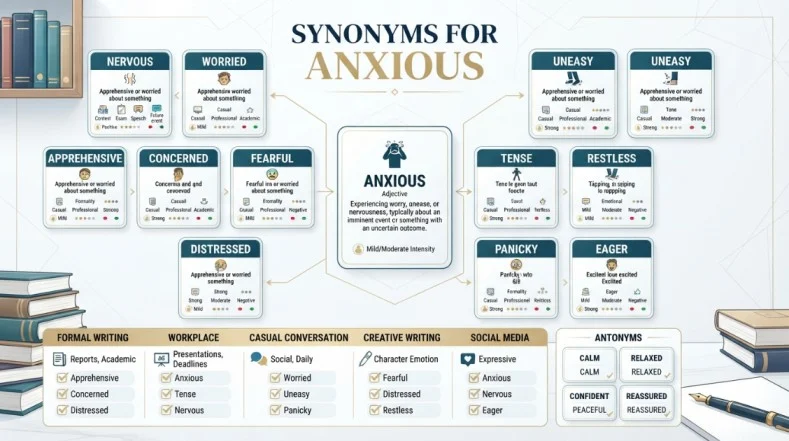
The best synonyms for anxious are not interchangeable in every situation. Words such as nervous, worried, apprehensive, uneasy, tense, and fearful each communicate a slightly different feeling.
This guide explains the meaning, tone, intensity, and context of each option so you can choose a word that fits your sentence naturally. The examples are designed for students, professionals, writers, job seekers, and anyone improving everyday American English.
What Does “Anxious” Mean?
Anxious usually means feeling worried, nervous, uneasy, or concerned about something uncertain. Depending on context, it can also mean eager or strongly wishing for something. Formal choices include apprehensive and concerned, while casual choices include nervous and uneasy.
Meaning, Tone and Context
Simple Definition
Anxious describes a feeling of worry, nervousness, uneasiness, or concern, especially when someone is uncertain about what may happen.
For example:
“I felt anxious before the interview.”
Here, anxious describes nervous concern about a future event.
The word can also have a second meaning related to eagerness or strong desire.
For example:
“She was anxious to hear the results.”
In this context, anxious means eager or very interested in finding out.
Part of Speech
Anxious is an adjective.
Related forms include:
Anxious, adjective: feeling worried or eager.
Anxiety, noun: a feeling of worry or nervousness.
Anxiously, adverb: in a worried, nervous, or eager manner.
Tone
Anxious generally has a negative or concerned emotional tone when it describes worry.
It can have a neutral or positive sense when it means eager.
For example:
“He was anxious about the exam.”
This expresses worry.
“She was anxious to begin her new job.”
This expresses eagerness.
Formality Level
Anxious works in casual conversation, academic writing, professional communication, journalism, and creative writing.
However, a more precise synonym can improve your sentence when you need to show exactly what kind of anxiety you mean.
Common Use Cases
Anxious commonly appears when discussing:
- Exams and school
- Job interviews
- Public speaking
- Important decisions
- Health concerns
- Relationships
- Future events
- Uncertain outcomes
- Major life changes
- Excitement or eagerness
When and How to Use “Anxious”
Use anxious when someone is experiencing worry, nervous anticipation, or uncertainty.
Professional
“The team was anxious about the potential impact of the announcement.”
This works in workplace communication because it communicates concern without sounding overly dramatic.
Personal
“I felt anxious before meeting her parents.”
The word naturally describes personal nervousness about an important situation.
Academic
“Many students become anxious before major examinations.”
This is appropriate for essays, educational articles, and classroom discussions.
Emotional
“He grew increasingly anxious as the hours passed without an update.”
The word creates a clear sense of growing emotional concern.
Creative
“She waited by the window, anxious for news from home.”
Here, anxious adds emotional tension to the scene.
Social Media
“Feeling anxious about tomorrow, but trying to stay positive.”
This sounds natural and conversational for a personal caption.
“I am anxious about the delay and would appreciate an update when possible.”
In a professional email, concerned may sound more measured depending on the situation.
Another Word for “Anxious”
The best single replacement depends on the intended meaning.
| Situation | Useful Alternative |
|---|---|
| Professional writing | Concerned |
| Academic writing | Apprehensive |
| Casual conversation | Nervous |
| Emotional writing | Distressed |
| Creative writing | Uneasy |
| Resume or workplace use | Concerned |
| Social media captions | Nervous |
| Stronger meaning | Panicky |
| Softer meaning | Uneasy |
If anxious means eager rather than worried, eager is usually the most direct replacement.
When Not to Use “Anxious”
Anxious can be too general when you need to identify the exact emotion.
Instead of saying:
“She was anxious about the meeting.”
You might say:
“She was nervous about speaking in front of the executives.”
Nervous gives the reader a more specific idea of the feeling.
Anxious can also be misleading when you actually mean excited or eager.
For example:
“I am anxious to start my new position.”
This can mean eager, but some readers may initially interpret it as worried. “I am eager to start my new position” removes that ambiguity.
In formal communication, concerned may sometimes be more measured than anxious.
Words Commonly Confused With “Anxious”
Anxious vs. Nervous
Anxious often involves worry about uncertainty or a future outcome. Nervous commonly describes tension before a specific event.
Anxious vs. Worried
Worried directly emphasizes concern about a problem or possible negative outcome. Anxious can also describe nervous anticipation.
Anxious vs. Apprehensive
Apprehensive usually suggests concern that something unpleasant or difficult may happen. It is more formal than nervous.
- Anxious vs. Eager
- Anxious can mean eager in some contexts, while eager clearly expresses enthusiasm or strong desire.
- Anxious vs. Fearful
Fearful suggests fear or expectation of danger. Anxious can exist without a clear threat.
Anxious vs. Uneasy
Uneasy often describes a mild or vague sense that something does not feel right. Anxious can indicate stronger worry.
Best Synonym by Context for “Anxious”
| Context | Best Synonym | Why It Works | Example |
|---|---|---|---|
| Formal writing | Apprehensive | Sounds precise and formal | She was apprehensive about the proposed changes. |
| Academic writing | Concerned | Clearly communicates intellectual or practical concern | Researchers were concerned about the results. |
| Professional use | Concerned | Measured and workplace appropriate | The manager was concerned about the delay. |
| Resume | Eager | Shows enthusiasm when anxious means strongly interested | I am eager to contribute to the team. |
| Casual conversation | Nervous | Natural and familiar | I am nervous about the interview. |
| Creative writing | Uneasy | Adds atmosphere without overstating emotion | He felt uneasy as the room grew quiet. |
| Emotional tone | Distressed | Communicates stronger emotional difficulty | She sounded distressed after the call. |
| Strong intensity | Panicky | Indicates intense fear or loss of calm | He became panicky when he could not find his child. |
| Mild tone | Uneasy | Suggests subtle discomfort | I felt uneasy about the decision. |
| Moderate tone | Worried | Directly communicates concern | She was worried about the outcome. |
| Social media | Nervous | Sounds conversational and relatable | A little nervous about tomorrow. |
| American English | Anxious | Common and natural in the United States | I am anxious about the presentation. |
| British English | Apprehensive | Useful in more formal contexts | He was apprehensive about the proposal. |
Which Synonym Should You Choose?
Start by identifying the exact emotion.
- If you mean general worry, choose worried.
- If you mean nervousness before an event, choose nervous.
- If you mean uncertainty about a possible negative outcome, choose apprehensive.
- If you mean mild discomfort or suspicion, choose uneasy.
- If you mean strong fear, choose fearful or alarmed.
- If you mean intense emotional distress, choose distressed.
- If you mean extreme nervousness, choose panicky.
- If anxious means strong interest or desire, choose eager.
For professional communication, concerned is often a measured choice.
For creative writing, uneasy, troubled, restless, or disquieted can provide more emotional texture.
Real Life Examples of “Anxious” in Sentences
School
“I was anxious about presenting my research in front of the class.”
Workplace
“The employees were anxious about the upcoming organizational changes.”
Writing
“The character became anxious when she realized that the door was unlocked.”
Conversation
“Are you anxious about tomorrow?”
Social Media
“Feeling anxious before the big day, but staying hopeful.”
Resume
“I am eager to take on new responsibilities and contribute to meaningful projects.”
Here, eager is better than anxious because the intended meaning is enthusiasm.
“I am concerned about the delay and would appreciate an update.”
Concerned can sound more professional when communicating a workplace issue.
Storytelling
“He grew increasingly anxious as the footsteps came closer.”
This creates tension without requiring a long explanation.
25 Synonyms for “Anxious”
| Synonym | Simple Meaning | Best Used For | Example Sentence |
|---|---|---|---|
| Nervous | Worried or tense about something | Everyday conversation | I felt nervous before the interview. |
| Worried | Concerned about a possible problem | General concern | She was worried about her brother. |
| Uneasy | Slightly uncomfortable or uncertain | Mild concern | He felt uneasy about the unfamiliar situation. |
| Apprehensive | Worried that something unpleasant may happen | Formal writing | They were apprehensive about the difficult decision. |
| Concerned | Thinking seriously about a possible problem | Professional communication | The director was concerned about the declining results. |
| Fearful | Feeling fear or expecting danger | Stronger emotional situations | She was fearful of what might happen next. |
| Afraid | Feeling fear or worry | Everyday language | He was afraid that he had made a mistake. |
| Restless | Unable to relax because of worry or anticipation | Emotional description | She became restless while waiting for the news. |
| Tense | Physically or mentally strained | Situational nervousness | Everyone felt tense before the announcement. |
| Jittery | Extremely nervous or physically unsettled | Casual language | He felt jittery before going on stage. |
| Edgy | Nervous, irritable, or unable to relax | Casual conversation | The long delay left everyone feeling edgy. |
| Fretful | Frequently worried or troubled | Literary and descriptive writing | The fretful child kept asking when they would leave. |
| Troubled | Emotionally disturbed or worried | Serious emotional situations | He looked troubled after reading the message. |
| Distressed | Deeply upset or emotionally strained | Strong emotional situations | She sounded distressed during the phone call. |
| Perturbed | Noticeably disturbed or unsettled | Formal writing | The unexpected criticism left him perturbed. |
| Disquieted | Made uneasy or concerned | Literary and formal writing | The strange silence left her disquieted. |
| Agitated | Highly unsettled or emotionally stirred | Strong emotional situations | The customer became agitated after waiting for an hour. |
| Alarmed | Suddenly worried because of possible danger | Urgent situations | The staff became alarmed when the warning appeared. |
| Panicky | Experiencing intense fear or nervousness | Very strong anxiety | He felt panicky when he realized he was lost. |
| Insecure | Uncertain about oneself or one’s position | Confidence related situations | She felt insecure about her performance. |
| Unsettled | Unable to feel calm or comfortable | Uncertainty and discomfort | The sudden change left everyone unsettled. |
| Overwrought | Extremely emotional or distressed | Formal and literary writing | She was overwrought after receiving the shocking news. |
| Eager | Very interested or excited to do something | Positive meaning of anxious | The students were eager to begin the project. |
| Keen | Strongly interested or enthusiastic | Positive meaning, especially British usage | She was keen to learn more about the opportunity. |
| Desirous | Strongly wanting something | Formal writing | The organization was desirous of expanding its services. |
Synonym Groups and Usage Differences
Professional vs. Personal Synonyms
Professional communication usually benefits from measured words such as concerned, apprehensive, and uneasy.
Personal communication allows more expressive choices such as nervous, jittery, edgy, and restless.
For example:
Professional: “I am concerned about the schedule.”
Personal: “I am really nervous about tomorrow.”
The first sounds measured. The second sounds more personal and conversational.
Formal vs. Conversational Synonyms
Apprehensive, perturbed, disquieted, and overwrought are more formal or literary.
Nervous, worried, uneasy, tense, and jittery are more common in everyday conversation.
For an academic essay, apprehensive may fit better than jittery.
For a text message, nervous is usually more natural.
Academic Synonyms
Academic writing should favor precision over dramatic language.
Concerned, apprehensive, uneasy, and troubled can work well when the context supports them.
For example:
“The participants were apprehensive about the potential consequences.”
This sounds more precise than:
“The participants were super nervous about what might happen.”
Professional and Business Synonyms
Concerned is particularly useful in workplace communication because it can communicate an issue without unnecessarily intensifying the emotion.
Apprehensive can work when discussing uncertainty about a proposal or change.
Eager is useful when anxious means enthusiastic.
For example:
“I am eager to discuss the opportunity.”
This communicates positive interest rather than worry.
Creative or Literary Synonyms
Creative writing benefits from words that create a specific emotional atmosphere.
Uneasy suggests subtle discomfort.
Restless suggests an inability to settle.
Disquieted creates a more literary sense of disturbance.
Overwrought suggests intense emotional strain.
Slang or Modern Synonyms
Words such as jittery and edgy are informal but widely understood.
They can work in conversations, texts, personal posts, and dialogue.
They are usually less appropriate in academic papers, formal reports, and professional documents.
Strongest vs. Weaker Synonyms
A useful intensity scale is:
Mild: uneasy
Mild to moderate: concerned
- Moderate: worried
- Moderate: nervous
- Moderate to strong: apprehensive
Strong: fearful
Strong: distressed
Very strong: panicky
The best choice depends on the actual emotional intensity. Do not use a dramatic word simply to make a sentence sound stronger.
Emotional vs. Neutral Synonyms
Neutral choices include concerned and worried.
More emotional choices include distressed, fearful, alarmed, and panicky.
More atmospheric choices include uneasy, restless, and disquieted.
Positive choices include eager and keen when anxious means strongly interested.
Antonyms of “Anxious”
| Antonym | Meaning | Example Sentence |
|---|---|---|
| Calm | Not nervous or worried | She remained calm during the discussion. |
| Relaxed | Free from tension | He felt relaxed after finishing the presentation. |
| Composed | Calm and in control | She stayed composed under pressure. |
| Confident | Certain about your abilities or outcome | He felt confident before the interview. |
| Assured | Certain and self confident | She sounded assured during the presentation. |
| Tranquil | Peaceful and free from disturbance | The quiet garden felt tranquil. |
| Peaceful | Calm and undisturbed | He enjoyed a peaceful afternoon. |
| Serene | Completely calm and peaceful | Her expression remained serene. |
| Untroubled | Free from worry or difficulty | The children appeared untroubled by the change. |
| Unworried | Not concerned about something | He seemed completely unworried about the delay. |
| Unconcerned | Not worried or interested in a problem | She appeared unconcerned about the criticism. |
| Content | Satisfied and comfortable | They were content with the final result. |
| Secure | Safe, stable, or confident | She felt secure in her new position. |
| Fearless | Not afraid | The fearless climber continued upward. |
| Reassured | Made less worried by new information | The explanation left everyone reassured. |
Comparison: “Anxious” vs. Similar Words
Anxious vs. Nervous
The main difference is emphasis. Anxious often focuses on worry or uncertainty, while nervous commonly describes tension before an event.
Anxious can be stronger when the concern is ongoing.
Neither word is inherently more formal, although both are widely accepted in professional and academic writing.
Anxious: “She was anxious about the results.”
Nervous: “She was nervous before the presentation.”
Anxious vs. Worried
Worried directly communicates concern about a problem or possible negative outcome.
Anxious can describe worry, nervous anticipation, or eagerness depending on context.
Worried is often more direct.
Anxious: “He was anxious about the upcoming decision.”
Worried: “He was worried that the decision would affect his job.”
Anxious vs. Apprehensive
Apprehensive specifically suggests concern that something difficult or unpleasant may happen.
It is generally more formal than nervous.
Apprehensive can sound more precise in formal writing.
Anxious: “She was anxious about the meeting.”
Apprehensive: “She was apprehensive about the consequences of the proposal.”
Anxious vs. Uneasy
Uneasy usually suggests mild discomfort or uncertainty.
Anxious can describe a stronger emotional reaction.
Neither is necessarily more formal, although uneasy can work particularly well in descriptive writing.
Anxious: “I felt anxious while waiting for the results.”
Uneasy: “I felt uneasy about the unusual request.”
Anxious vs. Fearful
Fearful emphasizes fear.
Anxious can exist without a clear threat and may simply involve uncertainty.
Fearful is stronger when genuine fear is present.
Anxious: “She was anxious about the procedure.”
Fearful: “She was fearful that the procedure might cause serious harm.”
Anxious vs. Eager
These words can overlap because anxious sometimes means eager.
Eager clearly communicates positive enthusiasm, while anxious can create ambiguity.
Eager is usually the better choice when expressing excitement about an opportunity.
Anxious: “He was anxious to hear the decision.”
Eager: “He was eager to join the new team.”
Common Phrases and Expressions with “Anxious”
1. Anxious about something
Meaning:
Feeling worried or nervous about a particular situation.
Example sentence:
“She was anxious about the upcoming interview.”
2. Anxious for news
Meaning:
Waiting impatiently or with concern for new information.
Example sentence:
“The family was anxious for news about the missing traveler.”
3. Anxious to know
Meaning:
Very interested in finding out something.
Example sentence:
“We were anxious to know whether the proposal had been accepted.”
4. Anxious to begin
Meaning:
Very eager or interested in starting something.
Example sentence:
“The students were anxious to begin their new project.”
5. Anxious thoughts
Meaning:
Thoughts connected with worry or uncertainty.
Example sentence:
“She tried to quiet her anxious thoughts before going to sleep.”
6. Anxious moments
Meaning:
Periods when someone feels worried or nervous.
Example sentence:
“There were several anxious moments during the storm.”
7. An anxious expression
Meaning:
A facial expression that shows worry or nervousness.
Example sentence:
“He wore an anxious expression while waiting for the results.”
8. Grow anxious
Meaning:
To become increasingly worried or nervous.
Example sentence:
“People began to grow anxious when the announcement was delayed.”
Common Mistakes to Avoid
1. Using Anxious When You Mean Excited
Anxious can mean eager, but it may also suggest worry.
Instead of “I am anxious about starting my new job,” use “I am excited about starting my new job” when you mean positive enthusiasm.
2. Confusing Anxious With Nervous
Nervous is especially natural for short term tension before an event.
Anxious can describe broader worry or uncertainty.
3. Using a Casual Synonym in Formal Writing
Words such as jittery and edgy may sound too conversational in an academic paper.
Use concerned or apprehensive when the context requires a more formal tone.
4. Using an Overly Dramatic Synonym
Do not replace anxious with panicky unless the person is actually experiencing intense fear or loss of calm.
Choose words that accurately represent the emotional intensity.
5. Repeating Anxious Too Often
Repeating anxious throughout an essay can make the writing feel monotonous.
Use precise alternatives such as worried, uneasy, nervous, apprehensive, or concerned when their meanings fit.
6. Choosing the Wrong Emotional Tone
Distressed communicates much stronger emotional difficulty than concerned.
Always consider whether your replacement sounds too strong, too weak, or simply different from the intended meaning.
7. Using Slang in Academic or Professional Writing
Jittery and edgy are useful conversational words, but they may not suit formal documents.
Choose vocabulary that matches the audience and purpose.
FAQs
What is the best synonym for anxious?
The best synonym depends on context. Nervous works for everyday situations, concerned suits professional writing, apprehensive sounds formal, and uneasy suggests milder discomfort.
What is a formal synonym for anxious?
Apprehensive is a strong formal synonym when someone expects a potentially unpleasant outcome. Concerned and perturbed can also work depending on context.
What is an informal synonym for anxious?
Nervous is the most natural everyday alternative. Jittery and edgy can also work when the situation involves noticeable tension or restlessness.
What is another word for anxious in professional writing?
Concerned is often a useful professional alternative because it communicates an issue without unnecessarily increasing emotional intensity.
What is the difference between anxious and nervous?
Anxious often involves broader worry or uncertainty, while nervous commonly describes temporary tension before a specific event such as an interview.
What is the opposite of anxious?
Common opposites include calm, relaxed, composed, confident, reassured, peaceful, serene, and untroubled. The best choice depends on the sentence.
Conclusion
Anxious usually describes worry, nervousness, or uncertainty, but it can also mean eager in certain contexts. The best replacement depends on the exact meaning you want to communicate.
Choose nervous for everyday tension, worried for direct concern, apprehensive for formal uncertainty, uneasy for mild discomfort, concerned for professional communication, and eager when anxious means enthusiastic.
The most useful vocabulary habit is to replace a word only when the alternative adds precision. A good synonym should make your meaning clearer, not simply make your sentence sound more complicated.
Before publishing educational content, verify definitions and usage with trusted dictionaries such as Cambridge, Oxford, Merriam Webster, Collins, or Britannica.
Discover More Post:
- 25+ Synonyms for Secret | Meanings, Examples, and Best …
- 25 Synonyms for Saw | Meanings, Examples, and Best …
- 25+ Synonyms for Dream | Meanings, Examples, and Best …