Have you ever written an email, essay, report, or social media caption and noticed that you keep using the phrase as a result? It is a useful expression, but repeating it can make your writing sound predictable. Choosing a different phrase can improve the flow of your sentences and help readers understand how one event leads to another.
Learning synonyms for as a result helps you communicate cause and effect more clearly. Some alternatives work best in academic essays, while others sound natural in business emails, everyday conversations, and creative writing. This guide explains their meanings, differences, and practical uses so you can choose the right expression for each situation. You will also learn which alternatives are formal, conversational, or best suited to showing a direct consequence.
What Does As a Result Mean?
As a result means because of something that happened, or as a consequence of an action or event. Common alternatives include therefore, consequently, thus, hence, and for this reason in formal writing, and so or because of that in everyday conversation.
Meaning, Tone and Context
What Does As a Result Mean?
As a result is a phrase used to show that something happened because of an earlier action, event, decision, or situation. It connects a cause with its outcome.
For example, if a company improves its customer service and receives more positive reviews, you can say that it received more positive reviews as a result.
Part of Speech
As a result is a prepositional phrase that commonly functions as a conjunctive expression or transition between ideas. It often introduces a consequence in a new clause or sentence.
Example: The roads were flooded. As a result, several schools closed.
Tone and Formality
The phrase has a neutral, clear, and slightly formal tone. It works in academic writing, professional reports, business emails, news articles, and everyday explanations.
It does not usually express a positive or negative feeling on its own. The situation determines whether the outcome is beneficial, harmful, or neutral.
Common Use Cases
- Academic writing, to explain the outcome of research or an argument.
- Business communication, to connect decisions with measurable outcomes.
- Everyday conversation, to explain why something happened.
- News and reports, to describe the consequences of an event.
- Creative writing, to connect actions and events in a story.
Related Words and Forms
As a result does not have a direct verb, adjective, or noun form because it is a phrase rather than a single word.
Related expressions include result, resulting, consequently, and as a consequence. Each has a different grammatical role, so they cannot always replace the original phrase in every sentence.
When and How to Use As a Result
Use as a result when you want to make the relationship between a cause and an outcome clear. It is particularly helpful when the connection needs to be easy for readers to follow.
Professional Example
The team improved its response time. As a result, customer satisfaction increased.
Academic Example
The researchers increased the sample size. Consequently, the findings became more reliable.
Personal Example
I forgot to set my alarm, so I missed the early bus.
Email Example
The supplier delivered the materials late. As a result, the project schedule has changed.
Each example shows a consequence, but the best replacement depends on the sentence structure and the level of formality you want.
Another Word for As a Result
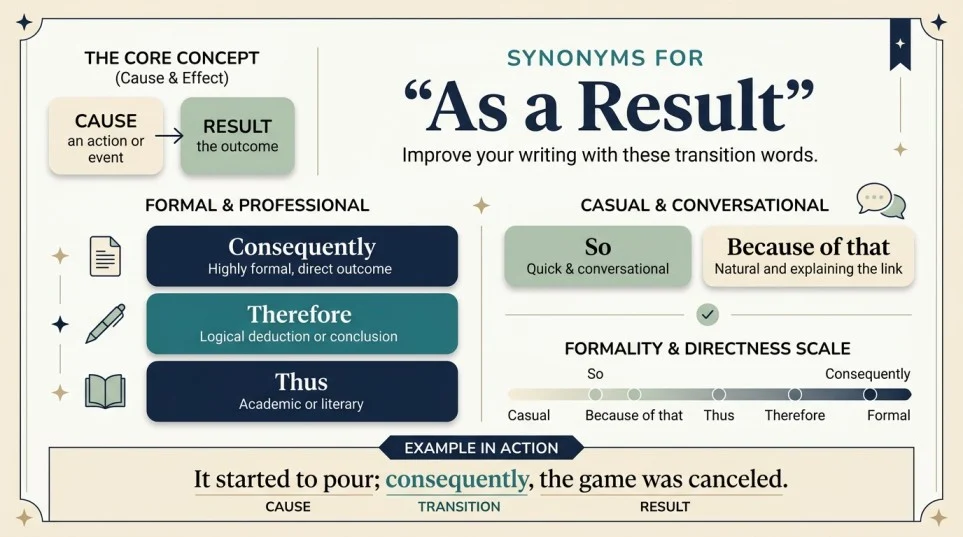
The best single replacement for as a result is usually therefore or consequently in formal writing, and so or because of that in casual conversation. However, these expressions are not always interchangeable.
Here are useful choices by situation.
| Context | Recommended alternative |
|---|---|
| Professional writing | Consequently |
| Academic writing | Therefore |
| Casual conversation | So |
| Emotional writing | Because of this |
| Creative writing | This led to |
| Resume or workplace achievements | Leading to |
| Social media captions | So |
| Strong cause and effect | As a consequence |
| Softer explanation | For this reason |
Professional Writing
Choose consequently when explaining the outcome of a business decision, process change, or workplace event.
Example: The company streamlined its hiring process. Consequently, recruitment costs decreased.
Academic Writing
Use therefore when drawing a conclusion from evidence or reasoning.
Example: The evidence supports the hypothesis. Therefore, further investigation is justified.
Casual Conversation
Use so or because of that when speaking naturally with friends, family, or colleagues.
Example: Traffic was terrible, so I arrived late.
Emotional Writing
Use because of this to create a more personal connection between an event and its effect.
Example: She supported me during a difficult time. Because of this, I learned to trust her.
Creative Writing
Use this led to or consequently to show how an event moves a story forward.
Example: He ignored the warning signs. This led to a decision that changed his life.
Resume and Workplace Use
Use leading to when describing an action and its measurable outcome in a resume.
Example: Improved the onboarding process, leading to faster employee training.
Social Media Captions
Use so for short, natural captions.
Example: The weather was perfect, so we spent the afternoon outdoors.
Stronger Meaning
Choose as a direct consequence when you want to emphasize a clear and closely connected outcome.
Example: The company ignored repeated safety warnings. As a direct consequence, operations were suspended.
Softer Meaning
Choose for this reason when you want to explain a decision without sounding overly forceful.
Example: The schedule has changed. For this reason, we will begin the meeting later.
When Not to Use As a Result
Although as a result is useful, it is not the best choice in every sentence.
When the Cause Is Unclear
Avoid using the phrase when you have not established a clear relationship between two events. A transition should not suggest that one event caused another without enough evidence.
Weak: The store changed its logo. As a result, sales increased.
Better: The store changed its logo, and sales increased during the same period.
The improved sentence avoids claiming that the new logo caused the increase without supporting evidence.
When a Shorter Expression Works Better
In casual speech, so may sound more natural than as a result.
Wordy: I missed the train. As a result, I arrived late.
Natural: I missed the train, so I arrived late.
When You Need a Specific Relationship
As a result can be too general when the sentence needs to identify the precise consequence.
General: The company changed its policies. As a result, employee satisfaction improved.
More precise: The company introduced flexible schedules, which helped improve employee satisfaction.
When You Are Repeating It Too Often
Using the same transition in every paragraph can make your writing feel mechanical. Vary your wording only when another expression fits the meaning and sentence structure.
Words Commonly Confused With As a Result
Several transitions express relationships between ideas, but they do not all communicate cause and effect in the same way.
| Expression | Main difference | Best use |
|---|---|---|
| Therefore | Draws a conclusion from evidence or reasoning | Essays and arguments |
| Consequently | Emphasizes an outcome caused by an earlier event | Reports and formal writing |
| Thus | Shows a logical result, often concisely | Academic and technical writing |
| Hence | Indicates a consequence or conclusion | Formal explanations |
| So | Connects cause and outcome naturally | Conversation |
| Subsequently | Means something happened afterward, not necessarily because of the earlier event | Timelines and reports |
For example, the sentence The team changed its strategy. Subsequently, sales increased establishes a sequence of events. It does not necessarily prove that the strategy change caused the increase.
The sentence The team changed its strategy. Consequently, sales increased makes a stronger connection between the action and the outcome.
Best Synonym by Context for As a Result
| Context | Best synonym | Why it works | Example |
|---|---|---|---|
| Formal writing | Consequently | Clearly signals an outcome | Consequently, the proposal was approved. |
| Academic writing | Therefore | Connects evidence with a conclusion | Therefore, the results support the theory. |
| Professional communication | As a consequence | Sounds precise and businesslike | As a consequence, the deadline changed. |
| Resume writing | Leading to | Connects an action with an achievement | Updated workflows, leading to fewer errors. |
| Casual conversation | So | Short and natural | It rained, so we stayed home. |
| Creative writing | This led to | Helps move a narrative forward | This led to an unexpected discovery. |
| Emotional writing | Because of this | Highlights a personal impact | Because of this, she felt more confident. |
| Strong cause and effect | As a direct consequence | Emphasizes a close relationship | As a direct consequence, the service stopped. |
| Softer explanation | For this reason | Explains a decision calmly | For this reason, we chose another option. |
| Social media captions | So | Keeps captions concise | The sun came out, so we went hiking. |
| Scientific reports | Consequently | Describes a measured outcome | Consequently, the reaction slowed. |
| Logical arguments | Thus | Presents a concise conclusion | Thus, the proposed method is more efficient. |
| News reporting | As a consequence | Clearly reports an outcome | As a consequence, several routes closed. |
| Everyday emails | Because of that | Sounds clear and friendly | Because of that, I need to reschedule. |
| Technical writing | Thereby | Connects an action with its direct effect | The system reduces duplicate entries, thereby improving accuracy. |
The strongest choice is not always the most formal one. Select the expression that communicates the relationship accurately and sounds natural to your intended reader.
Which Synonym Should You Choose?
Use these simple guidelines to find the best alternative.
- Consider the meaning. Use consequently when an event produces an outcome. Use therefore when a conclusion follows from evidence or reasoning.
- Match the formality. Choose therefore or consequently for formal reports. Choose so or because of that for everyday conversation.
- Check the strength of the connection. Use as a direct consequence when the relationship is clearly established. Use subsequently when you only mean that something happened later.
- Think about professional value. In a resume, leading to helps connect your actions with results. Whenever possible, include a measurable achievement.
- Read the full sentence. A synonym should fit the grammar and improve the flow. Do not replace a phrase simply to avoid repetition.
- Keep the reader in mind. Clear, familiar transitions are often more effective than complicated words.
Real Life Examples of As a Result in Sentences
These examples show how to communicate cause and effect in different situations.
School
The student reviewed her notes every evening. As a result, she felt better prepared for the exam.
Workplace
The department introduced a new scheduling system. Consequently, employees spent less time managing appointments.
Writing
The author removed repeated ideas. Therefore, the article became easier to read.
Conversation
I left home earlier than usual, so I reached the office on time.
Social Media
The sunset looked beautiful, so we stayed outside until dark.
Resume
Redesigned the customer support process, leading to faster response times.
The client requested additional changes. Because of that, we will send the final version tomorrow.
Storytelling
The traveler followed a narrow path through the forest. This led to a quiet village that was missing from his map.
Research
The researchers controlled the testing conditions. Consequently, the results were easier to compare.
Personal Decision
She realized she needed more time to prepare. For this reason, she postponed the interview.
18 Synonyms for As a Result
The following 18 alternatives express consequences, conclusions, or outcomes. Some are close replacements, while others work only in specific contexts.
| Synonym | Simple Meaning | Best Used For | Example Sentence |
|---|---|---|---|
| 1. Consequently | Because of what happened | Formal reports | The costs increased. Consequently, the budget was revised. |
| 2. Therefore | For that reason | Essays and logical arguments | The evidence was incomplete. Therefore, we need more research. |
| 3. Thus | In this way or as a result | Academic writing | The method reduced errors, thus improving accuracy. |
| 4. Hence | For this reason | Formal explanations | The data was unreliable, hence the need for further testing. |
| 5. So | For that reason | Everyday conversation | It was getting late, so we headed home. |
| 6. Accordingly | In response to the situation | Business communication | The requirements changed, and the team adjusted its plan accordingly. |
| 7. For this reason | Because of this situation | Explanations and arguments | For this reason, the school extended the deadline. |
| 8. Because of this | Due to the situation just mentioned | Personal writing | Because of this, I decided to try a different approach. |
| 9. Because of that | Due to that event | Casual conversation | The road was closed. Because of that, we took another route. |
| 10. As a consequence | As an outcome | Formal writing | As a consequence, the application was delayed. |
| 11. As a direct consequence | As an immediate or clearly connected outcome | Strong cause and effect | As a direct consequence of the error, the payment was reversed. |
| 12. For that reason | Because of the stated cause | General explanations | The instructions were unclear. For that reason, I asked for help. |
| 13. This led to | This caused an outcome | Storytelling and reports | Poor communication led to several missed deadlines. |
| 14. Leading to | Producing a particular outcome | Resumes and business writing | Introduced a new process, leading to shorter waiting times. |
| 15. Thereby | By doing so, producing an effect | Technical writing | The update removed duplicate records, thereby improving data quality. |
| 16. In turn | As an effect of something else | Connected processes | Better training improved confidence, which in turn increased productivity. |
| 17. Which resulted in | Which caused a particular outcome | Reports and explanations | The storm damaged power lines, which resulted in a temporary outage. |
| 18. Which is why | This explains the reason for something | Conversation and informal writing | I had another appointment, which is why I left early. |
Remember that not every alternative fits every sentence. For example, thereby usually connects an action with the way it produces an effect, while subsequently only indicates that something happened later.
Synonym Groups and Usage Differences
Professional vs. Personal Synonyms
Professional writing often benefits from consequently, therefore, accordingly, and as a consequence. These expressions make reports, proposals, and business explanations sound organized.
Personal writing can sound more natural with so, because of this, for that reason, and which is why. These choices work well when explaining everyday experiences, personal decisions, or feelings.
Example for work: The team missed the first deadline. Consequently, the delivery date was revised.
Example for personal writing: I needed more time, so I finished the assignment the next morning.
Formal vs. Conversational Synonyms
Formal transitions suit structured writing, while conversational alternatives help people communicate without sounding stiff.
| Formal expression | Conversational alternative |
|---|---|
| Consequently | So |
| Therefore | So, for that reason |
| As a consequence | Because of that |
| Accordingly | In response to that |
| Hence | That is why |
| Thus | So |
In a business report, consequently may be appropriate. In a text to a friend, so is usually simpler and more natural.
Academic Synonyms
Academic writing needs transitions that show whether a sentence presents a conclusion, a consequence, or a logical relationship.
Therefore is useful when the evidence supports a conclusion.
Example: The results were consistent across all groups. Therefore, the hypothesis received further support.
Consequently emphasizes an outcome that follows from an earlier event.
Example: The researchers changed the testing conditions. Consequently, the second trial produced different results.
Thus provides a concise link between an action and its outcome.
Example: The team controlled the variables, thus reducing the risk of measurement errors.
Use these expressions only when the relationship between ideas is clear. A formal transition does not make an unsupported conclusion valid.
Professional and Business Synonyms
Business writing often explains how decisions, delays, and process changes affect results.
Choose accordingly when describing a response to new circumstances.
Example: The client changed the requirements, so the project plan was updated accordingly.
Choose consequently when reporting an outcome.
Example: Customer demand increased. Consequently, the company expanded its support team.
Choose leading to when describing the result of an action, especially in a resume.
Example: Streamlined the ordering process, leading to fewer processing errors.
A useful workplace tip is to connect actions with measurable outcomes whenever possible. This makes reports and resume statements more informative.
Creative or Literary Synonyms
Creative writing often benefits from transitions that sound natural within a story rather than formal and repetitive.
Consider these options:
- This led to, for showing how one event changes the direction of a story.
- Because of this, for connecting an action with a character’s response.
- Which is why, for explaining a character’s decision.
- In turn, for showing how one consequence creates another.
- So, for keeping dialogue natural.
Example: The village had lost its only bridge. Because of this, the travelers had to find another way through the mountains.
Slang or Modern Synonyms
There is no widely accepted slang expression that precisely replaces as a result in every context. Informal expressions are usually better choices than slang.
For example, so, that is why, and because of that work in everyday conversations, texts, and casual captions.
Avoid using expressions such as so yeah as formal transitions in academic papers, business reports, or job applications. They can make otherwise clear writing seem careless.
Strongest vs. Weaker Synonyms
The following scale describes how explicitly the expressions present cause and effect. It is not a strict ranking of intensity.
| Level | Expression | Effect |
|---|---|---|
| Mild or neutral | Subsequently | Shows what happened later without proving causation |
| Neutral | So | Connects a cause with an outcome in simple language |
| Clear | For this reason | Identifies the stated reason for an outcome or decision |
| Clear and formal | Consequently | Emphasizes an outcome connected to an earlier event |
| Strongly explicit | As a direct consequence | Highlights a direct relationship between a cause and its outcome |
Choose the level that matches your evidence. A stronger expression should not be used to imply a direct cause when the relationship is uncertain.
Emotional vs. Neutral Synonyms
Neutral expressions focus on information rather than feelings. Therefore, consequently, and thus generally fit factual explanations.
Personal expressions such as because of this and that is why can feel more connected to a person’s experience, especially when the surrounding sentence describes emotions.
For example:
Neutral: The deadline changed. Consequently, the delivery date moved to Friday.
Personal: She helped me when I needed support. That is why I will always appreciate her kindness.
The surrounding details, rather than the transition alone, create most of the emotional effect.
Antonyms of As a Result
As a result is a phrase that describes a consequence, so it has no exact set of single word antonyms. The following 15 expressions provide useful contrasts, such as causes, conditions, lack of consequences, and simple sequence without a proven causal relationship. They are contextual opposites, not interchangeable dictionary antonyms.
| Contrastive expression | Meaning | Example Sentence |
|---|---|---|
| 1. Regardless | Without being affected by a particular factor | Regardless of the delay, the team completed the work. |
| 2. Despite this | Even with the situation mentioned | Despite this, the event continued as planned. |
| 3. Nevertheless | In spite of what was stated | The test was difficult. Nevertheless, she passed. |
| 4. Nonetheless | Despite the circumstances | The journey was long. Nonetheless, we enjoyed it. |
| 5. Even so | Despite that fact | The task was challenging. Even so, he accepted it. |
| 6. Still | Despite what has happened | The weather was poor. Still, the visitors arrived. |
| 7. In spite of this | Despite the previous situation | In spite of this, sales remained steady. |
| 8. Irrespective of | Without considering a particular factor | The policy applies irrespective of the outcome. |
| 9. Without consequence | Without a resulting effect or penalty | The minor error passed without consequence. |
| 10. To no effect | Without achieving the intended result | She repeated the request to no effect. |
| 11. In vain | Without success | They searched in vain for the missing document. |
| 12. Unrelatedly | In a way that is not connected to the previous topic | Unrelatedly, the library will open earlier tomorrow. |
| 13. Independently | Separately or without dependence on something else | The two teams reached their decisions independently. |
| 14. Coincidentally | Happening by chance rather than necessarily because of another event | Coincidentally, we chose the same restaurant. |
| 15. Subsequently | Happening afterward, without necessarily indicating cause | The meeting ended. Subsequently, the team sent its notes. |
The best choice depends on what you want to contrast. Use without consequence when no meaningful effect occurred, regardless when a factor does not change the outcome, and coincidentally when events happen together by chance.
Comparison: As a Result vs. Similar Words
As a Result vs. Therefore
The main difference is that as a result emphasizes an outcome, while therefore often introduces a conclusion based on reasoning.
Therefore is especially useful in essays and arguments. Both expressions are neutral and can work in formal writing.
Example with as a result: The road was flooded. As a result, traffic slowed.
Example with therefore: The road is flooded, so drivers should therefore choose another route.
As a Result vs. Consequently
Both expressions indicate consequences. Consequently often sounds more formal and compact, while as a result is familiar and straightforward.
Neither is automatically stronger in every sentence.
Example with as a result: The machine overheated. As a result, production stopped.
Example with consequently: The machine overheated. Consequently, production stopped.
As a Result vs. Thus
As a result directly identifies an outcome. Thus can indicate an outcome, a method, or a logical conclusion, depending on the sentence.
Thus is often more concise and is common in academic or technical writing.
Example with as a result: The team reduced waste. As a result, operating costs fell.
Example with thus: The team reduced waste, thus lowering operating costs.
As a Result vs. Hence
Both can introduce a consequence. Hence tends to sound more formal and is often used in concise explanations.
As a result is usually easier for general readers to understand immediately.
Example with as a result: The figures were incomplete. As a result, the report was delayed.
Example with hence: The figures were incomplete, hence the delay in the report.
As a Result vs. Subsequently
As a result suggests a consequence. Subsequently means afterward and does not necessarily show that the first event caused the second.
Subsequently is better for timelines and chronological reports.
Example with as a result: The storm damaged the power lines. As a result, the neighborhood lost electricity.
Example with subsequently: The storm ended. Subsequently, repair crews arrived.
As a Result vs. So
Both can connect a cause with an outcome. So is shorter and more conversational, while as a result is more formal and often introduces a separate sentence.
Example with as a result: I missed the bus. As a result, I arrived late.
Example with so: I missed the bus, so I arrived late.
Common Phrases and Expressions with As a Result
1. As a direct result
Meaning: An outcome that follows directly from a particular cause.
Example sentence: As a direct result of the software update, the system now processes requests faster.
2. As a result of
Meaning: Because of a particular event, action, or situation. This expression is followed by a noun or noun phrase.
Example sentence: As a result of heavy rain, the outdoor event was postponed.
3. As a natural consequence
Meaning: An outcome that follows naturally from a situation or action.
Example sentence: As a natural consequence of regular practice, her confidence improved.
4. With the result that
Meaning: Used to explain the outcome of an action or situation.
Example sentence: The instructions were unclear, with the result that several employees made the same mistake.
5. Resulting in
Meaning: Producing a particular effect or outcome.
Example sentence: The company simplified its forms, resulting in fewer incomplete applications.
6. This resulted in
Meaning: Explains the outcome of an earlier action or event.
Example sentence: The supplier missed the deadline. This resulted in a temporary production delay.
7. In turn
Meaning: Describes an effect that follows from another effect or action.
Example sentence: Better communication improved teamwork, which in turn increased productivity.
8. For this reason
Meaning: Introduces the reason for a decision, conclusion, or action.
Example sentence: The data was incomplete. For this reason, the team delayed its final recommendation.
Common Mistakes to Avoid
1. Using As a Result Without a Clear Cause
Do not use this phrase when you cannot establish a connection between two events.
Incorrect reasoning: The company changed its website. As a result, its sales increased.
Better: The company changed its website, and its sales increased during the same period.
The second sentence reports both events without assuming that one caused the other.
2. Confusing Consequences With Conclusions
Consequently usually highlights an outcome, while therefore often introduces a conclusion based on evidence or reasoning.
Choose the expression that reflects the relationship between your ideas.
3. Using Casual Expressions in Formal Writing
So and that is why are natural in conversation, but consequently or therefore may suit a formal report better.
However, simple language is not automatically unprofessional. Always consider your audience and purpose.
4. Choosing an Overly Formal Synonym
Using hence or thereby in every paragraph can make ordinary writing harder to read.
For example, The bus was late, so I missed class is clearer than The bus was delayed, thereby causing my absence from class.
5. Repeating the Same Transition
Repeatedly using as a result can make an essay or report sound monotonous.
Alternate it with consequently, therefore, for this reason, or a direct sentence when the meaning supports the change.
6. Using Subsequently to Claim Causation
Subsequently means afterward. It does not establish that an earlier event caused a later one.
Use consequently when a cause and outcome are supported, and subsequently when you simply want to describe the sequence of events.
FAQs
1. What is the best synonym for as a result?
Consequently is an excellent formal alternative. Therefore works well for conclusions, while so and because of that sound natural in everyday conversation.
2. What is a formal synonym for as a result?
Consequently, therefore, thus, and as a consequence are useful formal alternatives. Choose one based on whether you are explaining an outcome or drawing a conclusion.
3. What is an informal synonym for as a result?
So is the simplest informal alternative. Because of that and that is why are also natural choices for conversations, messages, and casual writing.
4. What is another word for as a result in professional writing?
Consequently works well in professional reports. Accordingly describes a response to circumstances, while leading to is useful when connecting workplace actions with measurable achievements.
5. What is the difference between as a result and subsequently?
As a result indicates a consequence, while subsequently means afterward. The first suggests causation, but the second describes the order in which events happen.
6. What is the opposite of as a result?
As a result has no exact antonym because it is a phrase describing a consequence. Depending on the context, regardless, nevertheless, or without consequence can express a contrast.
Conclusion
Synonyms for as a result help you explain consequences without repeating the same phrase throughout your writing. Consequently is a strong choice for formal communication, therefore works well for logical conclusions, and so is ideal for everyday conversation.
The most important skill is choosing an expression that accurately reflects the relationship between your ideas. A phrase that sounds formal is not always better, and a longer transition does not automatically make your writing clearer.
Discover More Post:
- 25+ Synonyms for Superior | Meanings, Examples, and Best …
- 25+ Synonyms for Anxious | Meanings, Examples, and Best …
- 25+ Synonyms for Potential | Meanings and Examples