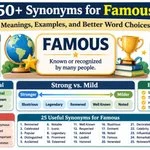
Have you ever used the word famous repeatedly in an essay, social media caption, email, or professional article? Although it clearly communicates that someone or something is widely known, using it too often can make your writing sound repetitive. Choosing a more specific alternative can make your message more engaging and meaningful.
Understanding synonyms for famous helps you describe celebrities, historical figures, successful businesses, popular destinations, and influential personalities with greater accuracy. Some alternatives emphasize public recognition, while others highlight achievement, reputation, popularity, or historical importance. This guide explores useful alternatives, explains their meanings and differences, and provides practical examples to help you choose the right word for academic, professional, creative, and everyday communication.
What Does “Famous” Mean?
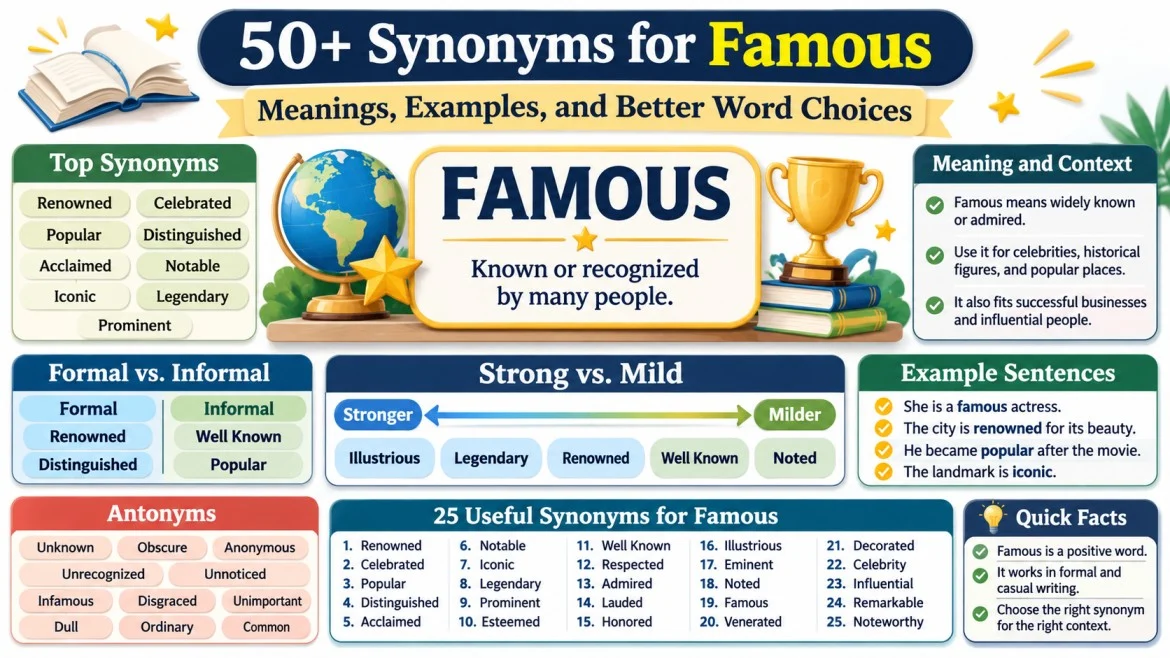
Famous means widely known or recognized by many people because of achievements, popularity, reputation, or public attention. The best synonyms include renowned, celebrated, well known, acclaimed, prominent, distinguished, iconic, and legendary, depending on the context.
Meaning, Tone and Context
The word famous describes a person, place, organization, event, or thing that many people know about.
Someone may become famous through professional achievements, entertainment, sports, historical contributions, social media, or public recognition.
1. Simple Definition
Famous means known by a large number of people. It usually suggests public recognition, although the reason for that recognition can be positive, negative, or neutral.
For example:
Taylor Swift is famous for her music and songwriting.
2. Part of Speech
Famous is an adjective. It describes a noun by explaining how widely known someone or something is.
Example: The famous author published another novel.
3. Tone and Connotation
Famous generally has a neutral or positive tone.
However, the surrounding context determines its emotional meaning. A famous actor may be admired, while a famous criminal may be widely recognized for negative reasons.
4. Formality Level
Famous is suitable for casual conversation, academic writing, professional communication, journalism, and creative content.
For more polished writing, alternatives such as renowned, distinguished, acclaimed, and prominent can communicate a more specific meaning.
5. Common Use Cases
Use famous when describing:
- Celebrities and entertainers.
- Historical personalities.
- Popular tourist attractions.
- Successful companies and brands.
- Well known authors and artists.
- Recognized athletes and public figures.
- Memorable historical events.
6. Related Word Forms
| Word | Part of Speech | Meaning |
|---|---|---|
| Famous | Adjective | Widely known |
| Famously | Adverb | In a widely recognized way |
| Fame | Noun | The condition of being widely known |
| Fame seeking | Descriptive expression | Seeking public recognition |
Example: The restaurant is famous for its traditional Italian dishes.
The chef achieved fame after receiving several international awards.
When and How to Use “Famous”
Use famous when your readers need to understand that a person, place, achievement, or organization has widespread public recognition.
It works particularly well when the exact reason for recognition is already clear from the sentence.
Here are realistic examples across different situations.
- Professional: The company became famous for developing innovative technology.
- Academic: Albert Einstein is famous for his contributions to modern physics.
- Personal: My grandmother is famous in our family for her delicious homemade desserts.
- Creative: The famous castle stood proudly above the quiet village.
- Social Media: Finally visiting the famous Hollywood sign was an unforgettable experience.
- Email: Our team recently partnered with a famous author for the upcoming campaign.
- Resume: Contributed to a marketing campaign for a widely recognized international brand.
The last example demonstrates why a more specific alternative can be valuable in professional writing.
Another Word for “Famous”
The best single replacement for famous is renowned when you want a polished expression that communicates widespread recognition and an impressive reputation.
However, the right choice depends on what makes someone or something famous.
| Context | Best Alternative |
|---|---|
| Professional writing | Renowned |
| Academic writing | Notable |
| Casual conversation | Well known |
| Emotional writing | Beloved |
| Creative writing | Legendary |
| Resume or workplace | Recognized |
| Social media captions | Iconic |
| Stronger meaning | Illustrious |
| Softer meaning | Noted |
Best Alternatives Explained
Professional writing: Renowned
Use renowned when describing someone or something respected and widely recognized for quality or achievement.
Example: She is a renowned expert in environmental science.
Academic writing: Notable
Notable works well when discussing an important person, event, discovery, or contribution.
Example: The researcher made several notable contributions to medical science.
Casual conversation: Well known
This is a natural and straightforward replacement for famous.
Example: That restaurant is well known for its excellent pizza.
Emotional writing: Beloved
Choose beloved when you want to emphasize affection and admiration rather than public recognition alone.
Example: The beloved teacher inspired generations of students.
Creative writing: Legendary
Legendary adds a sense of exceptional achievement, lasting reputation, or extraordinary importance.
Example: The legendary musician changed the direction of popular music.
Resume or workplace: Recognized
Recognized works well when describing professional achievements, industry standing, or organizational reputation.
Example: Worked with a nationally recognized organization.
Social media captions: Iconic
Iconic is suitable for memorable experiences, recognizable styles, influential personalities, and culturally significant moments.
Example: An iconic destination worth visiting at least once.
Stronger meaning: Illustrious
Illustrious communicates exceptional distinction and an impressive record of achievements.
Example: She comes from an illustrious family of scientists.
Softer meaning: Noted
Noted describes someone or something recognized for a particular quality or contribution without suggesting extraordinary fame.
Example: He is a noted writer on American history.
When Not to Use “Famous”
Although famous is a useful word, it does not always communicate the exact meaning you want.
Sometimes, a more precise alternative improves clarity and makes your writing sound more natural.
1. When Recognition Comes From Achievement
Instead of saying:
She is a famous scientist.
Consider:
She is a distinguished scientist.
Distinguished highlights professional achievement and an impressive reputation.
2. When Someone Is Admired
Instead of:
He is a famous community leader.
Consider:
He is a respected community leader.
Respected emphasizes the positive opinion people have of him.
3. When Something Is Widely Appreciated
Instead of:
The famous restaurant serves excellent food.
Consider:
The acclaimed restaurant serves excellent food.
Acclaimed suggests that the restaurant has received praise or recognition.
4. When Public Attention Is Negative
Instead of:
The famous criminal was arrested.
Consider:
The notorious criminal was arrested.
Notorious specifically communicates a negative reputation.
5. When Describing Cultural Importance
Instead of:
The famous building attracts millions of visitors.
Consider:
The iconic building attracts millions of visitors.
Iconic emphasizes recognition and cultural significance.
6. When Describing General Popularity
Instead of:
She is a famous singer among teenagers.
Consider:
She is a popular singer among teenagers.
Popular focuses on how much people like someone rather than how widely recognized that person is.
Words Commonly Confused With “Famous”
Several related words are sometimes used interchangeably with famous, but their meanings are not identical.
1. Famous vs. Popular
Famous means widely recognized. Popular means liked, enjoyed, or supported by many people.
Example: The actor is famous worldwide, while his latest movie is especially popular with teenagers.
2. Famous vs. Notorious
Famous can describe positive or negative recognition. Notorious specifically describes someone or something known for negative behavior.
Example: The famous musician received an award, while the notorious criminal appeared in the news.
3. Famous vs. Influential
Famous means widely known. Influential means capable of affecting people’s decisions, opinions, or behavior.
Example: She is a famous author whose books have influenced millions of readers.
4. Famous vs. Prominent
Famous emphasizes public recognition. Prominent describes someone or something important, noticeable, or influential within a particular field.
Example: He is a prominent attorney in the local legal community.
5. Famous vs. Celebrated
Famous means widely known, while celebrated adds a stronger sense of public admiration, praise, or recognition.
Example: The celebrated filmmaker received an international award.
6. Famous vs. Recognizable
Famous means widely known, while recognizable means easy to identify because of familiarity or distinctive features.
Example: The famous athlete has a recognizable face.
Best Synonym by Context for “Famous”
The most effective synonym depends on the type of recognition you want to describe. A professional report may require renowned, while a social media caption might sound more natural with iconic or legendary.
| Context | Best Synonym | Why It Works | Example |
|---|---|---|---|
| Formal writing | Renowned | Communicates an impressive reputation | She is a renowned researcher. |
| Academic writing | Notable | Highlights importance or achievement | He made a notable discovery. |
| Professional or business | Recognized | Shows professional acknowledgment | It is a recognized industry leader. |
| Resume | Acclaimed | Highlights professional praise | Worked with an acclaimed design agency. |
| Casual conversation | Well known | Sounds natural and familiar | That café is well known locally. |
| Creative writing | Legendary | Creates a memorable impression | The legendary warrior returned. |
| Emotional writing | Beloved | Expresses affection and admiration | The beloved actor inspired many. |
| Strong intensity | Illustrious | Suggests exceptional distinction | She enjoyed an illustrious career. |
| Soft or moderate tone | Noted | Communicates recognition without exaggeration | He is a noted historian. |
| Social media captions | Iconic | Highlights memorable cultural recognition | An iconic view of New York City. |
| Journalism | Prominent | Highlights public importance | A prominent political figure attended. |
| Historical writing | Celebrated | Communicates lasting recognition | The celebrated leader changed history. |
| Entertainment | Star | Identifies a recognized performer | The movie star attended the premiere. |
| International recognition | Globally recognized | Specifies worldwide acknowledgment | The university is globally recognized. |
| Negative reputation | Notorious | Communicates unwanted recognition | The notorious organization faced criticism. |
Which Synonym Should You Choose?
Choosing the right synonym for famous requires more than finding a replacement that sounds impressive. Consider what makes the person, place, or organization widely known.
Use these practical guidelines:
1. Consider the actual meaning
If you mean widespread recognition, choose well known or widely recognized. If you mean achievement, consider distinguished or accomplished.
2. Match the formality
Use renowned, eminent, and illustrious in formal writing. Choose well known or popular for everyday conversations.
3. Consider emotional intensity
Beloved communicates affection, acclaimed suggests praise, and legendary creates a sense of exceptional importance.
4. Think about professional value
For resumes, presentations, and business communication, recognized, distinguished, and reputable can be more informative than famous.
5. Avoid exaggeration
Not every popular person is legendary, and not every recognized professional is distinguished. Select words that accurately represent the subject.
6. Read the complete sentence
A synonym should fit naturally with the surrounding words. A replacement that changes the original meaning is not an effective synonym.
Real Life Examples of “Famous” in Sentences
Here are practical examples showing how different synonyms can improve everyday and professional communication.
| Situation | Example Sentence |
|---|---|
| School | Shakespeare is a renowned English playwright. |
| Workplace | Our organization works with recognized industry experts. |
| Writing | The celebrated novelist published another successful book. |
| Conversation | That little bakery is pretty well known around here. |
| Social media | Exploring an iconic location in California today! |
| Resume | Collaborated with a distinguished international research team. |
| We are pleased to welcome a renowned speaker to our event. | |
| Storytelling | The legendary explorer traveled across distant lands. |
| Travel | The Eiffel Tower is an iconic Paris landmark. |
| Business | The company has become a prominent name in technology. |
These examples demonstrate that a suitable alternative can add information about reputation, recognition, achievement, or popularity.
25 Synonyms for “Famous”
The following alternatives cover different levels of recognition, formality, emotional tone, and public reputation. Some are close replacements, while others work best in specific situations.
| Synonym | Simple Meaning | Best Used For | Example Sentence |
|---|---|---|---|
| 1. Well known | Recognized by many people | Everyday communication | She is a well known author. |
| 2. Renowned | Widely respected and recognized | Formal and professional writing | He is a renowned architect. |
| 3. Celebrated | Publicly admired and praised | Achievements and success | The celebrated artist opened an exhibition. |
| 4. Notable | Worthy of attention or recognition | Academic writing | She made a notable contribution. |
| 5. Prominent | Important, visible, or influential | Business and public affairs | He is a prominent business leader. |
| 6. Distinguished | Recognized for outstanding qualities or achievements | Professional achievements | The distinguished professor received an award. |
| 7. Illustrious | Highly distinguished and respected | Literary and formal writing | She had an illustrious career. |
| 8. Acclaimed | Publicly praised and appreciated | Entertainment and creative work | The acclaimed director released a new film. |
| 9. Eminent | Highly respected in a particular field | Academic and professional writing | An eminent scientist addressed the audience. |
| 10. Iconic | Widely recognized and culturally significant | Landmarks, people, and symbols | The iconic bridge attracts visitors. |
| 11. Legendary | Famous for extraordinary achievements or reputation | History and storytelling | The legendary athlete inspired young players. |
| 12. Popular | Liked or enjoyed by many people | Entertainment and everyday language | The popular singer performed live. |
| 13. Recognized | Acknowledged or identified by others | Workplace and professional writing | She is a recognized expert. |
| 14. Widely known | Familiar to a large audience | General descriptions | The tradition is widely known across the region. |
| 15. Famed | Known or celebrated for something | Travel and descriptive writing | The city is famed for its architecture. |
| 16. Noted | Known for a particular quality or achievement | Formal and academic writing | He is a noted historian. |
| 17. Beloved | Loved and admired by many people | Emotional and personal writing | The beloved author left a lasting legacy. |
| 18. Esteemed | Highly respected | Professional communication | She is an esteemed member of the community. |
| 19. Revered | Deeply respected or admired | Historical and emotional writing | The revered leader earned public trust. |
| 20. High profile | Receiving considerable public attention | Media and business | A high profile investor joined the project. |
| 21. Influential | Having significant power or impact | Leadership and public affairs | She is an influential voice in education. |
| 22. Household name | A name familiar to many people | Brands and celebrities | The company became a household name. |
| 23. Star | A highly recognized entertainer or performer | Entertainment | The television star attended the event. |
| 24. Notorious | Widely known for something negative | Crime and controversy | The notorious gang operated for years. |
| 25. Infamous | Famous for an undesirable reason | Negative reputation and history | The infamous incident changed public opinion. |
Important usage note: Not all 25 words are interchangeable in every sentence. Notorious and infamous carry negative meanings, while beloved and revered emphasize affection or respect. Influential describes impact, and popular describes public preference. Choose according to the intended meaning.
Synonym Groups and Usage Differences
Professional vs. Personal Synonyms
Professional writing often requires words that communicate achievement, credibility, and reputation.
Recommended choices include:
- Renowned
- Distinguished
- Recognized
- Acclaimed
- Esteemed
- Prominent
Example: The company hired a renowned consultant to improve its operations.
Personal writing can benefit from words that communicate affection, familiarity, and admiration.
Recommended choices include:
- Beloved
- Popular
- Celebrated
- Legendary
- Iconic
Example: My grandfather was a beloved member of our community.
The key difference is that professional alternatives often emphasize credibility, while personal alternatives can communicate emotional connection.
Formal vs. Conversational Synonyms
Formal synonyms are useful when writing essays, reports, presentations, and professional emails.
| Formal Alternatives | Conversational Alternatives |
|---|---|
| Renowned | Well known |
| Distinguished | Popular |
| Eminent | Widely known |
| Esteemed | A household name |
| Acclaimed | A big star |
| Notable | Pretty well known |
Example of formal writing: The renowned researcher presented her findings.
Example of casual conversation: That actor is pretty well known.
Use familiar expressions in texts and conversations, but choose more precise vocabulary for academic and professional documents.
Academic Synonyms
Academic writing benefits from language that describes recognition without unnecessary exaggeration.
Consider these alternatives:
Notable: Suitable for an important achievement, event, or contribution.
Example: The study revealed several notable findings.
Eminent: Appropriate for a highly respected expert in a particular discipline.
Example: The conference featured an eminent historian.
Distinguished: Useful when describing an individual with an impressive professional record.
Example: The distinguished scholar received international recognition.
Prominent: Appropriate for influential people, organizations, or developments within a field.
Example: The researcher became a prominent figure in environmental studies.
For research papers, use the word that accurately describes the evidence rather than selecting the most impressive sounding alternative.
Professional and Business Synonyms
In business communication, famous can sometimes sound vague because it does not explain why a company or individual is recognized.
Better alternatives include:
- Renowned: A business with an impressive reputation.
- Recognized: An organization acknowledged within its industry.
- Reputable: A business known for trustworthiness and good conduct.
- Prominent: An important company or industry figure.
- Acclaimed: A service, product, or organization that has received praise.
- Established: A business with a proven presence or history.
Examples:
- The company is a renowned provider of financial services.
- She joined a reputable consulting firm.
- The organization is a prominent player in the technology sector.
Notice that reputable and established are not exact synonyms for famous. They are useful alternatives when the intended message concerns trust or business history rather than public recognition.
Creative or Literary Synonyms
Creative writing often benefits from words that create atmosphere, emotion, and memorable descriptions.
Consider:
- Legendary
- Iconic
- Beloved
- Celebrated
- Illustrious
- Famed
Examples:
- The legendary king ruled the kingdom for decades.
- The iconic lighthouse guided sailors through dangerous waters.
- The celebrated poet inspired generations of readers.
- The beloved character became a symbol of hope.
These choices make descriptive writing more engaging without requiring additional explanation.
Slang or Modern Synonyms
Some modern expressions describe popularity or internet recognition rather than traditional fame.
A big name: Someone recognized or important in a particular industry.
Example: She is a big name in the fashion industry.
A household name: A person or brand familiar to a large portion of the public.
Example: The technology company has become a household name.
A star: A well recognized performer or entertainer.
Example: He became a television star after the series premiered.
Viral: Content that spreads rapidly online and attracts substantial attention.
Example: Her cooking video went viral overnight.
Viral does not mean famous in every context. It describes the rapid spread of online content, not necessarily lasting public recognition.
These expressions work well in casual communication, entertainment articles, and social media content. Avoid slang in formal research papers and professional reports.
Strongest vs. Weaker Synonyms
Not every synonym communicates the same degree of recognition or admiration.
The following scale is a practical writing guide, not a strict linguistic ranking.
| Intensity | Synonym | Intended Meaning |
|---|---|---|
| Mild | Noted | Recognized for a particular quality |
| Mild | Notable | Worthy of attention |
| Moderate | Well known | Recognized by many people |
| Moderate | Recognized | Acknowledged by others |
| Moderate | Prominent | Important or noticeable |
| Strong | Renowned | Widely recognized and respected |
| Strong | Acclaimed | Widely praised |
| Very strong | Illustrious | Exceptionally distinguished |
| Very strong | Legendary | Associated with extraordinary reputation |
| Very strong | Iconic | Culturally recognizable and significant |
Use moderate words when describing ordinary public recognition. Reserve stronger expressions for people, achievements, and places that genuinely deserve them.
Emotional vs. Neutral Synonyms
Some alternatives simply communicate recognition, while others express admiration or affection.
| Neutral Synonyms | Emotional Synonyms |
|---|---|
| Well known | Beloved |
| Recognized | Revered |
| Notable | Celebrated |
| Prominent | Legendary |
| Widely known | Esteemed |
| Noted | Acclaimed |
Example of neutral language: The researcher is widely known for her work.
Example of emotional language: The researcher is beloved by her students.
The first sentence communicates recognition. The second adds a sense of personal affection.
Antonyms of “Famous”
Antonyms of famous describe people, places, or things that receive little public attention or remain largely unknown.
Here are 15 useful opposite words.
| Antonym | Meaning | Example Sentence |
|---|---|---|
| 1. Unknown | Not known by many people | The unknown artist displayed her paintings. |
| 2. Obscure | Not widely known or understood | He discovered an obscure historical document. |
| 3. Little known | Recognized by very few people | The little known author published an excellent novel. |
| 4. Anonymous | Having no publicly known identity | An anonymous donor supported the project. |
| 5. Unrecognized | Not acknowledged or identified | Her contribution remained unrecognized for years. |
| 6. Unnoticed | Not attracting attention | The small detail went unnoticed. |
| 7. Forgotten | No longer remembered | The forgotten monument stood outside the city. |
| 8. Unheard of | Completely unfamiliar to most people | The new musician was almost unheard of. |
| 9. Unsung | Not receiving deserved recognition | The unsung heroes helped the community recover. |
| 10. Uncelebrated | Not publicly praised or honored | Their uncelebrated achievements deserved attention. |
| 11. Inconspicuous | Not easily noticed | The inconspicuous building stood behind the trees. |
| 12. Undistinguished | Not particularly remarkable | It was an undistinguished performance. |
| 13. Unfamiliar | Not recognized or known to someone | The unfamiliar author was new to me. |
| 14. Overlooked | Not given sufficient attention | The overlooked artist eventually received recognition. |
| 15. Nameless | Having no known or specified name | The nameless figure appeared in the old story. |
Usage note: Some words describe a lack of public recognition, while others refer to being forgotten, overlooked, or difficult to notice. Choose the opposite that matches your intended meaning.
Comparison: Famous vs. Similar Words
Understanding the differences between related words helps you avoid choosing a synonym that changes your original message.
Famous vs. Renowned
Main difference: Famous means widely known, while renowned suggests widespread recognition combined with respect or an impressive reputation.
Which is stronger? Renowned generally communicates a more distinguished reputation.
Which is more formal? Renowned.
Examples:
- Famous: She is a famous musician.
- Renowned: She is a renowned classical musician.
Famous vs. Popular
Main difference: Famous describes recognition, while popular describes being liked or enjoyed by many people.
Which is stronger? Neither is universally stronger. They communicate different qualities.
Which is more formal? Famous is more neutral in formal writing.
Examples:
- Famous: The actor is famous around the world.
- Popular: The actor is popular among younger audiences.
Famous vs. Notorious
Main difference: Famous can have a positive or neutral meaning. Notorious always suggests an undesirable reputation.
Which is stronger? Notorious has a stronger negative connotation.
Which is more formal? Both work in formal writing.
Examples:
- Famous: The famous politician addressed the nation.
- Notorious: The notorious politician was involved in several scandals.
Famous vs. Prominent
Main difference: Famous emphasizes widespread recognition, while prominent highlights importance, visibility, or influence.
Which is stronger? Prominent can communicate greater importance within a specific field.
Which is more formal? Prominent.
Examples:
- Famous: He is a famous businessman.
- Prominent: He is a prominent figure in the financial industry.
Famous vs. Celebrated
Main difference: Famous means widely recognized, while celebrated suggests that someone or something receives admiration and praise.
Which is stronger? Celebrated adds a stronger sense of positive appreciation.
Which is more formal? Both are suitable for formal communication.
Examples:
- Famous: She is a famous author.
- Celebrated: She is a celebrated author whose books have inspired millions.
Famous vs. Iconic
Main difference: Famous means widely recognized, while iconic suggests cultural significance, memorable identity, or symbolic importance.
Which is stronger? Iconic usually carries a stronger sense of cultural importance.
Which is more formal? Both are acceptable, depending on the context.
Examples:
- Famous: The building is famous among tourists.
- Iconic: The building is an iconic symbol of the city.
Common Phrases and Expressions with “Famous”
Certain expressions make it easier to describe recognition, reputation, and popularity naturally.
1. Famous for
Meaning: Known because of a particular achievement, quality, or characteristic.
Example sentence: Italy is famous for its history, architecture, and cuisine.
2. World famous
Meaning: Recognized by people across many countries.
Example sentence: The world famous museum attracts millions of visitors.
3. Become famous
Meaning: To gain public recognition or popularity.
Example sentence: The young singer became famous after releasing her first album.
4. Famous around the world
Meaning: Widely recognized internationally.
Example sentence: The company is famous around the world for its innovative products.
5. A famous name
Meaning: A person or brand that many people recognize.
Example sentence: The designer has become a famous name in the fashion industry.
6. Famous landmark
Meaning: A well recognized building, location, or structure.
Example sentence: The Statue of Liberty is a famous landmark in New York City.
7. Famous personality
Meaning: A widely recognized public figure.
Example sentence: The famous personality spoke about the importance of education.
8. Famous throughout history
Meaning: Recognized across different historical periods.
Example sentence: Several scientists have become famous throughout history for their discoveries.
Common Mistakes to Avoid
Even familiar vocabulary can cause problems when a synonym does not match the intended meaning.
Here are seven mistakes worth avoiding.
1. Using Famous When a More Precise Word Is Better
Famous does not explain why someone is recognized.
Weak: He is a famous professor.
Better: He is a distinguished professor.
The second sentence highlights professional achievement.
2. Confusing Famous With Popular
A person can be famous without being liked by everyone.
Incorrect assumption: Every famous celebrity is popular.
Better understanding: Famous describes recognition, while popular describes public preference or approval.
3. Using Casual Synonyms in Formal Writing
Expressions such as big name or a big star may sound inappropriate in academic research.
Instead, use renowned, prominent, or distinguished when they accurately describe the subject.
4. Using an Overly Dramatic Synonym
Calling every successful person legendary exaggerates their achievements.
Use notable or well known for ordinary recognition. Reserve legendary for exceptional reputations.
5. Repeating Famous Too Often
Repeated vocabulary makes articles and essays less engaging.
Instead of writing:
The famous actor visited a famous restaurant in a famous city.
Try:
The renowned actor visited a celebrated restaurant in an iconic city.
6. Choosing the Wrong Emotional Tone
Beloved and notorious communicate very different ideas.
Beloved expresses affection, while notorious describes a negative reputation.
Always consider the impression your chosen word creates.
7. Using Slang in Academic or Professional Writing
Words such as big name are acceptable in informal conversation but may weaken a formal report.
Choose established alternatives such as recognized, acclaimed, or renowned instead.
FAQs
1. What is the best synonym for famous?
Renowned is one of the best alternatives when describing someone widely recognized and respected for achievements, expertise, or an impressive reputation.
2. What is a formal synonym for famous?
Distinguished, renowned, eminent, and acclaimed are useful formal alternatives. Select one according to whether you mean recognition, professional respect, or public praise.
3. What is an informal synonym for famous?
Well known, popular, and a big name are natural informal alternatives. They work particularly well in everyday conversations and casual writing.
4. What is another word for famous in professional writing?
Renowned, recognized, prominent, and distinguished work well in professional communication when describing respected individuals, successful organizations, and industry leaders.
5. What is the difference between famous and popular?
Famous means widely recognized, whereas popular means liked or enjoyed by many people. Someone can be famous without being particularly popular.
6. What is the opposite of famous?
Unknown is a common opposite of famous. Other alternatives include obscure, anonymous, little known, unnoticed, and unrecognized, depending on context.
Conclusion
Famous means widely known or recognized, but the best alternative depends on why someone or something attracts public attention. Renowned and distinguished emphasize achievement, popular describes public preference, celebrated communicates admiration, and iconic highlights cultural significance.
Understanding synonyms for famous helps you write with greater precision in essays, professional documents, social media captions, creative projects, and everyday conversations.
One practical vocabulary tip: Before replacing famous, ask yourself whether you mean recognition, popularity, respect, influence, or admiration. Choosing a word that communicates the exact meaning will make your writing clearer, more natural, and more engaging.
Discover More Post:
- 50+ Synonyms for Phenomenon | From Everyday Events to …
- 50+ Synonyms for Detrimental | Expert Word Choices That …