Do you find yourself using the word “lack” repeatedly in essays, emails, reports, captions, or everyday conversations? Although it communicates the absence of something, repeating it can make your writing sound less expressive and precise. Choosing a suitable alternative can help you explain shortages, missing resources, insufficient qualities, or unmet needs more effectively.
Learning synonyms for lack is especially useful when you want to improve academic writing, professional communication, or everyday vocabulary. However, not every alternative works in every situation. Some words describe a serious shortage, while others suggest something is completely missing. This guide explores their meanings, differences, examples, and practical uses so you can select the most appropriate word for your message.
What Does “Lack” Mean?
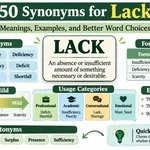
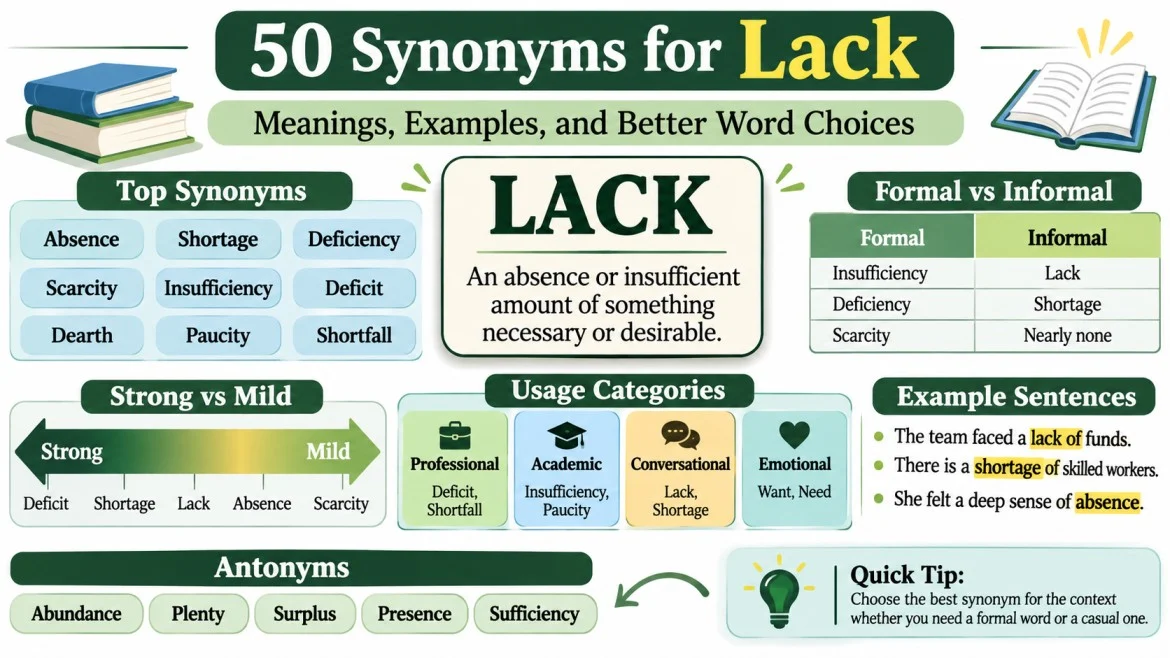
Lack means the absence of something necessary, desirable, or expected. Common synonyms include absence, shortage, deficiency, scarcity, insufficiency, deficit, and dearth. Professional writing often benefits from deficiency or shortfall, while shortage and absence work well in everyday communication.
Meaning, Tone and Context
Understanding the meaning of lack helps you choose an alternative that communicates your intended message accurately.
1. Simple Definition
Lack refers to a situation in which something is missing, unavailable, insufficient, or not present in the required amount.
It can describe missing resources, limited opportunities, insufficient knowledge, or the absence of a particular quality.
For example:
- The company has a lack of experienced employees.
- Her essay lacks supporting evidence.
- The community faces a shortage of clean water.
2. Part of Speech
Lack can function as both a noun and a verb.
As a noun: It describes the absence or insufficient amount of something.
Example: The lack of funding delayed the project.
As a verb: It means to be without something necessary or desirable.
Example: The proposal lacks sufficient detail.
3. Positive, Negative, or Neutral Tone
Lack generally has a negative or neutral tone because it describes something missing or insufficient.
Its emotional effect depends on the situation.
For example, a lack of confidence may suggest a personal challenge, while a lack of resources may describe an organizational problem.
4. Formality Level
Lack is a neutral word suitable for casual conversations, academic essays, business reports, emails, and professional documents.
However, alternatives such as deficiency, insufficiency, and paucity can sound more formal or technical.
5. Common Use Cases
The word commonly appears in situations involving:
- Education: A lack of understanding or preparation.
- Business: A lack of funding, employees, or resources.
- Personal development: A lack of motivation or confidence.
- Healthcare: A lack of essential nutrients.
- Relationships: A lack of communication or trust.
- Research: A lack of evidence or information.
- Everyday life: A lack of time, money, or opportunities.
6. Important Word Forms
| Word Form | Meaning | Example |
|---|---|---|
| Lack | Absence or insufficient amount | There is a lack of support. |
| Lacks | Does not have something | The report lacks detail. |
| Lacking | Not having something necessary | The explanation is lacking clarity. |
| Lacked | Did not have something | The project lacked funding. |
| Lack of | Absence or shortage | A lack of experience affected the results. |
When and How to Use “Lack”
Use lack when something is missing, unavailable, or present in an insufficient amount.
It works particularly well when you want to communicate a problem without using overly complicated vocabulary.
Here are seven realistic examples.
- Professional: The department is experiencing a lack of qualified employees.
- Academic: The research paper has a lack of reliable supporting evidence.
- Personal: I sometimes struggle with a lack of confidence when speaking publicly.
- Business: The company postponed its expansion because of a lack of investment.
- Emotional: Their relationship suffered from a lack of understanding and communication.
- Social Media: A little kindness can make a difference in a world that sometimes lacks compassion.
- Email: We cannot complete the project because we lack the necessary information.
These examples show how lack can describe missing qualities, resources, knowledge, and opportunities.
Another Word for “Lack”
The best alternative depends on what is missing and how you want to communicate it.
Here are useful replacements for different situations.
- Professional writing: Deficiency or shortfall. These words communicate an identifiable problem in reports and workplace discussions.
- Academic writing: Insufficiency or paucity. These alternatives can describe inadequate evidence, research, or information.
- Casual conversation: Shortage or not enough. These expressions sound natural in everyday discussions.
- Emotional writing: Absence or emptiness. These words can communicate missing affection, connection, or emotional support.
- Creative writing: Void or absence. These alternatives can create a stronger descriptive effect when something important is missing.
- Resume or workplace use: Limited experience or insufficient expertise. These expressions explain professional limitations more precisely.
- Social media captions: Missing, not enough, or shortage. These options work well in simple, conversational messages.
- Stronger meaning: Severe deficiency, serious shortage, or acute scarcity. These expressions emphasize a significant problem.
- Softer meaning: Limited availability or a small shortfall. These phrases communicate a limitation without sounding overly negative.
Best overall recommendation: Use shortage when describing insufficient quantities, deficiency when describing missing qualities or elements, and absence when something is not present at all.
When Not to Use “Lack”
Although lack is versatile, it does not always communicate the exact meaning you intend.
Here are situations where another word may improve your sentence.
1. When you mean a measurable shortage
Instead of: There is a lack of workers.
Better: There is a shortage of workers.
Shortage is more specific when discussing the number of available people or resources.
2. When you mean a technical weakness
Instead of: The system has a lack of accuracy.
Better: The system has an accuracy deficiency.
Deficiency can communicate a specific weakness in performance or quality.
3. When something is completely missing
Instead of: There is a lack of communication.
Better: There is an absence of communication.
Absence can emphasize that something is entirely missing.
4. When discussing insufficient research
Instead of: There is a lack of evidence.
Better: There is insufficient evidence.
This version is more direct and suitable for academic writing.
5. When you want a softer expression
Instead of: The employee has a lack of experience.
Better: The employee has limited experience.
Limited sounds less critical and more constructive.
Words Commonly Confused With “Lack”
Several words are related to lack, but their meanings are not always interchangeable.
Understanding these distinctions helps prevent inaccurate word choices.
| Word | Main Difference | Example |
|---|---|---|
| Shortage | An insufficient quantity of something | The hospital faces a shortage of nurses. |
| Deficiency | A missing or inadequate quality, element, or amount | The patient has an iron deficiency. |
| Absence | Something is not present | Her absence affected the meeting. |
| Scarcity | Something is difficult to find or obtain | Water scarcity affects the region. |
| Deficit | A measurable gap between what is available and what is needed | The organization has a budget deficit. |
| Insufficiency | An amount or level that is not adequate | The insufficiency of evidence weakened the argument. |
These words describe different types of limitations. Choosing the right one makes your writing more accurate.
Best Synonym by Context for “Lack”
The best synonym for lack changes according to your audience, writing purpose, and intended meaning.
Use this table as a practical reference.
| Context | Best Synonym | Why It Works | Example |
|---|---|---|---|
| Formal writing | Deficiency | Sounds precise and professional | The report identified a deficiency in planning. |
| Academic writing | Insufficiency | Communicates inadequate evidence or information | The study revealed an insufficiency of data. |
| Professional communication | Shortfall | Describes a gap between requirements and available resources | We experienced a shortfall in funding. |
| Resume | Limited experience | Communicates professional limitations constructively | I have limited experience with this software. |
| Business reports | Deficit | Works for measurable shortages | The company reported a financial deficit. |
| Casual conversation | Shortage | Simple and natural | We have a shortage of chairs. |
| Creative writing | Void | Creates an expressive sense of emptiness | A strange void remained after he left. |
| Emotional writing | Absence | Describes something emotionally or physically missing | The absence of support made things difficult. |
| Strong intensity | Severe deficiency | Highlights a serious problem | The system has a severe deficiency. |
| Soft or moderate tone | Limited availability | Communicates a restriction politely | The service has limited availability. |
| Social media captions | Missing | Easy to understand and conversational | Something is missing from this picture. |
| Research writing | Paucity | Describes a small amount of available information | The paucity of research deserves attention. |
| Healthcare | Deficiency | Describes insufficient nutrients or substances | Vitamin deficiency can affect health. |
| Education | Gap | Identifies missing knowledge or understanding | There is a gap in students’ understanding. |
| US and UK English | Shortage | Commonly understood in both varieties | The region faces a shortage of housing. |
Which Synonym Should You Choose?
Selecting the right synonym requires more than finding a word with a similar dictionary meaning.
Consider these five factors before replacing lack.
1. Consider the Exact Meaning
Ask yourself what is missing.
If something is completely absent, use absence. If there is not enough of something, consider shortage or insufficiency.
2. Match the Formality
For academic papers, consider deficiency, insufficiency, or paucity.
For casual conversations, shortage, missing, and not enough are easier to understand.
3. Think About Emotional Intensity
A simple shortage communicates a practical problem, while a serious deficiency suggests a more significant weakness.
Choose words that match the importance of the situation.
4. Consider Professional Value
In business communication, shortfall, deficit, and limited availability can communicate specific problems without unnecessary complexity.
5. Read the Complete Sentence
A synonym may have the correct general meaning but still sound unnatural in a particular sentence.
Always check the grammar and intended meaning after making a replacement.
Real Life Examples of “Lack” in Sentences
Here are practical examples showing how different alternatives can improve everyday and professional communication.
1. School
Original: There is a lack of understanding among students.
Improved: There is a gap in students’ understanding of the subject.
2. Workplace
Original: The department has a lack of experienced employees.
Improved: The department faces a shortage of experienced employees.
3. Writing
Original: The article has a lack of useful information.
Improved: The article contains insufficient information.
4. Conversation
Original: We have a lack of time to finish everything.
Improved: We do not have enough time to finish everything.
5. Social Media
Original: There is a lack of positivity in the world.
Improved: The world could use more positivity.
6. Resume
Original: I have a lack of experience in project management.
Improved: I have limited experience in project management and am actively developing my skills.
7. Email
Original: There is a lack of information in your application.
Improved: Your application is missing some essential information.
8. Storytelling
Original: He felt a lack of happiness after moving away.
Improved: An emptiness followed him after he moved away.
The improved examples demonstrate how a precise alternative can make communication clearer and more natural.
25 Synonyms for “Lack”: Meanings, Examples, and Best Alternatives
The following 25 alternatives cover different meanings and grammatical uses. Some are direct noun replacements, while others work as phrases or verb alternatives.
| Synonym | Simple Meaning | Best Used For | Example Sentence |
|---|---|---|---|
| 1. Absence | Something not being present | General and formal writing | The absence of clear instructions caused confusion. |
| 2. Shortage | An insufficient quantity | Resources, workers, supplies | The town is facing a shortage of housing. |
| 3. Deficiency | An inadequate amount or quality | Academic and technical writing | The report revealed a deficiency in the system. |
| 4. Scarcity | A limited supply of something | Economics and natural resources | Water scarcity is a growing concern. |
| 5. Insufficiency | Not having enough | Research and formal writing | The insufficiency of evidence weakened the claim. |
| 6. Deficit | A measurable difference between what is needed and available | Finance and business | The organization is working to reduce its budget deficit. |
| 7. Dearth | A very small amount or supply | Formal and literary writing | There is a dearth of reliable information on the subject. |
| 8. Inadequacy | A condition of not being good or sufficient enough | Performance and quality | The inadequacy of the training became apparent. |
| 9. Paucity | A notably small amount | Academic and research writing | The paucity of available studies limits the conclusion. |
| 10. Want | The absence of something needed or desired | Formal and literary contexts | The project failed for want of proper planning. |
| 11. Need | A requirement for something | Everyday and professional writing | The team has a need for additional support. |
| 12. Shortfall | An amount below what is required or expected | Business and financial reports | The department reported a funding shortfall. |
| 13. Nonexistence | The state of not existing | Technical and factual writing | The nonexistence of reliable records complicated the investigation. |
| 14. Void | An empty or unfilled space or condition | Emotional and creative writing | She felt a void after leaving her hometown. |
| 15. Emptiness | A state of being empty or unfulfilled | Personal and emotional writing | The room reflected the emptiness he felt. |
| 16. Gap | A missing part or difference | Education and professional communication | There is a gap in the available research. |
| 17. Unavailability | The state of not being available | Business and customer communication | The unavailability of materials delayed production. |
| 18. Inadequate supply | A quantity that does not meet requirements | Logistics and everyday use | The clinic has an inadequate supply of medicine. |
| 19. Insufficiency of resources | Not having enough necessary resources | Business and organizational writing | Insufficiency of resources slowed the project. |
| 20. Limited availability | A restricted amount or opportunity | Customer service and professional writing | Limited availability may affect delivery times. |
| 21. Be without | To not have something | Everyday conversation | Some families are without reliable internet access. |
| 22. Go without | To manage without something | Casual conversation | We had to go without electricity for several hours. |
| 23. Be short of | To have less than the required amount | Conversational and professional writing | The team is short of qualified technicians. |
| 24. Be deficient in | To lack a particular quality or substance | Technical and academic writing | The soil is deficient in essential nutrients. |
| 25. Fall short of | To fail to reach a required level or target | Business, education, and performance | The final results fell short of expectations. |
Important usage note: Words such as absence, shortage, deficiency, and scarcity are not interchangeable in every sentence. Similarly, phrases such as be without and fall short of usually replace the verb lack rather than the noun lack.
Synonym Groups and Usage Differences
Different situations require different alternatives. Grouping synonyms by tone and purpose makes it easier to choose the right expression.
Professional vs. Personal Synonyms
Professional writing benefits from precise expressions that explain the nature of a problem.
Words such as deficiency, shortfall, deficit, and insufficiency work well in business reports, presentations, and workplace communication.
Personal writing can use softer or more emotional expressions such as absence, emptiness, and void.
For example:
Professional: The project experienced a shortfall in financial support.
Personal: She felt an emptiness after losing contact with her friends.
Formal vs. Conversational Synonyms
Formal language is useful when writing reports, research papers, official documents, or professional emails.
Consider these alternatives:
| Formal Expression | Conversational Expression |
|---|---|
| Insufficiency | Not enough |
| Deficiency | Something missing |
| Paucity | Very little |
| Shortfall | Shortage |
| Absence | Not being there |
For everyday communication, simple words are usually more effective than complicated alternatives.
Academic Synonyms
Academic writing requires accurate vocabulary that communicates specific limitations.
The following words are particularly useful:
Insufficiency: Appropriate when research, evidence, or data does not meet the required standard.
Example: The insufficiency of available evidence prevents a definitive conclusion.
Deficiency: Useful for describing a missing quality, component, or necessary element.
Example: The study identified a deficiency in the research methodology.
Paucity: Suitable when there is a notably small amount of available information.
Example: The paucity of published studies highlights the need for further investigation.
Scarcity: Works when something is limited or difficult to obtain.
Example: Resource scarcity remains a significant challenge.
Professional and Business Synonyms
Business communication often requires language that identifies specific resource or performance problems.
Here are useful choices:
- Shortfall: A financial or resource amount below expectations.
- Deficit: A measurable financial or numerical gap.
- Deficiency: A weakness in quality, performance, or necessary elements.
- Limited availability: A polite way to describe restricted access.
- Insufficient capacity: A lack of ability or resources to meet demand.
For example:
Instead of writing, “We have a lack of resources,” write, “Our department has insufficient capacity to handle the additional workload.”
The second sentence provides a clearer explanation.
Creative or Literary Synonyms
Creative writing often benefits from words that express emotional depth or create imagery.
Consider these alternatives:
Void: Suggests a deep feeling of emptiness.
Emptiness: Describes an emotional or physical state without fulfillment.
Absence: Emphasizes that someone or something is missing.
Want: Can communicate an unmet desire or need in literary writing.
For example:
“The absence of her voice made the house feel unfamiliar.”
This sentence creates a stronger emotional impression than simply saying there was a lack of conversation.
Slang or Modern Synonyms
There is no single universally accepted slang replacement for lack. However, several informal expressions communicate similar ideas.
- Not enough.
- Running low.
- Out of.
- Missing something.
- Short on.
Examples:
“We are running low on supplies.”
“I am short on time today.”
“We are out of printer paper.”
These expressions are appropriate for conversations, texts, and informal social media captions.
Avoid using them in formal academic papers unless the context specifically requires conversational language.
Strongest vs. Weaker Synonyms
Not every alternative communicates the same degree of insufficiency.
The following scale provides a practical guide.
| Intensity | Word or Expression | Meaning |
|---|---|---|
| Mild | Limited | Available in a restricted amount |
| Mild | Shortfall | A relatively small gap |
| Moderate | Shortage | Not enough of something |
| Moderate | Insufficiency | Below the required amount |
| Strong | Deficiency | A significant missing element or quality |
| Strong | Scarcity | A serious limitation in availability |
| Very strong | Severe deficiency | A substantial or serious inadequacy |
| Very strong | Acute scarcity | An urgent and pronounced shortage |
The intensity depends on context. For example, scarcity can describe a serious economic or environmental issue, but a small shortage may simply describe an everyday inconvenience.
Emotional vs. Neutral Synonyms
Some alternatives communicate facts, while others create an emotional impression.
Neutral alternatives:
- Shortage
- Deficit
- Insufficiency
- Deficiency
- Unavailability
Emotionally expressive alternatives:
- Void
- Emptiness
- Absence
- Want
For example:
Neutral: The organization experienced a shortage of financial resources.
Emotional: His absence left a painful emptiness in her life.
Choose neutral expressions for factual communication and emotional words when the feeling behind something missing is important.
Antonyms of “Lack”
Antonyms describe the presence, availability, or sufficient amount of something.
Here are 15 useful opposites of lack, depending on the intended meaning.
| Antonym | Meaning | Example Sentence |
|---|---|---|
| 1. Abundance | A very large quantity | The region enjoys an abundance of natural resources. |
| 2. Plenty | More than enough | We have plenty of time to finish the assignment. |
| 3. Surplus | An amount exceeding requirements | The company sold its surplus inventory. |
| 4. Sufficiency | An adequate amount | The available funding provides sufficiency for the project. |
| 5. Adequacy | A satisfactory or sufficient level | The adequacy of the equipment was confirmed. |
| 6. Presence | The state of being present | Her presence made the meeting more productive. |
| 7. Availability | The state of being obtainable or accessible | The availability of clean water improved. |
| 8. Fullness | The state of being full | The fullness of the storage facility surprised everyone. |
| 9. Profusion | A large or abundant quantity | The garden displayed a profusion of colorful flowers. |
| 10. Plentifulness | The condition of being plentiful | The plentifulness of local produce benefited the market. |
| 11. Completeness | The state of having all necessary parts | The completeness of the report impressed the reviewers. |
| 12. Adequate supply | An amount that meets requirements | The hospital maintains an adequate supply of medicines. |
| 13. Wealth | An abundance of valuable possessions or resources | The region has considerable mineral wealth. |
| 14. Richness | An abundance or strong presence of something valuable | The richness of the soil supports healthy crops. |
| 15. Excess | An amount beyond what is needed | The restaurant donated its excess food. |
Some antonyms are contextual rather than exact grammatical opposites. For example, abundance is the opposite of scarcity, while presence is the opposite of absence.
Comparison: Lack vs. Similar Words
Understanding how lack differs from related words helps you avoid choosing an alternative that changes your intended meaning.
Lack vs. Shortage
Main difference: Lack describes general absence or insufficiency, while shortage usually refers to an inadequate quantity.
Which is stronger: Shortage can emphasize a measurable supply problem.
Which is more formal: Both are suitable for formal writing.
Examples:
Lack: There is a lack of qualified staff.
Shortage: The hospital is experiencing a shortage of qualified staff.
Lack vs. Deficiency
Main difference: Lack refers broadly to something missing, while deficiency often describes an inadequate quality, amount, or component.
Which is stronger: Deficiency can suggest a specific or identifiable weakness.
Which is more formal: Deficiency generally sounds more technical and formal.
Examples:
Lack: The report shows a lack of detail.
Deficiency: The report contains a deficiency in its supporting evidence.
Lack vs. Absence
Main difference: Lack can describe something insufficient or completely missing, while absence emphasizes that something is not present.
Which is stronger: Absence can communicate complete nonpresence more directly.
Which is more formal: Both are appropriate for professional and academic writing.
Examples:
Lack: The team suffers from a lack of leadership.
Absence: The absence of a team leader delayed the meeting.
Lack vs. Scarcity
Main difference: Lack describes a general shortage or absence, while scarcity suggests that something is limited or difficult to obtain.
Which is stronger: Scarcity often communicates a broader and more serious supply problem.
Which is more formal: Scarcity is especially common in economic, environmental, and academic writing.
Examples:
Lack: The area has a lack of clean water.
Scarcity: Water scarcity threatens agricultural production.
Lack vs. Deficit
Main difference: Lack describes something missing or insufficient, while deficit usually identifies a measurable gap.
Which is stronger: Deficit is more specific when discussing numerical or financial shortages.
Which is more formal: Both work in professional writing, but deficit is more specialized.
Examples:
Lack: The organization has a lack of funding.
Deficit: The organization is facing a budget deficit.
Lack vs. Insufficiency
Main difference: Lack describes general absence, while insufficiency specifically emphasizes that an amount or level is not adequate.
Which is stronger: Insufficiency more directly emphasizes that something does not meet requirements.
Which is more formal: Insufficiency is generally more formal.
Examples:
Lack: There is a lack of evidence to support the argument.
Insufficiency: The insufficiency of evidence makes the conclusion unreliable.
Common Phrases and Expressions with “Lack”
Several expressions involving lack are widely used in everyday, academic, and professional English.
1. Lack of Experience
Meaning: Not having enough practical knowledge or experience in a particular area.
Example sentence: Her lack of experience did not prevent her from learning quickly.
2. Lack of Confidence
Meaning: Not feeling sufficiently confident in your abilities or decisions.
Example sentence: A lack of confidence can make public speaking difficult.
3. Lack of Resources
Meaning: Not having enough money, equipment, materials, or support.
Example sentence: The project experienced delays because of a lack of resources.
4. Lack of Evidence
Meaning: Insufficient information or proof to support a claim.
Example sentence: The lawyer questioned the argument because of a lack of evidence.
5. Lack of Awareness
Meaning: Not having sufficient knowledge or understanding of an issue.
Example sentence: A lack of awareness can prevent people from recognizing important risks.
6. Lack of Communication
Meaning: Insufficient exchange of information between individuals or groups.
Example sentence: The lack of communication created unnecessary confusion.
7. For Lack of
Meaning: Because something necessary or desirable is unavailable.
Example sentence: The event was canceled for lack of funding.
8. Lack Nothing
Meaning: To have everything necessary or desirable.
Example sentence: With supportive friends and a stable home, she lacks nothing.
Common Mistakes to Avoid
Even familiar words can cause problems when used without considering their precise meaning.
Here are seven mistakes to avoid when using lack and its alternatives.
1. Using Lack When a More Precise Synonym Is Better
Incorrect: The company has a lack of money.
Improved: The company is experiencing a financial shortfall.
The improved sentence provides a more specific description.
2. Confusing Shortage With Deficiency
Shortage generally describes an insufficient quantity, while deficiency can describe a missing or inadequate quality or substance.
Incorrect: The patient has a shortage of vitamin D.
Improved: The patient has a vitamin D deficiency.
3. Using Casual Expressions in Formal Writing
Expressions such as “not enough” and “running low” work in everyday conversations.
However, insufficiency or shortage may be more appropriate in a formal report.
4. Choosing an Overly Dramatic Alternative
Void and emptiness can communicate emotional depth, but they are not suitable for every situation.
Incorrect: The office experienced a void of printer paper.
Improved: The office experienced a shortage of printer paper.
5. Repeating Lack Too Often
Using the same word repeatedly can make an essay or report sound monotonous.
Instead, choose appropriate alternatives such as absence, shortage, deficiency, and insufficiency.
6. Choosing the Wrong Emotional Tone
A word such as deficiency may sound technical, while emptiness can sound emotional.
Use the alternative that matches the message rather than selecting a word simply because it appears sophisticated.
7. Using Slang in Academic or Professional Writing
Phrases such as “running out of” or “short on” are natural in casual communication.
For academic writing, consider more precise alternatives such as insufficient, shortage, or deficiency.
FAQs
1. What Is the Best Synonym for Lack?
The best synonym depends on context. Absence describes something missing, shortage describes an insufficient quantity, and deficiency communicates an inadequate quality or amount.
2. What Is a Formal Synonym for Lack?
Deficiency, insufficiency, paucity, and scarcity are formal alternatives. Choose deficiency for weaknesses and insufficiency when something does not meet requirements.
3. What Is an Informal Synonym for Lack?
Shortage, not enough, missing, and short on are natural informal alternatives. They work well in everyday conversations, messages, and casual writing.
4. What Is Another Word for Lack in Professional Writing?
Shortfall, deficit, deficiency, and insufficiency work well in professional communication. Use shortfall for resource gaps and deficit for measurable financial differences.
5. What Is the Difference Between Lack and Shortage?
Lack broadly describes absence or insufficiency, while shortage usually refers to an inadequate quantity of something needed, available, or expected.
6. What Is the Opposite of Lack?
Common opposites include abundance, plenty, sufficiency, presence, availability, and surplus. The most accurate choice depends on what is missing.
Conclusion
Lack describes the absence or insufficient amount of something necessary, useful, or desirable. However, using the same word repeatedly can limit the clarity and variety of your writing.
Alternatives such as absence, shortage, deficiency, scarcity, insufficiency, and shortfall provide more specific ways to communicate different situations. Professional writers may prefer shortfall or deficiency, while everyday conversations often benefit from simple expressions such as shortage or not enough.
The most important vocabulary tip is to understand exactly what is missing before choosing a replacement. A well selected synonym does more than make a sentence sound different. It makes your message clearer, more natural, and more effective.
Discover More Post:
- 50+ Synonyms for Phenomenon | From Everyday Events to …
- 50+ Synonyms for Detrimental | Expert Word Choices That …