Have you ever used the word authority repeatedly in an essay, professional email, business report, or everyday conversation? Although it is a useful word, repeating it can make your writing sound less engaging. Choosing a more precise alternative can help communicate your ideas with greater clarity and confidence.
Understanding synonyms for authority is especially important because the word has several meanings. It can describe the power to make decisions, the expertise of a knowledgeable person, the credibility of a source, or an official organization. This guide explores 25 useful alternatives, explains their meanings, and shows you when to use each one in academic, professional, personal, and creative writing.
What Does “Authority” Mean?
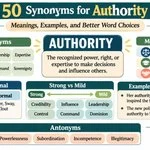
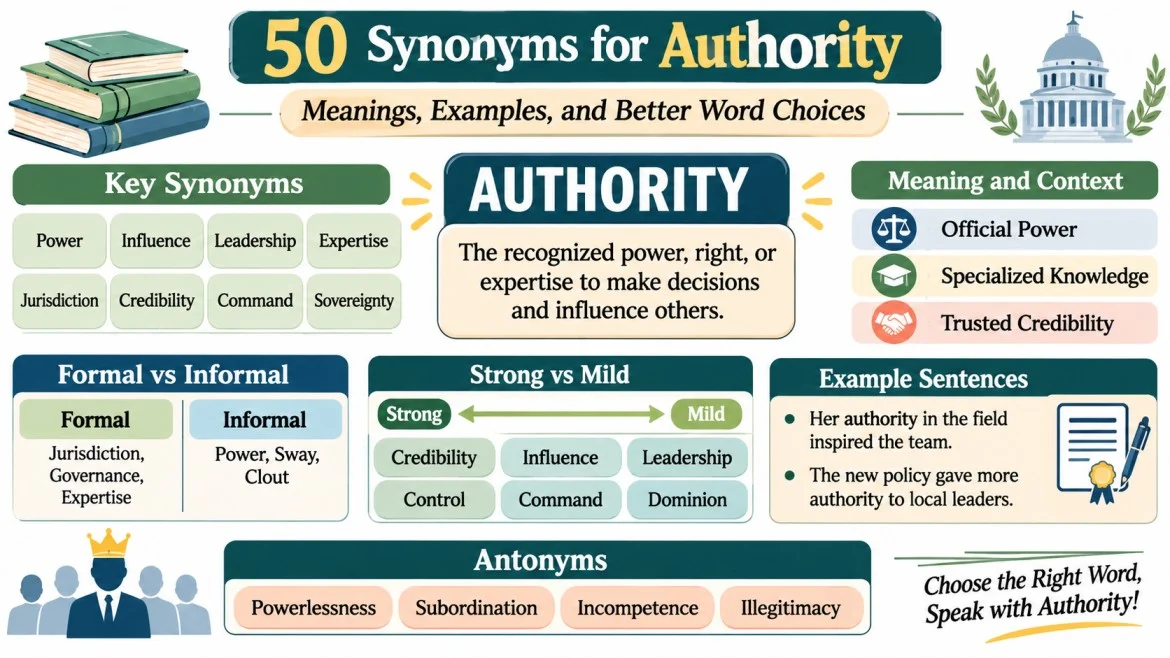
Authority means the power, right, or responsibility to make decisions, enforce rules, or direct others. It can also describe expertise, credibility, or an official organization. Common synonyms include power, control, jurisdiction, influence, expertise, credibility, and leadership.
Meaning, Tone and Context
What Does Authority Mean?
Authority is the recognized right or ability to make decisions, give instructions, establish rules, or influence how others behave. It can come from an official position, specialized knowledge, experience, or social recognition.
For example, a school principal has authority to establish school policies, while a medical specialist has authority in a particular area of healthcare because of professional knowledge and experience.
Simple Definition
Authority refers to the power, expertise, or recognized credibility that allows someone or something to be trusted, respected, or followed.
Part of Speech
Authority is a noun. It is generally used as an uncountable noun when describing power or expertise, and as a countable noun when referring to an organization or official body.
Examples:
- The manager has authority over the department.
- She is an authority on American literature.
- Local authorities announced new safety regulations.
Tone and Formality
| Feature | Description |
|---|---|
| Tone | Neutral, sometimes positive or commanding |
| Formality | Neutral to formal |
| Common meaning | Power, expertise, or official control |
| Professional use | Leadership, management, regulations, and responsibility |
| Academic use | Expertise, credibility, and recognized knowledge |
| Emotional meaning | Respect, dominance, or independence |
Common Use Cases
Authority frequently appears in these situations:
- Government and law: The authority to enforce regulations.
- Business: A manager’s authority to approve decisions.
- Education: A professor’s expertise in a subject.
- Healthcare: A trusted medical authority.
- Media: An authoritative source of information.
- Personal relationships: Parental authority and responsibility.
Important Word Forms
| Word Form | Meaning | Example |
|---|---|---|
| Authority | Power or recognized expertise | She has authority over the team. |
| Authoritative | Confident, reliable, or commanding | He gave an authoritative explanation. |
| Authoritatively | In a confident or commanding manner | She spoke authoritatively. |
| Authoritarian | Favoring strict control | The organization adopted an authoritarian approach. |
| Authorize | To officially permit something | The director authorized the payment. |
Remember that authoritative and authoritarian are not interchangeable. Authoritative generally suggests confidence or reliability, while authoritarian often describes excessive control.
When and How to Use “Authority”
Use authority when discussing someone’s recognized power, official responsibilities, expertise, or ability to influence decisions.
The word works particularly well when the context involves leadership, regulations, professional credibility, or established knowledge.
Realistic Examples
- Professional: The department head has the authority to approve employee requests.
- Academic: The professor is considered an authority on modern American history.
- Government: Local authorities introduced new traffic regulations.
- Personal: Parents have the responsibility and authority to guide their children.
- Workplace: The supervisor delegated decision making authority to the project manager.
- Media: Always check whether an article comes from an established authority.
- Casual: Nobody questioned her authority during the meeting.
Another Word for “Authority”
The best replacement depends on what authority means in your sentence. Power works when discussing control, expertise suits specialized knowledge, and credibility describes whether someone or something deserves trust.
Here are useful alternatives for different writing situations.
| Context | Best Alternative | Example |
|---|---|---|
| Professional writing | Jurisdiction | The department has jurisdiction over the matter. |
| Academic writing | Expertise | Her expertise makes her a respected researcher. |
| Casual conversation | Power | He has the power to make that decision. |
| Emotional writing | Influence | Her influence changed my perspective. |
| Creative writing | Dominion | The king maintained dominion over the kingdom. |
| Resume or workplace | Leadership | Demonstrated leadership across multiple departments. |
| Social media captions | Influence | Use your influence to inspire positive change. |
| Stronger meaning | Sovereignty | The nation protected its sovereignty. |
| Softer meaning | Credibility | Her credibility earned the team’s trust. |
Best Single Replacement
If you need one general alternative, power is often the closest replacement when authority refers to the ability to control or make decisions.
However, it is not suitable for every meaning. Discussing trust, use credibility. When referring to an official institution, use governing body or authority figure as appropriate.
When Not to Use “Authority”
Although authority is useful, it can sound too broad when a sentence requires a more specific meaning.
Consider these situations:
- When describing knowledge: Authority may sound vague. Use expertise or mastery instead.Less precise: She has authority in digital marketing.Better: She has extensive expertise in digital marketing.
- When describing official power: Use jurisdiction when discussing the legal boundaries of responsibility.Less precise: The agency has authority over the investigation.Better: The agency has jurisdiction over the investigation.
- When describing personal influence: Use influence or sway when someone affects opinions without having official control.Less precise: Her authority changed my opinion.Better: Her influence changed my opinion.
- When describing a respected person: Use expert or specialist when referring to someone’s knowledge.Less precise: He is an authority in cybersecurity.Better: He is a respected cybersecurity expert.
- When describing a government organization: Use agency, institution, or governing body when the organization itself is the subject.Less precise: The authority announced a new policy.Better: The regulatory agency announced a new policy.
Words Commonly Confused With “Authority”
Several related words have similar meanings but are not always interchangeable.
| Word | Main Difference | When to Use It |
|---|---|---|
| Power | Ability to control or influence | When discussing strength or control |
| Influence | Ability to affect opinions or actions | When formal control is not necessary |
| Expertise | Specialized knowledge or skill | When discussing professional knowledge |
| Credibility | Quality of being trustworthy | When discussing reliability |
| Leadership | Ability to guide people | When discussing direction and management |
| Jurisdiction | Official or legal area of responsibility | When discussing legal powers |
For example, a supervisor may have authority because of their position, influence because employees respect them, and expertise because of their experience. These qualities can exist together, but they describe different things.
Best Synonym by Context for Authority
The following table highlights the most useful alternatives according to writing style and intended meaning.
| Context | Best Synonym | Why It Works | Example |
|---|---|---|---|
| Formal writing | Jurisdiction | Communicates official responsibility | The court has jurisdiction over the case. |
| Academic writing | Expertise | Emphasizes specialized knowledge | Her expertise supports the research. |
| Professional communication | Leadership | Highlights guidance and responsibility | His leadership improved team performance. |
| Resume writing | Management | Describes organizational responsibility | Managed daily operations and staff responsibilities. |
| Casual conversation | Power | Easy to understand | She has the power to change the schedule. |
| Creative writing | Dominion | Creates a strong sense of control | The ruler expanded his dominion. |
| Emotional writing | Influence | Describes personal impact | Her influence inspired my decisions. |
| Strong intensity | Sovereignty | Expresses supreme independent power | The country defended its sovereignty. |
| Softer tone | Credibility | Emphasizes trust and respect | His credibility impressed the audience. |
| Social media captions | Influence | Works well for inspirational messages | Positive influence creates meaningful change. |
| Legal writing | Legal power | Clarifies recognized legal rights | The officer exercised legal power within the law. |
| Government use | Governance | Describes the process of directing an organization or country | Effective governance promotes accountability. |
| Leadership discussions | Command | Highlights the ability to direct others | The officer took command of the operation. |
| Expert recognition | Mastery | Shows a high level of knowledge or skill | Her mastery of the subject is impressive. |
| Organizational use | Governing body | Identifies an official decision making organization | The governing body approved the proposal. |
US and UK usage: Authority, power, jurisdiction, expertise, and credibility are commonly understood in both American and British English. There is no major difference in their basic meanings. Choose according to the intended context rather than regional preference.
Which Synonym Should You Choose?
Choosing the right synonym involves understanding the exact meaning you want to communicate.
Follow these practical guidelines:
- Identify the meaning: Decide whether authority refers to power, knowledge, credibility, or an official institution.
- Consider formality: Use jurisdiction, governance, or sovereignty in suitable formal contexts. Power and influence often work better in everyday communication.
- Check emotional intensity: Dominion and command can suggest strong control, while influence and credibility sound less forceful.
- Think about your audience: Academic readers may prefer expertise, while general readers may understand power more easily.
- Avoid changing the meaning: A synonym should preserve the original sentence’s message.
- Read the sentence aloud: If the replacement sounds unnatural, choose another word.
The best synonym is not necessarily the most sophisticated one. It is the word that communicates your intended meaning clearly.
Real Life Examples of Authority in Sentences
Here are examples showing how authority and its alternatives work in everyday situations.
1. School: The teacher has the authority to establish classroom rules.
2. Workplace: The manager used her leadership skills to guide the department.
3. Academic writing: The researcher has extensive expertise in environmental science.
4. Conversation: My older brother has a lot of influence over my decisions.
5. Social media: True influence comes from inspiring people, not controlling them.
6. Resume: Exercised management responsibility while coordinating a team of 15 employees.
7. Professional email: Please confirm whether you have the authority to approve this request.
8. Storytelling: The king ruled with absolute dominion over the distant kingdom.
9. Government: The regulatory agency exercised its jurisdiction over the industry.
10. Personal development: Building credibility requires consistency, honesty, and experience.
25 Synonyms for Authority
Below are 25 useful synonyms and related alternatives. Some describe official power, others refer to expertise, influence, or organizations. Their meanings depend on the context.
| Synonym | Simple Meaning | Best Used For | Example Sentence |
|---|---|---|---|
| 1. Power | Ability to control or make decisions | General control | The director has the power to approve the proposal. |
| 2. Control | Ability to direct or manage something | Management and supervision | She maintains control over the project. |
| 3. Jurisdiction | Official area of legal responsibility | Law and government | The court has jurisdiction over the dispute. |
| 4. Command | Power to give instructions | Military and leadership | The captain took command of the team. |
| 5. Dominion | Supreme control or rule | Historical and literary writing | The empire extended its dominion across the region. |
| 6. Sovereignty | Independent governing power | Politics and international relations | The nation defended its sovereignty. |
| 7. Governance | Process of directing and managing an organization | Business and government | Good governance encourages transparency. |
| 8. Leadership | Ability to guide and direct people | Workplace and personal development | Her leadership helped the company grow. |
| 9. Influence | Ability to affect decisions or opinions | Personal and professional situations | His influence shaped the final decision. |
| 10. Sway | Power to affect someone’s opinion | Persuasion and social situations | She has considerable sway within the organization. |
| 11. Clout | Informal influence or social power | Casual and modern communication | The executive has considerable clout in the industry. |
| 12. Prestige | Respect gained through reputation or achievement | Professional recognition | The university has international prestige. |
| 13. Credibility | Quality of being trusted or believed | Research and communication | The report gained credibility through reliable evidence. |
| 14. Expertise | Advanced knowledge or skill | Academic and professional writing | His expertise helped solve the problem. |
| 15. Mastery | Exceptional command of a subject or skill | Education and creative work | She demonstrated mastery of the language. |
| 16. Competence | Ability to perform something successfully | Workplace and professional contexts | His competence earned the team’s confidence. |
| 17. Knowledge | Information and understanding | Education and research | Her knowledge of history is impressive. |
| 18. Specialist | Person with advanced knowledge in a particular field | Professional and medical contexts | We consulted a financial specialist. |
| 19. Expert | Person with extensive knowledge or skill | Academic and professional contexts | The expert explained the findings. |
| 20. Official | Person with an established public or organizational role | Government and administration | A government official announced the decision. |
| 21. Administrator | Person responsible for managing an organization | Education and business | The administrator approved the new procedure. |
| 22. Regulator | Organization or person responsible for enforcing rules | Government and industries | The regulator introduced stricter standards. |
| 23. Governing body | Official group responsible for making decisions | Sports and organizations | The governing body revised its policies. |
| 24. Institution | Established organization with recognized responsibilities | Education and government | The institution plays an important public role. |
| 25. Source | Person or publication recognized as providing reliable information | Research and journalism | The journal is a trusted source of information. |
Important usage note: These 25 alternatives cover the major meanings of authority, but they are not perfect substitutes in every sentence. For example, an expert is a person, expertise is knowledge, and a governing body is an organization. Always match the replacement to the original meaning.
Synonym Groups and Usage Differences
Professional vs. Personal Synonyms
Professional communication often requires words that demonstrate responsibility, knowledge, and decision making.
Useful professional alternatives include:
- Leadership: Ability to guide a team.
- Jurisdiction: Official responsibility or legal power.
- Expertise: Specialized professional knowledge.
- Management: Responsibility for organizing people or operations.
- Governance: Direction and oversight of an organization.
In personal writing, influence, credibility, and power may communicate relationships and individual impact more naturally.
Example:
Professional: Her expertise in financial planning helped the company reduce costs.
Personal: Her influence encouraged me to pursue my goals.
Formal vs. Conversational Synonyms
Formal language is useful in academic papers, business reports, official documents, and professional emails.
| Formal Synonym | Conversational Alternative |
|---|---|
| Jurisdiction | Power |
| Governance | Leadership |
| Sovereignty | Independence |
| Expertise | Knowledge |
| Credibility | Trustworthiness |
| Dominion | Control |
| Command | Direction |
Example:
Formal: The department has jurisdiction over the matter.
Conversational: The department has the power to handle the matter.
Both sentences communicate official responsibility, but the first is more precise in a legal context.
Academic Synonyms
Academic writing benefits from precise words that explain knowledge, evidence, and recognized expertise.
Consider these alternatives:
- Expertise: Advanced knowledge in a particular subject.
- Credibility: Reliability of a person or source.
- Mastery: High level of understanding or skill.
- Competence: Demonstrated ability.
- Knowledge: Understanding gained through study or experience.
Example:
Instead of writing, “The author is an authority on climate change,” you could write, “The author has extensive expertise in climate science.”
The second sentence directly communicates the type of authority being discussed.
Professional and Business Synonyms
In business communication, authority usually involves decision making rights, responsibility, leadership, or organizational control.
The most useful alternatives include:
| Word | Business Application |
|---|---|
| Leadership | Guiding employees and teams |
| Management | Directing operations and resources |
| Jurisdiction | Defining official responsibilities |
| Governance | Establishing organizational oversight |
| Decision making power | Approving or rejecting proposals |
| Expertise | Providing specialized professional knowledge |
Example for an email:
“Please confirm whether the regional manager has the authority to approve this expense.”
Alternative:
“Please confirm whether the regional manager has the approval power for this expense.”
The original version is more natural for most professional emails.
Creative or Literary Synonyms
Creative writers can use stronger alternatives to create atmosphere, emphasize control, or develop characters.
- Dominion: Suggests powerful rule over a territory or group.
- Sovereignty: Highlights independence and supreme power.
- Command: Creates a sense of direction and control.
- Sway: Suggests subtle personal influence.
- Prestige: Communicates social respect and recognition.
Example:
“The queen’s dominion stretched across the northern lands.”
This sounds more descriptive than saying, “The queen had authority over the northern lands.”
Slang or Modern Synonyms
Some informal expressions describe authority through social influence or reputation.
| Expression | Meaning | Appropriate Context |
|---|---|---|
| Clout | Social or professional influence | Casual conversation |
| Pull | Ability to influence decisions | Informal discussion |
| Connections | Relationships that provide influence | Networking conversations |
| Street credibility | Respect within a particular community | Informal cultural discussions |
Example:
“He has enough clout to get the proposal noticed.”
These expressions are suitable for casual conversations, but formal reports and academic essays should use more precise alternatives.
Strongest vs. Weaker Synonyms
Different synonyms communicate different levels of control and influence.
Intensity scale, from mild to strong:
| Intensity | Word | Meaning |
|---|---|---|
| Mild | Credibility | Being trusted |
| Mild | Influence | Affecting opinions |
| Moderate | Leadership | Guiding people |
| Moderate | Control | Directing actions |
| Strong | Command | Giving authoritative instructions |
| Very strong | Dominion | Exercising extensive control |
| Very strong | Sovereignty | Possessing supreme independent governing power |
This scale is approximate because these words describe different dimensions of authority, not simply different degrees of the same quality.
Emotional vs. Neutral Synonyms
Some words communicate authority without strong emotional meaning, while others suggest respect, dominance, or admiration.
Neutral alternatives:
- Jurisdiction
- Governance
- Expertise
- Competence
- Administration
More expressive alternatives:
- Prestige
- Dominion
- Clout
- Sway
- Leadership
For a factual report, jurisdiction or governance may be more appropriate. For an inspirational article, influence or leadership can sound more engaging.
Antonyms of Authority
Authority has several meanings, so its opposite depends on the context. The following 15 words describe a lack of power, expertise, credibility, or accepted control.
| Antonym | Meaning | Example Sentence |
|---|---|---|
| 1. Powerlessness | Lack of power | The employee felt powerless to change the decision. |
| 2. Subordination | Lower position or status | Subordination limited his ability to make decisions. |
| 3. Dependence | Reliance on another person | Their dependence on external approval slowed the process. |
| 4. Weakness | Lack of strength or control | The leader’s weakness affected the organization. |
| 5. Incompetence | Lack of necessary ability | His incompetence damaged the project’s progress. |
| 6. Inexperience | Lack of practical knowledge | Her inexperience made the task challenging. |
| 7. Ignorance | Lack of knowledge | Ignorance of the rules caused confusion. |
| 8. Disrepute | Loss of respect or reputation | The scandal brought the institution into disrepute. |
| 9. Illegitimacy | Lack of lawful or accepted status | The court questioned the legitimacy of the decision. |
| 10. Lawlessness | Absence of effective legal control | Lawlessness created uncertainty in the region. |
| 11. Anarchy | Absence of established governing control | The collapse of government led to anarchy. |
| 12. Disorder | Lack of organization or control | Disorder spread throughout the department. |
| 13. Insubordination | Refusal to follow legitimate instructions | Repeated insubordination created workplace problems. |
| 14. Defiance | Open resistance to authority | Her defiance challenged the manager’s decision. |
| 15. Resistance | Opposition to control or influence | Resistance to the new policy increased. |
These are contextual antonyms rather than exact opposites in every situation. For instance, ignorance opposes expertise, while powerlessness opposes authority when authority means the ability to make decisions.
Comparison: Authority vs. Similar Words
Understanding the differences between related words helps prevent awkward or inaccurate sentences.
Authority vs. Power
Main difference: Authority is recognized or legitimate power, while power is the general ability to control, influence, or produce an outcome.
Stronger: Power can describe greater force or capacity.
More formal: Authority often sounds more formal when discussing official responsibilities.
Examples:
Authority: The director has the authority to approve the budget.
Power: The director has the power to influence company decisions.
Authority vs. Influence
Main difference: Authority involves recognized power or expertise, while influence refers to the ability to affect opinions or behavior.
Stronger: Authority is stronger when discussing official control.
More formal: Authority is generally more suitable for official responsibilities.
Examples:
Authority: The supervisor has authority over the department.
Influence: Her influence helped change company policy.
Authority vs. Jurisdiction
Main difference: Authority refers broadly to power or recognized expertise, while jurisdiction identifies the specific legal or official area in which someone can act.
Stronger: Jurisdiction is more precise in legal situations.
More formal: Both are formal, but jurisdiction is particularly useful in legal writing.
Examples:
Authority: The agency has authority to investigate complaints.
Jurisdiction: The agency has jurisdiction over financial regulations.
Authority vs. Expertise
Main difference: Authority can describe recognized knowledge or official power, while expertise specifically means advanced knowledge or skill.
Stronger: Authority may communicate broader recognition, while expertise emphasizes knowledge.
More formal: Both work in professional and academic contexts.
Examples:
Authority: She is an authority on public health.
Expertise: She has extensive expertise in public health.
Authority vs. Credibility
Main difference: Authority can involve recognized expertise or decision making power, while credibility means being trustworthy and believable.
Stronger: Authority suggests recognized standing, while credibility emphasizes reliability.
More formal: Both are suitable for academic and professional writing.
Examples:
Authority: The professor is a recognized authority in economics.
Credibility: The professor’s research has earned widespread credibility.
Authority vs. Leadership
Main difference: Authority is the recognized right to make decisions, while leadership is the ability to guide, motivate, and direct people.
Stronger: Authority is stronger when discussing formal control.
More formal: Both are appropriate in business communication.
Examples:
Authority: The manager has authority over hiring decisions.
Leadership: The manager demonstrated excellent leadership during the crisis.
Common Phrases and Expressions with Authority
Learning common expressions helps you understand how authority appears in natural American English.
1. In Authority
Meaning: Having an official position that allows someone to make decisions or give instructions.
Example: People in authority should act responsibly.
2. Authority Figure
Meaning: A person who holds a respected or powerful position.
Example: My high school principal was an important authority figure in my life.
3. Abuse of Authority
Meaning: Using official power unfairly or improperly.
Example: The investigation revealed an abuse of authority.
4. Under the Authority of
Meaning: Operating with the permission or control of a particular person or organization.
Example: The project was completed under the authority of the department director.
5. Authority on a Subject
Meaning: Someone with extensive knowledge of a particular topic.
Example: She is a recognized authority on American literature.
6. Grant Authority
Meaning: To officially give someone the power to make decisions.
Example: The board decided to grant authority to the new director.
7. Challenge Someone’s Authority
Meaning: To question or oppose someone’s right to make decisions.
Example: The employee publicly challenged the supervisor’s authority.
8. Exercise Authority
Meaning: To use an official position or recognized power.
Example: The principal exercised her authority to maintain school discipline.
Common Mistakes to Avoid
Using synonyms correctly requires attention to meaning, tone, and sentence structure.
1. Treating Every Synonym as Interchangeable
Power, influence, expertise, and jurisdiction have different meanings.
Incorrect: The doctor has jurisdiction in heart surgery.
Better: The doctor has expertise in heart surgery.
2. Confusing Authority with Authoritarian
Authority can describe legitimate power or recognized expertise. Authoritarian describes an approach that favors strict control.
Incorrect: The professor has an authority teaching style.
Better: The professor has an authoritative teaching style.
3. Using Casual Words in Formal Writing
Words such as clout and pull are informal.
Less suitable: The executive has a lot of pull in the industry.
Better: The executive has considerable influence in the industry.
4. Using Overly Dramatic Synonyms
Dominion and sovereignty may sound exaggerated when describing ordinary workplace responsibilities.
Less suitable: The assistant has dominion over office supplies.
Better: The assistant has control over office supplies.
5. Repeating Authority Too Often
Repeatedly using the same noun can make writing monotonous.
Repetitive: The manager has authority, and her authority helps her exercise authority.
Better: The manager has decision making power and uses her leadership skills to guide the team.
6. Choosing the Wrong Emotional Tone
Credibility, prestige, and dominance do not communicate the same message.
For example, dominance suggests control over others, while credibility suggests trustworthiness.
Choose the word that matches your intended tone.
7. Using Slang in Academic or Professional Writing
Expressions such as clout and pull can make formal writing sound overly casual.
Use influence, jurisdiction, expertise, or decision making power when greater precision is needed.
FAQs
1. What Is the Best Synonym for Authority?
Power is often the closest synonym when authority means the ability to control or make decisions. Expertise and credibility work better when discussing knowledge or trust.
2. What Is a Formal Synonym for Authority?
Jurisdiction, governance, sovereignty, and expertise are useful formal alternatives. The best choice depends on whether you mean legal responsibility, leadership, or specialized knowledge.
3. What Is an Informal Synonym for Authority?
Power, influence, sway, and clout are common informal alternatives. Clout is particularly casual and usually describes social or professional influence.
4. What Is Another Word for Authority in Professional Writing?
Leadership, jurisdiction, management, and expertise are effective professional alternatives. Use leadership for guiding teams and jurisdiction for official responsibilities.
5. What Is the Difference Between Authority and Power?
Authority generally means recognized or legitimate power, while power describes the broader ability to control, influence, or make something happen.
6. What Is the Opposite of Authority?
Powerlessness is a useful opposite when authority means control or decision making ability. Other contextual opposites include subordination, incompetence, and illegitimacy.
Conclusion
Authority is a versatile word that describes recognized power, official responsibility, professional expertise, or credibility. Its best alternatives include power, jurisdiction, leadership, influence, expertise, and credibility, depending on the intended meaning.
The most effective synonym is the one that matches your sentence, audience, and level of formality. Use jurisdiction for legal responsibility, expertise for specialized knowledge, and influence for personal impact.
Discover More Post:
- 50+ Synonyms for Phenomenon | From Everyday Events to …
- 50+ Synonyms for Detrimental | Expert Word Choices That …