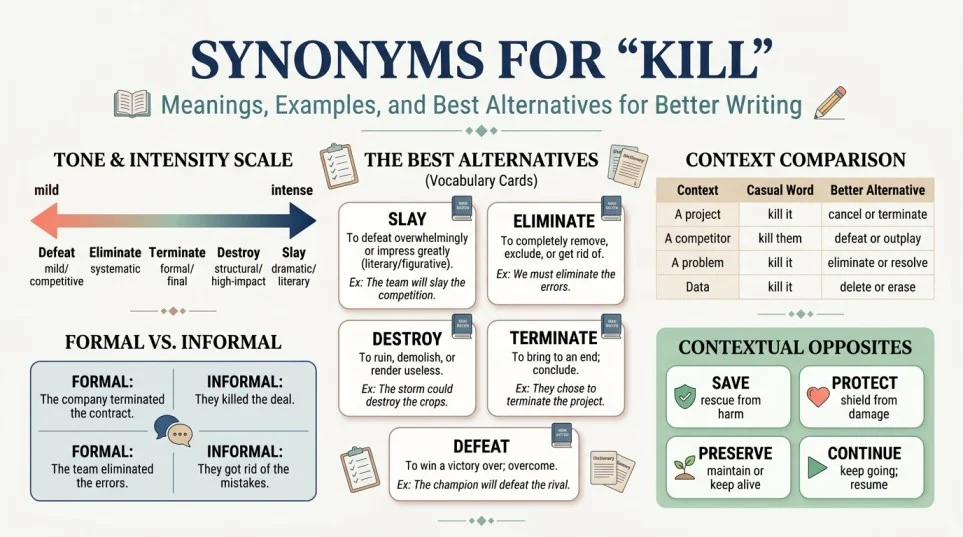
Choosing the right word can make your writing clearer and more powerful. If you keep repeating the word kill in stories, essays, conversations, captions, or professional writing, learning alternative words can help you express your meaning more precisely. However, not every synonym communicates the same action or emotion.
Some alternatives describe causing death, while others mean destroying something, ending a problem, defeating a competitor, or stopping an activity. Words such as eliminate, slay, destroy, defeat, and terminate have different uses and levels of intensity. Understanding these differences helps you avoid awkward sentences and choose language that fits your audience.
This guide explores synonyms for kill, with simple definitions, natural examples, formal and informal alternatives, antonyms, and practical usage advice. You will learn which words work best in academic writing, professional communication, everyday conversation, and creative storytelling.
What Does Kill Mean?
Kill means to cause the death of a person, animal, or living organism. Depending on context, it can also mean to destroy, stop, or defeat something. Common alternatives include slay, eliminate, destroy, end, defeat, and terminate, although each has a different meaning and appropriate use.
Meaning, Tone and Context
Simple Definition
The verb kill usually means to cause a living being to die. It can also describe destroying something, ending an activity, or preventing a process from continuing.
For example, a disease can kill a plant, a decision can kill a business proposal, and a strong performance can kill the competition in an informal expression.
Part of Speech
Kill is primarily a verb. It can appear in different grammatical forms.
| Word Form | Meaning | Example |
|---|---|---|
| Kill | Present tense verb | The disease can kill plants. |
| Kills | Present tense with a singular subject | The chemical kills bacteria. |
| Killed | Past tense or past participle | The storm killed several plants. |
| Killing | Present participle or gerund | The drought is killing the grass. |
| Killer | Noun or adjective | The detective searched for the killer. |
| Killing | Noun in informal expressions | The comedian was killing it on stage. |
Tone and Formality
The word kill is direct and often serious. When it refers to a person’s death, it can sound disturbing or emotionally intense.
In figurative expressions, it may be casual, humorous, or dramatic. The sentence and surrounding situation determine how the word feels to the reader.
Common Uses
Kill can appear in several contexts:
- Literal meaning: Causing the death of a person or animal.
- Scientific writing: Describing how a treatment or substance kills bacteria.
- Business communication: Describing the cancellation of a project or proposal.
- Creative writing: Describing death, danger, or conflict in a story.
- Casual conversation: Saying someone performed extremely well, as in the expression killing it.
- Figurative language: Describing something that ruins excitement, motivation, or an opportunity.
Related Word Forms
Related words include killer, killing, killed, and killable. The most suitable alternative depends on whether you are describing death, destruction, cancellation, or an impressive performance.
When and How to Use Kill
Use kill when you need a direct word for causing death or when a familiar figurative expression communicates your meaning clearly. Choose a more precise alternative when the action, tone, or setting requires it.
1. Scientific context
The disinfectant kills many common bacteria.
2. Professional context
The sudden budget reduction killed the proposed expansion plan.
3. Creative writing
In the mystery novel, the detective investigates who killed the wealthy businessman.
4. Casual conversation
You absolutely killed it during your presentation.
The last example is informal praise. It means the speaker performed exceptionally well, not that anyone died.
Another Word for Kill
The best replacement depends on what kill means in your sentence. There is no single synonym that works naturally in every situation.
| Context | Best Alternative | Example |
|---|---|---|
| Professional writing | Terminate | The company decided to terminate the agreement. |
| Academic writing | Cause death | The exposure can cause death in severe cases. |
| Casual conversation | Nail it | You nailed that presentation. |
| Emotional writing | Take a life | The tragedy took a young man’s life. |
| Creative writing | Slay | The hero slays the monster in the final chapter. |
| Workplace projects | Cancel | The board canceled the proposed initiative. |
| Social media captions | Crush it | You crushed it on stage. |
| Strong destructive meaning | Destroy | The fire destroyed the historic building. |
| Softer or indirect meaning | Pass away | His grandfather passed away peacefully. |
| Competition | Defeat | The team defeated its strongest rival. |
Best overall advice: Use eliminate when something is removed, destroy when something is ruined, terminate when an activity or arrangement ends, and cause death when scientific precision matters.
These alternatives are related to kill, but they are not interchangeable in every sentence.
When Not to Use Kill
Although kill is a common word, it can sound too blunt, violent, or vague in certain situations. A more specific alternative often makes your meaning easier to understand.
1. In sensitive personal messages
Instead of saying someone was killed when the circumstances are unknown, use a precise, verified description. If a person died from illness, died in an accident, or was murdered, those expressions communicate different facts.
2. In academic writing
Avoid using kill when a scientific explanation needs more detail. Words such as destroy, inhibit, and eliminate may be more suitable, depending on whether a substance destroys cells, slows growth, or removes an organism.
3. In business communication
Instead of writing that a manager killed a proposal, say the manager rejected, canceled, or discontinued it. These alternatives explain what actually happened.
4. In professional praise
The phrase you killed it may sound too casual in a formal performance review. Consider you delivered an excellent presentation or you exceeded expectations.
5. In emotional writing
Avoid dramatic language when a calmer expression better suits the situation. For example, a setback may damage confidence without completely destroying it.
Words Commonly Confused With Kill
Several related words describe different actions. Choosing the right one helps you communicate accurately.
| Word | Main Difference | Best Used When |
|---|---|---|
| Murder | Unlawfully and intentionally killing a person | Discussing a crime involving unlawful killing |
| Slay | Killing, often in a dramatic, literary, or historical context | Writing fiction, legends, or historical accounts |
| Eliminate | Removing or getting rid of something | Discussing risks, errors, or competitors |
| Destroy | Ruining something or making it unusable | Describing buildings, objects, plans, or systems |
| Terminate | Bringing something to an end | Discussing contracts, processes, or employment |
| Defeat | Winning against an opponent | Describing sports, debates, or competitions |
Remember that murder is not a general replacement for kill. It has a specific legal meaning, and its use should reflect the known facts.
Best Synonym by Context for Kill
The following table shows how to choose an alternative according to your purpose, audience, and intended meaning.
| Context | Best Synonym | Why It Works | Example |
|---|---|---|---|
| Formal writing | Cause death | Clear and factual | The disease can cause death without treatment. |
| Academic writing | Lethally affect | Emphasizes a fatal effect, although the phrase is less common | The exposure affected the animals lethally. |
| Professional or business use | Terminate | Suitable for ending an agreement or process | The company terminated the contract. |
| Resume | Resolve | Describes addressing a problem without violent language | Resolved recurring issues that delayed production. |
| Casual conversation | Nail it | Expresses excellent performance | You nailed the interview. |
| Creative writing | Slay | Adds a dramatic or legendary tone | The knight slays the dragon. |
| Emotional writing | Take a life | Emphasizes the human consequences of death | The tragedy took an innocent life. |
| Strong destructive meaning | Annihilate | Expresses total destruction or overwhelming defeat | The fictional army annihilated its enemy. |
| Softer meaning | Pass away | A gentle expression for death | Her beloved uncle passed away peacefully. |
| Social media captions | Crush it | Communicates success and confidence | Ready to crush it at the competition. |
| Scientific writing | Destroy | Describes damaging or eliminating a target | The treatment destroys infected cells. |
| Legal reporting | Murder | Appropriate when the facts support the legal meaning | The jury convicted him of murder. |
| Sports | Defeat | Describes beating an opponent | The home team defeated its rival. |
| Project management | Cancel | Clearly describes stopping a planned activity | The director canceled the project. |
| Technology | Shut down | Describes stopping a system or application | The update shut down the application. |
| Environmental writing | Eradicate | Describes removing a pest or harmful organism completely | The program aims to eradicate the invasive pest. |
The phrase lethally affect is grammatically possible, but it is not a preferred general synonym. In academic work, use a direct expression such as cause death, prove fatal, or kill, depending on the evidence and scientific context.
Which Synonym Should You Choose?
Follow these practical steps before replacing kill with another word.
1. Identify the actual meaning. If you mean death, use kill, cause death, or take a life. If you mean ending a project, use cancel or terminate.
2. Match the level of formality. Formal reports often benefit from precise language. Casual conversation may allow expressions such as nail it or crush it when describing success.
3. Consider emotional intensity. Slay and annihilate can sound dramatic. End, stop, and cancel are usually more neutral when discussing activities or plans.
4. Think about your audience. Academic readers need accuracy, business readers need clarity, and fiction readers may appreciate vivid language.
5. Check the full sentence. A word that works grammatically may still change the meaning. For example, defeat is not a suitable replacement when a sentence specifically describes causing death.
Real Life Examples of Kill in Sentences
These examples demonstrate how related words work across everyday situations.
| Situation | Example Sentence |
|---|---|
| School | The student explained how certain chemicals can kill harmful bacteria. |
| Workplace | Management canceled the proposal after reviewing the costs. |
| Writing | The author used the word slay to create a dramatic scene. |
| Conversation | You nailed that difficult question. |
| Social media | One of my favorite performers absolutely crushed it tonight. |
| Resume | Eliminated repeated reporting errors through improved quality checks. |
| We have decided to terminate the agreement at the end of the current term. | |
| Storytelling | The villain attempts to destroy the kingdom, but the hero stops him. |
| Science | The researchers measured whether the treatment could kill the targeted cells. |
| Sports | The underdog defeated the defending champion in the final match. |
For resumes and professional profiles, focus on the result you achieved rather than using violent or exaggerated expressions. Words such as improved, resolved, reduced, and eliminated often communicate workplace accomplishments more clearly.
18 Synonyms for Kill
The following 18 words and expressions cover literal death, destruction, removal, cancellation, and figurative success. Some are close synonyms, while others work only in specific contexts.
| Synonym | Simple Meaning | Best Used For | Example Sentence |
|---|---|---|---|
| 1. Slay | To kill, often in a dramatic way | Fiction, legends, and historical writing | The warrior slays the dragon in the final chapter. |
| 2. Murder | To unlawfully and intentionally kill a person | Crime reporting and legal contexts when accurate | The detective investigates the murder. |
| 3. Assassinate | To kill a prominent person, usually for political or ideological reasons | Historical and political writing | The novel centers on a plot to assassinate the ruler. |
| 4. Execute | To carry out a death sentence or put a plan into action | Legal history or formal descriptions of actions | The court ordered the sentence to be executed. |
| 5. Exterminate | To destroy or eliminate a group of organisms completely | Pest control and biological contexts | The treatment is designed to exterminate the infestation. |
| 6. Annihilate | To destroy completely or defeat overwhelmingly | Dramatic writing and competition | The fictional fleet annihilates the enemy force. |
| 7. Eliminate | To remove or get rid of something | Business, science, and general writing | The new process eliminates unnecessary steps. |
| 8. Destroy | To ruin something or make it unusable | Physical damage and figurative destruction | The storm destroyed several buildings. |
| 9. Slaughter | To kill, especially animals for food, or kill people brutally | Farming, history, and serious reporting | The historical account describes the slaughter of civilians. |
| 10. Dispatch | To kill quickly, or send someone or something away | Literary writing and specific formal contexts | In the fantasy story, the hero dispatches the monster. |
| 11. Put to death | To cause someone to die, often by official order | Historical or legal discussion | The condemned prisoner was put to death. |
| 12. Cause death | To bring about a fatal outcome | Medical, scientific, and factual writing | Severe exposure can cause death. |
| 13. Take a life | To cause a person or animal to die | Emotional writing and serious discussion | The accident took a young driver’s life. |
| 14. Terminate | To bring something to an end | Contracts, processes, and formal communication | The company terminated the agreement. |
| 15. Cancel | To decide that a planned event or activity will not happen | Projects, events, and proposals | The organizers canceled the event. |
| 16. Eradicate | To remove something completely | Disease control, pests, and social problems | The campaign aims to eradicate the disease. |
| 17. Defeat | To win against someone or something | Sports, games, and competition | The team defeated its strongest rival. |
| 18. Nail it | To do something extremely well | Informal conversation and praise | You nailed it during your interview. |
Important distinction: Murder, assassinate, and execute describe specific circumstances. Terminate and cancel generally refer to ending things rather than causing death. Defeat and nail it are suitable only for particular figurative meanings.
Synonym Groups and Usage Differences
Professional vs. Personal Synonyms
Professional writing benefits from precise verbs that describe a measurable action or outcome.
Use terminate for contracts, cancel for scheduled activities, eliminate for unwanted problems, and resolve for issues that have been addressed.
In personal writing about a death, expressions such as passed away and took a life communicate different tones. Passed away is gentle, while took a life emphasizes the seriousness of a death.
Formal vs. Conversational Synonyms
Formal language should make the facts clear without unnecessary drama.
| Formal or Neutral | Conversational | Difference |
|---|---|---|
| Cause death | Kill | The first is more explanatory and often more formal. |
| Terminate | Call off | Both can describe ending an arrangement, but their uses differ. |
| Defeat | Beat | Both describe winning against an opponent, with beat being more conversational. |
| Perform exceptionally well | Kill it | The second is informal praise. |
| Destroy | Wreck | Wreck often sounds more conversational. |
Use conversational expressions in friendly messages, informal captions, and everyday speech. For reports, essays, and official emails, choose wording that matches the exact situation.
Academic Synonyms
Academic writing values accuracy more than variety. Do not replace a technical word merely to avoid repeating it.
Useful choices include:
- Cause death: Suitable for a direct description of a fatal outcome.
- Destroy: Useful when an organism, cell, or object is physically damaged or rendered unusable.
- Eliminate: Appropriate when a target is removed from a system or population.
- Inhibit: Means to slow, reduce, or prevent a process. It does not necessarily mean kill.
- Prove fatal: Suitable when an event, injury, or condition results in death.
Always check whether the chosen word matches the scientific evidence. A substance that inhibits bacterial growth does not necessarily kill bacteria.
Professional and Business Synonyms
Business writing often uses kill informally to describe a canceled proposal or discontinued initiative. Clearer alternatives usually improve the message.
| Situation | Recommended Word | Example |
|---|---|---|
| Ending an agreement | Terminate | We will terminate the agreement according to its terms. |
| Stopping an event | Cancel | The team canceled the scheduled meeting. |
| Removing a problem | Eliminate | The new system eliminates duplicate records. |
| Addressing a challenge | Resolve | The support team resolved the issue. |
| Rejecting an idea | Reject | The committee rejected the proposal. |
| Ending a process | Discontinue | The company discontinued the outdated service. |
On a resume, use strong but truthful verbs such as improved, reduced, resolved, and eliminated. Avoid phrases such as killed costs or destroyed competition when a precise achievement would be more convincing.
Creative or Literary Synonyms
Creative writing sometimes benefits from strong, vivid words. The best choice depends on the scene, genre, and intended emotion.
Slay works well in fantasy, legends, and heroic stories.
Slaughter conveys brutality or large scale killing. It can be disturbing, so reserve it for scenes that justify its intensity.
Annihilate suggests complete destruction or overwhelming defeat. It often sounds dramatic rather than neutral.
Dispatch can create a formal or old fashioned tone in a fictional scene.
Use these words carefully. A dramatic synonym can strengthen a story, but too many intense words may make the writing feel exaggerated.
Slang or Modern Synonyms
Some expressions related to kill have positive meanings in casual American English.
| Expression | Meaning | Example |
|---|---|---|
| Kill it | Perform extremely well | You killed it at the show. |
| Crush it | Succeed impressively | She crushed it during the presentation. |
| Nail it | Do something exactly right | He nailed the final answer. |
| Slay | Look impressive or perform confidently | You slayed that outfit. |
These expressions are common in casual speech, social media, and friendly messages. They are usually unsuitable for formal scientific descriptions or reports about actual deaths.
Strongest vs. Weaker Synonyms
Words differ in intensity, but there is no universal ranking because meaning depends on context.
Mild
End, stop, cancel
Best for activities, processes, or plans.
Moderate
Eliminate, defeat, destroy
Describes removal, winning, or serious damage.
Intense
Slaughter, annihilate
Communicates brutality or complete destruction.
This scale compares general intensity, not legal meaning. For actual death, choose a word that accurately describes what happened rather than simply selecting the strongest expression.
Emotional vs. Neutral Synonyms
Neutral language focuses on facts. Emotional language highlights grief, fear, brutality, or personal loss.
| Neutral or Factual | More Emotional | Difference |
|---|---|---|
| Cause death | Take a life | The second emphasizes the human loss. |
| Die | Pass away | The second is gentler and more sensitive. |
| Kill | Slaughter | The second often suggests brutality. |
| Destroy | Annihilate | The second emphasizes total destruction. |
| End a plan | Crush a dream | The second emphasizes emotional disappointment. |
In sensitive communication, consider the reader’s feelings and the known facts. A softer expression can show care, but it should not hide important information.
Antonyms of Kill
The opposite of kill depends on the intended meaning. When kill refers to causing death, live and survive may express an opposite outcome. When it means destroying or ending something, preserve, protect, continue, and maintain may be more suitable.
The following 15 words are context dependent opposites, not direct antonyms in every sentence.
| Antonym | Meaning | Example Sentence |
|---|---|---|
| 1. Save | Prevent someone or something from dying or being lost | The doctors worked to save the patient. |
| 2. Rescue | Remove someone from danger | Firefighters rescued the trapped family. |
| 3. Protect | Keep someone or something safe | The shield protects the plants from frost. |
| 4. Preserve | Keep something in its existing or original condition | The team worked to preserve the historic building. |
| 5. Spare | Choose not to harm or kill | The king decided to spare the prisoner. |
| 6. Revive | Bring someone or something back to life or activity | The emergency team tried to revive the patient. |
| 7. Heal | Help a wound or illness recover | The treatment helped heal the injury. |
| 8. Cure | Remove a disease or restore health | The medicine helped cure the infection. |
| 9. Nurture | Help a living thing grow and develop | The gardener nurtured the young plants. |
| 10. Sustain | Keep something alive or functioning | The water helped sustain the seedlings. |
| 11. Maintain | Keep something operating or in good condition | Regular care maintains the machine. |
| 12. Continue | Allow an activity or process to carry on | The team continued the project. |
| 13. Retain | Keep something instead of removing it | The company retained its original staff. |
| 14. Build | Create or develop something | The community built a new school. |
| 15. Create | Bring something new into existence | The artist created a beautiful sculpture. |
For the clearest opposite, match the word to the original meaning. Save is a strong choice when preventing death, preserve when preventing destruction, and continue when preventing an activity from ending.
Comparison: Kill vs. Similar Words
Kill vs. Murder
Main difference: Kill is a general term for causing death. Murder refers to an unlawful killing of a person under the applicable legal definition.
Which is stronger? Murder carries a more specific criminal meaning.
Which is more formal? Both can appear in formal writing, but murder has a specific legal meaning.
Examples:
Kill: The poison killed the animal.
Murder: The court heard evidence related to the murder.
Kill vs. Slay
Main difference: Kill is neutral and widely used. Slay often sounds dramatic, literary, or historical.
Which is stronger? Slay can feel more dramatic, depending on the story.
Which is more formal? Kill is generally more neutral in modern factual writing.
Examples:
Kill: The disease killed several animals.
Slay: The knight slays the dragon.
Kill vs. Eliminate
Main difference: Kill usually describes death, while eliminate means removing something or someone from a situation, group, or system.
Which is stronger? Kill is more direct when referring to death. Eliminate can sound less graphic.
Which is more formal? Eliminate is common in professional and academic writing.
Examples:
Kill: The infection killed the cells.
Eliminate: The new procedure eliminated unnecessary steps.
Kill vs. Destroy
Main difference: Kill usually concerns living things, while destroy means to ruin or damage something severely. Both can have figurative meanings.
Which is stronger? Destroy often emphasizes extensive damage.
Which is more formal? Both are suitable for formal writing when used accurately.
Examples:
Kill: The disease killed the crop.
Destroy: The storm destroyed the greenhouse.
Kill vs. Terminate
Main difference: Kill commonly describes death or destruction. Terminate usually means to bring an agreement, activity, or process to an end.
Which is stronger? Kill is more forceful when referring to death, while terminate sounds official.
Which is more formal? Terminate is often more formal in business and administrative contexts.
Examples:
Kill: The toxin killed the fish.
Terminate: The company terminated the contract.
Kill vs. Defeat
Main difference: Kill means to cause death, while defeat means to win against an opponent.
Which is stronger? Kill has a literal fatal meaning, while defeat describes the outcome of a contest or struggle.
Which is more formal? Both are appropriate in formal writing.
Examples:
Kill: The disease killed the animal.
Defeat: The team defeated its opponent.
Common Phrases and Expressions with Kill
These expressions show how the meaning of kill changes in everyday American English. Some refer to actual death, while others are figurative.
1. Kill time
Meaning: To spend time while waiting for something.
Example sentence: We played cards to kill time before the train arrived.
2. Kill the mood
Meaning: To spoil the atmosphere or enjoyment of a situation.
Example sentence: His negative comment killed the mood at dinner.
3. Kill two birds with one stone
Meaning: To accomplish two goals with one action.
Example sentence: I walked to work to exercise and save money, killing two birds with one stone.
4. Kill it
Meaning: To perform exceptionally well.
Example sentence: You killed it during your job interview.
5. Kill the competition
Meaning: To outperform competing people or businesses, usually figuratively.
Example sentence: The brand hopes to kill the competition with better customer service.
6. Kill a deal
Meaning: To cause a potential agreement to fail.
Example sentence: The unexpected fee could kill the deal.
7. Kill the lights
Meaning: To switch off the lights, often informally.
Example sentence: Please kill the lights before leaving the room.
8. Kill with kindness
Meaning: To respond to difficult behavior with kindness rather than hostility.
Example sentence: She decided to kill her critics with kindness.
Common Mistakes to Avoid
1. Treating every synonym as interchangeable.
Murder, slay, destroy, and terminate have different meanings. Choose the word that describes the actual action.
2. Using murder when the facts are unclear.
Murder has a specific legal meaning. Use kill or a verified description when the legal circumstances have not been established.
3. Using slang in formal writing.
Expressions such as killed it and crushed it work in casual conversation. In a report or performance review, write performed exceptionally well or exceeded expectations.
4. Making a simple situation sound dramatic.
Annihilate and slaughter carry strong meanings. Use cancel, defeat, or eliminate when those words describe the situation more accurately.
5. Choosing a word with the wrong emotional tone.
Passed away is gentle, while slaughter suggests brutality. Consider your audience when discussing a death or painful event.
6. Repeating kill too often.
If the word appears repeatedly in a paragraph, revise the sentences according to their meanings. Use alternatives such as cause death, destroy, or eliminate only where they fit.
FAQs
1. What is the best synonym for kill?
The best synonym depends on context. Slay suits dramatic fiction, eliminate suits removal, destroy describes serious damage, and cause death works well in factual explanations.
2. What is a formal synonym for kill?
Cause death is a clear formal alternative in factual writing. Terminate is suitable for ending agreements or processes, but it does not generally mean causing death.
3. What is an informal synonym for kill?
In casual American English, nail it and crush it describe excellent performance. Beat can mean defeat an opponent, but these expressions do not describe literal death.
4. What is another word for kill in professional writing?
Use terminate for agreements, cancel for planned activities, eliminate for unwanted problems, and resolve for challenges. Select the verb that accurately describes the outcome.
5. What is the difference between kill and murder?
Kill is a broad term for causing death. Murder describes an unlawful killing of a person under the applicable legal definition, so the words are not interchangeable.
6. What is the opposite of kill?
Save is a useful opposite when the meaning concerns preventing death. Preserve suits preventing destruction, while continue is appropriate when kill means ending an activity or process.
Conclusion
Learning synonyms for kill helps you choose words that match your meaning, audience, and writing style. Alternatives such as slay, eliminate, destroy, terminate, and defeat can make your writing more precise, but each word serves a different purpose.
For formal writing, focus on clarity and accuracy. Creative stories, use vivid words when they fit the scene. For casual conversation, expressions such as nail it and crush it can communicate success naturally.
The most useful vocabulary tip is simple: understand the meaning first, then choose the synonym that fits the sentence. This approach makes your writing clearer, more natural, and more effective.included in this draft.
Discover More Post:
- 25+ Synonyms for Superior | Meanings, Examples, and Best …
- 25+ Synonyms for Anxious | Meanings, Examples, and Best …
- 25+ Synonyms for Potential | Meanings and Examples