Have you ever used the word concern several times in an email, essay, work report, or social media caption? It is a useful word, but repeating it can make your writing sound less clear. Depending on your meaning, words such as worry, issue, care, interest, and anxiety may express your thoughts more naturally.
Learning synonyms for concern helps you choose words that fit your message, audience, and tone. This guide explains the meaning of concern, shows how related words differ, and provides practical examples for everyday conversations, academic writing, professional emails, and creative work. You will also learn which alternatives sound formal, which express stronger emotions, and which work best when discussing a problem. The goal is simple: help you communicate clearly without sacrificing your natural voice.
What Does Concern Mean?
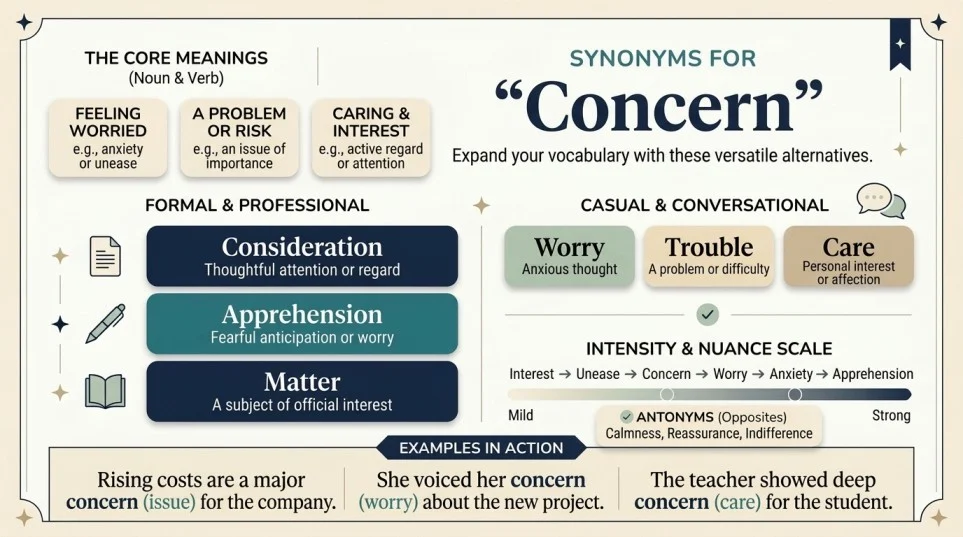
Concern means worry about something, an issue that needs attention, or an interest in someone or something. Common synonyms include worry in emotional contexts, issue in professional writing, care in personal relationships, and matter in formal communication.
Meaning, Tone and Context
What Does Concern Mean?
The word concern has several related meanings. It can describe a feeling of worry, something important that needs attention, or a feeling of care and interest toward another person.
For example, a parent may express concern about a child’s safety. A manager may discuss a concern about a project deadline. A teacher may show concern for a student’s progress.
Part of Speech
Concern is mainly used as both a noun and a verb.
As a noun: It can mean worry, an important matter, or care for someone.
Example: Her main concern is the safety of her family.
As a verb: It can mean to affect, involve, or relate to someone.
Example: This announcement concerns every employee in the department.
Tone and Formality
Concern is generally neutral, but its emotional meaning depends on the sentence.
| Tone | Meaning | Example |
|---|---|---|
| Neutral | A matter that needs attention | Cost is our main concern. |
| Emotional | Worry about a situation | His concern was easy to notice. |
| Caring | Interest in another person’s well being | She expressed concern for her friend. |
| Professional | A problem or issue | We discussed several customer concerns. |
| Formal | A matter involving responsibility or interest | This decision concerns public safety. |
Common Word Forms
| Word form | Meaning | Example |
|---|---|---|
| Concern | Worry, care, or an issue | My concern is the deadline. |
| Concerned | Worried or interested | She is concerned about the results. |
| Concerning | Related to, or causing worry | We received a concerning report. |
| Concernedly | In a manner showing worry, though uncommon | He looked at her concernedly. |
| Unconcerned | Not worried or interested | He seemed unconcerned about the delay. |
Use concerned when describing a person’s feelings. Use concerning when describing something that causes worry or deserves attention.
When and How to Use Concern
The best way to use concern depends on what you want to communicate. It can express emotion, introduce a problem, or describe something that affects a person or group.
Professional context: The team raised a concern about the new schedule.
Personal context: My biggest concern is that you are not getting enough rest.
Academic context: The research examines concerns about student privacy.
Email context: Please let me know if you have any concerns about the proposed changes.
Notice that the same word works in all four situations, but its meaning shifts slightly with the context.
Another Word for Concern
The best single replacement for concern is usually worry when you mean an uneasy feeling. However, issue is better for a problem, care works for personal feelings, and matter fits many formal situations.
Choose the synonym that matches the exact meaning of your sentence.
| Situation | Best alternative | Example |
|---|---|---|
| Professional writing | Issue | We need to address this issue promptly. |
| Academic writing | Consideration | Cost is an important consideration in the study. |
| Casual conversation | Worry | My biggest worry is the weather. |
| Emotional writing | Anxiety | She felt anxiety before the interview. |
| Creative writing | Unease | A sense of unease filled the room. |
| Resume or workplace use | Risk | Identified risks before project launch. |
| Social media captions | Worry | Less worry, more time for what matters. |
| Stronger meaning | Distress | The news caused considerable distress. |
| Softer meaning | Interest | She showed an interest in his progress. |
Which Alternative Should You Choose?
Use worry for an uneasy feeling, issue for a problem, care for affection or kindness, and matter for a subject that deserves attention. In business writing, specify the actual issue whenever possible.
When Not to Use Concern
Although concern is versatile, it is not always the clearest choice. A more precise word can help readers understand whether you mean a problem, a feeling, or an act of caring.
| Vague sentence | More precise sentence | Why it improves the meaning |
|---|---|---|
| I have a concern about the exam. | I am worried about the exam. | Makes the emotional meaning clear. |
| There is a concern with the software. | There is a technical issue with the software. | Identifies a practical problem. |
| She has concern for animals. | She cares deeply about animals. | Sounds more natural and personal. |
| The concern is very serious. | The safety risk is serious. | Names the exact problem. |
| My concern is music. | My main interest is music. | Better expresses a preference or interest. |
Avoid replacing concern with a dramatic word such as distress when you simply mean a small inconvenience. Likewise, do not use a vague word when a specific term would explain the situation more clearly.
Words Commonly Confused With Concern
Several words have meanings close to concern, but they are not interchangeable in every sentence.
| Word | Main difference | Best use |
|---|---|---|
| Worry | An uneasy feeling about something | Personal fears and uncertainty |
| Issue | A subject, difficulty, or problem | Work, school, and practical discussions |
| Care | Interest in or kindness toward someone | Relationships and personal values |
| Anxiety | Stronger or more persistent uneasiness | Emotional descriptions |
| Interest | Attention or curiosity about something | Hobbies, studies, and preferences |
| Problem | Something that needs a solution | Direct descriptions of difficulties |
For example, a concern about a deadline may mean you are worried about it or that the deadline itself is a problem. The surrounding sentence tells the reader which meaning you intend.
Best Synonym by Context for Concern
Different situations call for different alternatives. Use this table to choose a word that sounds natural and communicates the right level of seriousness.
| Context | Best synonym | Why it works | Example |
|---|---|---|---|
| Formal writing | Matter | Sounds neutral and professional | This matter requires further review. |
| Academic writing | Consideration | Fits analysis and evaluation | Cost is a key consideration. |
| Business communication | Issue | Identifies a practical difficulty | We must resolve the issue today. |
| Resume | Risk | Shows awareness of possible problems | Evaluated risks before implementation. |
| Casual conversation | Worry | Sounds natural and direct | My main worry is getting there on time. |
| Creative writing | Unease | Creates a subtle emotional effect | Unease followed him down the hallway. |
| Emotional writing | Anxiety | Expresses stronger worry | She struggled with anxiety before the move. |
| Strong intensity | Distress | Communicates significant emotional pain | The sudden news caused distress. |
| Mild tone | Interest | Expresses attention without suggesting fear | He showed interest in the project. |
| Social media captions | Worry | Simple and easy to understand | Choosing peace over worry today. |
| Personal relationships | Care | Expresses kindness and affection | Her care for others was clear. |
| Reports and reviews | Observation | Focuses on a point that needs attention | The review included an observation about safety. |
| Customer service | Complaint | Identifies expressed dissatisfaction | The customer filed a complaint. |
| Safety discussions | Risk | Focuses on potential harm | The inspection revealed a safety risk. |
| Legal or official writing | Issue | Describes a matter under consideration | The issue remains under review. |
| News reporting | Question | Highlights something needing clarification | Questions remain about the decision. |
US and UK Usage
Concern is common in both American and British English. There is no major difference in its basic meaning or spelling.
American writers may use issue, worry, or problem in everyday communication. British writers use the same alternatives, although individual preferences can vary by region and context.
Which Synonym Should You Choose?
Use these five steps to select the best alternative.
1. Identify the meaning. Are you describing a feeling, a problem, care for someone, or a subject that needs attention?
2. Match the formality. Choose issue or matter for many professional situations. Choose worry or care for natural everyday conversation.
3. Check emotional intensity. Worry is common and direct. Anxiety may suggest stronger uneasiness. Distress usually signals more serious emotional discomfort.
4. Consider your audience. Academic readers often benefit from precise terms such as consideration or risk. Friends may respond better to simple language such as worry.
5. Read the sentence aloud. The best synonym should preserve your intended meaning and sound natural in the complete sentence.
A useful rule is to replace a broad word with a specific one whenever the context makes the intended meaning clear.
Real Life Examples of Concern in Sentences
These examples show how concern and its alternatives work in everyday situations.
School: The teacher expressed concern about the student’s repeated absences.
Workplace: Our main issue is the limited time available for testing.
Writing: The essay explores public concern about online privacy.
Conversation: I am worried about missing the last bus.
Social media: A little less worry and a little more gratitude can change your day.
Resume: Identified project risks and recommended practical solutions.
Email: Please share any concerns before we finalize the proposal.
Storytelling: A quiet sense of unease settled over the empty house.
Customer service: The support team addressed the customer’s complaint.
Personal relationships: Her care for her younger brother showed in every small action.
These examples also demonstrate why there is no single synonym that fits every use of concern.
18 Synonyms for Concern
The following 18 words are useful alternatives when their specific meanings fit the sentence. Some describe worry, while others refer to problems, attention, or care.
| Synonym | Simple meaning | Best used for | Example sentence |
|---|---|---|---|
| 1. Worry | An uneasy feeling | Everyday emotions | Her main worry was the long journey. |
| 2. Anxiety | Uneasiness or nervousness | Emotional writing | He felt anxiety before the results arrived. |
| 3. Issue | A matter or difficulty | Work and practical problems | The team resolved the issue quickly. |
| 4. Problem | Something needing a solution | Direct communication | We found a problem with the report. |
| 5. Care | Kindness or personal interest | Relationships | She showed genuine care for her neighbors. |
| 6. Interest | Attention or curiosity | Hobbies and learning | His interest in history grew over time. |
| 7. Matter | A subject that needs attention | Formal communication | This matter deserves careful review. |
| 8. Consideration | A factor worth thinking about | Academic and professional writing | Cost is an important consideration. |
| 9. Unease | A feeling that something is wrong | Creative writing | Unease spread through the crowd. |
| 10. Apprehension | Nervousness about what may happen | Formal emotional writing | She approached the interview with apprehension. |
| 11. Distress | Serious emotional discomfort | Strong emotional situations | The sudden loss caused deep distress. |
| 12. Trouble | Difficulty or a possible problem | Informal conversation | We may have trouble finding parking. |
| 13. Risk | The possibility of harm or loss | Safety and business | The audit identified a financial risk. |
| 14. Complaint | An expression of dissatisfaction | Customer service | The manager reviewed the complaint. |
| 15. Objection | An expression of disagreement | Meetings and formal debate | He raised an objection to the proposal. |
| 16. Curiosity | A desire to learn or know | Positive interest | Her curiosity led her to explore astronomy. |
| 17. Regard | Attention, respect, or consideration | Formal and literary writing | He has great regard for his mentor. |
| 18. Attention | Notice or focus given to something | Instructions and practical writing | The safety warning deserves attention. |
Important distinction: These words are related alternatives, not exact replacements in every sentence. Worry and anxiety express emotions, while issue and problem refer to difficulties. Care, curiosity, and regard express forms of interest or attention.
Synonym Groups and Usage Differences
Professional vs. Personal Synonyms
Professional writing usually benefits from specific, neutral words. Issue, risk, consideration, and matter help readers understand what needs attention without adding unnecessary emotion.
Personal writing often calls for warmer or more emotional alternatives. Care expresses kindness, worry communicates uncertainty, and anxiety conveys stronger nervousness.
Compare these examples:
Professional: The report identifies a risk to the project timeline.
Personal: I am worried that we may not finish on time.
Both sentences describe a similar situation, but each suits a different audience.
Formal vs. Conversational Synonyms
Formal words work well in reports, essays, official letters, and presentations. Conversational words sound natural in texts, personal emails, and everyday discussions.
| Formal alternative | Conversational alternative | Example |
|---|---|---|
| Matter | Thing | We need to discuss this matter. |
| Consideration | Factor | Cost is one factor to consider. |
| Apprehension | Worry | She felt apprehension before the meeting. |
| Issue | Problem | We have a problem with the printer. |
| Regard | Care | He has great regard for his colleagues. |
Do not assume that formal words are always better. Clear and familiar language is often the strongest choice, especially when the message is simple.
Academic Synonyms
Academic writing should explain ideas accurately rather than use complicated words for their own sake.
Consideration works when discussing factors in an argument. Issue fits a subject being examined. Risk is useful when analyzing possible harm, while anxiety is suitable when discussing emotional responses.
Examples:
- The study examines concerns about student privacy.
- Privacy is an important consideration in online learning.
- The researchers identified a risk of biased results.
- The survey measured anxiety among participants.
Choose the word that matches the evidence and meaning. Do not replace concern with anxiety unless the sentence specifically refers to an emotional state.
Professional and Business Synonyms
In workplace communication, the most useful alternative often identifies exactly what needs action.
| Situation | Recommended word | Example |
|---|---|---|
| A technical difficulty | Issue | The technical issue has been resolved. |
| A possible loss | Risk | The team assessed the financial risk. |
| Customer dissatisfaction | Complaint | We responded to the customer’s complaint. |
| A decision factor | Consideration | Delivery time is a key consideration. |
| A disagreement | Objection | The committee discussed the objection. |
| A general topic | Matter | We will review the matter tomorrow. |
For resumes, action verbs and specific results are usually stronger than simply stating that you handled concerns.
Instead of writing, I addressed customer concerns, try Resolved customer complaints and improved response times, provided that this accurately reflects your experience.
Creative or Literary Synonyms
Creative writing often benefits from words that reveal a character’s emotional state or build atmosphere.
Unease suggests that something feels wrong, even when the reason is unclear.
Apprehension creates a sense of nervous anticipation.
Distress suggests deeper emotional pain.
Curiosity can show interest in a mystery or unfamiliar person.
Example: A strange noise stirred unease in the old house.
This sentence creates a stronger mood than saying that someone had a concern about the noise.
Slang or Modern Synonyms
There is no single modern slang term that accurately replaces concern in every context. Casual expressions such as freaking out or stressing out can describe worry, but they are not direct synonyms for every meaning.
Examples:
- I am stressing out about tomorrow’s test.
- She is freaking out over the unexpected bill.
These phrases suit informal conversations and some social media posts. In an academic essay or business report, prefer worrying, feeling anxious, or facing a problem.
Strongest vs. Weaker Synonyms
The following scale shows approximate emotional intensity when concern refers to worry. The order is not universal, because intensity depends on context.
Mild
Interest
Attention or curiosity without strong worry.
Low
Unease
A mild feeling that something may be wrong.
Moderate
Worry
An ordinary feeling of concern about a situation.
Strong
Anxiety or apprehension
More intense nervousness or fear about what may happen.
Very strong
Distress
Serious emotional discomfort or suffering.
Use the scale as a writing guide, not a fixed psychological measurement. A word that sounds strong in one sentence may sound milder in another.
Emotional vs. Neutral Synonyms
Emotional synonyms reveal how someone feels. Neutral alternatives focus on the subject or problem itself.
| Emotional words | Neutral words |
|---|---|
| Worry | Issue |
| Anxiety | Matter |
| Apprehension | Consideration |
| Distress | Risk |
| Unease | Question |
For example, The proposal raises a concern about cost sounds relatively neutral. The proposal causes anxiety about future expenses puts more emphasis on emotion.
Choose emotional words when feelings matter. Choose neutral words when explaining facts, reviewing options, or recommending action.
Antonyms of Concern
The opposite of concern depends on its meaning. If concern means worry, its opposites may include calmness or reassurance. If it means care or interest, indifference or neglect may be more suitable.
The following 15 words and expressions represent useful opposites in different contexts. Some are contextual opposites rather than exact dictionary antonyms.
| Antonym | Meaning | Example sentence |
|---|---|---|
| 1. Calmness | A peaceful state without agitation | She approached the exam with calmness. |
| 2. Reassurance | Comfort that reduces worry | His explanation gave us reassurance. |
| 3. Confidence | Belief that something will go well | She felt confidence in the team’s plan. |
| 4. Peace of mind | A feeling of security | The warranty gave customers peace of mind. |
| 5. Indifference | Lack of interest or feeling | His indifference surprised the group. |
| 6. Apathy | Lack of interest or motivation | Public apathy slowed the campaign. |
| 7. Unconcern | A state of not being worried | His unconcern about the deadline frustrated his team. |
| 8. Disinterest | Lack of interest in a subject | Her disinterest in the debate was obvious. |
| 9. Detachment | Emotional distance | He discussed the problem with detachment. |
| 10. Neglect | Failure to give needed attention or care | Neglect of the equipment caused damage. |
| 11. Disregard | Lack of proper attention or respect | Disregard for the rules created safety problems. |
| 12. Inattention | Failure to pay attention | Inattention led to a minor mistake. |
| 13. Carelessness | Failure to act with enough care | Carelessness damaged the finished product. |
| 14. Composure | The ability to remain calm | She maintained her composure during the interview. |
| 15. Serenity | A state of deep calm | The quiet garden gave him a sense of serenity. |
Remember that these opposites fit different meanings. Indifference is a useful opposite of caring, while reassurance and calmness are more suitable opposites of worry.
Comparison: Concern vs. Similar Words
Concern vs. Worry
Main difference: Concern can refer to a feeling, a problem, or an important matter. Worry specifically describes uneasiness about something.
Which is stronger? Worry often sounds more directly emotional, although the intensity depends on the sentence.
Which is more formal? Concern is often more suitable for professional communication.
Examples:
Concern: My main concern is the project’s cost.
Worry: I worry that the project will exceed its budget.
Concern vs. Issue
Main difference: Concern may express worry or refer to a matter needing attention. Issue usually identifies a subject, difficulty, or problem.
Which is stronger? Neither word is always stronger. Issue is more direct when describing a practical problem.
Which is more formal? Both work in professional writing, but issue is often more precise for a specific difficulty.
Examples:
Concern: The manager expressed concern about delays.
Issue: The manager identified an issue with the delivery schedule.
Concern vs. Anxiety
Main difference: Concern can be a general worry or a matter that needs attention. Anxiety describes nervousness or uneasiness.
Which is stronger? Anxiety often suggests a more intense or persistent emotional state.
Which is more formal? Both can appear in formal writing, but anxiety is more specific to emotional experience.
Examples:
Concern: She expressed concern about the interview.
Anxiety: She experienced anxiety while waiting for the interview.
Concern vs. Care
Main difference: Concern may mean worry or attention to a matter. Care emphasizes kindness, affection, or a sense of responsibility.
Which is stronger? Neither is inherently stronger. Care usually sounds warmer, while concern can suggest worry.
Which is more formal? Both suit formal and informal contexts.
Examples:
Concern: His concern for the children was clear.
Care: His care for the children showed in his daily actions.
Concern vs. Interest
Main difference: Concern may indicate worry or involvement. Interest usually means curiosity, attention, or a desire to learn more.
Which is stronger? Concern may imply a problem or responsibility, while interest is often more neutral or positive.
Which is more formal? Both are common in professional and academic writing.
Examples:
Concern: The report raises concern about water quality.
Interest: The report shows growing interest in water conservation.
Concern vs. Problem
Main difference: Concern can be a feeling or a subject requiring attention. A problem is a difficulty that needs to be addressed.
Which is stronger? Problem is more direct when something is clearly wrong.
Which is more formal? Both are appropriate for professional use. Problem is often clearer when a specific difficulty exists.
Examples:
Concern: We have a concern about the new system.
Problem: The new system has a problem with data storage.
Common Phrases and Expressions with Concern
These expressions are common in everyday English, emails, reports, and professional conversations.
1. Express concern
Meaning: To communicate worry or uneasiness about something.
Example sentence: Several parents expressed concern about the school’s new safety policy.
2. Raise a concern
Meaning: To bring a possible problem or worry to someone’s attention.
Example sentence: Please raise any concerns before the team approves the final plan.
3. Address a concern
Meaning: To respond to a worry or deal with an issue.
Example sentence: The manager addressed our concerns during the meeting.
4. A cause for concern
Meaning: Something that gives people a reason to worry.
Example sentence: The sudden drop in sales is a cause for concern.
5. Of particular concern
Meaning: Especially important or worrying.
Example sentence: Data security is of particular concern to the company.
6. As far as I am concerned
Meaning: From my point of view or according to my opinion.
Example sentence: As far as I am concerned, the proposal is ready for review.
7. With regard to
Meaning: In relation to a particular subject. This is a formal expression related to the idea of concern, but it does not mean worry.
Example sentence: With regard to your request, we will respond by Friday.
8. Concerned about
Meaning: Feeling worried about something.
Example sentence: She is concerned about the effects of poor sleep on her concentration.
Common Mistakes to Avoid
1. Using Concern When You Mean a Specific Problem
Concern can sound vague if the reader does not know what needs attention.
Less precise: We have a concern with the website.
Better: We have a technical issue with the website.
2. Confusing Concern With Interest
Interest usually describes curiosity or attention. Concern may describe worry or responsibility.
Less precise: He has concern in photography.
Better: He has an interest in photography.
3. Using Overly Casual Words in Formal Writing
Phrases such as freaking out may work in a text message but can sound unprofessional in a business report.
Casual: The team is freaking out about the deadline.
Professional: The team is concerned about meeting the deadline.
4. Choosing an Overly Dramatic Synonym
Do not use distress when a situation creates only mild worry.
Overstated: The late delivery caused great distress.
More natural: The late delivery caused some concern.
5. Repeating Concern Too Often
Repeated wording can make an email or essay feel dull. Replace repeated uses only when another word preserves the meaning.
Repetitive: My concern is the cost. Another concern is the schedule.
Improved: My main concern is the cost. We also need to review the schedule.
6. Choosing the Wrong Emotional Tone
A word such as indifference suggests a lack of interest, not a lack of worry in every situation. Check whether the intended meaning involves emotion, attention, or a practical problem before choosing a replacement.
FAQs
1. What is the best synonym for concern?
Worry is best when concern describes an uneasy feeling. Issue is better for a problem, while care suits personal relationships and feelings of kindness.
2. What is a formal synonym for concern?
Matter, consideration, and issue are useful formal alternatives. Choose matter for a subject, consideration for a factor, and issue for a specific difficulty.
3. What is an informal synonym for concern?
Worry is a natural everyday alternative when discussing fear or uncertainty. Problem also works in casual conversation when something needs fixing.
4. What is another word for concern in professional writing?
Issue is useful for workplace problems, risk for potential harm, and consideration for decision making. Choose the word that identifies the actual situation.
5. What is the difference between concern and worry?
Concern can describe worry, care, or a matter needing attention. Worry specifically describes uneasiness about something that may happen or go wrong.
6. What is the opposite of concern?
The opposite depends on the meaning. Calmness or reassurance can contrast with worry, while indifference or apathy can contrast with care or interest.
Conclusion
Concern can describe worry, care, interest, or a matter that needs attention. The best synonym depends on what you want to express and who will read your message.
Use worry for everyday emotions, issue for practical problems, care for personal relationships, and consideration for formal analysis. Choose anxiety or distress when stronger emotional meaning is appropriate.
A simple vocabulary tip can improve almost any sentence: identify the exact meaning before replacing a word. The best synonym is not the most complicated one. It is the word that helps your reader understand you clearly
Discover More Post:
- 25+ Synonyms for Superior | Meanings, Examples, and Best …
- 25+ Synonyms for Anxious | Meanings, Examples, and Best …
- 25+ Synonyms for Potential | Meanings and Examples