Have you ever described a winter morning, a snowy road, or a holiday scene and noticed that you keep using the word snow? Repeating the same word can make your writing feel less vivid, especially in school essays, blog posts, social media captions, emails, and creative stories.
Learning synonyms for snow helps you describe winter weather more clearly. Words such as snowfall, flurries, powder, and snowdrifts refer to different forms or conditions of snow. Some words are useful in weather reports, while others create a peaceful, magical, or dramatic feeling. The best choice depends on what you want readers to picture. This guide explains the meanings, differences, examples, and practical uses of snow related vocabulary so you can choose words that sound natural and precise.
What Does Snow Mean?
Snow is frozen precipitation made of ice crystals that fall from clouds, often forming a layer on the ground. Common alternatives include snowfall, flurries, powder, and snowflakes. Formal writing favors snowfall, while creative writing may use powder or winter imagery for a more descriptive effect.
Meaning, Tone and Context
What Does Snow Mean?
Snow is a form of frozen precipitation that develops when ice crystals grow in clouds and fall to the ground. It can appear as individual flakes, light showers, heavy storms, or a deep layer covering the landscape.
- Part of speech: Primarily a noun, but it can also function as a verb.
- Tone: Neutral. Its emotional meaning depends on the surrounding words.
- Formality: Suitable for casual conversation, academic writing, weather reports, and professional communication.
- Common uses: Weather forecasts, travel updates, winter descriptions, school assignments, holiday messages, and storytelling.
Important Word Forms
| Word form | Meaning | Example |
|---|---|---|
| Snow | Frozen precipitation | Snow covered the lawn. |
| Snowfall | Snow that falls during a period | Overnight snowfall closed the road. |
| Snowy | Covered with or marked by snow | We walked along a snowy trail. |
| Snowfalling | Uncommon as a standalone form | Use snow falling for a more natural description. |
| Snowed | Past tense of snow as a verb | It snowed throughout the night. |
| Snowless | Without snow | The region experienced a snowless winter. |
Snow is usually neutral, but writers can give it a peaceful, joyful, lonely, or threatening mood. For example, soft snow suggests calm, while a blinding snowstorm suggests danger.
When and How to Use Snow
Use snow when you mean the frozen precipitation itself or the general weather condition. Choose a more specific word when the amount, movement, texture, or effect of the snow matters.
- Academic: Snow forms when ice crystals develop in suitable atmospheric conditions.
- Professional: Heavy snowfall may delay deliveries and affect road safety.
- Personal: We watched the snow fall outside the kitchen window.
- Creative: Silver snowflakes drifted through the quiet winter night.
These examples show why context matters. Snow works in nearly every situation, but a more exact term can make your meaning clearer.
Another Word for Snow
The best single replacement for snow is often snowfall when describing snow coming down. However, snowfall does not replace every meaning of snow. A word such as powder describes texture, while flurries describes light, brief snowfall.
| Context | Best alternative | Example |
|---|---|---|
| Professional writing | Snowfall | Snowfall affected the morning commute. |
| Academic writing | Frozen precipitation | Snow is a form of frozen precipitation. |
| Casual conversation | Snowflakes | Look at those snowflakes outside. |
| Emotional writing | Winter blanket | A winter blanket covered the garden. |
| Creative writing | White powder | White powder covered the rooftops. |
| Resume or workplace use | Snow removal | Coordinated snow removal around the property. |
| Social media captions | Winter wonderland | Our town looks like a winter wonderland. |
| Stronger description | Heavy snowfall | Heavy snowfall blocked the mountain pass. |
| Softer description | Flurries | Light flurries drifted across the yard. |
A useful rule is to replace snow only when the alternative preserves the intended meaning. If the sentence is about the weather in general, snow may still be the clearest word.
When Not to Use Snow
Snow is a useful word, but it can be too general when you need to describe a specific winter condition.
- When precision matters: Use snowfall to describe snow that falls during a particular period.
- When describing texture: Use powder snow or packed snow if the surface matters.
- When describing a storm: Use snowstorm or blizzard when the weather conditions justify those terms.
- When describing a small amount: Use flurries if the snow is light and brief.
- When writing creatively: Use a descriptive phrase if you want to create a particular mood.
For example, the sentence It snowed all night is correct. However, Overnight snowfall made the roads difficult to navigate gives a more precise description for a weather report.
Words Commonly Confused With Snow
Several winter words are related to snow, but they do not all mean the same thing.
| Word | Meaning | When to use it |
|---|---|---|
| Sleet | Frozen or partly frozen precipitation, depending on regional usage | When describing icy precipitation |
| Hail | Balls or lumps of ice that form in thunderstorms | When describing hailstones |
| Frost | Ice crystals that form on cold surfaces | When describing icy grass or windows |
| Ice | Frozen water | When describing slippery surfaces or solid frozen water |
| Slush | A wet mixture of snow and water | When snow begins to melt |
| Graupel | Small, soft pellets of ice formed when supercooled droplets freeze onto snow crystals | In detailed weather explanations |
The key difference is how each form develops and appears. Snow usually falls as ice crystals or clusters of crystals, while hail, frost, and slush describe different forms or conditions of frozen water.
Best Synonym by Context for Snow
The best alternative depends on whether you are describing the weather, the snow’s appearance, its texture, or the mood of a scene.
| Context | Best synonym | Why it works | Example |
|---|---|---|---|
| Formal writing | Snowfall | Clearly describes snow coming down | Snowfall disrupted regional transportation. |
| Academic writing | Frozen precipitation | Provides a broad scientific description | Snow is a type of frozen precipitation. |
| Professional or business use | Snow accumulation | Describes snow building up | Snow accumulation affected the delivery schedule. |
| Resume | Snow removal | Names a practical work task | Performed snow removal during winter operations. |
| Casual conversation | Snowflakes | Refers to individual flakes | Huge snowflakes are falling outside. |
| Creative writing | White blanket | Creates a visual image | A white blanket covered the village. |
| Emotional writing | Winter wonderland | Suggests beauty and delight | The garden became a winter wonderland. |
| Strong intensity | Heavy snowfall | Communicates a large amount of falling snow | Heavy snowfall forced the school to close. |
| Soft or moderate tone | Flurries | Suggests light, brief snowfall | A few flurries passed over the town. |
| Social media captions | Fresh powder | Evokes fresh snow, especially for winter sports | Fresh powder made the mountain look beautiful. |
| Weather reporting | Snow showers | Describes intermittent periods of falling snow | Snow showers are expected this afternoon. |
| Describing deep snow | Snowdrifts | Identifies snow piled by wind | Snowdrifts covered the country lane. |
For US English, snowfall, snow showers, snowdrifts, and snow accumulation are natural choices in weather reports. British English also uses these terms, although local weather vocabulary and reporting conventions can differ.
Which Synonym Should You Choose?
Choose a replacement by asking five simple questions.
- What do I mean? Use snowfall for falling snow, snowflakes for individual flakes, and snowdrifts for wind formed piles.
- How formal is my writing? Use snowfall or snow accumulation in reports. Use fresh powder or a white blanket in descriptive writing.
- How strong is the weather? Use flurries for light snow and heavy snowfall for a substantial amount.
- What feeling do I want to create? Use winter wonderland for beauty, or a blinding snowstorm for danger when the conditions support that description.
- Who will read it? Choose familiar words for general readers and precise weather terms for scientific or professional audiences.
The best synonym is not necessarily the most unusual word. It is the word that communicates your meaning without making the sentence sound unnatural.
Real Life Examples of Snow in Sentences
Here are practical examples showing how snow related vocabulary works in everyday situations.
| Situation | Example sentence |
|---|---|
| School | The students wrote an essay about how snowfall affects wildlife. |
| Workplace | Our team cleared the entrance after the overnight snowfall. |
| Writing | A blanket of fresh snow transformed the empty field. |
| Conversation | Do you think we will get more snow tonight? |
| Social media | Fresh powder, warm coffee, and a perfect winter morning. |
| Resume | Assisted with snow removal and winter property maintenance. |
| Please allow extra travel time because of the expected snowfall. | |
| Storytelling | Snowflakes danced beneath the streetlights as the village grew quiet. |
| Travel | Deep snow made the mountain trail difficult to cross. |
| Weather update | Light flurries may continue through the evening. |
Notice that each example uses a term suited to its purpose. A resume names a task, an email shares useful information, and a story creates an image.
18 Synonyms for Snow
Snow does not have 18 perfect synonyms because several related words describe particular forms, textures, or effects rather than snow itself. The following list includes useful alternatives and closely related expressions, with their differences explained.
| Synonym or related term | Simple meaning | Best used for | Example sentence |
|---|---|---|---|
| 1. Snowfall | Snow falling during a period | Reports and formal writing | Overnight snowfall covered the roads. |
| 2. Snowflakes | Individual ice crystals or crystal clusters | Everyday and descriptive writing | Snowflakes landed on her coat. |
| 3. Flurries | Light, brief periods of snowfall | Weather updates | Flurries swept across the parking lot. |
| 4. Snow showers | Periods of falling snow that may start and stop | Forecasts | Snow showers could develop after sunset. |
| 5. Snowstorm | A storm involving falling snow | Strong weather conditions | A snowstorm delayed our return home. |
| 6. Blizzard | A severe snowstorm with strong winds and poor visibility | Serious winter weather | The blizzard made travel dangerous. |
| 7. Powder | Loose, light, dry snow | Skiing and texture descriptions | Fresh powder covered the slopes. |
| 8. Powder snow | Fine, loose snow with little moisture | Winter sports | The skiers enjoyed the powder snow. |
| 9. Snowpack | Snow accumulated on the ground over time | Science and mountain conditions | The snowpack remained deep in the valley. |
| 10. Snowdrifts | Piles of snow moved by wind | Landscapes and road conditions | Snowdrifts blocked the farm entrance. |
| 11. Snow cover | A layer of snow over a surface | Reports and geography | Snow cover remained across the fields. |
| 12. Snow accumulation | The amount of snow that builds up | Forecasts and safety notices | Snow accumulation reached several inches. |
| 13. Fresh powder | Recently fallen, loose snow | Skiing and informal captions | Fresh powder made the run enjoyable. |
| 14. Snow blanket | A descriptive phrase for a covering of snow | Creative writing | A snow blanket covered the rooftops. |
| 15. White blanket | An image of snow covering an area | Literary descriptions | A white blanket stretched across the garden. |
| 16. Snow squall | A brief, intense burst of snowfall, often with strong winds | Weather alerts | A snow squall reduced visibility suddenly. |
| 17. Snow grains | Small, opaque grains of ice precipitation | Technical weather descriptions | Snow grains collected on the frozen path. |
| 18. Snow pellets | Small, soft ice pellets, often associated with graupel | Weather education | Snow pellets dotted the ground near the field. |
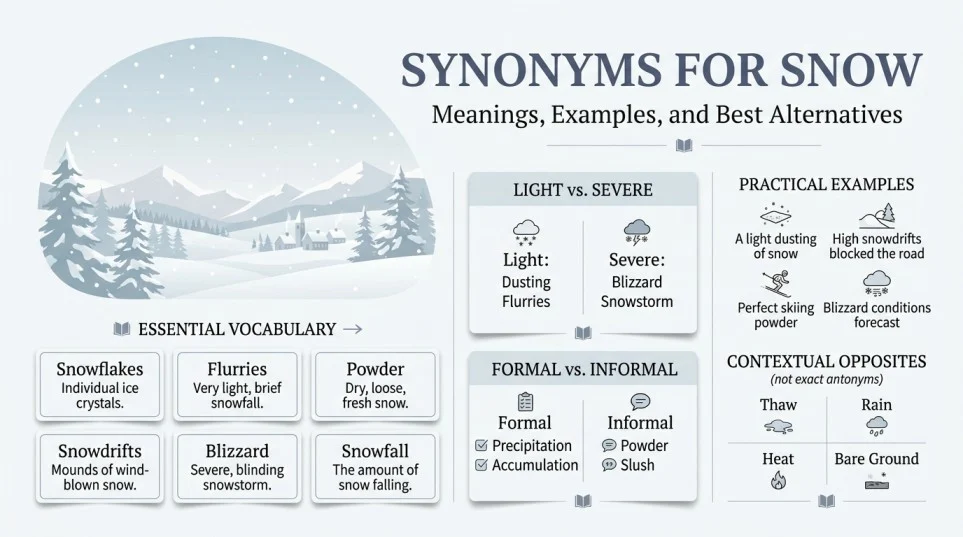
Important distinction: Snowfall, flurries, snowstorm, and snowflakes are closely related to snow but refer to different aspects of it. Powder describes texture, while snowpack and snow cover describe accumulated snow. Snow grains and snow pellets are specific precipitation forms, not general replacements for snow.
Synonym Groups and Usage Differences
Professional vs. Personal Synonyms
Professional writing benefits from precise terms such as snowfall, snow accumulation, snow removal, and snow cover. These expressions communicate measurable conditions or practical tasks.
Personal writing can be more expressive. Phrases such as a white blanket, fresh powder, and a winter wonderland help readers imagine the scene.
Formal vs. Conversational Synonyms
Formal writing often uses snowfall, snow accumulation, and snow cover. These terms fit reports, school assignments, workplace notices, and weather updates.
Conversational English often uses snow, snowflakes, and flurries. These words sound natural in texts, everyday conversations, and casual emails.
Academic Synonyms
In academic writing, choose the term that describes the process or condition being discussed. Snowfall works for precipitation, snowpack works for accumulated snow, and snow cover works for the layer covering land.
For scientific accuracy, avoid replacing snow with poetic expressions such as white blanket in a research paper unless you are discussing figurative language.
Professional and Business Synonyms
Business communication often focuses on the effects of winter weather. Snow accumulation can affect deliveries, snow removal can describe a maintenance service, and snowfall can explain travel delays.
For example, write Snow accumulation may delay deliveries rather than The white blanket may delay deliveries. The first sentence is clearer and more suitable for a business notice.
Creative or Literary Synonyms
Creative writing allows more imagery and emotion. A white blanket suggests a smooth covering, fresh powder suggests softness, and dancing snowflakes suggest gentle movement.
Choose imagery that matches the scene. A peaceful snowfall should not automatically be described as a raging blizzard, because the stronger term changes the meaning.
Slang or Modern Synonyms
There is no widely accepted slang word that can replace snow in every context. Informal expressions such as fresh powder are common in winter sports conversations, especially among skiers and snowboarders.
Use these expressions in captions and casual conversations when the audience understands them. In academic work, official notices, and business reports, prefer clear and standard terms.
Strongest vs. Weaker Synonyms
The following scale compares typical descriptions of snowfall intensity. It is a practical guide, not an exact scientific measurement.
Very light
Flurries
Brief, light snowfall.
Light to moderate
Snow showers
Snow that falls intermittently.
Heavy
Heavy snowfall
A substantial amount of falling snow.
Severe conditions
Blizzard
A severe snowstorm with strong winds and very poor visibility.
A blizzard is not simply another word for heavy snow. It refers to specific severe weather conditions, so use it only when appropriate.
Emotional vs. Neutral Synonyms
Neutral words such as snow, snowfall, and snow cover focus on what is happening. They are suitable for factual reports and straightforward explanations.
Emotional or descriptive expressions, such as winter wonderland and a white blanket, emphasize beauty or atmosphere. Words such as blizzard can suggest danger, but only when the actual weather supports that description.
Antonyms of Snow
Snow has no single, direct antonym in standard English. Instead, you can use contrasting words that describe warm weather, snow free ground, melting conditions, or the absence of frozen precipitation.
The following 15 words are contextual opposites, not exact dictionary antonyms.
| Antonym or contrast | Meaning | Example sentence |
|---|---|---|
| 1. Heat | High temperature | The afternoon heat melted the remaining snow. |
| 2. Warmth | A comfortable or higher temperature | The warmth of spring softened the snow. |
| 3. Rain | Liquid water falling from clouds | Rain replaced snow during the afternoon. |
| 4. Sunshine | Light and warmth from the sun | Sunshine brightened the snow covered garden. |
| 5. Thaw | A period when ice or snow melts | The thaw exposed the grass beneath the snow. |
| 6. Meltwater | Water produced by melting snow or ice | Meltwater flowed along the roadside. |
| 7. Drought | A prolonged period of unusually low rainfall | The drought left the fields dry and brown. |
| 8. Dryness | The state of having little or no moisture | Dryness returned after the snow melted. |
| 9. Summer | The warmest season of the year in many regions | Summer replaced the long snowy winter. |
| 10. Greenery | Green plants and leaves | Greenery appeared where snow had covered the lawn. |
| 11. Grass | A common green plant covering the ground | The grass emerged after the last snow melted. |
| 12. Bare ground | Land without a covering of snow or vegetation | Bare ground surrounded the snow covered hill. |
| 13. Snow free | Without snow | The lower trail remained snow free. |
| 14. Clear skies | Skies without significant cloud cover | Clear skies followed the snowy morning. |
| 15. Dry ground | Ground without surface moisture | Dry ground returned after several warm days. |
For most sentences, snow free, bare ground, rain, or thaw provides a useful contrast. The right choice depends on whether you mean the absence of snow, a change in weather, or the process of melting.
Comparison: Snow vs. Similar Words
Snow vs. Snowfall
Main difference: Snow refers to frozen precipitation generally, while snowfall refers to snow falling during a period or the amount that falls.
Which is stronger? Neither is inherently stronger.
Which is more formal? Snowfall often sounds more precise in weather reports.
Examples:
- Snow: Snow covered the backyard.
- Snowfall: Overnight snowfall covered the backyard.
Snow vs. Flurries
Main difference: Snow is the general term, while flurries describe light, brief periods of falling snow.
Which is stronger? Snow is neutral. Flurries usually suggest lighter conditions.
Which is more formal? Both are standard, but flurries is more specific.
Examples:
- Snow: Snow is expected this evening.
- Flurries: Light flurries may continue after sunset.
Snow vs. Sleet
Main difference: Snow falls as ice crystals or clusters of crystals. In US weather terminology, sleet usually refers to small ice pellets formed when raindrops freeze before reaching the ground.
Which is stronger? Neither is inherently stronger.
Which is more formal? Both are appropriate in weather reports.
Examples:
- Snow: Snow covered the road.
- Sleet: Sleet bounced off the windshield.
Snow vs. Frost
Main difference: Snow falls from clouds, while frost forms as ice crystals on cold surfaces.
Which is stronger? Neither is stronger because they describe different phenomena.
Which is more formal? Both work in everyday and technical writing.
Examples:
- Snow: Snow covered the field overnight.
- Frost: Frost covered the grass at sunrise.
Snow vs. Powder
Main difference: Snow is the general substance, while powder describes snow with a loose, light texture.
Which is stronger? Neither is inherently stronger.
Which is more formal? Snow is more general. Powder is common in skiing and winter sports.
Examples:
- Snow: The mountain received fresh snow.
- Powder: The skiers enjoyed the fresh powder.
Snow vs. Blizzard
Main difference: Snow is a form of precipitation. A blizzard is a severe winter storm involving strong winds and very poor visibility.
Which is stronger? Blizzard describes much more severe weather conditions.
Which is more formal? Both are standard terms, but blizzard has a specific weather meaning.
Examples:
- Snow: Snow fell throughout the morning.
- Blizzard: The blizzard forced authorities to close the highway.
Common Phrases and Expressions with Snow
1. Fresh snow
Meaning: Snow that has recently fallen and has not been greatly disturbed.
Example sentence: Fresh snow covered the park before sunrise.
2. Heavy snowfall
Meaning: A large amount of snow falling over a period.
Example sentence: Heavy snowfall forced the airport to delay several flights.
3. Blanket of snow
Meaning: A layer of snow covering an area.
Example sentence: A blanket of snow covered the rooftops and trees.
4. Snow covered
Meaning: Covered with snow.
Example sentence: The snow covered road was difficult to see at night.
5. Snowed in
Meaning: Unable to leave a place because snow blocks routes or makes travel unsafe.
Example sentence: We were snowed in at the cabin for two days.
6. Snow day
Meaning: A day when school or work closes because of snow or unsafe winter conditions.
Example sentence: The children celebrated when the district announced a snow day.
7. Snow melts
Meaning: Snow changes into liquid water as it warms.
Example sentence: The snow melts quickly when the afternoon sun comes out.
8. Pure as snow
Meaning: An expression suggesting innocence or purity.
Example sentence: The character appeared pure as snow, but the story later revealed a different side.
Common Mistakes to Avoid
1. Treating Every Related Word as an Exact Synonym
Snowfall, snowflakes, and snowdrifts describe different things. Choose the word that matches the detail you want to communicate.
2. Confusing Snow with Sleet or Hail
These forms of precipitation develop differently. Use snow for falling ice crystals, sleet for the small ice pellets described in US weather reports, and hail for larger ice lumps associated with thunderstorms.
3. Using Dramatic Weather Words Too Freely
A blizzard is more than ordinary snowfall. Avoid using it for a light dusting or a peaceful winter morning.
4. Using Poetic Language in Formal Reports
A phrase such as a white blanket may suit a story, but snowfall or snow accumulation is usually clearer in a weather report.
5. Repeating Snow in Every Sentence
Repeated words can make writing dull. Vary your language with precise terms such as flurries, snow cover, snowflakes, and snowdrifts when they fit the meaning.
6. Choosing a Synonym That Changes the Meaning
Powder describes texture, while snowpack describes accumulated snow. Replacing snow with either word without checking the context can make a sentence inaccurate.
FAQs
1. What is the best synonym for snow?
Snowfall is often the best alternative when describing snow coming down. For other contexts, use flurries for light snow, powder for texture, or snowflakes for individual crystals.
2. What is a formal synonym for snow?
Snowfall is a useful formal alternative when discussing precipitation. Snow accumulation and snow cover are more precise choices when describing the amount or layer of snow.
3. What is an informal synonym for snow?
Fresh powder is a familiar informal expression, especially among winter sports fans. Snowflakes and flurries also work naturally in everyday conversation, depending on the situation.
4. What is another word for snow in professional writing?
Use snowfall for weather updates, snow accumulation for buildup, and snow removal for maintenance tasks. These terms communicate specific information clearly in professional messages.
5. What is the difference between snow and snowfall?
Snow refers to frozen precipitation in general. Snowfall describes snow falling over a period or the amount that falls, making it useful for weather reports.
6. What is the opposite of snow?
Snow has no exact antonym. Depending on the context, useful contrasts include rain, heat, thaw, bare ground, and snow free conditions.
Conclusion
Snow is a simple word with many useful alternatives. Snowfall works well for weather reports, flurries describes light snowfall, powder highlights texture, and snowdrifts describes piles of snow moved by wind.
The best synonym depends on your purpose, audience, and tone. Formal writing benefits from precise weather terms, while creative writing can use expressions such as a blanket of snow to create a vivid picture.
For stronger vocabulary, focus on meaning before variety. Choose words that describe exactly what you see, whether it is gentle snowfall, deep snow, or a powerful winter storm. This small habit can make your writing clearer, more natural, and more engaging.
Discover More Post:
- 25+ Synonyms for Superior | Meanings, Examples, and Best …
- 25+ Synonyms for Anxious | Meanings, Examples, and Best …
- 25+ Synonyms for Potential | Meanings and Examples