Have you ever noticed how often you use the word actually in emails, essays, conversations, or social media captions? It is a useful word, but repeating it can make your writing sound less natural. Choosing a more precise alternative can help you express facts, correct misunderstandings, and share your thoughts with greater confidence.
This guide explores synonyms for actually, their meanings, and the situations where they work best. You will learn how to choose words for academic writing, workplace communication, casual conversations, and creative projects. You will also discover common mistakes, differences between similar words, and practical examples. The goal is simple: help you communicate clearly without making your sentences sound forced or overly formal.
What Does Actually Mean?
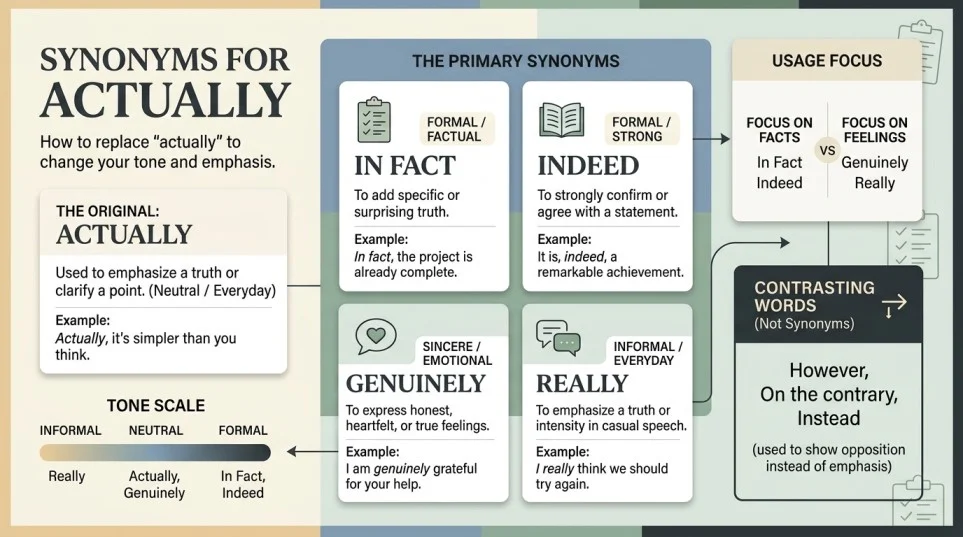
Actually means in fact, in reality, or as something truly exists or happens. Common synonyms include really, in fact, indeed, genuinely, and truly. For formal writing, use in fact or in reality. In casual conversation, really works well, while genuinely emphasizes sincerity.
Meaning, Tone and Context
What does actually mean?
Actually is an adverb used to show what is true, correct a mistaken belief, clarify information, or emphasize a real situation. It often signals that reality differs from what someone expects.
For example:
- I thought the store was closed, but it is actually open.
- She actually enjoyed the difficult assignment.
- Actually, I have already submitted the report.
In each sentence, actually helps the reader understand the real situation or notice a difference between expectation and fact.
Part of speech
Actually is an adverb. It modifies a statement or adds information about how something is true, happens, or is understood.
Related word forms include:
| Word | Part of Speech | Meaning |
|---|---|---|
| Actual | Adjective | Real or existing |
| Actually | Adverb | In fact or in reality |
| Reality | Noun | The state of things as they truly are |
| Real | Adjective | Genuine or not imaginary |
| Realize | Verb | To become aware of or understand something |
Tone and formality
Actually is generally neutral, but its tone depends on how it is used.
| Tone | Example | Effect |
|---|---|---|
| Neutral | The meeting actually starts at nine. | Clarifies a fact |
| Corrective | Actually, the office closes at five. | Corrects information |
| Emphatic | I actually loved the experience. | Expresses surprise or emphasis |
| Conversational | I actually forgot about it. | Sounds natural and informal |
| Professional | The figures are actually higher than expected. | Adds clarification, although a more direct sentence may be better |
Common uses of actually
Actually is useful when you want to:
- Correct incorrect information.
- Explain what happened in reality.
- Express surprise about an unexpected result.
- Emphasize that something is true.
- Clarify a statement in a conversation or written message.
The key is to use it when it adds meaning. If removing actually does not change your sentence, you may not need it.
When and How to Use Actually
Actually works best when the reader needs clarification, a correction, or a contrast between expectations and reality.
Here are four examples from everyday situations.
Professional context: The project actually finished two days ahead of schedule.
This highlights the real outcome and may express positive surprise.
Academic context: The results actually support the original hypothesis.
This emphasizes what the evidence shows. In a formal research paper, the sentence may be stronger without actually unless the contrast matters.
Personal context: I thought you were upset, but you were actually just tired.
This corrects a misunderstanding without changing the main meaning of the sentence.
Social media context: I actually needed this quiet weekend.
This expresses a personal feeling and adds a conversational sense of emphasis.
Another Word for Actually
The best single replacement for actually is usually really in conversation and in fact in explanatory writing. However, the right choice depends on what you want to communicate.
Actually can express truth, correction, emphasis, or surprise. These meanings overlap, but they are not identical. Choose a synonym that preserves the purpose of your original sentence.
| Situation | Best Alternative | Example |
|---|---|---|
| Professional writing | In fact | In fact, sales increased this quarter. |
| Academic writing | In reality | In reality, the findings were more complex. |
| Casual conversation | Really | I really liked the movie. |
| Emotional writing | Genuinely | I genuinely appreciate your support. |
| Creative writing | Truly | She truly believed in her dream. |
| Resume or workplace use | Demonstrably | The new process demonstrably improved efficiency. |
| Social media captions | Honestly | Honestly, this was the best weekend. |
| Stronger emphasis | Indeed | The task was indeed challenging. |
| Softer emphasis | In truth | In truth, I was unsure about the decision. |
A useful distinction: Demonstrably means something can be shown through evidence. It is not a universal replacement for actually. Likewise, honestly introduces sincerity, while indeed adds emphasis or confirmation.
When Not to Use Actually
Actually is not wrong in most everyday situations, but it can become repetitive or weaken your writing when a more precise expression is available.
1. When the fact is already clear
Weak: The team actually completed the report on Friday.
Better: The team completed the report on Friday.
The second sentence is more direct if there is no contrast or surprise to communicate.
2. When correcting someone too sharply
Potentially blunt: Actually, you are wrong about the deadline.
More constructive: The deadline is Friday, rather than Thursday.
The second version focuses on the information instead of making the correction feel personal.
3. When writing academic papers
Less precise: The results actually show a difference.
More precise: The results show a measurable difference.
Use measurable when the difference can be quantified. Use actually only when you need to emphasize an unexpected finding or contrast.
4. When a stronger word is more accurate
General: She actually cares about the project.
More specific: She genuinely cares about the project.
Genuinely emphasizes sincerity. It works better when you want to describe someone’s honest feelings rather than simply confirm a fact.
5. When writing professional resumes
Weak: I actually improved customer satisfaction.
Better: I improved customer satisfaction by 18 percent.
Specific results are more persuasive than emphasis words. Use a verified figure when one is available.
Words Commonly Confused With Actually
Several words can replace actually in certain sentences, but their meanings and tones differ.
| Word | Main Difference | Best Use |
|---|---|---|
| Really | Commonly expresses emphasis or truth in conversation | Everyday speaking |
| Indeed | Confirms or strongly emphasizes a statement | Formal writing and speeches |
| Literally | Refers to the exact meaning, not a figurative one | Precise descriptions |
| Currently | Means at the present time | Updates and reports |
| Apparently | Means something seems true based on available information | Uncertain or indirect evidence |
| Essentially | Means fundamentally or in its basic form | Summaries and explanations |
For example, actually and apparently are not interchangeable when certainty matters. Actually presents something as true, while apparently suggests that the available information points toward it being true.
Similarly, currently describes when something is happening. It does not usually replace actually when you are correcting a misunderstanding.
Best Synonym by Context for Actually
The best synonym depends on whether you are confirming a fact, expressing sincerity, correcting a belief, or adding emphasis.
| Context | Best Synonym | Why It Works | Example |
|---|---|---|---|
| Formal writing | In fact | Introduces or confirms factual information | In fact, the final report supports the proposal. |
| Academic writing | In reality | Contrasts an assumption with what is true | In reality, the two groups had different needs. |
| Professional communication | Indeed | Adds measured emphasis | The proposed solution is indeed practical. |
| Resume | Demonstrably | Highlights results that can be shown | The revised process demonstrably reduced errors. |
| Casual conversation | Really | Sounds natural and familiar | I really enjoyed the concert. |
| Creative writing | Truly | Adds emotional or reflective emphasis | He truly wanted to make a difference. |
| Emotional writing | Genuinely | Highlights sincere feelings | I genuinely miss our conversations. |
| Strong emphasis | Certainly | Expresses confidence or assurance | The team can certainly meet the target. |
| Mild clarification | In fact | Corrects or clarifies without dramatic emphasis | In fact, we have another option. |
| Social media captions | Honestly | Adds a personal, conversational tone | Honestly, I needed this break. |
| Unexpected result | Surprisingly | Highlights something unforeseen | Surprisingly, the smaller team finished first. |
| Evidence based writing | Verifiably | Emphasizes that something can be checked | The information is verifiably correct. |
| Personal reflection | In truth | Introduces a candid explanation | In truth, I needed more time. |
| Scientific explanation | In practice | Describes what happens in real situations | In practice, the method takes less time. |
| Business reporting | As it turns out | Introduces a discovered fact or outcome | As it turns out, demand was higher than expected. |
| Storytelling | As a matter of fact | Adds confirmation or an unexpected detail | As a matter of fact, she knew the answer. |
| Friendly email | To be honest | Signals an open or candid view | To be honest, I prefer the earlier design. |
| Clear correction | More precisely | Refines a statement or corrects its wording | More precisely, the trial lasted six weeks. |
Some expressions are full phrases rather than single word synonyms. They belong in the table because they can replace actually in particular sentence structures, even though they are not interchangeable in every context.
Which Synonym Should You Choose?
Use these five questions to find the best alternative.
1. What do you mean?
If you are confirming a fact, try in fact. If you are expressing sincere feelings, consider genuinely. If something was unexpected, use surprisingly.
2. Who will read it?
Use really in casual conversation, in fact in reports, and genuinely when describing sincere feelings.
3. How much emphasis do you need?
Truly and indeed can add emphasis. If the fact speaks for itself, remove actually instead.
4. Can you be more specific?
Replace vague emphasis with evidence, a clear result, or an exact detail whenever possible.
5. Does the replacement fit the sentence?
Read the revised sentence aloud. If the meaning or tone changes, choose another word or rewrite the sentence.
Real Life Examples of Actually in Sentences
These examples show how to replace actually with a more specific expression when the situation calls for it.
| Situation | Original Sentence | Improved Alternative |
|---|---|---|
| School | I actually understood the lesson. | I finally understood the lesson. |
| Workplace | We actually finished the project early. | We finished the project early, ahead of schedule. |
| Writing | The story was actually about friendship. | The story was really about friendship. |
| Conversation | I actually know her brother. | I do know her brother. |
| Social media | I actually love rainy days. | Honestly, I love rainy days. |
| Resume | I actually trained five new employees. | I trained five new employees. |
| We actually received your application. | We have received your application. | |
| Storytelling | He actually returned to the village. | To everyone’s surprise, he returned to the village. |
Notice that the improved sentence sometimes removes actually instead of replacing it. This is often the best editing choice because a synonym is only useful when it improves clarity, tone, or emphasis.
18 Synonyms for Actually
The following 18 alternatives cover different meanings and situations. Some emphasize truth, others express sincerity, certainty, surprise, or clarification.
| Synonym | Simple Meaning | Best Used For | Example Sentence |
|---|---|---|---|
| Really | Truly or in fact | Casual conversation | I really enjoyed the workshop. |
| In fact | To add or confirm a fact | Reports and explanations | In fact, the results exceeded our expectations. |
| Indeed | Certainly or truly | Formal emphasis | The proposal is indeed worth considering. |
| Truly | In a genuine or sincere way | Personal and creative writing | She truly believed in her abilities. |
| Genuinely | Honestly or sincerely | Feelings and intentions | He genuinely wanted to help. |
| Certainly | Without doubt | Professional communication | We can certainly discuss your request. |
| Honestly | In an honest or candid way | Casual and personal writing | Honestly, I prefer the original version. |
| In reality | In the real situation | Explaining facts or correcting assumptions | In reality, the process was much simpler. |
| Apparently | As it seems from available information | Uncertain or indirect evidence | Apparently, the train arrived early. |
| Surprisingly | In an unexpected way | Unexpected outcomes | Surprisingly, everyone agreed with the plan. |
| Verifiably | In a way that can be checked | Evidence based writing | The figures are verifiably accurate. |
| Admittedly | Recognizing a fact, often a limitation | Balanced arguments | Admittedly, the first draft needed work. |
| In truth | To state what is really true | Reflective or literary writing | In truth, she wanted a fresh start. |
| Fundamentally | At the most basic level | Analysis and explanation | The two proposals are fundamentally different. |
| Essentially | In the main or basic sense | Summaries and simplification | Essentially, the plan has three stages. |
| Frankly | Speaking openly and directly | Candid conversation | Frankly, we need a better solution. |
| Actually speaking | In literal or precise terms, depending on context | Clarification, when naturally phrased | Actually speaking, the phrase is uncommon in modern English. |
| As it turns out | As later information reveals | Stories and explanations | As it turns out, the missing file was on my desk. |
Usage note: Actually speaking is not a standard general replacement for actually. It is included to illustrate why similar looking expressions should not be treated as interchangeable synonyms. For natural writing, use in fact, really, or in reality instead.
Synonym Groups and Usage Differences
Professional vs. Personal Synonyms
Professional writing usually benefits from clear facts and measured language. In fact, indeed, and verifiably can work well when their meanings fit the sentence.
Personal writing often allows more warmth and emotion. Genuinely, truly, honestly, and really can help express feelings or individual opinions.
Compare these examples:
Professional: The updated process demonstrably reduced errors.
Personal: I genuinely appreciate everything you did.
The first sentence focuses on evidence. The second focuses on sincere feelings.
Formal vs. Conversational Synonyms
Formal alternatives include in fact, indeed, and in reality. These expressions can work in reports, essays, presentations, and professional explanations.
Conversational alternatives include really, honestly, and to be honest. They sound natural in everyday speech, texts, and friendly emails.
Avoid choosing a formal expression simply because it sounds impressive. A simple word is often clearer.
Academic Synonyms
Academic writing requires accurate claims and careful reasoning. Useful alternatives include in fact, in reality, fundamentally, and essentially.
For example:
Less precise: The experiment actually produced different results.
Clearer: The experiment produced different results.
More analytical: The results differed fundamentally from the original prediction.
The best choice depends on whether you are reporting a fact or explaining the nature of a difference. Avoid adding emphasis words when the evidence alone is sufficient.
Professional and Business Synonyms
In business communication, readers value clarity, accuracy, and directness.
Consider these alternatives:
- In fact, for introducing additional factual information.
- Indeed, for confirming a point or adding emphasis.
- Verifiably, for claims that can be independently checked.
- Certainly, for expressing confidence or agreement.
- Demonstrably, for results supported by evidence.
For resumes, a measurable accomplishment is often stronger than any synonym. Write that you reduced processing time by 20 percent if you can support that figure, rather than saying you actually improved efficiency.
Creative or Literary Synonyms
Creative writing may need a word that adds emotion, surprise, or reflection.
Truly can express deep conviction. Genuinely can highlight sincere feelings. Surprisingly can reveal an unexpected outcome, while in truth can introduce a more reflective statement.
Example:
She thought the journey would change her career. In truth, it changed how she understood herself.
The phrase in truth creates a reflective tone that actually would not necessarily provide.
Slang or Modern Synonyms
Actually does not have one universal slang equivalent. Informal alternatives depend on the speaker and the message.
- For real, to express sincerity or confirm something.
- No joke, to emphasize that a statement is serious.
- Seriously, to express emphasis, surprise, or concern.
- Honestly, to introduce a candid opinion.
Examples:
For real, that was an amazing performance.
Seriously, I did not expect that result.
These expressions suit casual conversation, personal posts, and informal messages. Avoid them in research papers, formal reports, and most professional resumes.
Strongest vs. Weaker Synonyms
There is no universal intensity scale because these words express different kinds of meaning. However, the following guide shows how their emphasis may feel in suitable contexts.
| Level | Word or Phrase | Typical Effect |
|---|---|---|
| Mild | In fact | Adds factual clarification |
| Mild | Essentially | Summarizes the main point |
| Moderate | Really | Adds everyday emphasis |
| Moderate | Truly | Emphasizes conviction |
| Strong | Indeed | Strongly confirms a point |
| Strong | Genuinely | Emphasizes sincerity |
| Strong | Without question | Expresses high confidence |
| Strong | Absolutely | Expresses emphatic agreement or certainty |
Do not assume that a stronger expression is always better. Absolutely and without question can sound exaggerated when the situation calls for a simple factual statement.
Emotional vs. Neutral Synonyms
Neutral expressions focus on information. In fact and in reality are useful for explaining what is true without necessarily expressing strong feelings.
Emotional or personal expressions include genuinely, truly, honestly, and frankly. They can suggest sincerity, personal conviction, or openness.
Compare:
Neutral: In fact, the meeting starts at ten.
Emotional: I genuinely value your friendship.
The first clarifies information. The second communicates a personal feeling.
Antonyms of Actually
Actually is an adverb, and English does not have 15 direct antonyms that work in every context. The following table provides 15 contextual contrasts. Some are single words, while others are expressions that oppose the meaning of actually in specific sentences.
| Antonym or Contrasting Expression | Meaning | Example Sentence |
|---|---|---|
| Apparently | Seemingly true, without full confirmation | Apparently, the office is closed. |
| Allegedly | Claimed to be true but not established | The company allegedly changed its policy. |
| Supposedly | Believed or claimed to be true | The package was supposedly delivered. |
| Theoretically | True in theory, not necessarily in practice | Theoretically, the plan should work. |
| Hypothetically | Based on an imagined situation | Hypothetically, we could open another branch. |
| Potentially | Possible but not yet certain | The change could potentially improve results. |
| Possibly | Perhaps, but not confirmed | The missing document could possibly be in storage. |
| Seemingly | Appearing to be true | The task was seemingly complete. |
| Ostensibly | Apparently true according to appearances or stated reasons | The meeting was ostensibly about training. |
| Falsely | In a way that is untrue | The report falsely claimed that sales had doubled. |
| Incorrectly | In a mistaken way | The figures were incorrectly recorded. |
| Mistakenly | Because of an error or misunderstanding | I mistakenly sent the wrong attachment. |
| Imaginarily | In an imagined rather than real way | The story imaginarily places the city underwater. |
| Fictionally | As part of an invented story | The author fictionally describes a journey to Mars. |
| Not in fact | Explicitly denying that something is true | The building is not in fact open to visitors. |
Important distinction: Apparently, allegedly, and supposedly are not exact opposites of actually. They contrast with its sense of established reality by introducing uncertainty, appearance, or a claim. Falsely, incorrectly, and not in fact provide clearer contrasts when the intended meaning is that a statement is untrue.
Comparison: Actually vs. Similar Words
Actually vs. Really
Both words can emphasize truth, but really is more common in casual speech. Actually can also correct a misunderstanding.
Actually: I thought the shop was closed, but it is actually open.
Really: I really enjoyed visiting the shop.
Really is usually more conversational. Neither word is always stronger because each has several uses.
Actually vs. Indeed
Indeed confirms or emphasizes a statement. Actually often clarifies what is true or contrasts it with an expectation.
Actually: The task was actually easier than I expected.
Indeed: The task was indeed challenging.
Indeed often sounds more formal. Actually is more conversational in many situations.
Actually vs. Literally
Literally means that something is true in its exact or nonfigurative sense. In informal speech, it is also sometimes used for emphasis.
Actually: I actually finished the entire book.
Literally: I read the entire book from the first page to the last.
Literally is more precise when exact meaning matters. Actually is better for confirming a fact or correcting an assumption.
Actually vs. Apparently
Actually presents information as true. Apparently suggests that something seems true based on the information available.
Actually: The manager is in the office.
Apparently: The manager is in the office, based on what I heard.
Actually communicates greater certainty. Apparently is useful when you cannot independently confirm a claim.
Actually vs. Currently
Currently means at the present time. Actually concerns truth, reality, or correction.
Actually: The store is actually open on Sundays.
Currently: The store is currently open.
The first sentence may correct an assumption about Sunday hours. The second describes the present situation. Currently is often more suitable for status updates.
Actually vs. Essentially
Essentially means fundamentally or in the most important sense. Actually emphasizes truth or reality.
Actually: The two designs are actually different.
Essentially: The two designs are essentially the same.
Essentially works well for summaries and explanations. Actually works better when confirming or correcting a fact.
Common Phrases and Expressions with Actually
These phrases help you use actually naturally in conversation and writing.
1. Actually, I think…
Meaning: Introduces an opinion that may differ from an earlier statement.
Example sentence: Actually, I think we should review the proposal once more.
2. Actually, it turns out…
Meaning: Introduces information discovered later. The more natural expression is it turns out.
Example sentence: It turns out that the restaurant closes earlier on Sundays.
3. Did you actually…?
Meaning: Asks whether something really happened or was genuinely done.
Example sentence: Did you actually finish the entire assignment last night?
4. I actually thought…
Meaning: Introduces a previous belief or expectation.
Example sentence: I actually thought the event started at six.
5. Not actually
Meaning: Corrects an assumption or explains that something is not quite true.
Example sentence: I am not actually looking for a new job right now.
6. Actually, now that I think about it
Meaning: Introduces a new thought after reconsidering something.
Example sentence: Actually, now that I think about it, I have seen that movie before.
7. As a matter of fact
Meaning: Adds information that confirms or strengthens a statement.
Example sentence: As a matter of fact, we have already completed the first stage.
8. Actually quite
Meaning: Adds emphasis to an adjective or adverb, often with a sense of surprise.
Example sentence: The exam was actually quite manageable.
Common Mistakes to Avoid
1. Repeating actually too often
Weak: I actually thought the class was actually useful.
Better: I thought the class was genuinely useful.
Use actually only when it adds a meaningful contrast or emphasis.
2. Confusing actually with apparently
Incorrect: The report is apparently accurate, and I have verified every figure.
Clearer: The report is accurate, and I have verified every figure.
Apparently suggests uncertainty or an inference. If you have checked the facts, state what you know.
3. Using casual expressions in formal writing
Weak: Honestly, the research was really good.
Better: The research findings were strong.
The second sentence is more direct and focuses on the quality of the evidence.
4. Making a simple fact sound dramatic
Overstated: The meeting was absolutely, genuinely, and truly scheduled for Monday.
Better: The meeting was scheduled for Monday.
Emphasis should help the reader, not distract them.
5. Replacing actually with a word that changes the meaning
Incorrect: The train apparently arrived at 8 AM, according to the confirmed station record.
Better: The train arrived at 8 AM, according to the confirmed station record.
Apparently introduces uncertainty. Do not use it when the information is confirmed.
6. Using actually when a precise result is stronger
Weak: I actually increased website traffic.
Better: I increased website traffic by 25 percent.
A specific, verifiable result is more useful in a resume or business report than a general emphasis word.
FAQs
1. What is the best synonym for actually?
The best synonym for actually is usually really in casual conversation and in fact in explanatory writing. Use genuinely for sincere feelings and indeed for formal emphasis.
2. What is a formal synonym for actually?
In fact, indeed, and in reality are useful formal alternatives. Choose in fact to introduce information, indeed to emphasize a point, and in reality to contrast facts with assumptions.
3. What is an informal synonym for actually?
Really is one of the most natural informal alternatives to actually. Honestly and seriously can also work when expressing personal opinions, surprise, or emphasis in conversation.
4. What is another word for actually in professional writing?
In fact is a useful choice for professional writing. For measurable outcomes, use precise language such as reduced, improved, or increased instead of adding unnecessary emphasis.
5. What is the difference between actually and apparently?
Actually presents information as true, while apparently suggests that something seems true based on available information. Use actually for confirmed facts and apparently for reasonable but unconfirmed conclusions.
6. What is the opposite of actually?
Actually has no single opposite that works in every sentence. Depending on context, contrasting expressions include supposedly, allegedly, theoretically, falsely, and not in fact.
Conclusion
Actually is a useful adverb for clarifying facts, correcting misunderstandings, and emphasizing what is true. However, the best alternative depends on your purpose and audience.
Choose really for casual conversation, in fact for factual explanations, genuinely for sincere feelings, and indeed for formal emphasis. In academic and professional writing, direct statements and specific evidence often communicate more effectively than repeated emphasis words.
A simple vocabulary tip can make a real difference: whenever you write actually, ask whether it adds useful meaning. If it does, keep it or choose a more precise alternative. If it does not, remove it and let your message speak clearly.
Discover More Post:
- 25+ Synonyms for Superior | Meanings, Examples, and Best …
- 25+ Synonyms for Anxious | Meanings, Examples, and Best …
- 25+ Synonyms for Potential | Meanings and Examples