Do you often use the word helping in emails, essays, social media captions, or everyday conversations? Although it is a useful word, repeating it too often can make your writing sound simple or less precise. Choosing the right alternative can help you express your ideas more clearly.
This guide explores synonyms for helping, their meanings, and how to use them naturally. You will learn which words fit professional communication, academic writing, resumes, personal messages, and creative work. Each suggestion focuses on real usage, so you can choose a word that matches your intended meaning. Whether you want to describe supporting a colleague, assisting a student, or making a meaningful difference, the right word can make your message more effective.
What Does Helping Mean?
Helping means making something easier for someone, providing support, or assisting with a task or problem. Common synonyms include assisting, supporting, aiding, backing, guiding, and contributing. The best choice depends on whether you mean practical assistance, emotional support, professional service, or positive influence.
Meaning, Tone and Context
What Does Helping Mean?
Helping means doing something that makes another person’s task, situation, or problem easier to manage. It can involve physical effort, useful information, emotional support, advice, or resources.
For example, helping a classmate understand a difficult lesson is different from helping a friend through a stressful experience. Both involve support, but the type of help is different.
Part of Speech
Helping is the present participle of the verb help. It can also function as a gerund, which means it can name an action.
Examples:
- Verb form: She is helping her brother with homework.
- Gerund: Helping others can build trust.
- Adjective like use: A helping hand can make a difficult day easier.
Tone and Formality
The word helping usually has a positive or neutral tone. It is common in everyday speech, school assignments, workplace communication, and personal writing.
It is friendly and easy to understand, but it may be too general when you need to describe a specific action. Words such as assisting, mentoring, advising, and facilitating provide more detail.
Common Uses of Helping
Helping commonly describes:
- Practical assistance with a task.
- Emotional support during a difficult time.
- Guidance or instruction for learning.
- Cooperation on a shared project.
- Contributions to a community or organization.
- Actions that improve a situation or solve a problem.
Related Word Forms
| Word | Meaning | Example |
|---|---|---|
| Help | Assistance or the act of helping | Your help made a difference. |
| Helpful | Providing useful support | She gave me helpful advice. |
| Helper | A person who helps | The volunteer worked as a classroom helper. |
| Helped | Past tense of help | He helped his neighbor move. |
| Helping | The act of providing assistance | Helping others takes patience. |
| Helpless | Unable to act or manage without support | The lost child felt helpless. |
When and How to Use Helping
Use helping when you want to describe an action that makes a task easier, supports a person, or improves a situation. For more precise writing, choose an alternative that explains exactly what the person does.
Professional context: Maria is helping the team prepare its quarterly report.
Academic context: The tutor is helping students understand the main idea of the passage.
Personal context: I appreciate you helping me through a difficult week.
Community context: Local volunteers are helping families affected by the storm.
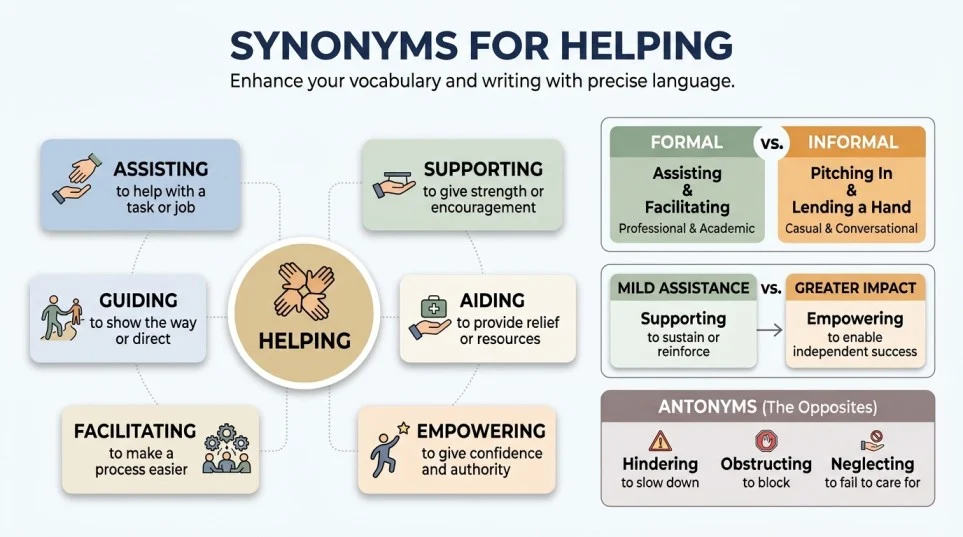
These examples show that helping works across many situations. However, assisting may sound more professional, mentoring emphasizes guidance, and supporting often highlights continued or emotional care.
Another Word for Helping
The best single replacement for helping in many professional situations is assisting. However, supporting, aiding, guiding, and contributing may be better when the intended action is more specific.
| Situation | Best alternative | Example |
|---|---|---|
| Professional writing | Assisting | I am assisting the project manager with scheduling. |
| Academic writing | Facilitating | The activity is facilitating student discussion. |
| Casual conversation | Pitching in | Everyone is pitching in to clean the house. |
| Emotional writing | Supporting | She is supporting her friend through a difficult time. |
| Creative writing | Guiding | The old teacher is guiding the young artist. |
| Resume or workplace use | Coordinating | Coordinated team activities to improve workflow. |
| Social media captions | Giving back | Spending Saturday giving back to the community. |
| Stronger meaning | Empowering | The program is empowering young entrepreneurs. |
| Softer meaning | Lending a hand | I am lending a hand with the decorations. |
Choose a synonym that describes the actual contribution. Assisting suggests practical work, empowering emphasizes greater independence, and lending a hand sounds friendly and informal.
When Not to Use Helping
Helping is a flexible word, but it does not always communicate the full meaning of an action.
When the task is specific: Instead of saying, She is helping with the event, write, She is organizing the event schedule. The second sentence explains her role.
When describing professional expertise: Instead of, He is helping new employees, write, He is training new employees. Training identifies the work more clearly.
When describing emotional care: Helping a grieving friend may sound too general. Supporting or comforting the friend better describes the emotional role.
When describing leadership: If someone develops another person’s skills, mentoring or coaching may be more accurate than helping.
When writing a resume: Avoid repeating helped in every bullet point. Use accurate action verbs such as coordinated, trained, advised, organized, or implemented when they reflect your actual responsibilities.
Words Commonly Confused With Helping
Several related words express different kinds of assistance. Understanding these differences helps you avoid choosing a synonym that changes your intended meaning.
| Word | Main difference | Best use |
|---|---|---|
| Assisting | Providing practical help with a task | Workplace duties and services |
| Supporting | Offering continued, practical, or emotional backing | Relationships and ongoing projects |
| Aiding | Providing help toward a particular goal | Formal writing and relief efforts |
| Guiding | Showing someone the right direction or approach | Education and personal development |
| Facilitating | Making a process or activity easier | Meetings, learning, and business processes |
| Empowering | Giving someone the confidence, ability, or authority to act | Leadership and personal growth |
For example, a teacher assists students with assignments, guides them through difficult concepts, and empowers them to solve problems independently. Each verb describes a different contribution.
Best Synonym by Context for Helping
The best synonym depends on what kind of help you mean and who will read your message.
| Context | Best synonym | Why it works | Example |
|---|---|---|---|
| Formal writing | Assisting | Clear and professional | She is assisting the research team. |
| Academic writing | Facilitating | Emphasizes making learning easier | Group work is facilitating discussion. |
| Business communication | Supporting | Works for ongoing cooperation | We are supporting the new initiative. |
| Resume | Coordinated | Shows a specific workplace action | Coordinated daily team activities. |
| Casual conversation | Pitching in | Sounds natural and friendly | I am pitching in after lunch. |
| Creative writing | Guiding | Suggests direction and care | Her grandmother was guiding her journey. |
| Emotional support | Comforting | Emphasizes emotional relief | He was comforting his upset friend. |
| Strong impact | Empowering | Highlights independence and confidence | The course is empowering new leaders. |
| Gentle assistance | Lending a hand | Sounds warm and approachable | Thanks for lending a hand. |
| Social media captions | Giving back | Fits charitable and community activities | Giving back to our local community. |
| Technical tasks | Troubleshooting | Focuses on finding and fixing problems | She is troubleshooting the software issue. |
| Education | Tutoring | Emphasizes teaching a subject | He is tutoring younger students. |
| Health and care | Caring for | Describes attention to someone’s needs | They are caring for older residents. |
| Project management | Facilitating | Emphasizes smoother progress | He is facilitating the planning session. |
| Teamwork | Collaborating | Highlights shared work | We are collaborating on the presentation. |
US and UK Usage
Helping, assisting, supporting, and aiding are widely understood in both American and British English. There is no major difference in their basic meanings.
In casual American English, pitching in and lending a hand sound natural. These expressions are also understood in the UK. Choose wording based on audience, tone, and situation rather than assuming every synonym belongs to one country.
Which Synonym Should You Choose?
Choosing the right synonym becomes easier when you consider five questions.
1. What kind of help are you describing?
Use assisting for practical tasks, comforting for emotional care, tutoring for teaching, and troubleshooting for solving technical problems.
2. How formal is the situation?
Assisting and aiding fit many formal settings. Pitching in and lending a hand are better suited to casual conversations.
3. How much impact does the action have?
Supporting suggests backing someone or something. Empowering suggests helping someone gain the ability or confidence to act independently.
4. Are you describing a professional achievement?
For resumes, choose specific action verbs that accurately describe your work. Coordinated, trained, organized, and mentored can be stronger than helped when they reflect what you actually did.
5. Does the sentence sound natural?
Read the sentence aloud. If the synonym sounds forced or changes the meaning, keep helping or rewrite the sentence to describe the action directly.
The most effective word is not always the most advanced one. It is the word that communicates your meaning accurately and clearly.
Real Life Examples of Helping in Sentences
Here are practical examples that show how alternatives can improve everyday writing.
School: The teaching assistant is guiding students through the science experiment.
Workplace: Daniel is assisting the sales team with customer requests.
Writing: A clear outline is making the writing process easier.
Conversation: Can you lend me a hand with these grocery bags?
Social media: Our volunteers are giving back to the neighborhood this weekend.
Resume: Trained five new employees to follow the company’s service procedures.
Email: Thank you for supporting the team during the busy period.
Storytelling: The traveler guided the lost child toward the nearest village.
Community service: Local residents are contributing food and supplies to the shelter.
Technical support: The technician is troubleshooting the computer before the meeting.
Each example uses a word that explains the type of assistance more clearly than a general reference to helping.
18 Synonyms for Helping
The following 18 synonyms offer different ways to describe assistance, guidance, cooperation, and support. Some are direct replacements, while others work best when the sentence identifies a specific kind of help.
| Synonym | Simple Meaning | Best Used For | Example Sentence |
|---|---|---|---|
| 1. Assisting | Giving practical help | Professional tasks | Nina is assisting the manager with the presentation. |
| 2. Supporting | Giving help or encouragement | Personal and professional situations | Our team is supporting the new employee. |
| 3. Aiding | Providing useful assistance | Formal writing | The organization is aiding families in need. |
| 4. Backing | Giving approval or support | Business and informal conversation | The director is backing the proposed changes. |
| 5. Guiding | Showing someone how to proceed | Education and personal growth | My mentor is guiding me through the process. |
| 6. Facilitating | Making an activity easier | Meetings and academic work | The instructor is facilitating a group discussion. |
| 7. Assisting with | Providing help for a particular task | Workplace communication | I am assisting with the annual review. |
| 8. Advising | Giving suggestions or recommendations | Professional and personal decisions | The consultant is advising the business owner. |
| 9. Mentoring | Helping someone develop skills over time | Careers and education | She is mentoring new graduates. |
| 10. Coaching | Helping someone improve performance | Sports and professional development | He is coaching the staff on customer service. |
| 11. Tutoring | Teaching a subject to improve understanding | School and education | Maya is tutoring a student in mathematics. |
| 12. Collaborating | Working together toward a goal | Team projects | We are collaborating on a research paper. |
| 13. Contributing | Giving time, effort, ideas, or resources | Community and workplace projects | Everyone is contributing ideas to the campaign. |
| 14. Empowering | Helping someone gain confidence or ability | Leadership and personal development | The program is empowering local entrepreneurs. |
| 15. Encouraging | Giving confidence or motivation | Emotional and educational settings | Her parents are encouraging her to keep learning. |
| 16. Comforting | Helping someone feel less upset | Emotional situations | He is comforting his friend after the loss. |
| 17. Pitching in | Joining others to help | Casual conversation | The neighbors are pitching in to repair the fence. |
| 18. Lending a hand | Offering practical assistance | Friendly everyday situations | My brother is lending a hand with the move. |
A Quick Note About Accuracy
These words are not interchangeable in every sentence. For example, tutoring means teaching, while comforting means easing emotional distress. Use each synonym only when its meaning matches the action you want to describe.
Synonym Groups and Usage Differences
Professional vs. Personal Synonyms
Professional writing often benefits from precise words that identify a person’s responsibility. Assisting, coordinating, advising, and facilitating work well when they accurately describe workplace activities.
Personal writing often focuses on care, kindness, and encouragement. Supporting, comforting, encouraging, and lending a hand communicate warmth more naturally.
Compare these examples:
Professional: The coordinator assisted the staff with the onboarding process.
Personal: My sister supported me when I felt overwhelmed.
Both sentences describe help, but the second emphasizes a personal relationship.
Formal vs. Conversational Synonyms
Formal alternatives are useful in reports, essays, presentations, and official communication. Assisting, aiding, facilitating, and contributing can fit these settings.
Conversational alternatives include pitching in, lending a hand, and pitching together on a shared task. The expression pitching in is especially natural when several people share the work.
For example, write, The department is assisting with the review, in a formal report. In a text message, write, Thanks for pitching in today.
Academic Synonyms
Academic writing should explain what an action accomplishes. Facilitating, supporting, guiding, and contributing can improve precision when used correctly.
Examples:
- The visual aid is facilitating student understanding.
- The evidence supports the main argument.
- The instructor is guiding students through the analysis.
- The findings contribute to a broader understanding of the issue.
Avoid replacing helping with a complicated word simply to sound academic. The synonym should clarify the idea, not make the sentence harder to read.
Professional and Business Synonyms
In business communication, choose verbs that describe real duties and results.
| Situation | Useful word | Example |
|---|---|---|
| Providing task assistance | Assisting | Assisted the finance team with monthly reports. |
| Offering expert advice | Advising | Advised clients on product selection. |
| Managing a process | Coordinating | Coordinated schedules across three departments. |
| Improving employee skills | Training | Trained new staff members in company procedures. |
| Supporting career growth | Mentoring | Mentored junior employees during onboarding. |
| Working with colleagues | Collaborating | Collaborated with designers to improve the website. |
For resumes, use past tense for completed responsibilities. Add numbers or results when you can verify them. Never claim leadership, management, or measurable success if you did not perform that work.
Creative or Literary Synonyms
Creative writing often benefits from words that communicate feeling, movement, or influence.
Guiding can suggest direction. Nurturing can describe helping a person or idea grow. Encouraging adds motivation, while comforting suggests emotional care.
Examples:
The old gardener nurtured the young artist’s love of nature.
Her quiet words comforted the frightened child.
A stranger guided the traveler through the unfamiliar town.
These verbs create a clearer picture of the action than repeatedly using helping.
Slang or Modern Synonyms
Everyday expressions can make messages sound friendly and natural.
Pitching in: Joining an effort.
Lending a hand: Offering practical assistance.
Having someone’s back: Supporting someone, especially when they face a challenge.
Showing up for someone: Being present and supportive when needed.
These expressions work well in casual speech, texts, and social media captions. In academic papers and formal business reports, choose a more precise alternative unless the informal expression is part of a direct quotation or a deliberate style choice.
Strongest vs. Weaker Synonyms
There is no universal scale of strength because different synonyms describe different actions. The following scale shows how strongly the wording can communicate involvement or impact in suitable contexts.
| Level | Word or phrase | What it suggests |
|---|---|---|
| 1. Light involvement | Assisting | Providing some practical help |
| 2. General support | Supporting | Offering continued backing |
| 3. Active involvement | Contributing | Giving meaningful effort or resources |
| 4. Direct guidance | Mentoring | Helping someone develop over time |
| 5. Greater independence | Empowering | Building another person’s ability to act |
These levels describe different kinds of involvement, not a strict ranking. Mentoring may require more time than empowering in one situation, while a single empowering action may have a greater long term effect in another.
Emotional vs. Neutral Synonyms
Neutral words describe what someone does without adding much emotion. Assisting, aiding, facilitating, and contributing are often neutral.
Emotional words communicate care or encouragement. Comforting, encouraging, nurturing, and supporting can express a more personal connection.
Compare the following:
Neutral: The volunteer assisted the residents with registration.
Emotional: The volunteer comforted residents who felt anxious about moving.
Choose the emotional option when feelings are central to the message. Use neutral language when accuracy and clarity matter most.
Antonyms of Helping
Helping does not have one perfect opposite in every context. The following words describe different forms of refusal, obstruction, neglect, or harm, depending on the sentence.
| Antonym | Meaning | Example Sentence |
|---|---|---|
| 1. Hindering | Making progress more difficult | Constant interruptions are hindering our work. |
| 2. Obstructing | Blocking progress or access | The fallen tree is obstructing the road. |
| 3. Impeding | Slowing or preventing progress | Poor communication is impeding the project. |
| 4. Preventing | Stopping something from happening | The broken lock is preventing access. |
| 5. Opposing | Acting against an idea or effort | Several members are opposing the proposal. |
| 6. Undermining | Weakening someone’s efforts or confidence | His negative comments are undermining her confidence. |
| 7. Discouraging | Reducing someone’s confidence or motivation | The harsh feedback is discouraging the students. |
| 8. Neglecting | Failing to give needed attention | The company is neglecting employee concerns. |
| 9. Abandoning | Leaving someone or something without needed support | The group is abandoning the project midway. |
| 10. Ignoring | Paying no attention to a need or request | He is ignoring the customer’s complaint. |
| 11. Refusing | Choosing not to provide something requested | She is refusing to offer further assistance. |
| 12. Withholding | Keeping back support or resources | The organization is withholding essential supplies. |
| 13. Sabotaging | Deliberately damaging an effort | Someone is sabotaging the team’s progress. |
| 14. Damaging | Causing harm or loss | The careless decision is damaging the relationship. |
| 15. Hindering progress | Making forward movement harder | Repeated delays are hindering progress. |
Use the opposite that describes the actual behavior. Ignoring means paying no attention, while sabotaging suggests deliberate harm. These words have different levels of seriousness and should not be treated as identical.
Comparison: Helping vs. Similar Words
Helping vs. Assisting
Helping is broad and common in everyday English. Assisting often sounds slightly more formal and emphasizes practical support.
Assisting may be the better choice in a professional report, but helping is usually more natural in casual conversation.
Example: I am helping my neighbor move.
Example: I am assisting the manager with the audit.
Helping vs. Supporting
Helping often describes an action that makes a task easier. Supporting can describe ongoing assistance, encouragement, or backing.
Supporting may carry a stronger sense of continued commitment, especially in emotional situations.
Example: I am helping my brother repair his bicycle.
Example: I am supporting my brother while he changes careers.
Helping vs. Aiding
Helping is a common, flexible word. Aiding is often more formal and can emphasize providing resources or assistance toward a goal.
Aiding may sound more suitable in reports about emergency relief or public programs.
Example: Volunteers are helping local families.
Example: Relief workers are aiding families affected by flooding.
Helping vs. Guiding
Helping can mean providing any useful assistance. Guiding specifically means showing someone a direction, method, or course of action.
Guiding is the stronger choice when advice or instruction is central to the activity.
Example: The teacher is helping the students.
Example: The teacher is guiding the students through a difficult lesson.
Helping vs. Facilitating
Helping is a general term for making a situation easier. Facilitating focuses on enabling a process, discussion, or activity to proceed smoothly.
Facilitating is often more precise in academic and professional contexts.
Example: She is helping the team prepare for the meeting.
Example: She is facilitating the team meeting.
Helping vs. Empowering
Helping may involve doing something for another person. Empowering means giving someone greater confidence, ability, or authority to act independently.
Empowering communicates a more specific goal than general assistance.
Example: The program is helping young people find work.
Example: The program is empowering young people to build their own businesses.
Common Phrases and Expressions with Helping
These expressions make everyday communication more natural and help describe different kinds of assistance.
1. Helping Hand
Meaning: Practical assistance offered to someone who needs it.
Example sentence: My neighbors gave me a helping hand when I moved into my new apartment.
2. Helping Others
Meaning: Providing assistance, kindness, or support to other people.
Example sentence: Helping others has taught me the value of patience and kindness.
3. Helping Out
Meaning: Giving someone extra assistance, often with a task.
Example sentence: My friends are helping out with the school fundraiser.
4. Helping Someone Through
Meaning: Supporting someone during a difficult experience.
Example sentence: Her family is helping her through a challenging period.
5. Helping Along the Way
Meaning: Providing support during a process or journey.
Example sentence: A good mentor can offer guidance and encouragement along the way.
6. Helping Make a Difference
Meaning: Contributing to a positive change or result.
Example sentence: Every volunteer is helping make a difference in the community.
7. Helping Behind the Scenes
Meaning: Providing assistance without being the main person receiving attention.
Example sentence: The production team is helping behind the scenes to make the event successful.
8. Helping Hands Make Light Work
Meaning: Sharing a task makes it easier for everyone involved.
Example sentence: We finished cleaning the community center quickly because helping hands make light work.
Common Mistakes to Avoid
1. Using Helping When a Specific Verb Is Better
Helping is correct, but it may not explain the action clearly.
Less precise: She is helping new employees.
More precise: She is training new employees.
Use training when the main task involves teaching skills.
2. Confusing Helping With Supporting
Helping often describes practical assistance, while supporting may involve encouragement or ongoing care.
For example, helping a friend move furniture is different from supporting a friend through a personal crisis.
3. Using Casual Expressions in Formal Writing
Expressions such as pitching in and lending a hand are natural in conversation. However, assisting, contributing, or coordinating may be more suitable for formal reports when they accurately describe the work.
4. Choosing an Overly Dramatic Word
Empowering is not always a suitable replacement for helping. It suggests building someone’s ability or independence.
If you simply carry a box for a neighbor, lending a hand is more accurate than empowering.
5. Repeating Helping Too Often
Repeated wording can make essays, emails, and resumes sound monotonous.
Instead of writing that you helped customers, helped colleagues, and helped managers, choose accurate verbs such as assisted, trained, coordinated, or advised.
6. Choosing the Wrong Emotional Tone
Aiding may sound formal, while comforting expresses emotional care. Using the wrong word can make a sentence feel distant or overly emotional.
Think about the reader and the purpose of the sentence before choosing a replacement.
FAQs About Synonyms for Helping
1. What Is the Best Synonym for Helping?
Assisting is a strong general alternative, especially in professional writing. Supporting, guiding, aiding, and contributing may be better when the type of assistance is more specific.
2. What Is a Formal Synonym for Helping?
Assisting is a widely useful formal synonym. Aiding and facilitating also work in appropriate contexts, particularly when describing practical support or making a process easier.
3. What Is an Informal Synonym for Helping?
Pitching in and lending a hand are common informal alternatives. They sound friendly and natural when discussing household tasks, group activities, or everyday favors.
4. What Is Another Word for Helping in Professional Writing?
Assisting, coordinating, advising, and facilitating can improve professional writing. Choose the verb that accurately describes your responsibility instead of using a more impressive word without justification.
5. What Is the Difference Between Helping and Supporting?
Helping often describes making a task easier or providing assistance. Supporting can mean giving practical help, emotional encouragement, or continued backing over time.
6. What Is the Opposite of Helping?
Possible opposites include hindering, obstructing, neglecting, and undermining. The best choice depends on whether someone is blocking progress, withholding assistance, or weakening another person’s efforts.
Conclusion
Helping is a simple, useful word that describes making tasks easier, offering support, or improving someone’s situation. However, the best synonym depends on the action, audience, and purpose of your writing.
Use assisting for practical tasks, supporting for continued care, guiding for direction, facilitating for smoother processes, and empowering when the goal is greater independence.
For professional communication and resumes, choose clear action verbs that reflect what you actually did. For personal messages, natural expressions such as lending a hand can communicate warmth without sounding formal.
Discover More Post:
- 25+ Synonyms for Superior | Meanings, Examples, and Best …
- 25+ Synonyms for Anxious | Meanings, Examples, and Best …
- 25+ Synonyms for Potential | Meanings and Examples