Have you ever repeated the word embarrassed in an email, school essay, social media caption, or everyday conversation? Sometimes, you need a better word to explain exactly how you feel. You might feel awkward after making a mistake, ashamed of something you did, or self conscious when everyone looks at you. Each situation calls for a slightly different word.
Learning synonyms for embarrassed helps you express your feelings with greater accuracy. As an English learner, student, writer, or professional, you can choose words that match the situation and your intended tone. This guide explains their meanings, differences, and everyday uses, with practical examples to help you write naturally and communicate with confidence.
What Does Embarrassed Mean?
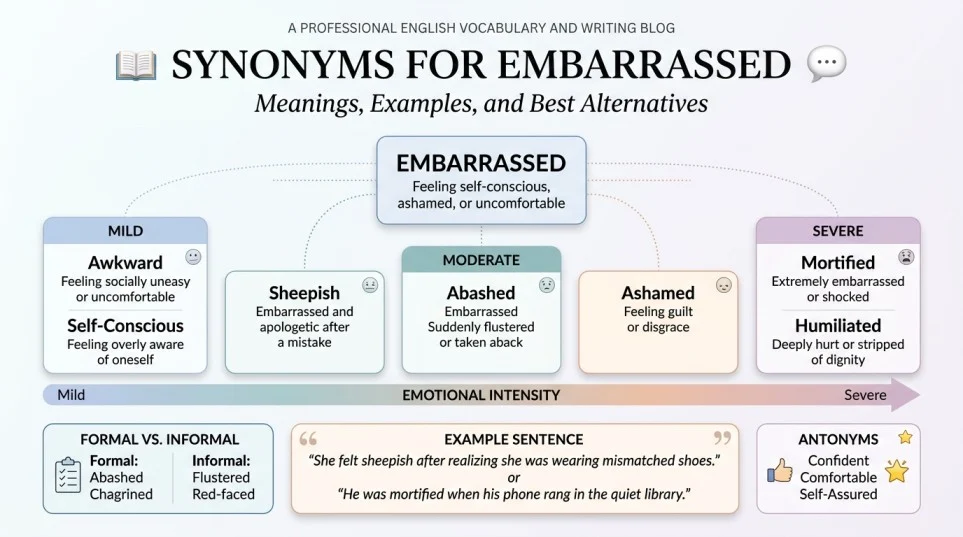
Embarrassed means feeling uncomfortable, awkward, or self conscious because of a mistake, an unexpected situation, or unwanted attention. Common synonyms include awkward, self conscious, humiliated, mortified, sheepish, and abashed. Choose a mild word for everyday discomfort and a stronger one for deep public embarrassment.
Meaning, Tone and Context
What Does Embarrassed Mean?
Embarrassed describes the uncomfortable feeling you experience when something makes you feel awkward, exposed, or concerned about how others see you. It can happen after a social mistake, an unexpected compliment, or an embarrassing public moment.
For example, forgetting someone’s name during an introduction might make you feel embarrassed. Making a serious mistake in front of a large audience might leave you feeling humiliated.
Part of speech: Embarrassed is an adjective and the past participle of the verb embarrass.
Tone: Usually negative or uncomfortable, although it can describe a lighthearted or harmless moment.
Formality: Suitable for casual conversations, academic writing, professional communication, and personal writing.
Common uses: Social situations, mistakes, public speaking, relationships, school experiences, workplace conversations, and personal stories.
Important Related Word Forms
| Word | Part of Speech | Meaning | Example |
|---|---|---|---|
| Embarrass | Verb | To make someone feel awkward or uncomfortable | Please do not embarrass him in front of his colleagues. |
| Embarrassed | Adjective | Feeling awkward or uncomfortable | I felt embarrassed after forgetting her name. |
| Embarrassing | Adjective | Causing discomfort or awkwardness | It was an embarrassing mistake. |
| Embarrassment | Noun | The feeling or situation of being embarrassed | She laughed to hide her embarrassment. |
| Unembarrassed | Adjective | Not feeling embarrassed | He remained unembarrassed by the attention. |
When and How to Use Embarrassed
Use embarrassed when you want to describe discomfort caused by a social mistake, unwanted attention, an awkward interaction, or something you wish had happened differently.
The word works in both serious and lighthearted situations. The surrounding sentence helps readers understand how intense the feeling is.
1. Professional context
I felt embarrassed when I realized I had sent the wrong attachment to my manager.
2. Academic context
The student was embarrassed after giving an incorrect answer during the presentation.
3. Personal context
She felt embarrassed when her friends surprised her with a birthday song in the restaurant.
4. Social media context
That awkward moment still makes me cringe whenever I think about it.
Another Word for Embarrassed
The best replacement depends on the reason and intensity of the feeling.
| Context | Best Alternative | Example |
|---|---|---|
| Professional writing | Uncomfortable | I felt uncomfortable discussing the mistake in the meeting. |
| Academic writing | Self conscious | The student became self conscious while presenting the research. |
| Casual conversation | Awkward | I felt awkward when I forgot his name. |
| Emotional writing | Ashamed | She felt ashamed of how she had treated her friend. |
| Creative writing | Abashed | He looked abashed when everyone turned toward him. |
| Resume or workplace communication | Uncomfortable | I was uncomfortable with the way the feedback was delivered. |
| Social media captions | Cringing | Still cringing at what I said yesterday. |
| Stronger meaning | Mortified | I was mortified when my phone rang during the speech. |
| Softer meaning | Sheepish | He gave a sheepish smile after arriving late. |
The Best Single Replacement
Awkward is a useful everyday alternative when you feel uncomfortable in a social situation. However, it can describe the situation itself rather than the emotion.
Choose self conscious when you worry about how others see you, ashamed when you feel guilty or morally uncomfortable, and mortified when the embarrassment is especially intense.
When Not to Use Embarrassed
Although embarrassed is versatile, it does not describe every uncomfortable emotion precisely.
When guilt is the main feeling: Use guilty if you believe you did something wrong.
Example: I felt guilty for blaming my coworker for my own mistake.
When the feeling is extremely intense: Use mortified if you want to show powerful embarrassment.
Example: She was mortified when her private message appeared on the projector.
When you worry about other people’s opinions: Use self conscious to emphasize your concern about how you look, sound, or behave.
Example: He felt self conscious about speaking in front of experienced professionals.
When the situation is uncomfortable rather than the person: Use awkward.
Example: There was an awkward silence after the unexpected question.
When you feel regret rather than embarrassment: Use regretful when you are sorry about a decision or action.
Example: She felt regretful about turning down the opportunity.
A more precise word helps readers understand the cause, intensity, and emotional meaning of the experience.
Words Commonly Confused With Embarrassed
| Word | Main Difference | Best Used When |
|---|---|---|
| Ashamed | Often involves guilt or a sense of wrongdoing | You regret your behavior or feel you acted badly. |
| Humiliated | Suggests a painful loss of dignity, often in front of others | Someone is publicly mocked or deeply embarrassed. |
| Awkward | Describes social discomfort or an uncomfortable situation | A conversation becomes difficult or unnatural. |
| Self conscious | Focuses on awareness of how others may judge you | You worry about your appearance or behavior. |
| Guilty | Focuses on believing you did something wrong | You feel responsible for a mistake or harm. |
| Shy | Describes a tendency to feel nervous around people | You struggle to speak to unfamiliar people. |
These words overlap, but they are not interchangeable in every sentence. Choose the word that reflects the actual feeling rather than simply replacing embarrassed with the first similar word you find.
Best Synonym by Context for Embarrassed
The right synonym depends on what happened, how strongly you feel, and who will read your words.
| Context | Best Synonym | Why It Works | Example |
|---|---|---|---|
| Formal writing | Abashed | Expresses visible discomfort or loss of confidence | The speaker looked abashed after the correction. |
| Academic writing | Self conscious | Describes discomfort about being observed or evaluated | The presenter became self conscious during the discussion. |
| Professional or business use | Uncomfortable | Sounds neutral and appropriate at work | I felt uncomfortable when the error was discussed publicly. |
| Resume or interview reflection | Challenged | Focuses on a difficult experience without emphasizing embarrassment | I was challenged by the unexpected questions and learned to prepare more carefully. |
| Casual conversation | Awkward | Natural for everyday social discomfort | I felt awkward when I walked into the wrong room. |
| Creative writing | Abashed | Adds a descriptive, slightly literary tone | He lowered his eyes, abashed by the praise. |
| Emotional writing | Ashamed | Highlights guilt or regret when wrongdoing is involved | She felt ashamed of her unkind response. |
| Strong intensity | Mortified | Communicates extreme embarrassment | I was mortified when everyone heard my mistake. |
| Mild discomfort | Sheepish | Suggests gentle embarrassment, often after a small mistake | He gave a sheepish grin. |
| Social media captions | Cringing | Expresses a strong reaction to an awkward memory | Cringing at my old school photos. |
| Public humiliation | Humiliated | Emphasizes an attack on dignity or respect | He felt humiliated when his colleagues mocked him. |
| Appearance related | Self conscious | Focuses on concern about appearance | She felt self conscious about her new haircut. |
| Unexpected praise | Flustered | Shows temporary confusion or nervousness | He became flustered when the audience applauded. |
| After being corrected | Chagrined | Expresses disappointment or annoyance at one’s mistake | She was chagrined to discover the error. |
| After arriving late | Sheepish | Suggests mild embarrassment about a small mistake | I offered a sheepish apology for being late. |
A Note on US and UK Usage
Embarrassed is common in both American and British English. Most alternatives in this guide are understood in both varieties.
In American English, awkward, uncomfortable, and self conscious are especially practical everyday choices. Abashed and chagrined can sound more literary or formal, although both are understood in the United States and the United Kingdom.
Which Synonym Should You Choose?
Choosing the best synonym for embarrassed becomes easier when you consider five things.
1. Identify the exact feeling.
Ask yourself what caused the discomfort. If you made a mistake, sheepish may fit. If you feel guilty about hurting someone, ashamed may be more accurate. You worry about other people’s opinions, choose self conscious.
2. Consider the level of formality.
Use awkward or uncomfortable in everyday conversations and workplace emails. Abashed or chagrined can suit more descriptive writing, depending on the audience.
3. Match the emotional intensity.
A small mistake may leave you sheepish. A deeply uncomfortable public incident may leave you mortified or humiliated. Avoid using an intense word for a minor event.
4. Think about professional value.
In workplace communication, focus on what happened and what you learned. Instead of repeatedly describing yourself as embarrassed, explain the mistake, your response, and the corrective action.
For example: I identified the reporting error, corrected the figures, and introduced an additional review step.
5. Check the sentence as a whole.
Some words describe a person’s feelings, while others describe a situation. You may feel embarrassed during an awkward conversation, but the conversation itself is awkward.
Reading the sentence aloud can help you identify the most natural choice.
Real Life Examples of Embarrassed in Sentences
Here are practical examples showing how similar words work in different situations.
School: I felt self conscious when I had to read my essay aloud to the class.
Workplace: She was chagrined to discover that the report contained an outdated figure.
Writing: The author described the character as abashed after receiving unexpected praise.
Conversation: I felt awkward when I called my new neighbor by the wrong name.
Social media: Still cringing at the speech I gave five years ago.
Interview: I felt flustered by the unexpected question, but I took a breath and answered thoughtfully.
Email: I apologize for the error in my previous message. I have attached the corrected document.
Storytelling: He gave a sheepish smile, rubbed the back of his neck, and admitted that he had forgotten the tickets.
Family situation: She was mortified when her childhood nickname appeared on the birthday cake.
Public speaking: The presenter looked abashed after mixing up two slides, then continued with confidence.
18 Synonyms for Embarrassed
The following list contains 18 useful alternatives. Each word has a distinct meaning or use, so choose according to the situation rather than treating every option as an exact substitute.
| Synonym | Simple Meaning | Best Used For | Example Sentence |
|---|---|---|---|
| 1. Awkward | Uncomfortable in a social situation | Everyday conversation | I felt awkward when nobody responded to my joke. |
| 2. Self conscious | Worried about how others see you | Appearance, public speaking, or social attention | He became self conscious about his accent. |
| 3. Ashamed | Feeling guilt or disgrace | Regret about behavior | She was ashamed of the hurtful comment. |
| 4. Humiliated | Feeling that your dignity has been damaged | Public insults or severe embarrassment | He felt humiliated when his mistake became a joke. |
| 5. Mortified | Extremely embarrassed | Intense emotional reactions | I was mortified when I realized the microphone was on. |
| 6. Abashed | Feeling shy or uncomfortable after attention or criticism | Formal and descriptive writing | The young speaker looked abashed after the compliment. |
| 7. Sheepish | Mildly embarrassed, often after a small mistake | Casual conversation and storytelling | He gave a sheepish grin and admitted he was late. |
| 8. Chagrined | Disappointed or annoyed by an error or failure | Formal writing | She was chagrined to learn that she had missed the deadline. |
| 9. Flustered | Nervous and confused for a short time | Unexpected questions or pressure | I grew flustered when three people asked questions at once. |
| 10. Disconcerted | Suddenly unsettled or confused | Formal and professional situations | The unexpected criticism left him disconcerted. |
| 11. Uncomfortable | Not feeling at ease | Neutral, everyday, or workplace language | I felt uncomfortable discussing the issue in public. |
| 12. Ill at ease | Nervous or unable to relax | Descriptive and slightly formal writing | She felt ill at ease among the unfamiliar guests. |
| 13. Contrite | Feeling sincere regret for wrongdoing | Apologies and accountability | He sounded contrite when he admitted his mistake. |
| 14. Regretful | Feeling sorry about a decision or action | Personal reflection | She felt regretful about interrupting her colleague. |
| 15. Sheepish looking | Appearing mildly embarrassed | Descriptive storytelling | The sheepish looking student returned the missing book. |
| 16. Chastened | Made more careful or humble by an experience | Reflective or formal writing | He emerged chastened after the failed presentation. |
| 17. Red faced | Visibly showing embarrassment, often through blushing | Informal descriptions | She stood red faced after forgetting the speaker’s name. |
| 18. Cringing | Reacting with discomfort to an awkward or embarrassing moment | Informal speech and social media | I am cringing at the message I sent last night. |
Usage note: Some entries describe a related reaction or appearance rather than the exact feeling of being embarrassed. Ill at ease, contrite, regretful, and chastened are context dependent. Sheepish looking is a descriptive phrase, not a single word synonym. Cringing often describes a person’s reaction to an uncomfortable memory or event.
Synonym Groups and Usage Differences
Professional vs. Personal Synonyms
Professional communication usually benefits from calm, precise wording. Uncomfortable, concerned, and chagrined can work when they accurately describe the situation.
Personal conversations allow more emotional language. You might say you were mortified by a mistake or felt sheepish after forgetting a friend’s birthday.
For workplace messages, it is often more useful to explain the problem and the solution than to focus on your embarrassment.
Formal vs. Conversational Synonyms
Formal writing may use abashed, chagrined, or disconcerted when those words match the meaning. They are particularly useful in essays, reports, literary analysis, and detailed narratives.
Conversational English favors awkward, uncomfortable, sheepish, and flustered. These words are easy to understand and sound natural in everyday speech, text messages, and informal emails.
Academic Synonyms
For academic writing, choose words that explain the experience accurately.
Self conscious works when a student worries about being judged. Humiliated may be appropriate when the discussion involves public ridicule or a loss of dignity. Chagrined can describe disappointment after discovering a mistake.
Avoid replacing embarrassed with an impressive sounding word if the new word changes the meaning.
Professional and Business Synonyms
In emails, reviews, presentations, and workplace conversations, uncomfortable and concerned can help describe a difficult interaction without sounding overly emotional.
Chagrined can work in a formal account of a mistake. However, a professional apology is usually clearer when it states what went wrong and how the issue will be resolved.
For example: I apologize for the incorrect figures. I have updated the report and checked the remaining calculations.
Creative or Literary Synonyms
Creative writing often benefits from words that reveal a character’s emotional state.
Abashed can suggest someone who feels humbled by attention. Sheepish creates a lighter feeling after a minor mistake. Mortified shows intense embarrassment, while red faced gives readers a visible clue about the character’s reaction.
Pair these words with actions or expressions to make a scene feel more realistic.
Slang or Modern Synonyms
The phrase I am cringing is common in informal American English, especially when people recall an awkward memory or see something uncomfortable.
Awkward also works well in casual online conversations. These expressions may be suitable for captions, texts, and personal posts, but they are less suitable for formal academic writing.
Strongest vs. Weaker Synonyms
The intensity of these words depends on the situation. This guide offers a general scale, not a strict ranking.
| Intensity | Word | Typical Situation |
|---|---|---|
| Mild | Sheepish | A small mistake or late arrival |
| Mild to moderate | Awkward | An uncomfortable interaction |
| Moderate | Self conscious | Worry about being observed |
| Moderate | Abashed | Feeling humbled or uncomfortable after attention |
| Moderate to strong | Flustered | Losing composure under pressure |
| Strong | Chagrined | Disappointment over a mistake |
| Very strong | Mortified | Intense embarrassment |
| Very strong | Humiliated | A painful attack on dignity |
Ashamed is not simply a stronger version of embarrassed. It emphasizes guilt, disgrace, or a negative judgment about one’s behavior or self.
Emotional vs. Neutral Synonyms
Emotional words communicate more than discomfort alone. Ashamed suggests guilt or disgrace, mortified conveys intense embarrassment, and humiliated emphasizes damaged dignity.
Neutral words are often better when you want to describe an event without making a strong emotional claim. Uncomfortable and awkward can communicate social difficulty without suggesting severe distress.
Select the emotional level that matches the facts and the purpose of your writing.
Antonyms of Embarrassed
The opposite of embarrassed depends on the situation. Confident, comfortable, and at ease are useful opposites when the focus is social discomfort. Proud, unashamed, and self assured fit other situations.
| Antonym | Meaning | Example Sentence |
|---|---|---|
| 1. Confident | Believing in your abilities | She felt confident while answering questions. |
| 2. Comfortable | Feeling relaxed and at ease | He felt comfortable speaking to the group. |
| 3. Unashamed | Not feeling shame about something | She remained unashamed of her decision. |
| 4. Proud | Feeling pleased about an achievement or quality | He felt proud of his presentation. |
| 5. Self assured | Showing confidence in yourself | The speaker appeared self assured on stage. |
| 6. Relaxed | Free from tension or worry | She looked relaxed during the interview. |
| 7. Composed | Calm and in control | He remained composed after the mistake. |
| 8. Poised | Calm, confident, and in control | The presenter gave a poised response. |
| 9. Unfazed | Not troubled by something unexpected | She was unfazed by the audience’s reaction. |
| 10. Unbothered | Not upset or concerned | He seemed unbothered by the minor error. |
| 11. Assured | Confident and certain | She sounded assured during the discussion. |
| 12. At ease | Comfortable and relaxed | I felt at ease among my classmates. |
| 13. Fearless | Showing little or no fear | The fearless performer welcomed the challenge. |
| 14. Bold | Willing to act confidently | He made a bold statement without hesitation. |
| 15. Unperturbed | Calm despite a disturbance | She remained unperturbed when the plan changed. |
These are contextual opposites, not exact antonyms in every sentence. For example, proud is a useful opposite when embarrassment comes from feeling inadequate, while comfortable is better when the issue is social awkwardness.
Comparison: Embarrassed vs. Similar Words
Embarrassed vs. Ashamed
Main difference: Embarrassed usually describes awkwardness or discomfort. Ashamed often involves guilt, disgrace, or regret about behavior.
Stronger word: Ashamed may carry a deeper moral or personal meaning, although the intensity depends on the situation.
Formality: Both work in casual and formal English.
Examples:
Embarrassed: I felt embarrassed when I forgot my colleague’s name.
Ashamed: I felt ashamed after making an unfair accusation.
Embarrassed vs. Humiliated
Main difference: Embarrassed describes discomfort, while humiliated suggests a more painful loss of dignity.
Stronger word: Humiliated usually expresses a more severe experience.
Formality: Both are suitable for formal and informal contexts.
Examples:
Embarrassed: She felt embarrassed after stumbling over her introduction.
Humiliated: He felt humiliated when his supervisor mocked him in front of the team.
Embarrassed vs. Awkward
Main difference: Embarrassed describes a person’s feeling. Awkward can describe a feeling, interaction, or situation.
Stronger word: Embarrassed emphasizes personal discomfort, while awkward often sounds milder.
Formality: Both are common in everyday English.
Examples:
Embarrassed: I was embarrassed when I gave the wrong answer.
Awkward: The conversation became awkward after the misunderstanding.
Embarrassed vs. Self Conscious
Main difference: Embarrassed often follows a particular event. Self conscious focuses on worrying about how other people perceive you.
Stronger word: Neither is always stronger. Embarrassed can describe a sudden reaction, while self conscious can describe ongoing discomfort.
Formality: Both work in academic, personal, and professional writing.
Examples:
Embarrassed: He was embarrassed when his phone rang during the speech.
Self conscious: He felt self conscious about speaking with a strong accent.
Embarrassed vs. Mortified
Main difference: Embarrassed can describe mild discomfort. Mortified conveys an intense feeling of embarrassment.
Stronger word: Mortified is generally stronger.
Formality: Both are acceptable in formal and informal English, although mortified is more emotionally emphatic.
Examples:
Embarrassed: I felt embarrassed after calling the teacher by the wrong name.
Mortified: I was mortified when I realized I had shared the private document with the entire team.
Embarrassed vs. Guilty
Main difference: Embarrassed relates to awkwardness or unwanted attention. Guilty relates to believing you did something wrong.
Stronger word: Neither is universally stronger because they describe different feelings.
Formality: Both work in everyday and professional communication.
Examples:
Embarrassed: She felt embarrassed after interrupting the meeting.
Guilty: She felt guilty for taking credit for someone else’s work.
Common Phrases and Expressions with Embarrassed
1. Feel embarrassed
Meaning: To experience discomfort or awkwardness because of something that happened.
Example sentence: I felt embarrassed when I realized I had entered the wrong classroom.
2. Embarrassed about something
Meaning: To feel uncomfortable or ashamed about a particular issue.
Example sentence: He was embarrassed about his mistake in the report.
3. Embarrassed by someone
Meaning: To feel uncomfortable because of another person’s behavior or actions.
Example sentence: She was embarrassed by her brother’s loud comments at dinner.
4. Embarrassed in front of others
Meaning: To experience embarrassment while other people are watching.
Example sentence: I felt embarrassed in front of my classmates when I forgot my lines.
5. Look embarrassed
Meaning: To show signs of embarrassment through facial expressions or body language.
Example sentence: He looked embarrassed and quickly changed the subject.
6. Deeply embarrassed
Meaning: To feel a strong level of embarrassment.
Example sentence: She was deeply embarrassed when the private message appeared on the shared screen.
7. Embarrassed to admit
Meaning: To feel uncomfortable about acknowledging something.
Example sentence: I am embarrassed to admit that I forgot the appointment.
8. Save someone from embarrassment
Meaning: To help someone avoid an awkward or uncomfortable situation.
Example sentence: My friend changed the subject to save me from embarrassment.
Common Mistakes to Avoid
1. Treating every synonym as an exact match.
Embarrassed, ashamed, and humiliated express different experiences. Use ashamed when guilt is central and humiliated when dignity has been seriously damaged.
2. Confusing embarrassed with embarrassing.
Embarrassed describes the person experiencing the feeling. Embarrassing describes the thing that causes the feeling.
Correct: I was embarrassed by the embarrassing mistake.
3. Using casual expressions in formal writing.
Cringing can work in a social media caption, but it may sound too informal in a research paper. Choose self conscious, uncomfortable, or another precise alternative when appropriate.
4. Making a minor situation sound dramatic.
Mortified may exaggerate a small inconvenience. If you simply forgot someone’s name, embarrassed or awkward may be more natural.
5. Repeating the same word too often.
If embarrassed appears several times in one paragraph, consider whether awkward, sheepish, or self conscious better explains each situation. Do not replace it just for variety if the meaning changes.
6. Choosing the wrong emotional tone.
Feeling embarrassed after receiving a compliment is different from feeling ashamed after hurting someone. Match the word to the reason behind the emotion.
FAQs
1. What is the best synonym for embarrassed?
Awkward is a useful everyday synonym. Self conscious works for social anxiety, sheepish for a minor mistake, and mortified for intense embarrassment.
2. What is a formal synonym for embarrassed?
Abashed and chagrined can work in formal writing. Abashed describes discomfort after attention or criticism, while chagrined often suggests disappointment about a mistake.
3. What is an informal synonym for embarrassed?
Awkward, sheepish, and cringing are useful informal choices. Awkward suits uncomfortable situations, sheepish fits minor mistakes, and cringing expresses a strong reaction to an awkward memory.
4. What is another word for embarrassed in professional writing?
Uncomfortable is a neutral option for workplace communication. Chagrined may suit a formal account of an error, but a clear explanation of the mistake is often more effective.
5. What is the difference between embarrassed and ashamed?
Embarrassed usually describes awkwardness or unwanted attention. Ashamed often involves guilt, disgrace, or regret about behavior. The right choice depends on why the person feels bad.
6. What is the opposite of embarrassed?
Confident, comfortable, and at ease are useful opposites when the feeling involves social discomfort. Unashamed may fit when embarrassment is closely related to shame.
Conclusion
Understanding synonyms for embarrassed helps you describe uncomfortable moments more clearly. Awkward and uncomfortable suit everyday situations, self conscious describes concern about other people’s opinions, sheepish fits minor mistakes, and mortified expresses intense embarrassment.
The best word depends on your audience, the cause of the feeling, and its emotional intensity. In professional writing, focus on clear language and practical solutions. In creative writing, use more descriptive words to help readers understand a character’s emotions.
Read More Related Articles:
- 25+ Synonyms for Foundation | Meanings, Examples, and Best …
- 25+ Synonyms for Broken | Meanings, Examples, and Best …
- 25+ Synonyms for Potential | Meanings and Examples