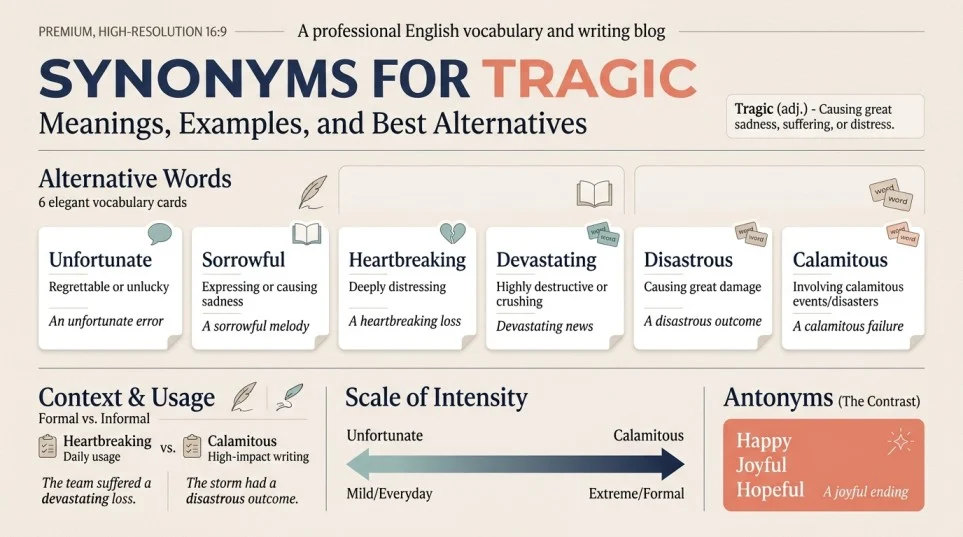
Have you ever used the word tragic repeatedly in an essay, email, social media caption, or personal story? Although it describes deep sadness and suffering, using the same word too often can make your writing feel repetitive. The right synonym can help you express your thoughts more clearly and naturally.
The best synonyms for tragic depend on the situation. Words such as heartbreaking, devastating, sorrowful, disastrous, and unfortunate communicate different kinds of sadness, loss, and hardship. This guide explains their meanings, differences, and everyday uses. You will discover how to choose the right alternatives for school assignments, professional communication, creative writing, personal messages, and social media captions.
What Does Tragic Mean?
Tragic describes an event, experience, or outcome involving great sadness, suffering, loss, or disaster. Common synonyms include heartbreaking, devastating, sorrowful, disastrous, and calamitous. Use heartbreaking for emotional pain, disastrous for serious failure, and devastating for overwhelming loss.
Meaning, Tone and Context
1. Simple Definition
Tragic describes something that causes deep sadness, involves serious suffering, or ends in a deeply unfortunate way. It often refers to death, accidents, disasters, personal loss, or painful events that affect people’s lives.
For example, a tragic accident may result in the loss of life. A tragic ending may describe a story in which a character experiences suffering, defeat, or death.
2. Part of Speech
Tragic is an adjective. It describes a person, event, experience, situation, or outcome associated with suffering or sadness.
Example: The community came together after the tragic accident.
Related word forms include:
| Word | Part of Speech | Meaning |
|---|---|---|
| Tragic | Adjective | Involving great sadness or suffering |
| Tragedy | Noun | An event involving great suffering or a sad outcome |
| Tragically | Adverb | In a deeply sad or unfortunate way |
| Tragicomic | Adjective | Combining tragic and comic elements |
3. Tone and Formality
Tragic usually has a serious, emotional, and negative tone. It is appropriate in everyday conversations, news reports, academic essays, literature, and professional communication when the situation deserves such a strong description.
However, tragic can sound exaggerated when used for minor inconveniences. A canceled appointment may be disappointing, but a fatal accident may genuinely be tragic.
4. Common Uses of Tragic
The word is commonly used to describe:
- Death, serious injury, or unexpected loss.
- Accidents and natural disasters.
- Painful family or personal experiences.
- Sad endings in books, plays, and films.
- Historical events involving human suffering.
- Decisions that lead to severe and unfortunate consequences.
When and How to Use Tragic
Use tragic when an event involves significant suffering, deep sadness, or an extremely unfortunate outcome. The following examples show how the word and its alternatives work in different situations.
1. News and formal writing
The city mourned the victims of a tragic accident.
This sentence communicates the seriousness of the event without unnecessary emotional detail.
2. Personal and emotional writing
Losing someone so unexpectedly was a heartbreaking experience.
Heartbreaking is more personal than tragic because it emphasizes emotional pain and grief.
3. Academic and literary writing
The novel presents a tragic ending shaped by ambition, jealousy, and betrayal.
Here, tragic describes the suffering and consequences experienced by the characters.
4. Workplace communication
The project failure was costly and could have been avoided with better planning.
Costly is more precise than tragic when describing a business setback with financial consequences.
Another Word for Tragic
The best single alternative to tragic is often devastating when an event causes overwhelming emotional pain, damage, or loss. However, the most accurate replacement depends on your intended meaning.
| Situation | Best Alternative | Why It Works |
|---|---|---|
| Professional writing | Serious | Clear and measured |
| Academic writing | Catastrophic | Emphasizes extremely severe consequences |
| Casual conversation | Awful | Natural and familiar |
| Emotional writing | Heartbreaking | Focuses on emotional pain |
| Creative writing | Heartrending | Adds literary emotion |
| Resume or workplace use | Costly | Describes a measurable setback |
| Social media captions | Heartbreaking | Expresses sadness and sympathy |
| Stronger meaning | Calamitous | Suggests an extreme disaster |
| Softer meaning | Sad | Communicates sorrow without dramatic intensity |
A useful rule is to choose the word that explains the actual impact. Heartbreaking describes grief, disastrous describes severe failure, and sorrowful emphasizes sadness.
When Not to Use Tragic
- Tragic is a powerful word, so it should match the seriousness of the situation.
- When the event is only disappointing: Use disappointing instead of tragic when a plan does not work out.
- When you mean physical damage: Use destructive or catastrophic when the main concern is extensive damage.
- When you mean emotional pain: Use heartbreaking or distressing to emphasize the emotional impact.
- When you mean poor results: Use disastrous or unsuccessful to describe a failed plan, project, or attempt.
- When you want a neutral report: Use serious or unfortunate when those words accurately reflect the facts.
Consider these examples:
| Less Precise | More Precise |
|---|---|
| The meeting was tragic. | The meeting was disastrous because the team lost its largest client. |
| It was a tragic day because it rained. | It was a disappointing day because the outdoor event was canceled. |
| The news was tragic. | The news was heartbreaking because the family had lost a loved one. |
Precise language makes writing more trustworthy. Avoid using an emotionally intense word simply to make an ordinary situation sound more dramatic.
Words Commonly Confused With Tragic
Several words describe sadness, suffering, or negative outcomes, but each has a slightly different meaning.
| Word | Main Difference | When to Use It |
|---|---|---|
| Sad | General unhappiness | Everyday disappointment or grief |
| Unfortunate | Something undesirable or unlucky | An undesirable situation or outcome |
| Devastating | Causing overwhelming harm or distress | Major loss or severe consequences |
| Disastrous | Extremely unsuccessful or damaging | Failed plans, accidents, or crises |
| Gruesome | Horrifying because of disturbing details | Graphic violence or disturbing scenes |
| Melancholy | A quiet, thoughtful kind of sadness | Reflective writing, moods, or art |
Tragic often combines sadness with serious suffering or an unfortunate outcome. A sad moment is not always tragic, and a disastrous business decision may not involve the grief associated with a tragedy.
Best Synonym by Context for Tragic
Choosing the right synonym helps you communicate the intended meaning without exaggerating or weakening your message.
| Context | Best Synonym | Why It Works | Example |
|---|---|---|---|
| Formal writing | Unfortunate | Measured and professional | The incident had an unfortunate outcome. |
| Academic writing | Catastrophic | Highlights extreme consequences | The event had catastrophic effects on the region. |
| Professional communication | Serious | Direct and objective | The company faced a serious setback. |
| Resume writing | Costly | Focuses on business impact | I identified a costly process error and helped correct it. |
| Casual conversation | Awful | Natural and familiar | That was an awful accident. |
| Creative writing | Heartrending | Adds emotional depth | Her heartrending farewell stayed with him. |
| Emotional writing | Heartbreaking | Highlights grief | Their final conversation was heartbreaking. |
| Strong intensity | Calamitous | Conveys extreme disaster | The calamitous storm destroyed entire communities. |
| Softer tone | Sad | Simple and restrained | The film has a sad ending. |
| Social media captions | Devastating | Expresses powerful impact | A devastating loss for everyone involved. |
| News reporting | Fatal | Specifies an event involving death | The collision resulted in a fatal injury. |
| Literary analysis | Fateful | Emphasizes a major turning point | One fateful decision changed the character’s life. |
| Personal communication | Painful | Focuses on personal suffering | It was a painful chapter in her life. |
| Historical writing | Catastrophic | Highlights widespread damage | The catastrophic event changed the nation’s future. |
American and British English Usage
Tragic is widely understood in both American and British English. Most synonyms in this guide are also used in both varieties.
There is no major difference between US and UK English that requires a separate synonym. Choose words according to meaning, audience, and tone rather than assuming that one variety needs a different alternative.
Which Synonym Should You Choose?
Before replacing tragic, ask yourself five simple questions.
1. What happened?
If the event involved death or serious suffering, tragic or devastating may fit. If a plan failed, disastrous may be more accurate.
2. How formal is the writing?
Use serious or unfortunate in measured professional communication. Choose heartrending or sorrowful for expressive writing.
3. How intense is the meaning?
Sad is relatively mild. Heartbreaking communicates deeper emotional pain. Calamitous suggests an extreme disaster.
4. What do you want readers to notice?
Use fatal when referring to death, destructive for damage, distressing for emotional discomfort, and disastrous for severe failure.
5. Who will read the sentence?
A school essay may need a precise explanation. A sympathy message may call for compassionate language. A business report should focus on facts and consequences.
The strongest synonym is not always the best choice. The right word is the one that preserves your intended meaning.
Real Life Examples of Tragic in Sentences
The following examples demonstrate how alternatives to tragic can improve communication in different situations.
| Situation | Example Sentence |
|---|---|
| School | The tragic ending of the novel helped us understand the cost of revenge. |
| Workplace | The company suffered a costly setback after ignoring customer feedback. |
| Writing | The author describes a devastating loss that changes the main character. |
| Conversation | It was heartbreaking to hear what happened to their family. |
| Social media | Sending love and support to everyone affected by this terrible loss. |
| Resume | Identified a costly reporting error and introduced a process to prevent future mistakes. |
| I was deeply saddened to learn about your loss. | |
| Storytelling | One fateful choice led the hero toward an unhappy ending. |
| News | The fatal collision prompted calls for better road safety. |
| Academic writing | The disaster had severe consequences for local communities. |
For resumes and workplace documents, describe the specific problem, outcome, or achievement. Emotional words such as tragic rarely add value unless they are genuinely relevant to the subject.
18 Synonyms for Tragic
The following words provide useful alternatives, but they are not interchangeable in every sentence. Some emphasize emotional pain, while others focus on damage, sadness, or a disastrous outcome.
| Synonym | Simple Meaning | Best Used For | Example Sentence |
|---|---|---|---|
| 1. Heartbreaking | Causing deep emotional pain | Grief and personal loss | The family’s story was heartbreaking. |
| 2. Devastating | Causing overwhelming damage or distress | Major losses and serious consequences | The devastating flood displaced thousands of residents. |
| 3. Sorrowful | Full of sadness | Emotional and reflective writing | She gave a sorrowful account of her childhood. |
| 4. Calamitous | Involving an extreme disaster | Formal and historical writing | The calamitous failure changed the course of the war. |
| 5. Disastrous | Extremely harmful or unsuccessful | Plans, events, and outcomes | Their disastrous decision cost the business its biggest contract. |
| 6. Heartrending | Causing intense sadness | Literary and emotional writing | The heartrending letter revealed his final wishes. |
| 7. Dreadful | Extremely bad or distressing | Everyday speech and descriptions | The town experienced a dreadful storm. |
| 8. Unfortunate | Unlucky or undesirable | Formal and neutral communication | An unfortunate error delayed the announcement. |
| 9. Distressing | Causing worry, sadness, or upset | Reports and personal experiences | The family received distressing news. |
| 10. Grievous | Very serious or severe | Formal descriptions of harm or loss | The conflict resulted in grievous injuries. |
| 11. Woeful | Marked by deep sadness or misery | Expressive and literary writing | His woeful expression revealed his disappointment. |
| 12. Mournful | Expressing grief or sorrow | Funerals, music, and reflective scenes | A mournful melody filled the room. |
| 13. Painful | Causing emotional or physical suffering | Personal experiences and difficult memories | Their painful separation took months to overcome. |
| 14. Catastrophic | Causing extremely severe damage or consequences | Disasters and large scale failures | A catastrophic earthquake destroyed much of the town. |
| 15. Dire | Extremely serious or urgent | Warnings and critical situations | The region faced dire conditions after the storm. |
| 16. Pitiful | Deserving pity or showing weakness or inadequacy | Situations that invite sympathy | The abandoned building was in a pitiful state. |
| 17. Bleak | Offering little hope | Difficult futures and gloomy situations | The report presented a bleak picture of the economy. |
| 18. Fateful | Having important, often harmful consequences | Turning points in stories and history | A fateful meeting changed both of their lives. |
Important usage note: Grievous usually describes serious harm or loss, while fateful describes an event with major consequences. Bleak focuses on a lack of hope. These words can relate to tragic situations, but they do not replace tragic in every context.
Synonym Groups and Usage Differences
Professional vs. Personal Synonyms
Professional writing should focus on facts and outcomes. Serious, costly, severe, and disastrous may be appropriate, depending on the situation.
Personal writing can communicate feelings more directly. Heartbreaking, painful, heartrending, and sorrowful work well when discussing grief, separation, or personal loss.
For example, a report might describe a severe incident, while a personal message might call the same experience heartbreaking.
Formal vs. Conversational Synonyms
Formal language suits reports, academic essays, speeches, and official statements. Words such as calamitous, grievous, catastrophic, and unfortunate can fit these settings when their meanings are accurate.
Conversational alternatives include awful, sad, terrible, and heartbreaking. They sound natural in everyday speech and informal messages.
Choose the word that matches both the seriousness of the event and the tone of the conversation.
Academic Synonyms
Academic writing benefits from precision rather than emotional exaggeration. Use catastrophic when discussing extreme consequences, devastating when explaining substantial harm, and unfortunate when describing an undesirable result in a measured tone.
For literary analysis, tragic may remain the most accurate term because it can describe a genre, a character’s fate, or an outcome involving suffering.
Always explain the evidence supporting your word choice instead of relying on an emotional adjective alone.
Professional and Business Synonyms
In workplace communication, tragic may be appropriate when discussing a serious accident, death, or human loss. For a missed target or failed project, more specific alternatives usually work better.
Consider these examples:
- A serious incident affected employee safety.
- A costly error increased operating expenses.
- A disastrous launch damaged customer confidence.
- An unfortunate delay affected the delivery schedule.
These descriptions are clearer because they explain the type of problem rather than simply labeling it tragic.
Creative or Literary Synonyms
Creative writing often benefits from words that communicate mood and emotion.
- Heartrending emphasizes deep emotional pain.
- Mournful creates a feeling of grief.
- Woeful suggests misery or sorrow.
- Bleak presents a situation with little hope.
- Fateful signals a turning point with lasting consequences.
Use vivid alternatives when they deepen the scene or reveal a character’s feelings. Avoid placing several dramatic adjectives in a single sentence.
Slang or Modern Synonyms
There is no single modern slang word that accurately replaces tragic in every situation. Casual expressions such as awful, rough, and a total disaster may work in informal conversation.
For example, someone might say that a vacation was a total disaster after a series of problems. However, that phrase may sound insensitive when discussing death or serious suffering.
In academic essays, professional reports, and sensitive conversations, use clear language instead of slang.
Strongest vs. Weaker Synonyms
This scale is a practical guide to tone, not a strict ranking. The impact of each word depends on the event being described.
| Intensity | Synonyms | Typical Meaning |
|---|---|---|
| Mild | Sad, unfortunate | General unhappiness or an undesirable outcome |
| Moderate | Distressing, painful, sorrowful | Noticeable emotional difficulty or suffering |
| Strong | Heartbreaking, devastating, heartrending | Deep emotional pain or overwhelming loss |
| Extreme | Calamitous, catastrophic | Extremely severe disaster or widespread consequences |
Do not treat emotional intensity and physical damage as the same thing. Heartbreaking may express greater personal grief than catastrophic, while catastrophic usually emphasizes the scale of the damage or consequences.
Emotional vs. Neutral Synonyms
Emotional words help readers understand how an experience feels. Heartbreaking, heartrending, sorrowful, and mournful communicate grief or sadness.
Neutral or measured words include serious, unfortunate, and severe. These are useful when the writer needs to communicate information without adding unnecessary emotion.
For example, a news report may describe a serious accident, while a family member may call the loss heartbreaking.
Antonyms of Tragic
An antonym is a word with an opposite or contrasting meaning. Because tragic can describe sadness, suffering, disaster, or an unfortunate outcome, its opposites depend on the context.
The following 15 words are useful contrasts. Some oppose the emotional meaning of tragic, while others contrast with an unfortunate outcome or a lack of hope.
| Antonym | Meaning | Example Sentence |
|---|---|---|
| 1. Joyful | Full of happiness | The family shared a joyful reunion. |
| 2. Happy | Feeling pleasure or contentment | It was a happy ending for everyone. |
| 3. Cheerful | Showing happiness and optimism | Her cheerful message lifted our spirits. |
| 4. Fortunate | Having good luck or a favorable outcome | Fortunately, everyone escaped unharmed. |
| 5. Hopeful | Expecting a positive outcome | The community remained hopeful after the storm. |
| 6. Triumphant | Showing victory or success | The team celebrated a triumphant return. |
| 7. Successful | Achieving a desired result | The project was successful from the start. |
| 8. Pleasant | Enjoyable or agreeable | We spent a pleasant afternoon together. |
| 9. Wonderful | Extremely good or enjoyable | Their wedding was a wonderful celebration. |
| 10. Delightful | Giving great pleasure | The children had a delightful day at the park. |
| 11. Blissful | Extremely happy and peaceful | They enjoyed a blissful vacation. |
| 12. Encouraging | Giving confidence or hope | The encouraging results brought relief to the team. |
| 13. Promising | Showing signs of future success | The early results looked promising. |
| 14. Reassuring | Restoring confidence or reducing worry | The doctor gave the family reassuring news. |
| 15. Uplifting | Making someone feel more positive | The uplifting story inspired many readers. |
For the most direct contrast, use joyful or happy when tragic describes sadness. Use fortunate when it describes an unfortunate outcome, and successful when it contrasts with failure.
Comparison: Tragic vs. Similar Words
Tragic vs. Sad
Main difference: Sad describes unhappiness, while tragic usually suggests serious suffering, loss, or a deeply unfortunate outcome.
Which is stronger? Tragic generally carries more weight.
Which is more formal? Both are common, but tragic can be more precise in discussions of serious events.
Examples:
- Sad: She felt sad when her friend moved away.
- Tragic: The family experienced a tragic loss.
Tragic vs. Devastating
Main difference: Tragic emphasizes suffering or an unfortunate outcome. Devastating emphasizes overwhelming emotional pain, damage, or consequences.
Which is stronger? Neither is always stronger. Devastating often emphasizes the scale of the impact.
Which is more formal? Both work in formal writing, depending on context.
Examples:
- Tragic: The community mourned the tragic death of a local firefighter.
- Devastating: The devastating fire destroyed hundreds of homes.
Tragic vs. Disastrous
Main difference: Tragic often emphasizes suffering or loss, while disastrous focuses on severe damage or failure.
Which is stronger? Both can describe extreme situations, but their emphasis differs.
Which is more formal? Both are suitable for formal writing.
Examples:
- Tragic: The accident resulted in several deaths.
- Disastrous: Poor planning led to a disastrous product launch.
Tragic vs. Unfortunate
Main difference: Tragic suggests serious suffering, while unfortunate describes something undesirable or unlucky.
Which is stronger? Tragic is generally stronger.
Which is more formal? Unfortunate often sounds more measured in professional communication.
Examples:
- Tragic: The village mourned the tragic loss of its residents.
- Unfortunate: An unfortunate scheduling error delayed the meeting.
Tragic vs. Heartbreaking
Main difference: Tragic describes an event or outcome involving suffering. Heartbreaking focuses on the intense sadness it causes.
Which is stronger? Heartbreaking can feel more emotionally direct, while tragic can suggest a broader situation.
Which is more formal? Tragic is often better suited to neutral reporting.
Examples:
- Tragic: The documentary recounts a tragic event in local history.
- Heartbreaking: Her heartbreaking letter described the family’s grief.
Tragic vs. Catastrophic
Main difference: Tragic emphasizes suffering or a sad outcome, while catastrophic emphasizes extremely severe damage or consequences.
Which is stronger? Catastrophic generally stresses the scale of the disaster.
Which is more formal? Both are suitable for reports and academic writing.
Examples:
- Tragic: The novel ends with the tragic death of its hero.
- Catastrophic: The catastrophic earthquake destroyed vital infrastructure.
Common Phrases and Expressions with Tragic
1. Tragic Accident
Meaning: An accident that causes death, serious injury, or great suffering.
Example sentence: The town held a memorial for the victims of the tragic accident.
2. Tragic Loss
Meaning: The death or loss of someone or something deeply valued.
Example sentence: The entire community offered support after the family’s tragic loss.
3. Tragic Ending
Meaning: An ending in which a character experiences death, suffering, or a deeply unfortunate outcome.
Example sentence: The play has a tragic ending that leaves the audience reflecting on its message.
4. Tragic Mistake
Meaning: A mistake that leads to severe or irreversible consequences.
Example sentence: Ignoring the safety warning proved to be a tragic mistake.
5. Tragic Hero
Meaning: A central character in a tragedy whose choices, flaws, or circumstances lead to suffering or downfall.
Example sentence: The tragic hero loses everything because of his pride.
6. Tragic Circumstances
Meaning: Extremely sad or unfortunate conditions surrounding an event.
Example sentence: Despite the tragic circumstances, the neighbors worked together to support the family.
7. Tragic Irony
Meaning: A situation in a tragedy where the outcome sharply contrasts with what a character expects or intends.
Example sentence: The play uses tragic irony to show how the hero’s attempt to escape fate helps bring it about.
8. Tragic Consequences
Meaning: Severe and often painful results of an action or event.
Example sentence: The decision had tragic consequences for several generations.
Common Mistakes to Avoid
1. Using Tragic for Minor Problems
Calling a canceled lunch tragic may sound exaggerated unless you are using deliberate humor.
Better choice: Use disappointing, inconvenient, or frustrating for everyday setbacks.
2. Confusing Tragic With Disastrous
Tragic often emphasizes suffering or loss. Disastrous usually describes a severe failure or harmful outcome.
Better choice: Describe a failed presentation as disastrous and a death involving deep suffering as tragic.
3. Using Dramatic Words in Professional Reports
Words such as heartrending and woeful may sound overly emotional in a business report.
Better choice: Use serious, severe, costly, or unfortunate when the facts support those descriptions.
4. Treating Every Synonym as Interchangeable
Catastrophic does not always replace tragic naturally. A tragic ending may involve one character’s death without a large scale disaster.
Better choice: Match the synonym to the type of suffering, damage, or outcome.
5. Repeating Tragic Too Often
Using tragic in every paragraph can make your writing repetitive and reduce the impact of the word.
Better choice: Alternate carefully with heartbreaking, devastating, sorrowful, or unfortunate when the meaning fits.
6. Choosing the Wrong Emotional Tone
A casual phrase such as a total disaster may sound insensitive in a message about someone’s bereavement.
Better choice: Use compassionate language, such as heartbreaking loss or deeply sad news, when responding to personal grief.
FAQs
1. What Is the Best Synonym for Tragic?
Devastating is an excellent choice for overwhelming loss or harm. Heartbreaking is better for grief, while disastrous suits severe failures and unfortunate describes less extreme outcomes.
2. What Is a Formal Synonym for Tragic?
Calamitous, catastrophic, grievous, and unfortunate can work in formal writing. Choose catastrophic for extreme damage and unfortunate for a measured description of an undesirable event.
3. What Is an Informal Synonym for Tragic?
Awful, terrible, and heartbreaking are common conversational alternatives. Awful is broad, while heartbreaking communicates deeper emotional pain and is suitable for sensitive personal situations.
4. What Is Another Word for Tragic in Professional Writing?
Serious is useful for measured reports, while costly describes financial setbacks and disastrous describes major failures. Choose the word that reflects the actual workplace impact.
5. What Is the Difference Between Tragic and Devastating?
Tragic describes an event involving great sadness or suffering. Devastating emphasizes overwhelming emotional pain, damage, or consequences. Both can describe the same event from different angles.
6. What Is the Opposite of Tragic?
Happy and joyful are direct contrasts when tragic describes sadness. Fortunate is a better opposite when the word refers to an unfortunate outcome, while successful contrasts with failure.
Conclusion
Tragic describes an event, experience, or outcome involving deep sadness, suffering, or serious loss. The best synonyms for tragic include devastating, heartbreaking, sorrowful, disastrous, and calamitous, but each word communicates a different shade of meaning.
Choose heartbreaking for emotional pain, catastrophic for extreme damage, unfortunate for a measured tone, and disastrous for severe failure. In professional writing, prioritize accuracy. In personal messages and creative writing, choose words that express the right emotion without exaggeration.
A simple vocabulary tip can improve every sentence: identify what makes the situation tragic before choosing a replacement. The more precisely you describe the event, the clearer and more natural your writing becomes.
Read More Related Articles:
- 25+ Synonyms for Foundation | Meanings, Examples, and Best …
- 25+ Synonyms for Broken | Meanings, Examples, and Best …
- 25+ Synonyms for Potential | Meanings and Examples