The word dream can describe a future ambition, a private wish, a vivid nighttime experience, or an imaginative idea. Using it repeatedly in captions, essays, emails, resumes, conversations, or creative writing can make otherwise strong language feel predictable.
The best synonyms for dream depend on what you actually mean. An ambitious career goal may call for aspiration or ambition, while an emotional desire may sound better as longing or wish. Choosing the right alternative makes your writing clearer, more precise, and more natural.
This guide explains synonyms for dream by meaning, tone, formality, emotional strength, and context. You will also find practical examples, common mistakes, comparisons, antonyms, and recommendations for professional, academic, casual, and creative communication.
What Does “Dream” Mean?
Dream can mean a desired future, an ambition, an imagined possibility, or an experience during sleep. Depending on context, aspiration works for goals, ambition for achievement, wish for desire, vision for future plans, and fantasy for imagination.
Meaning, Tone and Context
Simple Definition
Dream commonly refers to something a person strongly hopes to achieve or experience. It can also mean a series of thoughts or images experienced during sleep.
For example, someone may say, “My dream is to become a doctor.” Here, dream means a deeply desired goal.
In another sentence, “I had a strange dream last night,” dream refers to a sleeping experience.
Part of Speech
Dream can function as both a noun and a verb.
As a noun, it can describe an ambition, desire, imagined possibility, or sleeping experience.
Example: “Her dream is to open a small bookstore.”
As a verb, dream can mean to imagine, hope for, or experience thoughts and images while sleeping.
Example: “He dreams of building his own company.”
Tone
Dream is generally neutral, but it can become positive, emotional, inspirational, romantic, or imaginative depending on the sentence.
“My dream is to graduate from college” has a positive and ambitious tone.
“She dreamed of returning home” can sound emotional or nostalgic.
“That plan is only a dream” can sound doubtful or dismissive.
Formality Level
Dream is appropriate in casual conversation, personal writing, speeches, captions, essays, and many professional situations.
However, more precise alternatives can work better in formal or technical writing. Words such as objective, aspiration, vision, or goal may communicate a specific meaning more effectively.
Common Use Cases
Dream frequently appears in discussions about:
- Career ambitions
- Personal goals
- Future plans
- Romantic hopes
- Childhood ambitions
- Creative ideas
- Sleeping experiences
- Imagination
- Life achievements
- Inspirational messages
Important Word Forms
The main forms include dream, dreams, dreamed, dreaming, and dreamer.
The noun describes the idea or experience.
The verb describes the act of imagining, hoping, or experiencing thoughts during sleep.
The word dreamer describes a person who dreams or tends to imagine possibilities and ambitions.
When and How to Use “Dream”
Dream works best when the idea involves personal hope, ambition, imagination, or a sleeping experience. The word is especially natural when discussing something meaningful or emotionally important.
1. Professional Context
“I have always dreamed of leading a creative team.”
Here, dream expresses a long term professional ambition.
2. Personal Context
“Her dream is to travel across the country with her family.”
The word communicates a meaningful personal desire.
3. Academic Context
“His dream of becoming a researcher began during high school.”
Dream works naturally when describing a student’s long term aspiration.
4. Emotional Context
“She dreamed of seeing her childhood home again.”
The word creates a nostalgic and emotional feeling.
5. Creative Context
“The novel began with a dream about a mysterious city.”
Here, dream refers to an imaginative or sleeping experience.
6. Social Media Context
“Still chasing the dream and enjoying every step.”
Dream sounds inspirational and conversational in a caption.
7. Email Context
“I appreciate your support as I work toward my dream of starting a business.”
The word can work well in a personal professional message when the tone is warm.
Another Word for “Dream”
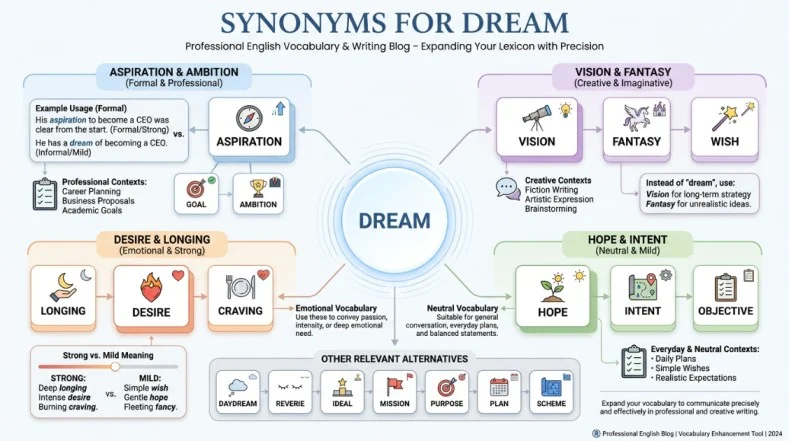
There is no single replacement that works in every sentence. The best synonym depends on the exact meaning you want to communicate.
- For professional writing, aspiration or objective may sound more precise.
- For academic writing, aspiration, ambition, or vision can work well depending on the subject.
- For casual conversation, wish or hope usually sounds natural.
- For emotional writing, longing or desire can add depth.
- For creative writing, fantasy, reverie, or vision can create stronger imagery.
- For resumes and workplace communication, aspiration, goal, objective, or professional ambition is often more specific.
- For social media captions, vision, goal, aspiration, or wish can provide different emotional effects.
- For a stronger meaning, ambition or aspiration can suggest determination and purpose.
- For a softer meaning, wish or hope can express desire without sounding overly intense.
When Not to Use “Dream”
Dream can become too vague when the reader needs to know exactly what someone wants to accomplish.
Instead of saying, “My dream is to improve my career,” a more precise sentence is, “My goal is to become a project manager.”
Dream can also sound too emotional in technical or highly formal writing.
Instead of “The company’s dream is to expand globally,” a business report may be clearer with “The company’s objective is to expand globally.”
In academic writing, aspiration can sometimes communicate a serious long term aim more precisely than dream.
The key is not to avoid dream. The key is to replace it when a more specific word communicates the intended meaning better.
Words Commonly Confused With “Dream”
Dream vs. Goal
A dream is often an important desired outcome, while a goal is a specific result someone intends to achieve.
“My dream is to become a writer” expresses a broad ambition.
“My goal is to finish my first novel this year” gives a measurable target.
Dream vs. Hope
Hope usually expresses a desired possibility. Dream often suggests a deeper or more personal ambition.
“I hope I get the job” describes a desired outcome.
“My dream is to build a successful company” describes a larger ambition.
Dream vs. Wish
Wish often describes something desired that may be difficult, uncertain, or outside someone’s control.
“I wish I could travel more” expresses desire.
“My dream is to become a travel writer” suggests a meaningful aspiration.
Dream vs. Fantasy
Fantasy usually involves imagination and may be unrealistic or detached from practical plans.
“Her dream is to own a restaurant” can represent a realistic ambition.
“His fantasy is to live on a private island” emphasizes imagination rather than a practical objective.
Dream vs. Vision
Vision usually describes a clear picture of a desired future, especially in professional, organizational, or creative contexts.
“Her dream is to start a company.”
“Her vision is to create an affordable company that serves local communities.”
Dream vs. Ambition
Ambition emphasizes determination to achieve something important.
Dream can express the desired outcome without necessarily suggesting strong action.
“My dream is to become a CEO” focuses on the desired future.
“His ambition is to lead a global company” emphasizes drive and achievement.
Best Synonym by Context for “Dream”
| Context | Best Synonym | Why It Works | Example |
|---|---|---|---|
| Formal writing | Aspiration | Sounds polished and purposeful | Her aspiration is to serve the community. |
| Academic writing | Aspiration | Fits serious long term aims | His aspiration is to pursue medical research. |
| Professional or business use | Objective | Communicates a defined result | The objective is to increase customer retention. |
| Resume | Goal | Shows a clear professional target | My goal is to advance into a leadership role. |
| Casual conversation | Wish | Sounds natural and relaxed | I wish I could visit Alaska someday. |
| Creative writing | Vision | Creates an imaginative sense of the future | She carried a vision of a better world. |
| Emotional tone | Longing | Adds strong emotional desire | He felt a deep longing to return home. |
| Strong intensity | Ambition | Suggests drive and determination | Her ambition is to lead a major organization. |
| Soft or moderate tone | Hope | Expresses desire gently | I hope to visit Japan next year. |
| Social media captions | Aspiration | Sounds inspirational without being too formal | Turning an aspiration into reality. |
| US usage | Dream | Extremely natural across everyday contexts | My dream is to own a cabin in the mountains. |
| UK usage | Dream | Also natural and widely understood | His dream is to become a professional musician. |
Which Synonym Should You Choose?
Start by identifying the exact idea behind dream.
- If you mean a clear target, choose goal or objective.
- If you mean a serious long term ambition, choose aspiration or ambition.
- If you mean a desired possibility, choose hope.
- If you mean a personal desire, choose wish or desire.
- If you mean an emotionally powerful desire, choose longing.
- If you mean a future picture or strategic direction, choose vision.
- If you mean something imaginative or unrealistic, choose fantasy.
- If you are writing creatively, choose the word that adds the emotional or visual quality you want.
For professional communication, prioritize precision. For personal communication, emotional meaning may matter more.
Real Life Examples of “Dream” in Sentences
School
“Her dream is to earn a scholarship and attend her preferred university.”
Workplace
“My dream is to build a career where I can combine technology and creativity.”
Writing
“The author turned a childhood dream into the central theme of the novel.”
Conversation
“I have always dreamed of visiting the Grand Canyon.”
Social Media
“Dream big, stay consistent, and celebrate every small victory.”
Resume
“My professional dream is to contribute to innovative projects that improve everyday life.”
For a more precise resume style, “career goal” or “professional aspiration” may be stronger.
“Thank you for helping me move closer to my dream of launching my own business.”
Storytelling
“As a child, she dreamed of discovering a hidden world beyond the mountains.”
25 Synonyms for “Dream”
| Synonym | Simple Meaning | Best Used For | Example Sentence |
|---|---|---|---|
| Aspiration | A strong desire to achieve something | Formal, academic, professional | Her aspiration is to become a physician. |
| Ambition | A strong drive to succeed | Career and achievement | His ambition pushed him toward leadership. |
| Goal | A result someone wants to achieve | Professional and personal planning | My goal is to complete the course this year. |
| Hope | A desired future possibility | Personal and emotional situations | I hope to visit California someday. |
| Wish | Something a person wants | Casual and personal writing | Her wish is to spend more time with family. |
| Desire | A strong feeling of wanting something | Formal and emotional writing | He expressed a desire to learn another language. |
| Vision | A clear idea of a desired future | Business, leadership, creative writing | She has a vision for a more accessible workplace. |
| Objective | A specific result intended to be achieved | Business and formal writing | The team’s objective is to improve service quality. |
| Aim | A purpose or intended result | Academic and professional writing | The program aims to improve literacy rates. |
| Purpose | The reason behind an action or direction | Professional and reflective writing | Her purpose is to help young writers succeed. |
| Plan | An intended course of action | Practical situations | His plan is to open a local design studio. |
| Ideal | A perfect or highly desired standard | Formal and descriptive writing | The ideal is a workplace where everyone feels valued. |
| Fantasy | An imagined situation or desire | Creative and imaginative contexts | Owning a castle became his childhood fantasy. |
| Daydream | Pleasant thoughts about imagined situations | Casual and imaginative contexts | She spent the afternoon in a daydream about traveling. |
| Reverie | A state of pleasant, dreamy thought | Literary and expressive writing | He slipped into a quiet reverie while watching the rain. |
| Aspiration | A meaningful future aim | Serious personal goals | Her aspiration is to become an accomplished editor. |
| Yearning | A strong emotional desire | Emotional writing | He felt a deep yearning for home. |
| Longing | A powerful desire for something absent | Emotional and literary writing | She carried a lasting longing for her hometown. |
| Craving | A very strong desire | Informal and specific desires | He had a craving for a fresh start. |
| Want | A simple desire for something | Everyday conversation | I want a career that gives me more flexibility. |
| Envision | To imagine a future possibility | Professional and creative writing | She envisions a company built around sustainability. |
| Imagine | To form an idea in the mind | General and creative contexts | Imagine living in a city surrounded by mountains. |
| Fantasize | To imagine an unlikely or pleasurable situation | Informal and imaginative contexts | He sometimes fantasizes about writing a bestselling novel. |
| Yearn | To strongly desire something | Emotional and literary writing | She yearns for the freedom to travel. |
| Aspire | To strongly seek or hope to achieve something | Formal and professional contexts | Many students aspire to work in technology. |
Note: Aspiration appears twice in the table because it is one of the closest replacements for dream, but for a published article, you may prefer replacing the second occurrence with “intention” if you want every table entry to be completely distinct. The core distinction remains that dream is broad, while aspiration emphasizes a serious aim.
Synonym Groups and Usage Differences
Professional vs. Personal Synonyms
Professional writing benefits from precise words such as goal, objective, aspiration, ambition, and vision.
Personal writing can comfortably use dream, wish, hope, desire, longing, or yearning.
For example, “My dream is to help people” sounds personal and warm.
“My professional objective is to develop programs that help underserved communities” sounds more precise and workplace appropriate.
Formal vs. Conversational Synonyms
Formal writing often favors aspiration, objective, aim, ambition, and vision.
Conversational English commonly uses dream, wish, hope, want, and plan.
In a casual text, “My dream is to move somewhere warmer” sounds completely natural.
In a formal report, “The organization’s objective is to expand its services” is more precise.
Academic Synonyms
Academic writing usually benefits from words that communicate specific meaning.
Aspiration works for long term personal or educational aims.
Aim works well when describing the purpose of research or an academic project.
Objective works when describing a specific intended result.
Vision can work when discussing theories, future models, or broader concepts.
Professional and Business Synonyms
Business communication should generally favor precision over emotional language.
Objective is useful for measurable outcomes.
Goal works for targets and professional development.
Vision describes a broader future direction.
Aspiration works when discussing career development or organizational ambitions.
Ambition can describe a person’s strong drive for advancement.
Creative or Literary Synonyms
Creative writing offers more freedom to choose expressive alternatives.
Reverie creates a dreamy and reflective atmosphere.
Longing communicates emotional distance or desire.
Yearning adds intensity.
Fantasy emphasizes imagination.
Vision can create a powerful image of an imagined future.
Slang or Modern Synonyms
There is no single slang replacement for dream that works across all situations.
Words such as goal can appear in modern motivational language, especially in phrases about personal achievement.
Expressions such as “big goal” or “life goal” are casual and common online.
However, overly casual expressions should be avoided in academic essays, formal reports, and professional applications.
Strongest vs. Weaker Synonyms
A useful intensity scale is:
Mild: hope
Moderate: wish
Meaningful: desire
Strong: aspiration
Very strong: ambition
Highly emotional: yearning or longing
The intensity depends on context. A word may feel stronger because of emotion rather than because of dictionary meaning alone.
Emotional vs. Neutral Synonyms
Dream can be emotional or neutral depending on usage.
Goal and objective are relatively neutral.
Aspiration has a positive and purposeful tone.
Ambition emphasizes achievement.
Hope feels gentle and optimistic.
Longing and yearning are strongly emotional.
Fantasy emphasizes imagination rather than practical achievement.
Antonyms of “Dream”
Dream does not have one perfect antonym because it has several meanings. The following words represent contextual opposites for the ideas of imagination, aspiration, hope, and unreality.
| Antonym | Meaning | Example Sentence |
|---|---|---|
| Reality | The actual state of things | She decided to face reality and revise her plan. |
| Fact | Something objectively true | The report focuses on facts rather than dreams. |
| Certainty | A condition of being sure | There was certainty about the final decision. |
| Truth | What is real or accurate | The story separates truth from imagination. |
| Actuality | The condition of being real | The proposal differed from the actuality of the situation. |
| Realism | Acceptance of practical conditions | His approach was based on realism rather than fantasy. |
| Practicality | Concern with realistic action | Practicality helped turn the idea into a workable plan. |
| Failure | Lack of success in achieving an aim | Failure ended the original plan. |
| Disappointment | The feeling caused by an unmet desire | The result brought disappointment after months of effort. |
| Resignation | Acceptance of something without trying to change it | Resignation replaced her earlier ambition. |
| Apathy | Lack of interest or concern | Apathy made it difficult to pursue any goal. |
| Indifference | Lack of strong feeling or interest | His indifference contrasted with her strong ambition. |
| Pessimism | Expectation of negative outcomes | Pessimism made the opportunity seem impossible. |
| Doubt | Uncertainty about something | Doubt prevented him from pursuing the opportunity. |
| Surrender | Giving up an effort or objective | Surrender ended his attempt to reach the goal. |
These are contextual contrasts rather than perfect dictionary opposites for every meaning of dream.
Comparison: “Dream” vs. Similar Words
- Dream vs. Goal
- Main difference: Dream often describes a meaningful desired future, while goal usually identifies a specific target.
- Stronger: Dream can feel more emotionally important, while goal can feel more practical.
- More formal: Goal is generally more precise in professional writing.
- Example: “My dream is to become an author.” “My goal is to publish my first novel this year.”
- Dream vs. Hope
- Main difference: Hope focuses on a desired possibility, while dream often describes a deeper ambition.
- Stronger: Dream usually carries more personal significance.
- More formal: Both are common, but hope is often more conversational.
- Example: “I hope I get the position.” “My dream is to lead a creative team.”
- Dream vs. Wish
- Main difference: Wish often expresses a desire, while dream can suggest a larger life ambition.
- Stronger: Dream generally feels more substantial.
- More formal: Wish can sound conversational, while dream works across many styles.
- Example: “I wish I had more free time.” “My dream is to write a novel.”
- Dream vs. Ambition
- Main difference: Ambition emphasizes determination and achievement.
- Stronger: Ambition often sounds more driven.
- More formal: Ambition works particularly well in professional contexts.
- Example: “Her dream is to become a leader.” “Her ambition is to lead an international organization.”
- Dream vs. Vision
- Main difference: Vision describes a clear picture of a desired future.
- Stronger: Vision can sound more strategic, while dream can sound more personal.
- More formal: Vision is often better for business and leadership contexts.
- Example: “His dream is to build a company.” “His vision is to create a company that changes the industry.”
- Dream vs. Fantasy
- Main difference: Fantasy usually emphasizes imagination and may suggest something unrealistic.
- Stronger: Fantasy can sound more imaginative rather than more ambitious.
- More formal: Dream is generally more versatile.
- Example: “Her dream is to own a bookstore.” “Her fantasy is to live in a castle.”
Common Phrases and Expressions with “Dream”
1. Dream Big
Meaning:
To think ambitiously and imagine achieving something significant.
Example sentence:
“Dream big, but create a practical plan that helps you move forward.”
2. Follow Your Dream
Meaning:
To pursue something that you deeply want to achieve.
Example sentence:
“She left a comfortable job to follow her dream of becoming a writer.”
3. Live the Dream
Meaning:
To experience the lifestyle or success someone has wanted.
Example sentence:
“After years of hard work, he finally feels like he is living the dream.”
4. Dream Come True
Meaning:
Something wonderful happens that matches a deeply held desire.
Example sentence:
“Winning the scholarship was a dream come true for her.”
5. Beyond My Wildest Dreams
Meaning:
Something is much better or more successful than expected.
Example sentence:
“The response to her first book was beyond her wildest dreams.”
6. Pipe Dream
Meaning:
An idea or hope that is unlikely to become reality.
Example sentence:
“Without funding or a plan, the proposal may remain a pipe dream.”
7. Dream Job
Meaning:
A job that someone considers especially desirable.
Example sentence:
“Working as a travel photographer has always been her dream job.”
8. American Dream
Meaning:
A widely discussed idea of achieving prosperity and opportunity through effort and opportunity.
Example sentence:
“Many immigrants connect their personal goals with the idea of the American Dream.”
Common Mistakes to Avoid
1. Using Dream When a More Precise Word Is Better
“My dream is to increase sales by 20 percent” is understandable, but “My objective is to increase sales by 20 percent” is more precise in business writing.
2. Confusing Dream With Goal
A dream can be broad and emotional, while a goal is usually more specific and actionable.
3. Using a Casual Synonym in Formal Writing
Words such as want or fantasy may sound inappropriate in a formal report when aspiration or objective would communicate the intended meaning better.
4. Making a Simple Situation Sound Overly Dramatic
Longing or yearning can be too intense for ordinary preferences.
“I yearn for a cup of coffee” sounds dramatic unless used humorously or creatively.
5. Repeating Dream Too Often
Repeating the same word can make writing feel predictable. Replace it with a suitable alternative when the meaning remains accurate.
6. Choosing the Wrong Emotional Tone
Ambition sounds achievement focused, while longing sounds emotional. Replacing one with the other can change the meaning of the sentence.
7. Using Slang in Academic or Professional Writing
Modern casual expressions may work on social media but can weaken an essay, report, resume, or formal email.
FAQs
What is the best synonym for “dream”?
The best synonym depends on context. Aspiration works for serious ambitions, goal for specific targets, hope for possibilities, and vision for future direction.
What is a formal synonym for “dream”?
Aspiration is one of the strongest formal alternatives when dream means a serious personal or professional ambition.
What is an informal synonym for “dream”?
Wish, hope, and want can work as informal alternatives, depending on the exact meaning and sentence.
What is another word for “dream” in professional writing?
Goal, objective, aspiration, ambition, and vision are useful professional alternatives because they provide more specific meaning.
What is the difference between “dream” and “goal”?
A dream is often broad and emotionally meaningful, while a goal usually describes a specific result that someone plans to achieve.
What is the opposite of “dream”?
There is no single perfect opposite. Reality, fact, realism, practicality, certainty, and actuality can contrast with different meanings of dream.
Conclusion
Dream is a flexible word that can describe a personal ambition, future hope, imagined possibility, or sleeping experience. Its meaning changes with the sentence and situation.
The best synonyms for dream include aspiration for serious ambitions, goal for specific targets, hope for desired possibilities, ambition for strong achievement, vision for future direction, and longing for emotional desire.
The most useful vocabulary strategy is to choose a synonym based on meaning first, then consider tone and formality. A precise word can make an essay clearer, a resume stronger, an email more professional, and a caption more expressive.
When you want to replace dream, do not simply choose a word that looks similar. Choose the word that communicates exactly what you mean.
Discover More Post:
- 25+ Synonyms for Achieve | Meanings, Examples, and Best …
- 25+ Synonyms for We | Meanings, Examples, and Best …
- 25+ Synonyms for Share | Meanings, Examples and Best …