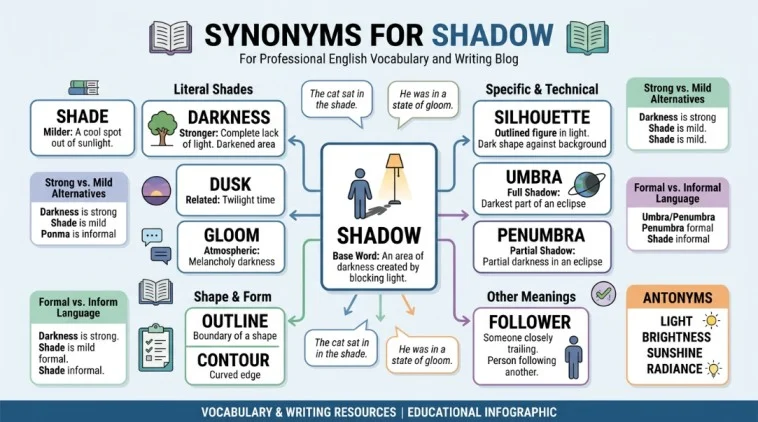
The word shadow can describe much more than a dark shape on the ground. In an essay, caption, email, story, or conversation, repeating it can make your language feel predictable. The right alternative can add precision, emotion, imagery, or professional clarity.
The best synonyms for shadow depend on what you mean. You might need shade for protection from sunlight, silhouette for a visible outline, gloom for emotional darkness, or follower for someone who stays close behind. This guide helps you choose the natural word for each situation.
What Does “Shadow” Mean?
A shadow is a dark area created when an object blocks light. Depending on context, useful alternatives include shade, silhouette, gloom, outline, umbra, penumbra, follower, and trail.
Meaning, Tone and Context
Simple Definition
As a noun, shadow commonly means a dark shape or area produced when something blocks light. It can also describe a person or thing that closely follows another.
The word can have a figurative meaning too. It may represent sadness, fear, secrecy, influence, uncertainty, or a past experience that continues to affect someone.
Part of Speech
Shadow can function as both a noun and a verb.
As a noun:
The tree cast a long shadow across the sidewalk.
As a verb:
The journalist shadowed the manager for a day.
Tone
The tone of shadow is usually neutral when it describes physical light and darkness.
Its figurative use can become mysterious, serious, emotional, threatening, or literary depending on the sentence.
Formality Level
Shadow is a common everyday word. It works naturally in casual conversation, academic writing, professional communication, journalism, creative writing, and social media.
Its simplicity is one of its strengths, but a more specific word can make formal or creative writing more precise.
Common Uses
You may use shadow when discussing:
- Light and darkness
- Weather and sunlight
- Shapes and outlines
- Fear or sadness
- Hidden influences
- Someone who follows another person
- Job training and workplace observation
- Storytelling and imagery
- Photography
- Figurative emotional experiences
Important Word Forms
Noun: shadow
Verb: shadow
Past tense: shadowed
Present participle: shadowing
Related adjective: shadowy
Common expression: in the shadow of
When and How to Use “Shadow”
Use shadow when you want a broad, familiar word that communicates physical darkness or the idea of following or influencing something closely.
1. Personal Context
I sat in the shadow of a large oak tree while reading my book.
2. Professional Context
The new employee will shadow an experienced technician during the first week.
3. Academic Context
The building cast a long shadow over the school courtyard.
4. Emotional Context
A shadow of doubt remained after the conversation.
5. Creative Context
Her childhood memories followed her like a shadow.
6. Social Media Context
Chasing sunlight and leaving the shadows behind.
7. Workplace Context
I spent Friday shadowing the customer service team to understand its daily workflow.
Another Word for “Shadow”
There is no single replacement that works in every sentence. The best synonym depends on the meaning you want to preserve.
- Professional writing: shade, outline, influence, follower
- Academic writing: umbra, penumbra, obscurity, outline
- Casual conversation: shade, dark area, follower
- Emotional writing: gloom, darkness, burden
- Creative writing: silhouette, wraith, darkness, murk
- Resume or workplace use: observe, follow, monitor
- Social media captions: silhouette, shade, darkness
- Stronger meaning: gloom, darkness, wraith
- Softer meaning: shade, outline, trace
When Not to Use “Shadow”
Do not automatically replace shadow with another word just to make writing sound sophisticated. Many alternatives have narrower meanings.
For example:
The tree gave us shadow.
This is understandable, but shade is more natural:
The tree gave us shade.
Likewise, if you mean a visible human outline against bright light, silhouette is more precise:
Her silhouette appeared against the sunset.
If you mean emotional sadness, gloom may communicate the feeling more clearly:
A sense of gloom filled the room.
The goal is not to avoid shadow. The goal is to choose the most accurate word.
Words Commonly Confused With “Shadow”
Shadow vs. Shade
Shadow is usually the dark area created when light is blocked. Shade can refer to an area protected from direct sunlight.
The building cast a shadow across the street.
We sat in the shade to escape the heat.
Shadow vs. Silhouette
A silhouette is a recognizable dark outline of a person or object, usually seen against a lighter background.
The mountain appeared as a dark silhouette at sunset.
Shadow vs. Reflection
A reflection is an image produced when light bounces from a surface. It is not the same as a shadow.
Her reflection appeared in the window.
Shadow vs. Outline
An outline shows the outer edge or shape of something. It does not necessarily imply darkness.
The artist drew the outline of the house.
Shadow vs. Shade
These words overlap in some situations, but shade often emphasizes protection from sunlight, while shadow emphasizes the dark shape created by blocked light.
Shadow vs. Darkness
Darkness describes a lack of light generally. A shadow is usually a particular dark area caused by an object blocking light.
Best Synonym by Context for “Shadow”
| Context | Best Synonym | Why It Works | Example |
|---|---|---|---|
| Formal writing | Obscurity | Expresses lack of clarity or visibility | The issue remained in obscurity. |
| Academic writing | Umbra | Precisely identifies the darkest central shadow | The object produced an umbra. |
| Professional use | Observer | Works when describing someone learning by watching | The trainee acted as an observer. |
| Resume use | Follow | Clearly describes workplace learning | Shadowed senior staff during client meetings. |
| Casual conversation | Shade | Natural when discussing protection from sunlight | We found shade under a tree. |
| Creative writing | Silhouette | Creates strong visual imagery | Her silhouette stood against the moonlight. |
| Emotional tone | Gloom | Suggests sadness or heaviness | Gloom settled over the house. |
| Strong intensity | Darkness | Creates a more powerful sense of absence of light | Darkness covered the valley. |
| Soft or moderate tone | Shade | Sounds less dramatic than darkness | A little shade covered the porch. |
| Social media captions | Silhouette | Short, visual, and expressive | A silhouette against the evening sky. |
| Scientific use | Penumbra | Describes the partially shaded region | The moon entered the penumbra. |
| Storytelling | Wraith | Gives the image a ghostly quality | A wraith moved through the mist. |
Which Synonym Should You Choose?
Start with the basic meaning.
If you mean protection from sunlight, choose shade. You mean a recognizable dark outline, choose silhouette. If you mean the darkest central area of a shadow, choose umbra.
For emotional writing, gloom, darkness, or burden may work better. For following someone, follower, tail, trail, or monitor can be more precise.
Always consider formality and emotional intensity. A scientific term such as umbra may sound unnatural in casual conversation, while a dramatic word such as wraith may be inappropriate in professional writing.
Real Life Examples of “Shadow” in Sentences
School
The students moved into the shadow of the building during the afternoon heat.
Workplace
The intern spent the morning shadowing the sales manager.
Writing
The shadow of failure influenced his decisions.
Conversation
That tall building casts a huge shadow over the parking lot.
Social Media
Finding beauty in every shadow.
Resume
Shadowed experienced staff to learn customer service procedures and workplace communication.
I would appreciate the opportunity to shadow your team and learn more about the department.
Storytelling
A strange shadow moved across the wall before anyone heard the door open.
25 Synonyms for “Shadow”
The following words are context based alternatives. Some describe a physical shadow, while others match figurative or verb meanings. They are not interchangeable in every sentence.
| Synonym | Simple Meaning | Best Used For | Example Sentence |
|---|---|---|---|
| Shade | An area protected from direct light | Sunlight and comfort | We rested in the shade of the tree. |
| Silhouette | A dark outline against a lighter background | Visual description | Her silhouette appeared in the doorway. |
| Umbra | The darkest central part of a shadow | Science and technical writing | The object moved into the eclipse’s umbra. |
| Penumbra | A partly shaded outer region | Science and astronomy | The satellite entered the penumbra. |
| Darkness | Absence of light | Strong general darkness | Darkness covered the empty road. |
| Gloom | Deep or depressing darkness | Emotional and literary writing | Gloom filled the abandoned house. |
| Dimness | Low or weak light | Mild darkness | The dimness of the room made reading difficult. |
| Obscurity | A state of being hidden or unclear | Figurative and formal writing | The truth remained in obscurity. |
| Murk | Dark, unclear, or hazy surroundings | Atmospheric description | The boat disappeared into the murk. |
| Outline | The outer shape of something | Drawing and visual description | The outline of the tower was visible. |
| Contour | The shape or edge of something | Art and descriptive writing | Moonlight revealed the contour of the hills. |
| Profile | A visible side outline or shape | People and objects | His profile stood out against the window. |
| Figure | A visible human or object shape | General visual description | A distant figure crossed the field. |
| Image | A visual representation | General descriptive use | The image appeared clearly on the screen. |
| Reflection | An image produced by reflected light | Mirrors and surfaces | Her reflection appeared in the glass. |
| Trace | A small remaining indication | Figurative writing | There was still a trace of doubt. |
| Hint | A slight indication | Figurative meaning | His silence gave a hint of concern. |
| Echo | A remaining effect or impression | Figurative writing | The event left an echo in her memory. |
| Impression | An effect or mental image | Figurative descriptions | The experience left a lasting impression. |
| Follower | Someone who stays behind another | People and social behavior | The child became a constant follower. |
| Tail | Someone who closely follows another | Informal and surveillance contexts | The detective noticed a tail behind him. |
| Trail | To follow closely behind | Verb use | The dog trailed its owner through the park. |
| Track | To follow or monitor movement | Professional and investigative use | The team tracked the suspect’s movements. |
| Monitor | To observe or watch carefully | Professional use | The supervisor monitored the new process. |
| Overshadow | To dominate or make something less noticeable | Figurative writing | Her success overshadowed the team’s other achievements. |
Synonym Groups and Usage Differences
Professional vs. Personal Synonyms
In professional settings, choose words that explain the action clearly.
Shadow, observe, monitor, and follow are useful for workplace training or observation.
I shadowed the senior consultant during client meetings.
In personal or emotional writing, words such as gloom, darkness, trace, and echo can communicate feelings more effectively.
A shadow of regret remained in his voice.
Formal vs. Conversational Synonyms
Shadow and shade are natural in everyday speech.
Formal writing may benefit from terms such as obscurity, umbra, penumbra, or silhouette, but only when their precise meanings fit.
Do not choose a complex word simply because it sounds more academic.
Academic Synonyms
For scientific or research based writing, umbra and penumbra are particularly useful because they identify specific regions of shadow.
For literary analysis, darkness, gloom, obscurity, and silhouette can describe symbolic or visual effects.
Professional and Business Synonyms
For workplace training, shadow is often highly natural:
I shadowed the department manager.
For observation or oversight, monitor, observe, and track can be more precise.
Choose the word according to the actual activity. Watching someone learn a job is different from monitoring performance.
Creative or Literary Synonyms
Creative writing has more freedom.
Silhouette emphasizes visual shape. Wraith creates a ghostly impression. Gloom creates emotional darkness. Murky imagery can suggest uncertainty or mystery.
These words should support the atmosphere rather than simply replace shadow.
Slang or Modern Synonyms
Tail can describe someone who follows another person, particularly in informal or investigative contexts.
I think someone is tailing us.
This is much more casual than monitor and should not be used casually in a formal report unless the context specifically calls for it.
Strongest vs. Weaker Synonyms
A useful intensity scale is:
Trace → hint → shade → dimness → shadow → gloom → darkness
This is not a strict dictionary scale because each word describes a slightly different idea. The scale simply shows how the emotional or visual effect can become more intense.
Emotional vs. Neutral Synonyms
Shadow, shade, and outline are generally neutral.
Gloom, darkness, wraith, and burden can create a stronger emotional effect.
For factual writing, use neutral terms. For storytelling or emotional writing, a more expressive synonym may be appropriate.
Antonyms of “Shadow”
Because shadow has several meanings, its opposites also depend on context.
| Antonym | Meaning | Example Sentence |
|---|---|---|
| Light | Brightness that makes things visible | Light filled the room. |
| Brightness | Strong illumination | The brightness made the details clear. |
| Illumination | The act or condition of providing light | Better illumination improved visibility. |
| Sunlight | Direct natural light from the sun | Sunlight entered through the window. |
| Exposure | Direct contact with light | The plants need more exposure to sunlight. |
| Clarity | Freedom from confusion or obscurity | The report provided clarity. |
| Visibility | The ability to be clearly seen | Good visibility made driving easier. |
| Openness | A lack of concealment | The company valued openness. |
| Transparency | Clear and open communication | Transparency improved customer trust. |
| Prominence | A state of being noticeable | The new logo gained prominence. |
| Foreground | The most noticeable or nearest part | The tree stands in the foreground. |
| Independence | Freedom from following or dependence | She developed professional independence. |
| Exposure | Being fully visible or uncovered | The building received full exposure to sunlight. |
| Reveal | To make something known or visible | The investigation revealed the truth. |
| Highlight | To make something especially noticeable | The presentation highlighted the main findings. |
Comparison: Shadow vs. Similar Words
Shadow vs. Shade
Main difference: A shadow is produced when an object blocks light, while shade often refers to protection from direct sunlight.
Which one is stronger: Neither is inherently stronger.
Which one is more formal: Both are standard and widely accepted.
Example:
The building cast a shadow across the road.
We sat in the shade.
Shadow vs. Silhouette
Main difference: A silhouette emphasizes the recognizable outline of something against a contrasting background.
Which one is stronger: Silhouette is more visually specific.
Which one is more formal: Both can work in formal writing, depending on context.
Example:
A shadow stretched across the floor.
Her silhouette appeared against the sunset.
Shadow vs. Darkness
Main difference: Darkness describes a general absence of light, while a shadow usually refers to a particular dark area.
Which one is stronger: Darkness usually creates a broader and stronger effect.
Which one is more formal: Both are suitable for formal writing.
Example:
The tree cast a shadow.
Darkness covered the valley.
Shadow vs. Gloom
Main difference: Gloom suggests darkness with a sad, depressing, or unpleasant emotional quality.
Which one is stronger: Gloom is usually more emotionally charged.
Which one is more formal: Both can be used in formal and literary writing.
Example:
The shadow moved across the wall.
Gloom settled over the house.
Shadow vs. Outline
Main difference: An outline describes the outer shape, while a shadow specifically relates to blocked light or figurative darkness.
Which one is stronger: Shadow can be more atmospheric.
Which one is more formal: Outline is often more precise in technical or visual descriptions.
Example:
The shadow of the building covered the street.
The architect drew the outline of the building.
Shadow vs. Reflection
Main difference: A reflection is an image produced by reflected light, while a shadow results from blocked light.
Which one is stronger: Neither is stronger because they describe different phenomena.
Which one is more formal: Both are standard terms.
Example:
The tree created a shadow on the grass.
The tree appeared in the lake’s reflection.
Common Phrases and Expressions with “Shadow”
1. In the Shadow of
Meaning: Being influenced, dominated, or physically located near something larger or more powerful.
Example sentence:
The small business grew in the shadow of a major corporation.
2. Cast a Shadow
Meaning: To create a physical dark area or have a negative effect.
Example sentence:
The tall building cast a shadow over the park.
3. Follow Like a Shadow
Meaning: To remain very close to someone.
Example sentence:
The little boy followed his father like a shadow.
4. Beyond the Shadow of a Doubt
Meaning: With complete certainty.
Example sentence:
The evidence proved beyond the shadow of a doubt that the records were authentic.
5. A Shadow of Doubt
Meaning: A small amount of uncertainty.
Example sentence:
There was not a shadow of doubt about her commitment.
6. Shadow of the Past
Meaning: A past event that continues to influence the present.
Example sentence:
He finally learned to live beyond the shadow of his past.
7. Shadow Boxing
Meaning: Practicing boxing movements without an opponent, or figuratively fighting an imaginary problem.
Example sentence:
The athlete spent ten minutes shadow boxing before practice.
8. Shadow Cabinet
Meaning: A group of political figures who monitor and challenge the work of a government.
Example sentence:
The shadow cabinet criticized the proposed policy.
Common Mistakes to Avoid
1. Using Shadow When Shade Is More Precise
If you mean protection from sunlight, shade is usually the better choice.
We sat under the shade of the tree.
2. Confusing Shadow With Reflection
A reflection comes from light bouncing off a surface. A shadow comes from something blocking light.
3. Using a Casual Synonym in Formal Writing
Words such as tail may sound too informal for professional reports.
Use monitor, track, or observe when appropriate.
4. Using an Overly Dramatic Synonym
Words such as wraith can sound unnecessarily dramatic when you simply mean a dark shape.
Use shadow, outline, or silhouette when the situation is ordinary.
5. Repeating Shadow Too Often
If the same word appears several times in a paragraph, consider whether shade, silhouette, outline, darkness, or another precise alternative fits.
6. Choosing the Wrong Emotional Tone
Gloom suggests sadness. Silhouette is mainly visual. Shade is often neutral. Replacing shadow without considering tone can change the meaning.
7. Using Slang in Academic or Professional Writing
Informal expressions such as tail may be unsuitable in academic essays, formal reports, or professional emails.
FAQs
What is the best synonym for shadow?
The best synonym depends on context. Shade works for sunlight, silhouette for an outline, gloom for emotional darkness, and umbra for technical writing.
What is a formal synonym for shadow?
Umbra, penumbra, obscurity, and silhouette can work as formal alternatives when their precise meanings match the sentence and subject.
What is an informal synonym for shadow?
Shade is common in casual speech when discussing protection from sunlight. Tail can informally describe someone who follows another person.
What is another word for shadow in professional writing?
For workplace training, shadow itself is often the clearest choice. For observation, monitor, observe, or track may be more precise.
What is the difference between shadow and shade?
A shadow is generally a dark area caused by blocked light, while shade commonly describes an area protected from direct sunlight.
What is the opposite of shadow?
Depending on meaning, useful opposites include light, brightness, illumination, visibility, clarity, and exposure.
Conclusion
The word shadow is versatile because it can describe physical darkness, a visible shape, emotional influence, or someone who follows another person. The strongest alternative depends entirely on the intended meaning.
Use shade for protection from sunlight, silhouette for a clear dark outline, umbra and penumbra for scientific contexts, and gloom or darkness for emotional or atmospheric writing.
The practical vocabulary tip is simple: do not replace a word just to sound advanced. Replace it when another word expresses your exact meaning more clearly.
For publication, verify individual definitions and specialized usage with trusted dictionaries such as Cambridge, Oxford, Merriam Webster, Collins, or Britannica.
Discover More Post:
- 25+ Synonyms for Share | Meanings, Examples and Best …
- 25+ Synonyms for Navigate | Meanings, Examples, and Best …
- 25+ Synonyms for Achieve | Meanings, Examples, and Best …