You may use the word “safety” several times when writing an email, school assignment, workplace report, social media caption, or professional document. Repeating the same word can make otherwise strong writing feel flat.
The good news is that English offers many alternatives, from “security” and “protection” to “precaution,” “safeguarding,” and “risk prevention.” The right choice depends on what kind of safety you mean and how formal your writing needs to be.
This guide explains synonyms for safety with clear meanings, realistic examples, tone differences, common phrases, antonyms, and context based recommendations.
What Does “Safety” Mean?
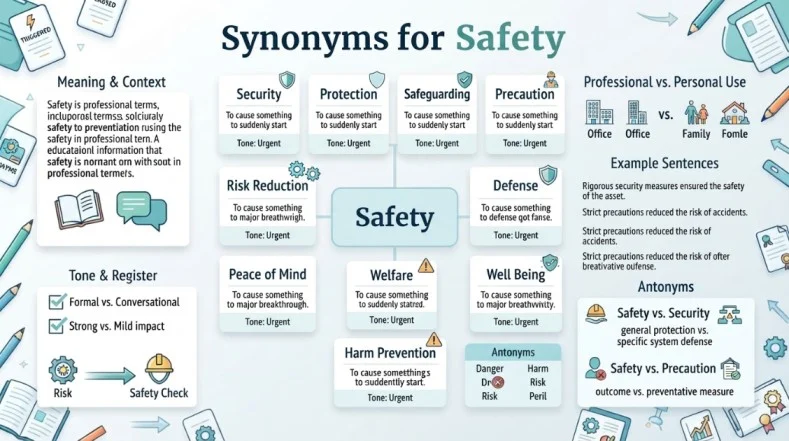
Safety means being protected from danger, injury, harm, or unwanted risk. Depending on context, useful synonyms include security, protection, precaution, safeguarding, defense, welfare, and risk prevention.
Meaning, Tone and Context
Simple Definition
Safety is the condition of being protected from danger, injury, damage, or harm.
For example:
“Everyone’s safety is our top priority.”
This sentence means that protecting people from harm is considered especially important.
Part of Speech
“Safety” is primarily a noun.
Examples include:
“Safety comes first.”
“The company reviewed its safety procedures.”
The related adjective is “safe,” as in:
“The building is safe.”
The related verb is “safeguard,” which means to protect something or someone from harm.
Tone
Safety is generally neutral and practical.
It can become reassuring when discussing people, families, health, travel, or personal protection. In professional settings, it often sounds responsible and objective.
Formality Level
“Safety” works in almost every type of communication.
It is suitable for casual conversation, academic writing, workplace communication, government notices, technical documents, emails, advertisements, and everyday speech.
Common Use Cases
Safety commonly appears in discussions about:
- Workplace practices
- Public health
- Transportation
- Construction
- Children and families
- Cybersecurity
- Emergency planning
- Travel
- Product design
- Personal protection
- Environmental protection
- Physical spaces
Important Word Forms
“Safe” is the main adjective.
“Safely” is the adverb.
“Safety” is the noun.
“Safeguard” can function as a verb or noun.
“Safeguarding” describes the act or process of protecting people or things from harm.
When and How to Use “Safety”
“Safety” is the best general word when you want to communicate protection from harm or danger without adding a very specific emotional or technical meaning.
1. Professional Context
“Employee safety should remain a central part of every workplace policy.”
2. Personal Context
“I always check the weather before leaving for a long drive because safety matters.”
3. Academic Context
“The study examines how transportation design can improve public safety.”
4. Emotional Context
“Her family’s safety was the only thing on her mind during the storm.”
5. Creative Context
“The old lighthouse offered a sense of safety against the violent sea.”
6. Social Media Context
“Drive carefully and put safety first on your road trip.”
7. Email Context
“Please review the updated safety guidelines before entering the facility.”
Another Word for “Safety”
The best single replacement for “safety” depends on what you are trying to emphasize.
For professional writing, “security,” “protection,” and “risk prevention” are often useful.
- For academic writing, “risk reduction,” “harm prevention,” and “safeguarding” can provide greater precision.
- For casual conversation, “security,” “protection,” and “being safe” sound natural.
- For emotional writing, “peace of mind,” “security,” and “protection” can communicate reassurance.
- For creative writing, “refuge,” “haven,” and “shelter” may create stronger imagery when physical or emotional protection is intended.
- For resumes and workplace writing, “risk management,” “safety compliance,” and “harm prevention” can be more specific than the general word “safety.”
- For social media captions, “security,” “protection,” “peace of mind,” and “staying safe” are easy to understand.
- For a stronger meaning, “protection,” “defense,” “safeguarding,” or “harm prevention” may be appropriate.
- For a softer meaning, “care,” “well being,” or “peace of mind” may work better when the context supports them.
When Not to Use “Safety”
“Safety” is useful, but it can sometimes be too broad.
For example:
“Safety is important in the workplace.”
This is correct, but it does not explain what kind of safety is being discussed.
A more precise sentence could be:
“Preventing workplace injuries is essential.”
You may also want a different word when you mean digital protection. In that case, “security” is often more precise.
For emotional reassurance, “peace of mind” may communicate the intended idea better.
For formal risk planning, “risk reduction” or “risk management” can provide more technical detail.
The goal is not to avoid the word “safety.” The goal is to choose a word that communicates your exact meaning.
Words Commonly Confused With “Safety”
Safety vs. Security
Safety usually focuses on protection from physical harm, accidents, or dangerous conditions.
Security often focuses on protection from threats, crime, unauthorized access, or deliberate attacks.
Example:
“The helmet improves rider safety.”
“The password improves account security.”
Safety vs. Protection
Protection means keeping someone or something from harm, damage, or loss.
It is broader than safety and can apply to physical, financial, legal, emotional, or digital situations.
Safety vs. Precaution
A precaution is an action taken to prevent a possible problem.
Safety is the desired condition. A precaution is something you do to help create that condition.
Example:
“Wearing protective equipment is a safety precaution.”
Safety vs. Welfare
Welfare refers to health, happiness, comfort, and general well being.
Safety is more specifically concerned with avoiding danger or harm.
Safety vs. Defense
Defense focuses on resisting or protecting against an attack, threat, or opposing force.
Safety is broader and does not necessarily involve an active threat.
Safety vs. Risk Management
Risk management is the process of identifying, assessing, and controlling potential risks.
Safety is the condition or goal that risk management can help achieve.
Best Synonym by Context for “Safety”
| Context | Best Synonym | Why It Works | Example |
|---|---|---|---|
| Formal writing | Protection | Clear and professional | The policy provides protection for employees. |
| Academic writing | Risk reduction | Emphasizes measurable reduction of danger | The program focuses on risk reduction. |
| Professional use | Security | Works well for systems, facilities, and information | The company improved building security. |
| Workplace | Safeguarding | Emphasizes active protection | Safeguarding employees requires consistent procedures. |
| Resume | Risk management | Highlights a professional skill | Assisted with workplace risk management. |
| Casual conversation | Being safe | Sounds natural and conversational | I just want everyone to be safe. |
| Creative writing | Haven | Creates an image of a protected place | The cabin became a quiet haven. |
| Emotional tone | Peace of mind | Emphasizes reassurance | The new lock gives us peace of mind. |
| Strong intensity | Defense | Suggests active protection against threats | The system provides an additional layer of defense. |
| Soft or moderate tone | Care | Communicates concern without sounding technical | The children were treated with care. |
| Social media | Protection | Simple and immediately understandable | Wear a helmet for better protection. |
| Digital context | Security | Commonly associated with online threats | Strong passwords improve account security. |
| Public health | Harm prevention | Focuses on avoiding negative outcomes | The campaign promotes harm prevention. |
| Travel | Security | Common for airports, hotels, and transportation | Travelers passed through airport security. |
| Emergency planning | Precaution | Highlights preventive action | Extra supplies are a sensible precaution. |
| Physical shelter | Refuge | Suggests a protected place | The building became a refuge during the storm. |
| Family context | Well being | Adds a broader caring meaning | The decision supports the children’s well being. |
| Business operations | Risk control | Sounds precise and professional | Effective risk control reduces operational problems. |
| Construction | Accident prevention | Directly addresses workplace incidents | Accident prevention training is required. |
| US and UK usage | Safety | Widely understood in both varieties of English | Safety procedures must be followed. |
Which Synonym Should You Choose?
Start by asking what you actually mean.
- If you mean protection from physical harm, “protection” or “safeguarding” may work.
- If you mean protection from crime or unauthorized access, choose “security.”
- If you mean an action taken before a problem happens, choose “precaution.”
- If you mean lowering potential danger, “risk reduction” is more precise.
- If you mean protection from an attack or threat, “defense” may be appropriate.
- If you mean emotional reassurance, “peace of mind” can sound more natural.
- If you are writing a formal report, select the word that describes the specific process or outcome rather than automatically replacing “safety.”
Real Life Examples of “Safety” in Sentences
School
“School safety depends on clear emergency procedures and responsible supervision.”
Workplace
“Employee safety should be considered before new equipment is introduced.”
Writing
“The author uses the character’s search for safety to explore fear and trust.”
Conversation
“Your safety matters, so please call when you arrive.”
Social Media
“Road trip checklist: snacks, water, maps, and safety first.”
Resume
“Supported workplace safety initiatives and helped maintain compliance procedures.”
“Please confirm that all safety requirements have been completed before the project begins.”
Storytelling
“After hours in the storm, the travelers finally found safety inside a small farmhouse.”
25 Synonyms for “Safety”
| Synonym | Simple Meaning | Best Used For | Example Sentence |
|---|---|---|---|
| Security | Protection from threats, crime, or unauthorized access | Digital, personal, and physical protection | The new security system protects the building at night. |
| Protection | Keeping someone or something from harm | General professional and personal use | Protective equipment provides important protection for workers. |
| Safeguarding | Actively protecting people or things from harm | Formal, institutional, and professional contexts | Safeguarding children requires careful policies and training. |
| Defense | Protection against an attack or threat | Military, cybersecurity, and physical threats | The network has several layers of defense. |
| Precaution | An action taken to prevent possible harm | Travel, health, workplace, and everyday situations | Wearing gloves is a useful precaution when handling chemicals. |
| Risk prevention | Efforts to stop harmful events before they happen | Professional and technical writing | The program focuses on risk prevention in industrial settings. |
| Risk reduction | Lowering the possibility or impact of harm | Academic and professional writing | Better lighting can contribute to risk reduction. |
| Risk control | Managing conditions that could cause harm | Business and technical contexts | Regular inspections are part of the company’s risk control process. |
| Harm prevention | Efforts designed to avoid injury or damage | Public health and social contexts | The campaign focuses on harm prevention among young drivers. |
| Accident prevention | Measures intended to stop accidents | Workplace, transportation, and construction | Training plays an important role in accident prevention. |
| Care | Attention intended to avoid harm or provide support | Personal and emotional contexts | The equipment should be handled with care. |
| Welfare | General health, comfort, and well being | Social, workplace, and institutional contexts | The organization considers employee welfare when creating policies. |
| Well being | A healthy and comfortable state | Personal, emotional, and health related writing | The program supports the well being of local families. |
| Peace of mind | A feeling of reassurance and freedom from worry | Emotional and consumer contexts | The warranty gives customers peace of mind. |
| Refuge | A place or condition offering protection | Emergencies and creative writing | The shelter provided refuge during the severe storm. |
| Haven | A safe or peaceful place | Creative and descriptive writing | The garden became a quiet haven from the busy city. |
| Shelter | A place that protects from weather or danger | Physical protection and emergencies | The travelers searched for shelter before nightfall. |
| Guarding | Watching or protecting against danger | Physical protection and descriptive contexts | Guarding the entrance helped protect the facility. |
| Safeness | The condition of being safe | General explanation and informal language | The design was created to improve the safeness of the environment. |
| Preservation | Protection from damage, destruction, or loss | Environmental, cultural, and historical contexts | Preservation of the historic building required careful planning. |
| Carefulness | Attention to avoiding mistakes or danger | Everyday behavior and instructions | Carefulness is important when working around heavy machinery. |
| Security measures | Specific actions used to create protection | Professional, technical, and organizational writing | Additional security measures were introduced after the review. |
| Protective measures | Actions intended to prevent harm | Workplace, health, and public safety contexts | Protective measures were required before construction began. |
| Safe conditions | Circumstances without significant danger | Workplace, travel, and public environments | The crew waited until safe conditions returned. |
| Harmlessness | A state of causing little or no harm | Technical or descriptive contexts | Researchers evaluated the harmlessness of the substance. |
Synonym Groups and Usage Differences
Professional vs. Personal Synonyms
Professional writing often benefits from specific terms such as “risk management,” “risk control,” “security,” “safeguarding,” and “protective measures.”
Personal communication can use simpler expressions such as “safety,” “protection,” “being safe,” and “peace of mind.”
For example, a company report might discuss “risk reduction,” while a parent might simply say, “Your safety comes first.”
Formal vs. Conversational Synonyms
“Safety,” “security,” and “protection” work across many levels of formality.
“Safeguarding,” “risk reduction,” and “risk control” sound more specialized.
“Being safe” is more conversational and natural in everyday speech.
Choose based on your audience rather than replacing a familiar word simply to sound sophisticated.
Academic Synonyms
Academic writing usually benefits from precise terms.
“Risk reduction,” “harm prevention,” “risk management,” “risk control,” and “protective measures” can be useful when they accurately describe the subject.
For example:
“The intervention was designed to reduce workplace injury risk.”
This is more specific than simply saying:
“The intervention was designed for safety.”
Professional and Business Synonyms
In workplace communication, “safety,” “security,” “risk management,” “risk control,” “safeguarding,” and “protective measures” can each serve different purposes.
- Use “security” for unauthorized access or threats.
- Use “risk management” for identifying and controlling potential problems.
- Use “safety” for preventing injury and dangerous conditions.
- Use “safeguarding” when emphasizing active protection of people or vulnerable groups.
Creative or Literary Synonyms
Creative writing gives you more room to use words such as “haven,” “refuge,” and “shelter.”
These terms can create atmosphere and imagery.
For example:
“The small cottage became a haven from the chaos outside.”
The word “haven” does more than state that the character was safe. It creates an emotional image of comfort and protection.
Slang or Modern Synonyms
There are few true slang synonyms for “safety” that work reliably across American English.
Expressions such as “staying safe” are conversational and modern, but they are not slang.
In professional and academic writing, standard terms such as “safety,” “security,” “protection,” and “risk prevention” remain preferable.
Strongest vs. Weaker Synonyms
The intensity of a synonym depends heavily on context.
Mild:
Care
Well being
Peace of mind
Moderate:
Safety
Protection
Precaution
Security
Stronger or more active:
Safeguarding
Defense
Harm prevention
Risk control
Very specific protective framing:
Accident prevention
Risk reduction
Protective measures
These words are not a perfect universal intensity scale. The perceived strength changes depending on the situation.
Emotional vs. Neutral Synonyms
Neutral terms include “safety,” “protection,” “security,” “risk reduction,” and “risk control.”
More emotional expressions include “peace of mind,” “haven,” “refuge,” and “care.”
Use neutral terms when you need accuracy. Use emotional terms when reassurance, comfort, or atmosphere is part of your message.
Antonyms of “Safety”
| Antonym | Meaning | Example Sentence |
|---|---|---|
| Danger | A condition that could cause harm | The hikers entered an area of danger after the storm. |
| Risk | The possibility of harm or loss | Driving without rest creates unnecessary risk. |
| Peril | Serious and immediate danger | The sailors were in peril during the violent storm. |
| Hazard | Something that can cause harm | Wet floors can become a serious hazard. |
| Threat | Something that may cause harm or damage | The exposed wiring created a threat to workers. |
| Insecurity | A lack of protection or confidence | Poor security can create a sense of insecurity. |
| Vulnerability | Exposure to possible harm | The outdated system left the company vulnerable. |
| Exposure | Contact with something potentially harmful | Prolonged exposure to extreme heat can be dangerous. |
| Harm | Physical or other damage | The treatment was designed to prevent harm. |
| Injury | Physical damage to the body | The new equipment helped reduce workplace injuries. |
| Jeopardy | A state of being at risk | The passengers were placed in jeopardy by the mechanical failure. |
| Recklessness | Careless behavior that ignores danger | Recklessness behind the wheel can have serious consequences. |
| Carelessness | Failure to act carefully | Carelessness caused the safety procedure to be ignored. |
| Neglect | Failure to provide necessary attention or protection | Neglect of maintenance can create dangerous conditions. |
| Unsafe conditions | Circumstances that present significant danger | Workers were told not to enter because of unsafe conditions. |
Comparison: “Safety” vs. Similar Words
Safety vs. Security
The main difference is the type of threat involved.
“Safety” often refers to protection from accidents, injury, or physical harm.
“Security” often refers to protection from crime, attacks, unauthorized access, or deliberate threats.
Neither is universally stronger. “Security” is more specific when an intentional threat is involved.
“Safety” is more general for physical harm and accidents.
Example:
“The factory improved worker safety.”
“The company improved building security.”
Safety vs. Protection
“Protection” is broader than “safety.”
Protection can involve physical, emotional, financial, legal, environmental, or digital harm.
“Safety” is more directly connected with avoiding danger and injury.
Example:
“The helmet improves safety.”
“The law provides protection for consumers.”
Safety vs. Precaution
A precaution is an action.
Safety is a condition or goal.
A person takes a precaution to improve safety.
Example:
“Wearing a seat belt is a safety precaution.”
“Seat belts improve passenger safety.”
Safety vs. Welfare
Welfare includes general health, comfort, and well being.
Safety focuses more specifically on avoiding danger and harm.
“Welfare” is broader and often more concerned with overall quality of life.
Example:
“The policy protects employee safety.”
“The policy supports employee welfare.”
Safety vs. Defense
Defense usually involves protection against an opposing force, attack, or threat.
Safety does not require an active opponent.
“Defense” is therefore more forceful and threat focused.
Example:
“The building has strong fire safety measures.”
“The network has multiple layers of cyber defense.”
Safety vs. Risk Management
Risk management describes a process for identifying and controlling potential problems.
Safety is often the desired outcome.
“Risk management” is more technical and professional.
Example:
“Safety is a major project goal.”
“Risk management helps the team identify potential hazards.”
Common Phrases and Expressions with “Safety”
1. Safety First
Meaning:
A phrase that emphasizes putting protection from harm before other concerns.
Example sentence:
“Safety first, so please wait until the equipment has stopped completely.”
2. For Your Safety
Meaning:
An expression used to explain that an action or instruction is intended to prevent harm.
Example sentence:
“For your safety, please remain behind the marked line.”
3. Safety Measures
Meaning:
Actions or procedures designed to prevent accidents, injuries, or other harm.
Example sentence:
“The school introduced additional safety measures after reviewing its emergency plan.”
4. Safety Precautions
Meaning:
Actions taken to reduce the chance of an accident or harmful event.
Example sentence:
“Follow all safety precautions before using the equipment.”
5. Safety Standards
Meaning:
Rules or requirements designed to maintain acceptable levels of protection.
Example sentence:
“The manufacturer must meet established safety standards.”
6. Safety Concerns
Meaning:
Issues or worries related to possible danger or harm.
Example sentence:
“Several employees raised safety concerns about the damaged stairs.”
7. Safety Record
Meaning:
A history of how well a person, organization, product, or system has performed regarding safety.
Example sentence:
“The company has maintained a strong safety record for several years.”
8. Safety Net
Meaning:
Something that provides protection or support when a person or system encounters difficulty.
Example sentence:
“Emergency savings can serve as a financial safety net.”
Common Mistakes to Avoid
1. Using “Safety” When a More Precise Word Is Better
“Safety” can be too broad.
Instead of “online safety,” consider “cybersecurity” or “account security” when the subject is unauthorized access or digital attacks.
2. Confusing Safety With Security
These words overlap, but they are not interchangeable in every sentence.
Use “safety” for accidents and physical harm. Use “security” for threats such as theft, unauthorized access, and attacks.
3. Using a Casual Expression in Formal Writing
“Stay safe” is natural in conversation.
A formal report may require “follow the established safety procedures” instead.
4. Using an Overly Dramatic Synonym
Words such as “peril” and “jeopardy” can sound dramatic.
Do not use them when you simply mean ordinary workplace safety.
5. Repeating “Safety” Too Often
Repeating the same word can make a paragraph feel mechanical.
Where appropriate, vary the language with terms such as “protection,” “security,” “risk reduction,” or “safeguarding.”
6. Choosing the Wrong Emotional Tone
“Haven” may sound warm and comforting.
“Defense” sounds stronger and more confrontational.
Choose the word that matches the emotional effect you want.
7. Using Slang in Academic or Professional Writing
Conversational expressions can be friendly, but they may sound inappropriate in formal documents.
Use precise standard vocabulary for reports, research papers, resumes, and professional communication.
FAQs
What is the best synonym for safety?
“Protection” is a strong general synonym, while “security,” “precaution,” “safeguarding,” and “risk reduction” may be better for specific contexts.
What is a formal synonym for safety?
Formal alternatives include “safeguarding,” “risk reduction,” “risk control,” “protective measures,” and “harm prevention,” depending on the intended meaning.
What is an informal synonym for safety?
In casual English, “being safe” is natural. “Protection” and “security” can also work without sounding overly formal.
What is another word for safety in professional writing?
Professional alternatives include “security,” “risk management,” “risk control,” “safeguarding,” “protective measures,” and “risk reduction.”
What is the difference between safety and security?
Safety generally concerns protection from accidents and physical harm, while security often concerns protection from threats, crime, attacks, or unauthorized access.
What is the opposite of safety?
Common opposites include danger, risk, hazard, peril, vulnerability, exposure, insecurity, and unsafe conditions.
Conclusion
Safety means being protected from danger, injury, damage, or harm. It is a flexible word that works naturally in everyday conversation, academic writing, professional communication, and creative writing.
The best synonym depends on your exact meaning. Use “security” for threats and unauthorized access, “protection” for broad protection, “precaution” for preventive action, “risk reduction” for lowering danger, and “peace of mind” when emotional reassurance matters.
The most useful vocabulary habit is to ask what you specifically mean before choosing a synonym. A precise word will usually make your writing clearer than a more complicated word simply chosen for variety.
If you are unsure, start with “safety,” then replace it only when another word communicates your intended meaning more accurately.
Discover More Post:
- 25+ Synonyms for God | Meanings, Examples, and Best …
- 25+ Synonyms for Yelled | Meanings, Examples, and Best …
- 25+ Synonyms for Secret | Meanings, Examples, and Best …