Have you ever written “she yelled” several times in a story, email, caption, or essay and felt that the sentence needed more variety? Choosing a more precise word can show whether someone shouted in anger, called for attention, screamed in fear, or simply spoke loudly.
The best synonym depends on volume, emotion, urgency, and context. This guide explains synonyms for yelled with practical examples so you can choose words that sound natural in American English.
What Does “Yelled” Mean?
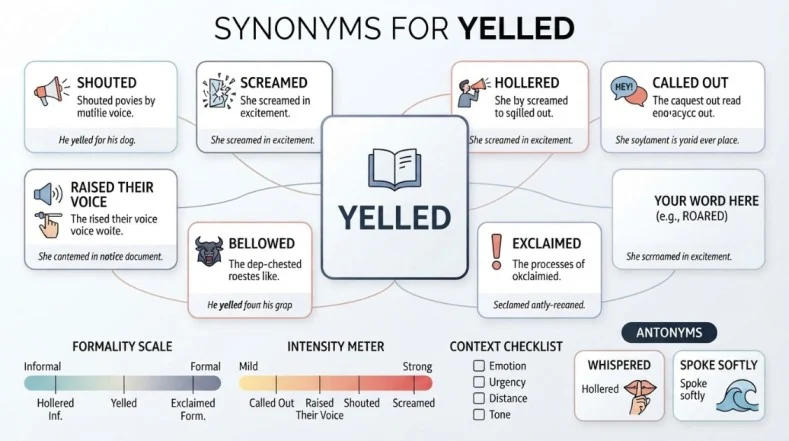
“Yelled” means spoke or called out very loudly, usually because of anger, excitement, fear, urgency, or distance. Formal choices include called out or exclaimed, while casual and emotional choices include shouted, hollered, screamed, or bellowed.
Meaning, Tone and Context
Simple Definition
Yelled is the past tense of the verb “yell.” It means to speak, call, or cry out with a loud voice.
For example:
“She yelled for her brother.”
Here, the person used a louder voice than normal, possibly because her brother was far away or could not hear her.
Part of Speech
“Yelled” is a verb.
The base form is “yell,” the present form is “yells,” the past form is “yelled,” and the present participle is “yelling.”
Tone
Yelled is generally neutral in meaning, but the surrounding sentence can make it sound angry, frightened, excited, playful, or urgent.
Compare these examples:
“He yelled across the field.”
This may simply indicate distance.
“She yelled at her manager.”
This usually suggests anger or confrontation.
“She yelled with excitement.”
This shows positive emotion.
Formality Level
Yelled is common and conversational. It works well in everyday speech, fiction, personal writing, and informal communication.
For formal or academic writing, a more precise expression such as “spoke loudly,” “called out,” or “exclaimed” may be more appropriate depending on the intended meaning.
Common Use Cases
You might use yelled when describing:
- An angry argument
- A warning
- Someone calling from a distance
- Excitement at a sports event
- Fear or panic
- A dramatic story scene
- A loud conversation
- An urgent request
When and How to Use “Yelled”
“Yelled” is useful when loudness is an important part of the action. The word becomes more precise when you explain why the person raised their voice.
Personal Context
“Dad yelled from the kitchen that dinner was ready.”
Emotional Context
“She yelled in frustration when the computer crashed again.”
Academic Context
“The student yelled an answer before the teacher finished the question.”
Professional Context
“The supervisor yelled for everyone to leave the building.”
For formal workplace writing, “called out” or “instructed loudly” may sound more neutral.
Creative Context
“Get out!” he yelled as the door slammed behind him.
Social Media Context
“I yelled when my team scored in the final seconds!”
Email Context
Instead of writing, “The customer yelled at me,” a more neutral professional description might be, “The customer raised their voice during the conversation.”
Another Word for “Yelled”
The best single replacement for yelled is often “shouted.” It preserves the basic meaning of speaking loudly without automatically suggesting extreme fear or anger.
The ideal choice changes with the situation.
- Professional writing: called out or raised their voice
- Academic writing: called out or spoke loudly
- Casual conversation: shouted or hollered
- Emotional writing: screamed or cried out
- Creative writing: bellowed, roared, shrieked, or thundered
- Resume or workplace use: raised their voice
- Social media captions: screamed or shouted
- Stronger meaning: screamed or shrieked
- Softer meaning: called out or spoke loudly
When Not to Use “Yelled”
“Yelled” may not be the best word when the exact emotion or manner of speaking matters.
If the person is simply trying to get someone’s attention from far away, “called out” can be more precise.
“She yelled from across the room” is understandable, but “She called out from across the room” may sound less aggressive.
- If the person is extremely frightened, “screamed” may communicate the intensity more clearly.
- If the character uses a deep, powerful voice, “bellowed” can provide stronger imagery.
- If the writing is formal, “raised their voice” may sound more professional than “yelled.”
Precision matters because different synonyms can communicate different emotions even when they all involve loud speech.
Words Commonly Confused With “Yelled”
Yelled vs. Shouted
Both mean speaking loudly. Shouted is usually a close replacement, while yelled can sound slightly more conversational or emotionally charged.
Yelled vs. Screamed
Screamed usually suggests greater intensity and can indicate fear, pain, excitement, or anger. Yelled does not necessarily imply extreme emotion.
Yelled vs. Hollered
Hollered is informal and often describes a loud call over a distance. It is especially common in casual American English.
Yelled vs. Called Out
Called out can simply mean speaking loudly enough to get someone’s attention. It does not necessarily suggest anger.
Yelled vs. Exclaimed
Exclaimed emphasizes strong emotion or surprise rather than volume alone.
Yelled vs. Bellowed
Bellowed describes a very loud, powerful, often deep voice. It creates a stronger and more dramatic image than yelled.
Best Synonym by Context for “Yelled”
| Context | Best Synonym | Why It Works | Example |
|---|---|---|---|
| Formal writing | Called out | Sounds more neutral | She called out a warning to the group. |
| Academic writing | Spoke loudly | Focuses on volume without unnecessary emotion | The participant spoke loudly enough for everyone to hear. |
| Professional or business use | Raised their voice | Describes conflict in a neutral way | The customer raised their voice during the discussion. |
| Resume | Communicated loudly | Describes the action without emotional judgment | Communicated loudly during emergency drills. |
| Casual conversation | Shouted | Natural and widely understood | He shouted when he saw his friend across the street. |
| Creative writing | Bellowed | Adds force and vividness | The captain bellowed an order across the deck. |
| Emotional tone | Cried out | Highlights emotional reaction | She cried out when she saw the damage. |
| Strong intensity | Screamed | Indicates extreme volume or emotion | He screamed when the alarm went off. |
| Soft or moderate tone | Called out | Can describe loud communication without aggression | She called out his name from the hallway. |
| Social media caption | Screamed | Works for dramatic or playful reactions | I screamed when the surprise appeared. |
| Urgent warning | Shouted | Clearly communicates urgency | The lifeguard shouted a warning. |
| Anger | Roared | Adds powerful emotional force | The coach roared at the players. |
| Fear | Shrieked | Conveys a high, piercing emotional sound | She shrieked when the spider appeared. |
| Distance | Hollered | Natural for calling across a large space | He hollered from the other side of the yard. |
| Surprise | Exclaimed | Focuses on emotional reaction | “You won!” she exclaimed. |
US and UK Usage
Yelled and shouted are both widely understood in American and British English.
“Hollered” is particularly natural in informal American English, while words such as “bellowed,” “shrieked,” and “exclaimed” are broadly understood in both varieties.
Which Synonym Should You Choose?
Start by asking what the person is actually doing.
- If the main idea is simply loud speech, choose shouted or spoke loudly.
- If someone is trying to get attention from a distance, choose called out or hollered.
- If the voice expresses extreme emotion, consider screamed, shrieked, or cried out.
- If the person sounds powerful or commanding, bellowed or roared may work better.
For professional communication, raised their voice is often more neutral than an emotionally loaded word.
For creative writing, choose the synonym that reveals the character’s emotion, voice, and situation rather than simply increasing volume.
Real Life Examples of “Yelled” in Sentences
School
“The teacher yelled when the students started running through the hallway.”
Workplace
“The manager yelled during the disagreement.”
A neutral professional version would be:
“The manager raised their voice during the disagreement.”
Writing
“She yelled his name when she saw him disappear into the crowd.”
Conversation
“I yelled across the room because you could not hear me.”
Social Media
“I yelled when I saw the final score!”
“The caller yelled at the representative.”
For a professional email, “The caller raised their voice at the representative” may be more appropriate.
Storytelling
“Stop!” Maya yelled as the car began to move.
Everyday Situation
“Mom yelled from upstairs that it was time to leave.”
25 Synonyms for “Yelled”
| Synonym | Simple Meaning | Best Used For | Example Sentence |
|---|---|---|---|
| Shouted | Spoke very loudly | General loud speech | She shouted his name across the street. |
| Screamed | Used an extremely loud or emotional voice | Fear, anger, pain, excitement | He screamed when the lights suddenly went out. |
| Hollered | Called loudly, often across a distance | Casual American speech | She hollered from the porch. |
| Called out | Spoke loudly to get attention | Neutral situations | He called out to his friend in the crowd. |
| Cried out | Spoke or cried loudly because of emotion | Fear, pain, urgency | She cried out when she realized what had happened. |
| Exclaimed | Spoke suddenly with strong emotion | Surprise or excitement | “That is incredible!” he exclaimed. |
| Bellowed | Spoke with an extremely loud, powerful voice | Commands and dramatic scenes | The captain bellowed an order to the crew. |
| Roared | Spoke with great force and volume | Anger and powerful emotion | The coach roared at the team. |
| Shrieked | Made a high, piercing loud sound | Fear or excitement | She shrieked when the mouse ran across the floor. |
| Screeched | Produced a harsh, piercing loud sound | Panic, anger, or dramatic scenes | He screeched for help when the door jammed. |
| Howled | Cried out in a long, loud voice | Strong emotion or dramatic description | He howled with frustration after losing the game. |
| Shouted out | Spoke loudly and suddenly | Answers and reactions | The student shouted out the answer. |
| Called | Spoke loudly enough for someone at a distance to hear | Getting attention | She called to her brother from the driveway. |
| Raised their voice | Spoke more loudly than normal | Professional or neutral descriptions | The customer raised their voice during the complaint. |
| Spoke loudly | Used a louder than normal voice | Formal or factual writing | The witness spoke loudly so everyone could hear. |
| Cried | Called or spoke loudly with emotion | Literary and emotional writing | “Wait for me!” she cried. |
| Roared out | Uttered something with tremendous force | Dramatic writing | He roared out the command. |
| Thundered | Spoke in a deep, powerful, forceful way | Literary descriptions | “Leave now,” the king thundered. |
| Vociferated | Spoke or argued very loudly | Formal or literary writing | The protester vociferated his objections. |
| Yowled | Made a loud, drawn out cry | Pain, distress, or dramatic scenes | The cat yowled when it became trapped. |
| Screamed out | Cried something with extreme force | Intense emotional scenes | She screamed out his name. |
| Shouted angrily | Spoke loudly with anger | Explicit emotional description | He shouted angrily during the argument. |
| Called loudly | Used a strong voice to attract attention | Distance and practical communication | She called loudly for assistance. |
| Cried aloud | Expressed something loudly | Literary or emotional writing | He cried aloud for someone to help. |
| Spoke forcefully | Used a strong, emphatic voice | Formal and professional descriptions | The speaker spoke forcefully about the issue. |
Synonym Groups and Usage Differences
Professional vs. Personal Synonyms
Personal writing often allows emotionally expressive words such as screamed, shrieked, or hollered.
Professional writing usually benefits from neutral descriptions such as raised their voice, called out, or spoke loudly.
For example:
Personal: “The customer screamed at the employee.”
Professional: “The customer raised their voice during the interaction.”
The second version describes the event without adding as much emotional judgment.
Formal vs. Conversational Synonyms
Formal writing favors precise expressions such as spoke loudly, raised their voice, or called out.
Conversational English naturally uses shouted, yelled, hollered, and screamed.
Choose the word according to the audience and purpose rather than simply searching for the most sophisticated alternative.
Academic Synonyms
Academic writing generally values factual descriptions over dramatic language.
If volume matters, “spoke loudly” may be appropriate. If a person’s emotional reaction matters, “exclaimed” or “cried out” may be useful.
Avoid using words such as bellowed or roared in analytical writing unless you are directly describing a literary or historical source.
Professional and Business Synonyms
Workplace communication often benefits from neutral wording.
“Raised their voice” is useful when describing a difficult interaction. “Called out” works when someone needs to attract attention.
Words such as screamed, roared, and bellowed can sound judgmental or overly dramatic in business documents.
Creative or Literary Synonyms
Creative writing gives you more freedom to choose vivid verbs.
Bellowed can make a character sound powerful. Shrieked can suggest fear. Thundered can create a commanding atmosphere.
The strongest word is not automatically the best word. It should fit the character and scene.
Slang or Modern Synonyms
There is no single slang replacement for yelled that works naturally in every situation.
Casual expressions such as hollered are common and easy to understand, but they may sound too informal for academic or professional writing.
Strongest vs. Weaker Synonyms
A useful intensity scale is:
Spoke loudly → called out → shouted → yelled → hollered → screamed → shrieked → bellowed or roared
This is not a strict universal ranking because context changes the strength of each word. A person can bellow a command without being angry, while someone can quietly yell in frustration.
Emotional vs. Neutral Synonyms
More neutral choices include:
- Called out
- Spoke loudly
- Raised their voice
- Called
More emotional choices include:
- Screamed
- Shrieked
- Roared
- Bellowed
- Cried out
Choose neutral language when you want the reader to interpret the situation independently. Choose emotional language when the emotional reaction is important to the meaning.
Antonyms of “Yelled”
There is no single perfect opposite of yelled in every context. The following are contextual opposites that describe quieter or calmer ways of communicating.
| Antonym | Meaning | Example Sentence |
|---|---|---|
| Whispered | Spoke very quietly | She whispered the answer. |
| Spoke softly | Used a gentle, quiet voice | He spoke softly to the child. |
| Murmured | Spoke in a low, quiet voice | She murmured a quick response. |
| Mumbled | Spoke unclearly and quietly | He mumbled an apology. |
| Spoke quietly | Used little vocal volume | The students spoke quietly in the library. |
| Said calmly | Spoke without loud emotional force | She said calmly that everything was fine. |
| Breathed | Spoke extremely softly | He breathed the words under his breath. |
| Muttered | Spoke quietly, often with irritation | She muttered a complaint. |
| Hushed | Made something quiet | The teacher hushed the class. |
| Spoke gently | Used a soft and considerate voice | He spoke gently to his nervous dog. |
| Whispered softly | Used an especially quiet voice | She whispered softly so nobody else could hear. |
| Spoke in a low voice | Used reduced vocal volume | He spoke in a low voice during the meeting. |
| Spoke under their breath | Spoke so quietly that others could barely hear | She spoke under her breath. |
| Remained silent | Did not speak | He remained silent during the argument. |
| Listened | Gave attention without speaking loudly | She listened instead of responding angrily. |
Comparison: “Yelled” vs. Similar Words
Yelled vs. Shouted
Main difference: Both describe loud speech, and their meanings often overlap.
Stronger: Neither is always stronger. Context determines intensity.
More formal: Neither is particularly formal, although “shouted” can sound slightly more neutral.
Examples:
“He yelled for help.”
“She shouted for help.”
Both sentences are natural.
Yelled vs. Screamed
Main difference: Screamed usually suggests greater emotional or physical intensity.
Stronger: Screamed is generally more intense.
More formal: Neither is formal.
Examples:
“She yelled at him.”
“She screamed at him.”
The second sentence suggests a more extreme emotional reaction.
Yelled vs. Hollered
Main difference: Hollered often describes a loud call across a distance and has a casual tone.
Stronger: Both can be very loud.
More formal: Yelled is more neutral than hollered.
Examples:
“He yelled across the room.”
“He hollered across the field.”
Yelled vs. Called Out
Main difference: Called out emphasizes attracting attention rather than anger.
Stronger: Yelled usually sounds stronger.
More formal: Called out can sound more neutral.
Examples:
“She yelled his name.”
“She called out his name.”
Yelled vs. Exclaimed
Main difference: Exclaimed focuses on strong emotion or sudden reaction, while yelled focuses more directly on loudness.
Stronger: Yelled is generally stronger in volume.
More formal: Exclaimed can work better in polished writing.
Examples:
“Wow!” she exclaimed.
“Stop!” she yelled.
Yelled vs. Bellowed
Main difference: Bellowed suggests a very loud, powerful, often deep voice.
Stronger: Bellowed generally creates a more forceful impression.
More formal: Bellowed is literary rather than professionally formal.
Examples:
“He yelled an order.”
“He bellowed an order across the room.”
Common Phrases and Expressions with “Yelled”
1. Yelled at someone
Meaning:
Spoke to someone loudly, often because of anger or frustration.
Example sentence:
“She yelled at her brother for breaking the vase.”
2. Yelled for help
Meaning:
Called loudly because assistance was needed.
Example sentence:
“He yelled for help when the boat began to drift away.”
3. Yelled across the room
Meaning:
Spoke loudly enough for someone at a distance to hear.
Example sentence:
“I yelled across the room to get her attention.”
4. Yelled out a name
Meaning:
Said someone’s name loudly to attract attention.
Example sentence:
“She yelled out his name as he walked away.”
5. Yelled in anger
Meaning:
Used a loud voice because of anger.
Example sentence:
“He yelled in anger after discovering the mistake.”
6. Yelled with excitement
Meaning:
Spoke or cried loudly because of happiness or excitement.
Example sentence:
“The fans yelled with excitement when the winning goal was scored.”
7. Yelled a warning
Meaning:
Gave an urgent warning using a loud voice.
Example sentence:
“The lifeguard yelled a warning to the swimmers.”
Common Mistakes to Avoid
1. Using “yelled” when a more precise synonym is better
If someone simply needs to attract attention, “called out” may be more accurate.
2. Confusing “yelled” with “screamed”
Screamed generally carries more emotional intensity. Do not use it when the person merely speaks loudly.
3. Using a casual synonym in formal writing
Words such as hollered may sound too conversational in reports, academic papers, or professional documents.
4. Using an overly dramatic synonym
Bellowed, roared, and shrieked can make an ordinary situation sound extreme. Use them when the scene genuinely supports that intensity.
5. Repeating “yelled” too often
In creative writing, repeated use can make dialogue tags feel monotonous. Use precise alternatives only when they add meaningful information.
6. Choosing the wrong emotional tone
“Exclaimed” can suggest surprise, while “screamed” can suggest extreme emotion. Consider the feeling behind the voice.
7. Using slang in academic or professional writing
Casual expressions can weaken an otherwise polished sentence. Choose neutral language when the audience expects formal communication.
FAQs
What is the best synonym for “yelled”?
“Shouted” is usually the closest general synonym for yelled. For specific situations, called out, screamed, hollered, or bellowed may communicate the intended meaning more precisely.
What is a formal synonym for “yelled”?
A formal alternative depends on context. “Raised their voice,” “spoke loudly,” and “called out” are useful neutral choices for professional or academic writing.
What is an informal synonym for “yelled”?
“Hollered” is an informal synonym for yelled, especially when describing someone calling loudly across a distance. “Shouted” is also natural in casual conversation.
What is another word for “yelled” in professional writing?
“Raised their voice” is often useful in professional writing because it describes loud speech without automatically suggesting extreme anger or emotional behavior.
What is the difference between “yelled” and “screamed”?
Yelled means speaking loudly, while screamed usually suggests greater intensity, stronger emotion, or a very high level of volume.
What is the opposite of “yelled”?
Contextual opposites include whispered, murmured, spoke softly, spoke quietly, and remained silent. The best choice depends on the intended contrast.
Conclusion
“Yelled” describes speaking or calling with a loud voice, but the right synonym can reveal much more about the situation.
Use shouted for general loud speech, called out for getting attention, hollered for casual calls across a distance, screamed for stronger emotion, and bellowed or roared for powerful dramatic voices.
For professional and academic writing, neutral choices such as raised their voice or spoke loudly are often more precise.
The most useful vocabulary tip is simple: do not choose a synonym only because it sounds sophisticated. Choose the word that accurately matches the speaker’s volume, emotion, purpose, and context.
Before publishing educational content, verify individual definitions and usage with trusted dictionaries such as Cambridge, Oxford, Merriam Webster, Collins, or Britannica.
Discover More Post:
- 25+ Synonyms for Secret | Meanings, Examples, and Best …
- 25+ Synonyms for Proficient | Meanings, Examples, and Best …
- 25+ Synonyms for Walked | Meanings, Examples, and Best …