You may notice how often the word “attention” appears in emails, essays, workplace messages, captions, and everyday conversations. Sometimes you need a more precise word to describe concentration, interest, care, awareness, or public notice.
This guide explains synonyms for attention by meaning, tone, and context. You will learn which alternatives work best in academic writing, professional communication, casual conversation, emotional writing, resumes, and creative work.
What Does “Attention” Mean?
Attention means directing your mind, senses, or interest toward someone or something. Depending on context, useful synonyms include focus for concentration, interest for curiosity, heed for careful consideration, and awareness for conscious recognition.
Meaning, Tone and Context
Simple Definition
Attention means the act of noticing, listening to, thinking about, or concentrating on something. It can also describe interest or public notice given to a person, topic, event, or issue.
For example, “Please pay attention” asks someone to concentrate. In “The article attracted attention,” the word refers to interest or notice from other people.
Part of Speech
Attention is primarily a noun.
Examples include:
“Your attention is important.”
“She gave the presentation her full attention.”
“The campaign received national attention.”
Tone
Attention is generally neutral. Its emotional effect depends on the surrounding words.
“Careful attention” sounds positive and responsible, while “unwanted attention” has a negative meaning. “Public attention” can be neutral, positive, or negative depending on the situation.
Formality Level
Attention works naturally in formal, professional, academic, and casual English. It is one of the most flexible words in this group.
However, a more specific synonym can make your sentence clearer. For example, “focus” may be better when discussing concentration, while “interest” may be better when discussing curiosity.
Common Use Cases
Attention commonly appears when discussing:
- Concentration and mental focus
- Listening and observation
- Care and consideration
- Interest in a subject
- Public recognition
- Workplace communication
- Academic study
- Safety and awareness
- Customer engagement
- Creative or emotional expression
Important Word Forms
The main related forms include “attentive,” meaning careful or observant, and “attentively,” meaning in a careful or focused manner.
The opposite concept is commonly expressed through words such as “inattention,” “disregard,” or “distraction.”
When and How to Use “Attention”
Attention is useful whenever you want to describe concentration, awareness, interest, or notice.
Professional
“Please give this issue your immediate attention.”
This is appropriate when asking a colleague to deal with an important matter.
Personal
“Thank you for giving me your attention during our conversation.”
Here, attention refers to listening and being mentally present.
Academic
“Students need sustained attention to understand complex material.”
In this context, attention means concentration.
Emotional
“She appreciated the attention her friends gave her during a difficult week.”
Here, attention suggests care, support, and personal consideration.
Creative
“The unusual painting immediately captured my attention.”
The word describes the strong effect the artwork had on the observer.
Social Media
“The creator quickly attracted attention with a thoughtful video.”
In this example, attention means public interest.
“Thank you for your attention to this matter.”
This is a common professional expression when asking someone to consider or address an issue.
Another Word for “Attention”
The best single replacement depends on what you mean by attention.
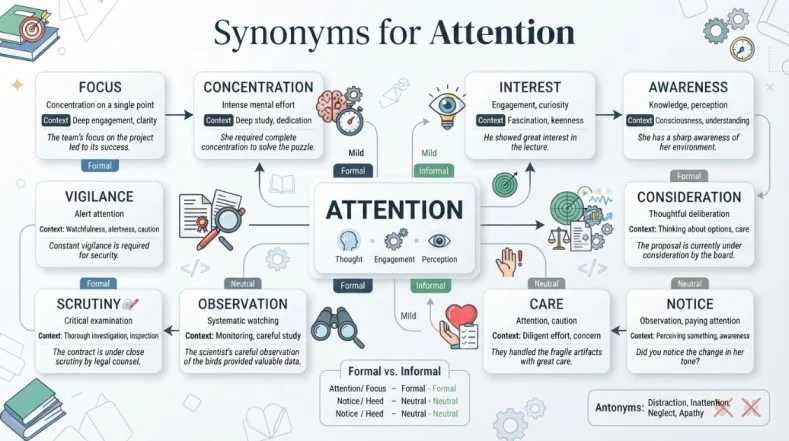
| Situation | Useful Alternative |
|---|---|
| Professional writing | Consideration |
| Academic writing | Concentration |
| Casual conversation | Focus |
| Emotional writing | Care |
| Creative writing | Notice |
| Resume or workplace use | Focus |
| Social media captions | Interest |
| Stronger meaning | Scrutiny |
| Softer meaning | Awareness |
- If you mean mental concentration, “focus” is usually the clearest alternative.
- If you mean curiosity or public interest, “interest” works better. If you mean careful consideration, “heed” or “regard” may be more precise.
When Not to Use “Attention”
Attention is broad, so it is not always the most precise word.
Instead of saying, “The manager gave attention to the problem,” you could say, “The manager examined the problem carefully.” The second sentence communicates a clearer action.
Avoid using attention when you specifically mean concentration, curiosity, care, observation, or public interest and another word expresses that idea more naturally.
For example:
“The student gave attention to the lecture” is understandable, but “The student focused on the lecture” sounds more natural.
“The campaign gained attention” is also broad. “The campaign gained public interest” makes the intended meaning clearer.
Words Commonly Confused With “Attention”
Attention vs. Focus
Focus usually refers to concentrated mental effort or the central subject of something. Attention is broader and can also mean notice or interest.
Attention vs. Concentration
Concentration specifically describes sustained mental effort. Attention can involve concentration, but it also covers awareness and public notice.
Attention vs. Interest
Interest means curiosity or concern about something. Attention means directing your mind or senses toward it.
Attention vs. Awareness
Awareness means knowing or recognizing that something exists or is happening. Attention usually involves actively noticing or considering it.
Attention vs. Consideration
Consideration involves careful thought about something before making a judgment or decision. Attention can be much less deliberate.
Attention vs. Notice
Notice means becoming aware of something. Attention can continue beyond the initial act of noticing.
Best Synonym by Context for “Attention”
| Context | Best Synonym | Why It Works | Example |
|---|---|---|---|
| Formal writing | Consideration | Suggests careful thought | The proposal deserves careful consideration. |
| Academic writing | Concentration | Clearly describes mental effort | Concentration is essential during complex research. |
| Professional or business use | Focus | Direct and practical | The team needs greater focus on customer needs. |
| Resume | Focus | Shows directed effort | Maintained strong focus on client satisfaction. |
| Casual conversation | Notice | Sounds natural in everyday speech | Did you notice the change? |
| Creative writing | Notice | Can create a subtle observational effect | Her bright scarf caught his notice. |
| Emotional tone | Care | Suggests personal concern | She showed great care for her friend. |
| Strong intensity | Scrutiny | Suggests close and detailed examination | The decision came under intense scrutiny. |
| Soft or moderate tone | Awareness | Sounds less forceful | The campaign increased public awareness. |
| Social media captions | Interest | Fits public curiosity and engagement | The post generated considerable interest. |
| Safety communication | Vigilance | Emphasizes alert observation | Drivers must maintain vigilance near the crossing. |
| Detailed analysis | Observation | Emphasizes careful noticing | The conclusion was based on close observation. |
Which Synonym Should You Choose?
Start by identifying the exact meaning you want.
If you mean mental concentration, choose “focus” or “concentration.” These words are especially useful in school, work, and productivity discussions.
If you mean curiosity, choose “interest.” This is often the natural choice for articles, social media, entertainment, and public discussion.
If you mean careful thought, choose “consideration” or “regard.” These words work well in professional and formal writing.
If you mean close examination, choose “scrutiny” or “observation.” These choices communicate a stronger level of examination.
If you mean personal concern, choose “care.” This gives the sentence a warmer emotional tone.
Always consider formality, emotional intensity, and the specific action being described before replacing attention.
Real Life Examples of “Attention” in Sentences
School
“Students should pay close attention when the teacher explains the assignment.”
Workplace
“The project manager brought the scheduling issue to the team’s attention.”
Writing
“The opening paragraph immediately captured the reader’s attention.”
Conversation
“I was giving you my full attention.”
Social Media
“The new video attracted a lot of attention online.”
Resume
“Maintained strong attention to detail while reviewing client documents.”
“Thank you for bringing this matter to my attention.”
Storytelling
“The strange sound caught her attention from across the room.”
25 Synonyms for Attention
| Synonym | Simple Meaning | Best Used For | Example Sentence |
|---|---|---|---|
| Focus | Concentrated mental effort | Study, work, productivity | Her focus remained on the final project. |
| Concentration | Sustained mental effort | Academic and professional contexts | The task required intense concentration. |
| Interest | Curiosity or concern | Topics, media, public reactions | The documentary sparked widespread interest. |
| Notice | Awareness of something | Everyday observation | His unusual response caught my notice. |
| Heed | Careful attention to advice or warning | Instructions and warnings | Drivers should heed the posted warning. |
| Consideration | Careful thought | Formal and professional writing | The proposal deserves serious consideration. |
| Regard | Respectful or thoughtful attention | Formal communication | The committee treated the concern with due regard. |
| Awareness | Knowledge or recognition | Education, safety, public issues | The program raised awareness about recycling. |
| Observation | Careful noticing | Research and analysis | Her observation revealed an important pattern. |
| Scrutiny | Very close examination | Investigations and detailed review | The contract received careful scrutiny. |
| Vigilance | Alert watchfulness | Safety and security | Night staff maintained constant vigilance. |
| Attentiveness | Quality of being attentive | Personal and professional behavior | His attentiveness impressed the customers. |
| Mindfulness | Conscious awareness | Wellness and reflective writing | Mindfulness helped her stay present during the discussion. |
| Care | Concern and thoughtful treatment | Personal and emotional contexts | The child received gentle care from the nurse. |
| Engagement | Active involvement or interest | Education, business, digital media | The lesson increased student engagement. |
| Absorption | Deep involvement in something | Reading and creative activities | Her absorption in the novel made her lose track of time. |
| Awareness | Conscious recognition | Safety and social topics | Greater awareness can prevent common mistakes. |
| Interest | Mental curiosity or concern | Public and personal contexts | His research attracted interest from several students. |
| Consideration | Thoughtful evaluation | Decisions and proposals | We appreciate your consideration of our request. |
| Regard | Attention combined with respect | Formal communication | The organization holds privacy in high regard. |
| Observation | Act of noticing carefully | Science and research | The observation led to a new question. |
| Vigilance | Continuous alertness | Security and risk prevention | The guards remained vigilant throughout the night. |
| Scrutiny | Detailed inspection | Finance, law, and reporting | The figures were subjected to close scrutiny. |
| Engagement | Active participation | Marketing and education | The presentation encouraged audience engagement. |
| Awareness | Recognition of circumstances | Public information | The campaign improved awareness of the issue. |
The table includes several repeated semantic families because English does not provide 25 completely interchangeable replacements for “attention.” Words such as focus, interest, awareness, consideration, observation, and vigilance overlap with attention but differ in meaning and context.
Synonym Groups and Usage Differences
Professional vs. Personal Synonyms
Professional writing often benefits from precise words such as “focus,” “consideration,” “scrutiny,” and “regard.”
Personal writing can use warmer choices such as “care,” “interest,” “notice,” and “attentiveness.”
For example, “Thank you for your consideration” sounds professional, while “Thank you for your care” communicates a more personal feeling.
Formal vs. Conversational Synonyms
“Consideration,” “regard,” “scrutiny,” and “heed” can sound formal depending on the sentence.
“Focus,” “notice,” “interest,” and “care” are generally easier in everyday conversation.
In an email to a client, “Thank you for your consideration” is appropriate. In casual conversation, “Thanks for paying attention” sounds more natural.
Academic Synonyms
Academic writing often benefits from “concentration,” “observation,” “awareness,” “scrutiny,” and “focus.”
Choose based on meaning rather than formality alone. “Concentration” is appropriate for mental effort, while “scrutiny” suggests detailed examination.
Professional and Business Synonyms
Workplace communication frequently uses “focus,” “consideration,” “regard,” “scrutiny,” and “attention.”
For example, “The team needs greater focus on customer retention” is more specific than simply saying, “The team needs more attention.”
On a resume, “attention to detail” is a familiar phrase. However, whenever possible, demonstrate the skill through a measurable accomplishment instead of relying only on the phrase.
Creative or Literary Synonyms
Creative writing can use “notice,” “absorption,” “observation,” “interest,” and “care” depending on the scene.
“Her attention moved toward the window” is straightforward. “Her gaze drifted toward the window” can be more visual, although “gaze” is not a direct synonym for attention.
Slang or Modern Synonyms
There are informal expressions for getting attention, such as “get noticed” and “grab attention.”
These can work in marketing, social media, and casual conversation. They are less suitable for formal academic writing when a precise alternative is available.
Strongest vs. Weaker Synonyms
A useful intensity scale is:
Mild: awareness
Moderate: notice
Moderate: interest
Strong: focus
Strong: concentration
Very strong examination: scrutiny
Continuous alertness: vigilance
These words are not perfect intensity equivalents because each describes a slightly different type of attention.
Emotional vs. Neutral Synonyms
Neutral choices include “focus,” “concentration,” “awareness,” and “observation.”
More emotional choices include “care,” “interest,” and “attentiveness.”
“Care” can suggest affection or concern, while “scrutiny” can suggest pressure, criticism, or suspicion depending on the sentence.
Antonyms of “Attention”
The following words function as opposites or contextual contrasts to attention. Some describe lack of concentration, while others describe lack of interest, care, or awareness.
| Antonym | Meaning | Example Sentence |
|---|---|---|
| Inattention | Lack of attention | His inattention caused him to miss the instruction. |
| Distraction | Something that pulls attention away | Phone notifications became a major distraction. |
| Neglect | Failure to give proper care or attention | Neglect of the equipment created unnecessary problems. |
| Disregard | Lack of consideration | The warning was ignored with complete disregard. |
| Indifference | Lack of interest or concern | Her indifference surprised everyone in the room. |
| Disinterest | Lack of interest | His disinterest in the topic was obvious. |
| Unawareness | Lack of knowledge or recognition | Their unawareness of the rule caused confusion. |
| Obliviousness | Lack of awareness of what is happening | His obliviousness made the situation difficult to explain. |
| Heedlessness | Failure to pay attention to advice or danger | His heedlessness led to an avoidable mistake. |
| Carelessness | Lack of careful attention | Carelessness during data entry created errors. |
| Absentmindedness | Failure to notice because of preoccupation | Her absentmindedness caused her to leave the keys behind. |
| Unmindfulness | Lack of conscious awareness | Unmindfulness can lead to simple errors. |
| Apathy | Lack of concern or motivation | Public apathy made the campaign difficult to sustain. |
| Nonchalance | Casual lack of concern | He responded to the serious issue with nonchalance. |
| Inobservance | Failure to observe or follow something | Inobservance of the instructions caused delays. |
Comparison: “Attention” vs. Similar Words
Attention vs. Focus
Main difference: Attention is broad, while focus specifically emphasizes concentrated direction of thought.
Which one is stronger: Focus often suggests more deliberate concentration.
Which one is more formal: Both are suitable for formal writing.
Example with attention: “Please give the speaker your full attention.”
Example with focus: “Please focus on the main argument.”
Attention vs. Concentration
Main difference: Concentration describes sustained mental effort, while attention can also mean notice or interest.
Which one is stronger: Concentration usually suggests deeper mental effort.
Which one is more formal: Concentration is common in academic and professional writing.
Example with attention: “Her attention shifted toward the discussion.”
Example with concentration: “The complex calculation required intense concentration.”
Attention vs. Interest
Main difference: Interest describes curiosity or concern, while attention describes directed awareness or notice.
Which one is stronger: Neither is universally stronger.
Which one is more formal: Both work in formal contexts.
Example with attention: “The announcement attracted attention.”
Example with interest: “The announcement generated public interest.”
Attention vs. Awareness
Main difference: Awareness means knowing or recognizing something, while attention usually suggests actively noticing or considering it.
Which one is stronger: Attention can imply more active mental involvement.
Which one is more formal: Both are widely used in formal writing.
Example with attention: “She paid attention to the instructions.”
Example with awareness: “She was aware of the instructions.”
Attention vs. Consideration
Main difference: Consideration involves thoughtful evaluation, while attention can simply mean noticing something.
Which one is stronger: Consideration suggests more deliberate thought.
Which one is more formal: Consideration is particularly common in professional and formal communication.
Example with attention: “Please bring this issue to your attention.”
Example with consideration: “Please give this proposal careful consideration.”
Attention vs. Notice
Main difference: Notice often describes the act of becoming aware of something, while attention can involve continued focus.
Which one is stronger: Attention generally suggests more sustained involvement.
Which one is more formal: Both are flexible, although “notice” is especially common in everyday English.
Example with attention: “The speaker had everyone’s attention.”
Example with notice: “She noticed a small change in the report.”
Common Phrases and Expressions with “Attention”
1. Pay attention
Meaning:
To listen carefully, observe carefully, or concentrate on something.
Example sentence:
“Please pay attention while the instructor explains the safety procedure.”
2. Bring something to someone’s attention
Meaning:
To make someone aware of a particular issue, fact, or problem.
Example sentence:
“I would like to bring an important scheduling issue to your attention.”
3. Capture someone’s attention
Meaning:
To make someone notice or become interested in something.
Example sentence:
“The opening image captured the reader’s attention immediately.”
4. Attract attention
Meaning:
To cause people to notice or become interested in something.
Example sentence:
“The innovative design attracted attention from customers.”
5. Draw attention to something
Meaning:
To deliberately make people notice something.
Example sentence:
“The report draws attention to several important trends.”
6. Give something your full attention
Meaning:
To concentrate completely on something.
Example sentence:
“She gave the interview her full attention.”
7. Seek attention
Meaning:
To try to make other people notice or focus on you.
Example sentence:
“The performer did not need to seek attention because the quality of the work spoke for itself.”
8. Attention to detail
Meaning:
Careful consideration of small or important elements.
Example sentence:
“Her attention to detail helped the team catch several errors before publication.”
Common Mistakes to Avoid
1. Using “attention” when a more precise synonym is better
“Attention” is broad. If you specifically mean concentration, “focus” or “concentration” may communicate your idea more clearly.
2. Confusing attention with awareness
Being aware of something does not always mean actively focusing on it.
“She was aware of the noise” means she knew it existed. “She paid attention to the noise” suggests active listening.
3. Using a casual synonym in formal writing
Expressions such as “grab attention” can work in marketing and casual writing but may sound less formal in academic contexts.
Choose “attract attention” or “draw attention” when a more formal tone is appropriate.
4. Using an overly dramatic synonym
“Scrutiny” implies close examination and can sound intense. Do not use it when you simply mean someone noticed something.
5. Repeating “attention” too often
Repeated use can make an essay or article sound mechanical.
Where the meaning changes, consider alternatives such as “focus,” “interest,” “awareness,” “consideration,” or “observation.”
6. Choosing the wrong emotional tone
“Care” sounds warmer than “scrutiny.” If your sentence describes support or compassion, “scrutiny” would create the wrong impression.
7. Using slang in academic or professional writing
Modern informal expressions can make a formal sentence sound unnecessarily casual. Match the synonym to the audience and purpose.
FAQs
What is the best synonym for attention?
The best synonym depends on meaning. “Focus” works well for concentration, “interest” for curiosity, “consideration” for thoughtful review, and “notice” for simple recognition.
What is a formal synonym for attention?
“Consideration,” “regard,” “scrutiny,” and “heed” can serve as formal alternatives, depending on whether you mean thought, respect, examination, or careful response.
What is an informal synonym for attention?
“Focus” is a natural everyday alternative when you mean concentration. “Notice” also works when you mean becoming aware of something.
What is another word for attention in professional writing?
“Focus” is useful for priorities and concentration, while “consideration” works for requests and decisions. “Scrutiny” fits detailed examination.
What is the difference between attention and focus?
Attention is a broader concept involving notice, interest, or concentration. Focus specifically emphasizes directing mental effort toward a particular subject.
What is the opposite of attention?
Common opposites include inattention, distraction, neglect, disregard, indifference, and unawareness. The best choice depends on the type of attention being contrasted.
Conclusion
Attention can describe concentration, awareness, interest, care, observation, or public notice. Because these meanings overlap without being identical, the best synonym depends on the exact idea you want to express.
Use “focus” for concentration, “interest” for curiosity, “consideration” for thoughtful review, “awareness” for recognition, “care” for emotional concern, and “scrutiny” for close examination.
The most useful vocabulary habit is to identify the meaning first and choose the synonym second. A precise word usually makes your writing clearer, more natural, and more effective.
Discover More Post:
- 25+ Synonyms for Secret | Meanings, Examples, and Best …
- 25+ Synonyms for Proficient | Meanings, Examples, and Best …
- 25+ Synonyms for Walked | Meanings, Examples, and Best …