If you keep writing “clearly” in emails, essays, captions, reports, or everyday conversations, you may be looking for a more precise way to express the same idea.
The right synonym can make your writing sound more confident, academic, professional, emotional, or creative without changing the basic meaning.
This guide explains synonyms for clearly by context, tone, intensity, and purpose. You will also find examples, antonyms, commonly confused words, and practical tips for choosing the best alternative.
What Does “Clearly” Mean?
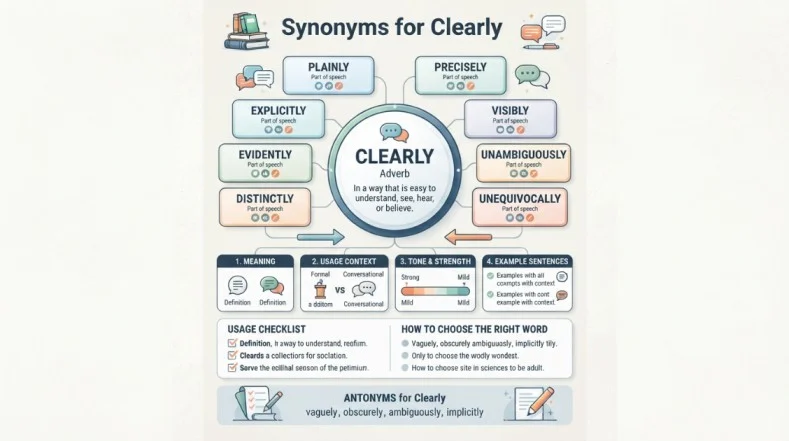
“Clearly” means in a way that is easy to understand, see, recognize, or prove. Depending on context, useful alternatives include plainly, distinctly, explicitly, evidently, obviously, unambiguously, and transparently.
Meaning, Tone and Context
Simple Definition
Clearly is an adverb used to describe something that is easy to understand, recognize, see, hear, or establish.
For example:
“Please explain the instructions clearly.”
Here, clearly means in an understandable way.
It can also describe something that is obvious or strongly supported by evidence.
For example:
“The results clearly show a change.”
In this sentence, clearly suggests that the evidence makes the conclusion easy to recognize.
Part of Speech
Clearly is an adverb.
It commonly modifies verbs, adjectives, or entire statements.
Examples include:
“Speak clearly.”
“She clearly understood the question.”
“Clearly, the plan needs revision.”
Tone
Clearly is usually neutral, but its tone can change depending on how it is used.
In factual writing, it can sound precise. In conversation, it can sometimes sound emphatic.
For example:
“The instructions clearly state the deadline.”
This sounds factual.
“You clearly ignored my message.”
This can sound critical or confrontational.
Formality Level
Clearly works in casual conversation, academic writing, professional communication, essays, reports, and presentations.
However, a more specific alternative can sometimes make formal writing more precise.
For example:
“The data clearly supports the conclusion.”
can become:
“The data unequivocally supports the conclusion.”
The second sentence expresses a stronger level of certainty.
Common Use Cases
Clearly is commonly used when discussing:
- Understandability
- Visibility
- Evidence
- Certainty
- Communication
- Instructions
- Arguments
- Observations
- Professional explanations
- Academic conclusions
Important Word Forms
The main related forms include:
Clear, adjective.
Clearly, adverb.
Clarity, noun.
Clearer, comparative adjective.
Clearest, superlative adjective.
Clear up, phrasal verb meaning to make something understandable or resolve confusion.
When and How to Use “Clearly”
Use clearly when you want to show that information is understandable, noticeable, obvious, or supported strongly enough to be recognized.
1. Professional Context
“The manager clearly explained the new procedure.”
Clearly shows that the explanation was easy to understand.
2. Personal Context
“She clearly wanted to spend more time with her family.”
Here, clearly expresses a strong impression about her intentions.
3. Academic Context
“The findings clearly indicate a relationship between the two variables.”
The word emphasizes that the evidence supports the stated interpretation.
4. Emotional Context
“He was clearly disappointed by the decision.”
Clearly communicates that the emotion was easy to recognize.
5. Creative Context
“The moon was clearly visible through the thin clouds.”
The word describes something that could be seen without difficulty.
6. Email Context
“Please clearly indicate which option you prefer.”
This asks the recipient to communicate their choice without confusion.
7. Social Media Context
“The difference is clearly visible in the final results.”
Clearly emphasizes an easily noticed contrast.
Another Word for “Clearly”
The best single replacement depends on what you mean by clearly.
- If you mean easy to understand, use plainly or intelligibly.
- If you mean easy to see or recognize, use distinctly or visibly.
- If you mean obvious from evidence, use evidently or demonstrably.
- If you mean without ambiguity, use unambiguously or unequivocally.
Professional Writing
Best choices include explicitly, precisely, unambiguously, and transparently.
Academic Writing
Consider evidently, distinctly, demonstrably, or unequivocally, depending on the evidence.
Casual Conversation
Obviously, plainly, and definitely can work, although obviously may sound stronger or more emphatic.
Emotional Writing
Obviously, noticeably, and visibly can communicate recognizable emotions or reactions.
Creative Writing
Distinctly, visibly, plainly, and conspicuously can add descriptive detail.
Resume or Workplace Use
Explicitly, precisely, and demonstrably can be useful when describing measurable actions or results.
Social Media Captions
Obviously, plainly, visibly, and distinctly may work depending on the desired tone.
Stronger Meaning
Use unequivocally, unambiguously, or definitively when you want to communicate a high degree of certainty.
Softer Meaning
Use apparently, noticeably, or evidently when the context supports an observation without making the statement unnecessarily forceful.
When Not to Use “Clearly”
Clearly is useful, but it can become vague when the reader needs to know exactly what is obvious or understandable.
For example:
“The employee clearly performed well.”
This does not tell the reader what evidence demonstrates strong performance.
A more precise sentence would be:
“The employee consistently exceeded quarterly sales targets.”
The second sentence provides measurable information instead of relying on a general statement.
Clearly can also sound too strong when evidence is incomplete.
For example:
“The policy clearly caused the decline.”
If the evidence only suggests a connection, a softer expression such as “apparently” or “the evidence suggests” may be more responsible.
Avoid repeating clearly throughout the same paragraph. Repetition can make writing sound mechanical.
Words Commonly Confused With “Clearly”
Clearly vs. Obviously
Clearly can mean easy to understand or recognize. Obviously usually suggests that something should be apparent to almost anyone.
“Please explain the process clearly.”
“The answer is obviously incorrect.”
Clearly vs. Explicitly
Clearly focuses on understandability or obviousness. Explicitly means something is stated directly and specifically.
“The speaker explained the issue clearly.”
“The contract explicitly prohibits the practice.”
Clearly vs. Plainly
Plainly often means in a simple, direct, or unmistakable manner.
“Please state your opinion plainly.”
Clearly has a broader range of meanings.
Clearly vs. Evidently
Evidently suggests that something appears true based on available evidence or observation.
“The results clearly support the conclusion.”
“The team was evidently prepared for the change.”
Clearly vs. Distinctly
Distinctly emphasizes being separate, recognizable, or easy to perceive.
“I could clearly hear her voice.”
“I could distinctly hear her voice above the crowd.”
Clearly vs. Transparently
Transparently emphasizes openness and the absence of concealment.
“The instructions were clearly written.”
“The organization communicated the decision transparently.”
Best Synonym by Context for “Clearly”
| Context | Best Synonym | Why It Works | Example |
|---|---|---|---|
| Formal writing | Explicitly | Shows that something was stated directly | The policy explicitly addresses employee conduct. |
| Academic writing | Evidently | Connects an observation with supporting evidence | The findings evidently reflect a broader pattern. |
| Professional use | Precisely | Emphasizes accuracy and exactness | Please state precisely what needs to change. |
| Resume | Demonstrably | Highlights evidence that can be shown | She demonstrably improved customer retention. |
| Casual conversation | Plainly | Sounds direct and natural | He plainly did not understand the question. |
| Creative writing | Distinctly | Adds sensory and descriptive precision | She distinctly remembered the sound of rain. |
| Emotional tone | Visibly | Describes an emotion that can be observed | He was visibly upset after the announcement. |
| Strong intensity | Unequivocally | Communicates very strong certainty | The report unequivocally rejects the allegation. |
| Soft or moderate tone | Evidently | Makes an observation without excessive emphasis | She was evidently tired after the trip. |
| Social media | Obviously | Works for an emphatic conversational tone | Obviously, everyone enjoyed the surprise. |
| Instructions | Explicitly | Removes uncertainty about what is required | The form explicitly asks for your mailing address. |
| Business communication | Transparently | Emphasizes openness and straightforward communication | The company communicated transparently with customers. |
Which Synonym Should You Choose?
Start by asking what clearly means in your sentence.
- If you mean “easy to understand,” choose plainly, intelligibly, or explicitly.
- If you mean “easy to see or recognize,” consider distinctly, visibly, or noticeably.
- If you mean “supported by evidence,” evidently or demonstrably may be more accurate.
- If you mean “without any possible ambiguity,” choose unambiguously or unequivocally.
- If your goal is professional precision, avoid choosing a synonym simply because it sounds more sophisticated. The best vocabulary choice is the one that expresses the intended meaning accurately.
Real Life Examples of “Clearly” in Sentences
School
“The teacher clearly explained how to solve the equation.”
Workplace
“The presentation clearly outlined the company’s goals for the next quarter.”
Writing
“Her argument clearly explains why the proposal deserves consideration.”
Conversation
“I clearly remember meeting him at the conference.”
Social Media
“The before and after photos clearly show the difference.”
Resume
“She clearly demonstrated strong leadership during the project.”
“Please clearly identify the files that need approval.”
Storytelling
“The path clearly disappeared into the forest as the fog became thicker.”
25 Synonyms for “Clearly”
| Synonym | Simple Meaning | Best Used For | Example Sentence |
|---|---|---|---|
| Plainly | In a simple or unmistakable way | Direct communication | She plainly stated what she expected from the team. |
| Obviously | In a way that is easy to recognize | Strong conversational emphasis | The plan was obviously not ready for launch. |
| Explicitly | In a direct and specific way | Rules and instructions | The agreement explicitly defines the payment terms. |
| Evidently | As shown by available evidence or observation | Analysis and observations | The results evidently reflect a change in customer behavior. |
| Distinctly | In a clearly recognizable way | Sights, sounds, memories, and details | I distinctly remember hearing that announcement. |
| Unambiguously | Without allowing more than one interpretation | Formal and technical writing | The document unambiguously identifies the responsible department. |
| Unequivocally | In a completely definite way | Strong certainty | The spokesperson unequivocally rejected the accusation. |
| Precisely | Exactly and accurately | Professional and technical contexts | The engineer precisely described the problem. |
| Visibly | In a way that can be seen | Physical or emotional observations | She was visibly relieved after receiving the news. |
| Noticeably | In a way that can readily be noticed | Changes and differences | The new design is noticeably easier to navigate. |
| Conspicuously | In a way that attracts attention | Prominent differences or features | The missing signature was conspicuously absent from the form. |
| Overtly | In an open and visible manner | Actions or attitudes that are not hidden | The organization overtly supported the initiative. |
| Intelligibly | In a way that can be understood | Speech and explanations | The presenter spoke slowly and intelligibly. |
| Lucidly | In a very understandable way | Formal, academic, and literary writing | The professor lucidly explained a difficult theory. |
| Coherently | In a logical and organized way | Arguments and explanations | She coherently presented the evidence during the meeting. |
| Directly | In a straightforward manner | Conversation and professional communication | He directly addressed the customer’s concern. |
| Definitely | With certainty | Casual and general communication | We definitely need more time to finish the project. |
| Decisively | In a firm and conclusive way | Decisions and actions | The board acted decisively after reviewing the report. |
| Demonstrably | In a way that can be shown with evidence | Academic and professional claims | The new system demonstrably reduced processing time. |
| Transparently | Openly, without concealment | Business and organizational communication | The company handled the transition transparently. |
| Manifestly | In an unmistakably apparent manner | Formal writing | The proposal was manifestly inconsistent with the stated objectives. |
| Perceptibly | In a way that can be noticed or perceived | Formal descriptions of changes | The atmosphere perceptibly changed after the announcement. |
| Understandably | In a way that is easy to understand or justify | Explanations and reactions | She was understandably concerned about the unexpected delay. |
| Definitively | In a conclusive or final manner | Conclusions and decisions | The test did not definitively establish the cause. |
| Candidly | Openly and honestly | Personal and professional communication | She candidly explained why the original plan had failed. |
Synonym Groups and Usage Differences
Professional vs. Personal Synonyms
Professional writing often benefits from words that communicate evidence and precision.
Use explicitly, precisely, demonstrably, or transparently when discussing policies, results, procedures, responsibilities, or business decisions.
Personal writing allows more expressive choices.
Words such as obviously, plainly, visibly, and distinctly can sound natural when describing memories, reactions, or everyday experiences.
Formal vs. Conversational Synonyms
Formal writing often favors unambiguously, unequivocally, demonstrably, and evidently.
Conversational English commonly uses obviously, plainly, definitely, and directly.
Choose based on the audience rather than simply choosing the longest word.
Academic Synonyms
Academic writing should distinguish observation from certainty.
Evidently works when a conclusion follows from evidence.
Demonstrably works when evidence can establish or show something.
Unequivocally is appropriate only when the available evidence genuinely supports a very strong conclusion.
Professional and Business Synonyms
For workplace emails and reports, explicitly is useful for requirements and policies.
Precisely works for accuracy.
Transparently works when discussing open communication.
Demonstrably can strengthen claims supported by measurable results.
Creative or Literary Synonyms
Creative writing can benefit from more descriptive alternatives.
Distinctly can highlight sensory details.
Visibly can reveal emotions through observable behavior.
Conspicuously can draw attention to something unusual.
Lucidly can describe unusually clear expression or thought.
Slang or Modern Synonyms
There is no necessary slang replacement for clearly.
Words such as “obviously” may feel conversational, but they are standard English rather than slang.
Avoid forcing informal expressions into academic essays or professional reports simply to sound modern.
Strongest vs. Weaker Synonyms
A useful approximate intensity scale is:
Noticeably → evidently → obviously → explicitly → definitely → unambiguously → unequivocally
This is not a strict ranking because each word expresses a different aspect of clarity.
For example, explicitly concerns direct wording, while unequivocally concerns certainty.
Emotional vs. Neutral Synonyms
Neutral choices include evidently, precisely, explicitly, and distinctly.
More emotionally charged choices can include obviously, especially when used to criticize something.
Visibly can describe emotion without directly naming the person’s internal state.
Antonyms of “Clearly”
| Antonym | Meaning | Example Sentence |
|---|---|---|
| Unclearly | In a way that is difficult to understand | The instructions were presented unclearly. |
| Ambiguously | In a way that allows multiple interpretations | The statement was written ambiguously. |
| Vaguely | Without enough specific detail | He vaguely described what had happened. |
| Obscurely | In a difficult to understand or recognize manner | The concept was explained obscurely. |
| Confusingly | In a way that creates uncertainty or confusion | The directions were confusingly arranged. |
| Indistinctly | In a way that is difficult to perceive separately | I could hear the speaker indistinctly from the back. |
| Uncertainly | Without confidence or certainty | She answered the question uncertainly. |
| Implicitly | Without stating something directly | The message implicitly criticized the decision. |
| Indirectly | Without communicating something in a direct manner | He indirectly referred to the disagreement. |
| Covertly | In a hidden or concealed manner | The information was obtained covertly. |
| Subtly | In a way that is difficult to notice | The writer subtly suggested a change in attitude. |
| Inconclusively | Without producing a definite conclusion | The evidence pointed inconclusively toward several possibilities. |
| Doubtfully | With uncertainty or skepticism | He looked doubtfully at the proposed solution. |
| Hazily | In an indistinct or uncertain way | She hazily remembered the details of the event. |
| Cryptically | In a mysterious or difficult to interpret manner | The note was written cryptically. |
Comparison: “Clearly” vs. Similar Words
Clearly vs. Obviously
Clearly can mean easy to understand, perceive, or establish.
Obviously usually carries a stronger implication that something should be immediately apparent.
Clearly is generally more flexible and neutral.
Example:
“The teacher clearly explained the lesson.”
“The answer is obviously wrong.”
Clearly vs. Explicitly
Clearly focuses on clarity.
Explicitly focuses on direct and specific expression.
Explicitly is more precise when discussing instructions, rules, requirements, or statements.
Example:
“The manager clearly explained the procedure.”
“The manager explicitly stated that all forms were required.”
Clearly vs. Evidently
Clearly can indicate strong clarity or obviousness.
Evidently often signals that something appears true based on evidence or observation.
Evidently is particularly useful in analytical writing.
Example:
“The pattern clearly appears in the data.”
“The pattern evidently reflects a broader trend.”
Clearly vs. Plainly
Plainly often sounds direct and straightforward.
Clearly is more neutral and broadly applicable.
Plainly can be especially effective when emphasizing simple, direct communication.
Example:
“She clearly explained the problem.”
“She plainly stated her concerns.”
Clearly vs. Distinctly
Distinctly emphasizes clear perception or recognition.
Clearly has a broader meaning.
Distinctly works well for sounds, memories, visual details, and separate features.
Example:
“I clearly remember the conversation.”
“I distinctly remember the conversation.”
Clearly vs. Transparently
Clearly means easy to understand or recognize.
Transparently means openly and without concealment.
Transparently is more formal and specialized in organizational contexts.
Example:
“The instructions were clearly written.”
“The company communicated transparently with its employees.”
Common Phrases and Expressions with “Clearly”
1. Clearly Understand
Meaning:
To understand something without confusion.
Example sentence:
“Students need to clearly understand the assignment before beginning.”
2. Clearly State
Meaning:
To express information directly and understandably.
Example sentence:
“Please clearly state your preferred delivery date.”
3. Clearly Explain
Meaning:
To communicate an idea in an understandable manner.
Example sentence:
“The guide clearly explains each step of the process.”
4. Clearly Demonstrate
Meaning:
To show something strongly through evidence or action.
Example sentence:
“The results clearly demonstrate the value of the new approach.”
5. Clearly Indicate
Meaning:
To show or suggest something in an understandable way.
Example sentence:
“The survey results clearly indicate a change in customer preferences.”
6. Clearly Define
Meaning:
To explain the exact meaning or boundaries of something.
Example sentence:
“The handbook clearly defines each employee’s responsibilities.”
7. See Clearly
Meaning:
To perceive something without visual obstruction or confusion.
Example sentence:
“We could see the mountains clearly after the storm passed.”
Common Mistakes to Avoid
1. Using Clearly When a Precise Synonym Is Better
“The project clearly improved performance” is broad.
If you have measurable evidence, “The project demonstrably improved performance” may communicate the evidence more precisely.
2. Confusing Clearly With Explicitly
Something can be clear without being explicitly stated.
If a requirement is directly written in a document, explicitly is usually the more exact choice.
3. Using a Casual Synonym in Formal Writing
Obviously can sound conversational or emphatic.
In a formal report, evidently or explicitly may better match the intended meaning.
4. Using an Overly Strong Synonym
Do not use unequivocally simply because it sounds authoritative.
Use strong certainty only when the evidence genuinely supports it.
5. Repeating Clearly Too Often
Repeating clearly in every paragraph makes writing predictable.
Replace some instances with precise alternatives or rewrite the sentence to communicate the evidence directly.
6. Choosing the Wrong Emotional Tone
“You obviously made a mistake” can sound accusatory.
“You may have overlooked a detail” communicates the same concern more tactfully.
7. Using Slang in Academic or Professional Writing
Clearly does not require slang replacements.
Standard vocabulary is usually more effective when writing essays, reports, resumes, applications, and professional emails.
FAQs
What is the best synonym for “clearly”?
The best synonym depends on context. Plainly works for direct communication, explicitly for stated information, evidently for evidence, and unequivocally for strong certainty.
What is a formal synonym for “clearly”?
Formal alternatives include explicitly, evidently, precisely, unambiguously, unequivocally, and demonstrably. The correct choice depends on the specific meaning.
What is an informal synonym for “clearly”?
Obviously and plainly can work in informal conversation. Obviously is more emphatic, while plainly often sounds direct and straightforward.
What is another word for “clearly” in professional writing?
Professional alternatives include explicitly, precisely, demonstrably, evidently, and transparently. Choose the word that matches evidence, accuracy, openness, or directness.
What is the difference between “clearly” and “obviously”?
Clearly means something is easy to understand, perceive, or establish. Obviously suggests that something should be readily apparent and can sound more emphatic.
What is the opposite of “clearly”?
Common contextual opposites include ambiguously, vaguely, unclearly, indistinctly, confusingly, indirectly, and obscurely. The best antonym depends on the sentence.
Conclusion
Clearly is a flexible adverb that can describe understandable communication, recognizable details, visible information, or conclusions supported by evidence.
The best synonym depends on the intended meaning. Use plainly for direct expression, explicitly for stated information, evidently for evidence, distinctly for perception, and unequivocally for very strong certainty.
Good vocabulary is not about replacing every repeated word with a more complicated one. It is about choosing the word that communicates your exact meaning and appropriate tone.
When searching for synonyms for clearly, always consider your audience, evidence, formality, emotional tone, and sentence context before making a substitution.
A practical vocabulary tip is to replace clearly only when another word adds useful precision. If the original word already expresses your meaning accurately, keeping it may be the strongest choice,.
Discover More Post:
- 25+ Synonyms for Shadow | Meanings, Examples, and Best …
- 25+ Synonyms for Dream | Meanings, Examples, and Best …
- 25+ Synonyms for Potential | Meanings and Examples