Have you ever written the word “multiple” several times in an essay, email, report, caption, or resume and felt that your writing needed more variety? Choosing a precise alternative can make your message clearer and more natural.
The best synonym depends on what you mean. Words such as several, numerous, various, manifold, and many can all replace “multiple” in certain situations, but they do not always carry the same tone or meaning.
This guide explains the meaning of multiple, shows how to use it naturally, compares similar words, and helps you choose the right alternative for professional, academic, personal, and creative communication.
What Does “Multiple” Mean?
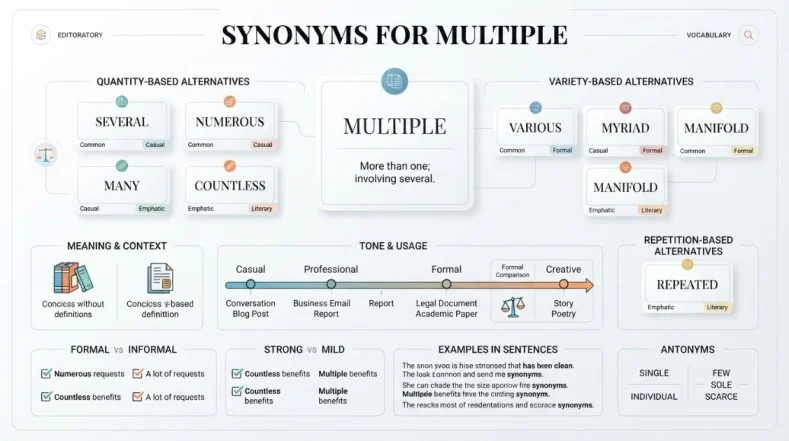
“Multiple” means more than one or involving several people, things, events, or parts. Common alternatives include several for general use, numerous for many items, various for different types, and manifold for formal writing.
Meaning, Tone and Context
The word multiple generally means more than one. It can describe several people, objects, choices, events, actions, or parts of something.
For example, “The company received multiple applications” means the company received more than one application.
Simple Definition
Multiple means consisting of, involving, or occurring more than once or involving more than one thing.
Part of Speech
Multiple is primarily an adjective.
Examples:
“Multiple students submitted the assignment.”
“The device has multiple functions.”
It can also appear in mathematical and technical contexts as a noun, such as “a multiple of five.”
Tone
Multiple usually has a neutral tone. It does not normally express positive or negative emotion.
The emotional effect comes from the noun or situation surrounding it.
For example:
“Multiple opportunities are available.”
“Multiple complaints were filed.”
The first sounds positive, while the second may sound concerning.
Formality Level
Multiple works well in everyday speech, academic writing, professional communication, journalism, technical writing, and formal reports.
It is especially useful when you want to state that something happened more than once without specifying the exact number.
Common Use Cases
You can use multiple when talking about:
- Several choices
- More than one person
- Several events
- Repeated actions
- Different sources
- Several problems
- Various options
- Multiple components
- More than one location
- Several opportunities
Important Word Forms
The related noun is multiplicity, which refers to the state of being numerous or having many parts.
The verb multiply can mean to increase in number or to perform multiplication in mathematics.
The mathematical noun multiple refers to a number that can be divided by another number without a remainder.
For example, 15 is a multiple of 5.
When and How to Use “Multiple”
Use multiple when you want to communicate that something involves more than one item, person, event, or occurrence.
It is particularly useful when the exact number is unknown or unimportant.
Professional
“The team reviewed multiple proposals before making a decision.”
Personal
“I have multiple errands to finish this afternoon.”
Academic
“The study examines multiple factors that influence student performance.”
Emotional
“She faced multiple disappointments during the difficult year.”
Creative
“The story moves through multiple layers of memory and imagination.”
Social Media
“Multiple photos from the weekend are now available.”
“We have received multiple requests for additional information.”
Another Word for “Multiple”
The best single replacement depends on the meaning you want to communicate.
For general situations, several is a natural alternative. For a larger number, numerous may be more precise. When emphasizing differences, various often works better.
Professional Writing
Use numerous, several, or various depending on the intended meaning.
Academic Writing
Use several, various, numerous, or manifold when appropriate.
Casual Conversation
Use many, several, or a number of.
Emotional Writing
Use numerous, countless, or repeated when the context supports stronger emphasis.
Creative Writing
Use myriad, manifold, countless, or multifarious when stylistically appropriate.
Resume or Workplace Use
Use multiple, several, various, or a more specific description.
For example, “Managed multiple client accounts” is clear, but “Managed 18 client accounts” is more precise when the number is useful.
Social Media Captions
Use several, many, various, or simply name the number.
Stronger Meaning
Use numerous, countless, innumerable, or myriad when you want to emphasize a large quantity.
Softer Meaning
Use several, a few, or more than one when you want a less dramatic expression.
When Not to Use “Multiple”
Multiple can become vague when the exact number matters.
For example:
“Managed multiple projects.”
This tells the reader that there was more than one project, but it does not show the scale of the work.
If the number is relevant, write:
“Managed 12 projects.”
Multiple can also be less natural when several, various, or many communicates the intended idea more clearly.
Compare:
“The report discusses multiple approaches.”
“The report discusses several approaches.”
Both are correct, but several can sound more natural when referring to a modest number.
Similarly, use various when you mean different kinds rather than simply more than one.
Words Commonly Confused With “Multiple”
Multiple vs. Several
Both indicate more than one. Several usually suggests a relatively small but unspecified number, while multiple simply emphasizes that there is more than one.
Multiple vs. Various
Multiple means more than one. Various emphasizes difference or variety.
Multiple vs. Numerous
Numerous means many. It generally suggests a larger quantity than multiple.
Multiple vs. Many
- Many directly expresses a large or considerable number. Multiple is broader and can refer to just two or a small number.
- Multiple vs. Repeated
- Multiple can describe more than one item or event. Repeated specifically suggests that something happens again.
Multiple vs. Diverse
- Multiple means more than one. Diverse means different from one another, especially in type, background, character, or quality.
Best Synonym by Context for “Multiple”
| Context | Best Synonym | Why It Works | Example |
|---|---|---|---|
| Formal writing | Numerous | Clearly communicates a considerable number | The organization received numerous applications. |
| Academic writing | Several | Precise and natural for an unspecified smaller group | Several studies support this conclusion. |
| Professional use | Multiple | Direct and widely accepted | The manager oversees multiple departments. |
| Resume | Several | Sounds natural when the exact number is not essential | Coordinated several client projects. |
| Business communication | Various | Useful when different types are involved | We considered various solutions. |
| Casual conversation | Many | Simple and conversational | I have many things to do today. |
| Creative writing | Myriad | Adds a literary sense of abundance | A myriad of possibilities emerged. |
| Emotional writing | Countless | Adds emphasis and emotional weight | She remembered countless moments from childhood. |
| Strong intensity | Innumerable | Suggests an extremely large number | The archive contains innumerable records. |
| Mild intensity | Several | Suggests more than one without exaggeration | Several people attended the meeting. |
| Social media | Many | Short, natural, and easy to understand | Many great memories from this trip. |
| Different types | Various | Highlights differences among items | The store offers various styles. |
| Repeated events | Repeated | Focuses on recurrence | He made repeated attempts to contact the office. |
| Mathematical context | Multifold | Appropriate for multiplication or increase | The investment produced a multifold return. |
| Technical context | Multiplex | Suitable for specialized technical meanings | The system supports multiplex signals. |
Which Synonym Should You Choose?
Start by asking what you actually want to communicate.
- If you simply mean more than one, use multiple, several, or more than one.
- If you mean many, choose numerous, many, countless, or innumerable depending on the size and emphasis.
- If you mean different types, choose various, diverse, assorted, or multifarious.
- If you mean repeated occurrences, choose repeated or recurring rather than multiple.
- If you are writing professionally, prioritize clarity over vocabulary variety. A familiar word is often better than an impressive word that changes the meaning.
If you are writing creatively, you have more freedom to use words such as myriad, manifold, or countless when their tone fits the passage.
Real Life Examples of “Multiple” in Sentences
School
“The teacher gave students multiple opportunities to revise their essays.”
Workplace
“Our department handles multiple projects at the same time.”
Writing
“The author explores multiple perspectives throughout the novel.”
Conversation
“I received multiple messages while I was away from my phone.”
Social Media
“Multiple photos from the event were shared this morning.”
Resume
“Managed multiple customer accounts and maintained detailed records.”
“We have multiple questions regarding the updated policy.”
Storytelling
“After multiple attempts, the traveler finally found the hidden path.”
25 Synonyms for “Multiple”
Some alternatives below are exact replacements only in particular contexts. Several emphasize quantity, while others emphasize variety, repetition, or a specific mathematical meaning.
| Synonym | Simple Meaning | Best Used For | Example Sentence |
|---|---|---|---|
| Several | More than two but not many | Everyday and professional writing | Several applicants were invited for interviews. |
| Many | A large number | General conversation and writing | Many students prefer digital resources. |
| Numerous | A large number | Formal and professional writing | Numerous factors affected the final result. |
| Various | More than one kind or type | Different options or categories | We explored various solutions. |
| Diverse | Different in type or character | Groups, ideas, perspectives, or qualities | The conference attracted a diverse group of speakers. |
| Manifold | Many and varied | Formal or literary writing | The benefits of the program are manifold. |
| Myriad | A very large number | Literary and polished writing | A myriad of possibilities remains open. |
| Countless | Too many to count or specify | Emotional and expressive writing | She has created countless memories with her family. |
| Innumerable | Extremely numerous | Formal or literary contexts | Innumerable records were stored in the archive. |
| Multifarious | Many and varied | Formal writing | The organization faces multifarious challenges. |
| Assorted | Made up of different kinds | Collections and groups | The package contained assorted samples. |
| Sundry | Various or miscellaneous | Formal and somewhat old fashioned writing | The document covers sundry administrative matters. |
| Plural | More than one | Grammar and formal contexts | The sentence uses a plural noun. |
| Repeated | Happening more than once | Recurring actions or events | Repeated attempts eventually solved the issue. |
| Recurring | Happening again over time | Events, problems, or patterns | The company addressed recurring technical problems. |
| Double | Twice as much or involving two | Quantities and paired situations | The restaurant offered a double serving. |
| Dual | Consisting of two | Two roles, purposes, or functions | She has a dual role within the organization. |
| Twofold | Twice as much or involving two aspects | Formal descriptions | The proposal has a twofold purpose. |
| Multifold | Many times greater or involving many aspects | Formal and technical contexts | The project produced multifold benefits. |
| Multiplex | Having multiple channels or functions | Technical contexts | The device can process multiplex signals. |
| Multitudinous | Existing in very large numbers | Formal or literary writing | Multitudinous stars filled the night sky. |
| Miscellaneous | Made up of different unrelated things | Collections and categories | The drawer contained miscellaneous office supplies. |
| A number of | More than one or several | General and professional writing | A number of employees attended the workshop. |
| More than one | Two or more | Clear and direct explanation | More than one solution is possible. |
| A range of | Several different options or types | Choices, products, and possibilities | The company offers a range of services. |
Synonym Groups and Usage Differences
Professional vs. Personal Synonyms
Professional writing often benefits from precise words such as multiple, several, numerous, and various.
Personal communication can use simpler alternatives such as many, several, or a number of.
For example, “I have many errands today” sounds natural in conversation, while “The department reviewed numerous applications” fits a professional context.
Formal vs. Conversational Synonyms
Formal writing can accommodate words such as numerous, manifold, innumerable, and multifarious.
Conversational English generally favors multiple, several, many, and various.
Words such as sundry and multitudinous may sound unnecessarily formal in everyday conversation.
Academic Synonyms
Academic writing values precision.
- Use several when referring to a modest number of studies or examples. Use numerous when the quantity is substantial.
- Use various when you are emphasizing differences between categories, methods, or approaches.
Professional and Business Synonyms
Multiple is especially common in workplace communication.
For example:
“The company operates in multiple markets.”
However, more specific language can make professional writing stronger.
Instead of:
“Handled multiple accounts.”
Consider:
“Managed 18 client accounts.”
Specific information usually communicates professional value more effectively than a vague quantity.
Creative or Literary Synonyms
Creative writing gives you more room to use words such as myriad, countless, manifold, and innumerable.
These choices can create a stronger sense of scale or emotion.
However, the most sophisticated sounding word is not automatically the best word. The tone of the entire passage should remain consistent.
Slang or Modern Synonyms
There are few genuine slang replacements for multiple.
In casual digital communication, people may simply use many, several, or a bunch of, although a bunch of is much more informal.
For academic papers, resumes, business writing, and formal emails, choose a more precise standard expression.
Strongest vs. Weaker Synonyms
A useful intensity scale is:
More than one → several → many → numerous → countless → innumerable
This is not a strict numerical scale because the meaning changes according to context.
The main idea is that several usually feels moderate, while countless and innumerable suggest a very large or unspecified quantity.
Emotional vs. Neutral Synonyms
Multiple is generally neutral.
Several is also neutral and understated.
Numerous can emphasize quantity without necessarily creating emotion.
Countless can add emotional emphasis.
Myriad can sound expressive or literary.
Choose based on whether you want the reader to notice the number, the variety, or the emotional significance.
Antonyms of “Multiple”
Because multiple means more than one, its clearest opposite is a concept involving one or singularity. Some entries below are contextual opposites rather than perfect dictionary antonyms.
| Antonym | Meaning | Example Sentence |
|---|---|---|
| Single | One rather than more than one | The form requires a single response. |
| Singular | Existing as one | The sentence contains a singular subject. |
| Sole | The only one | She was the sole applicant. |
| Only | No other one | This is the only available option. |
| One | A single unit | One person answered the question. |
| Individual | A single separate person or thing | Each individual case was reviewed. |
| Lone | Being alone or single | A lone visitor entered the building. |
| Solitary | Existing alone | The researcher worked in a solitary office. |
| Unitary | Forming one complete unit | The system operates as a unitary structure. |
| Undivided | Not separated into multiple parts | She gave the project her undivided attention. |
| Exclusive | Limited to one person, group, or choice | The invitation was exclusive to members. |
| Unique | Existing as a single distinct example | The museum owns a unique artifact. |
| Unary | Involving one element | The operation has a unary function. |
| Once | Happening one time | The procedure was performed once. |
| Monolithic | Forming one large unified whole | The organization adopted a monolithic structure. |
Comparison: “Multiple” vs. Similar Words
Multiple vs. Several
Main difference: Both mean more than one, but several usually suggests a modest number.
Stronger: Multiple is broader because it can refer to two or many items without suggesting a particular size.
More formal: Both work in formal writing.
Examples:
“Multiple teams participated in the competition.”
“Several teams participated in the competition.”
Multiple vs. Various
Main difference: Multiple focuses on quantity, while various emphasizes differences.
Stronger: Neither is universally stronger.
More formal: Both are suitable for formal writing.
Examples:
“The company has multiple offices.”
“The company operates various types of offices.”
Multiple vs. Numerous
Main difference: Multiple means more than one, while numerous suggests a large number.
Stronger: Numerous suggests greater quantity.
More formal: Numerous can sound slightly more formal.
Examples:
“Multiple factors influenced the decision.”
“Numerous factors influenced the decision.”
Multiple vs. Many
Main difference: Many clearly communicates a substantial number, while multiple simply indicates more than one.
Stronger: Many usually conveys greater quantity.
More formal: Multiple is often more neutral in professional writing.
Examples:
“We received multiple applications.”
“We received many applications.”
Multiple vs. Repeated
Main difference: Multiple means more than one. Repeated means something happened again.
Stronger: Repeated is stronger when recurrence is the main idea.
More formal: Both are suitable for formal writing.
Examples:
“The system has multiple errors.”
“The system experienced repeated errors.”
Multiple vs. Diverse
Main difference: Multiple means more than one, while diverse means noticeably different from one another.
Stronger: Diverse adds information about difference rather than quantity.
More formal: Both can work in professional and academic contexts.
Examples:
“The report considers multiple perspectives.”
“The report considers diverse perspectives.”
Common Phrases and Expressions with “Multiple”
1. Multiple factors
Meaning:
More than one factor contributes to a result.
Example sentence:
“Multiple factors contributed to the project’s success.”
2. Multiple options
Meaning:
More than one choice is available.
Example sentence:
“Customers can choose from multiple payment options.”
3. Multiple sources
Meaning:
Information comes from more than one source.
Example sentence:
“The researcher reviewed multiple sources before writing the report.”
4. Multiple opportunities
Meaning:
Several chances or possibilities are available.
Example sentence:
“The program gives students multiple opportunities to practice their skills.”
5. Multiple locations
Meaning:
Something exists or operates in more than one place.
Example sentence:
“The company has offices in multiple locations.”
6. Multiple reasons
Meaning:
More than one reason explains an outcome.
Example sentence:
“There are multiple reasons why customers prefer this service.”
7. Multiple perspectives
Meaning:
Several viewpoints are considered.
Example sentence:
“The discussion included multiple perspectives on the issue.”
8. Multiple attempts
Meaning:
Something was tried more than once.
Example sentence:
“After multiple attempts, the team successfully repaired the system.”
Common Mistakes to Avoid
1. Using “multiple” when a precise number is better
“Managed multiple projects” is acceptable, but a specific number can be more persuasive on a resume.
“Managed 15 projects” gives the reader measurable information.
2. Confusing “multiple” with “various”
Multiple means more than one. Various means different kinds.
Use various when the differences between items are important.
3. Using a casual synonym in formal writing
Phrases such as “a bunch of” may work in casual conversation but usually sound inappropriate in academic papers and professional reports.
4. Using an overly dramatic synonym
Words such as innumerable and countless can sound exaggerated when discussing a small number.
For three options, “several” is more natural than “countless.”
5. Repeating “multiple” too often
Using the same word repeatedly can make an article or report feel monotonous.
Replace it selectively with several, numerous, various, or a more specific expression when the meaning remains accurate.
6. Choosing the wrong emotional tone
Countless can sound emotional, while multiple is usually neutral.
Choose the word that matches the feeling you want the reader to receive.
7. Using slang in academic or professional writing
Informal phrases may make a formal document sound less polished.
Use standard alternatives such as several, numerous, various, or multiple when writing for professional or academic audiences.
FAQs
What is the best synonym for “multiple”?
The best synonym depends on context. Use several for a modest number, numerous for many items, and various when emphasizing different types.
What is a formal synonym for “multiple”?
Numerous, manifold, multifarious, and innumerable can work as formal alternatives, depending on whether you mean quantity, variety, or a very large number.
What is an informal synonym for “multiple”?
Many and several are natural informal alternatives. In very casual speech, a bunch of can work, but it is not suitable for formal writing.
What is another word for “multiple” in professional writing?
Multiple, several, numerous, and various are useful professional alternatives. Choose based on whether you mean quantity, variety, or repeated occurrences.
What is the difference between “multiple” and “various”?
Multiple means more than one, while various emphasizes that the items are different types or kinds. The words overlap but are not always interchangeable.
What is the opposite of “multiple”?
The clearest opposite is single or singular. Other contextual opposites include sole, only, one, individual, and solitary.
Conclusion
Multiple means more than one, and it is a flexible, neutral word that works in everyday, academic, professional, and technical English.
The best alternative depends on your intended meaning. Choose several for a modest number, numerous for a larger quantity, various for different types, and repeated when recurrence is the key idea.
Words such as myriad, manifold, and countless can add literary or emotional emphasis, but they should be used only when their stronger tone fits the context.
When choosing synonyms for multiple, focus on precision rather than simply replacing a repeated word. The strongest vocabulary choice is the one that tells your reader exactly what you mean.
Discover More Post:
- 25+ Synonyms for Shadow | Meanings, Examples, and Best …
- 25+ Synonyms for Dream | Meanings, Examples, and Best …
- 25+ Synonyms for Potential | Meanings and Examples