When you write the same word repeatedly, your sentences can start to sound predictable. This is especially common with caused in essays, reports, emails, captions, resumes, and everyday conversations.
Learning synonyms for caused helps you explain relationships between actions, events, and results more precisely. The right alternative can make a sentence sound more formal, academic, emotional, conversational, or professional.
What Does “Caused” Mean?
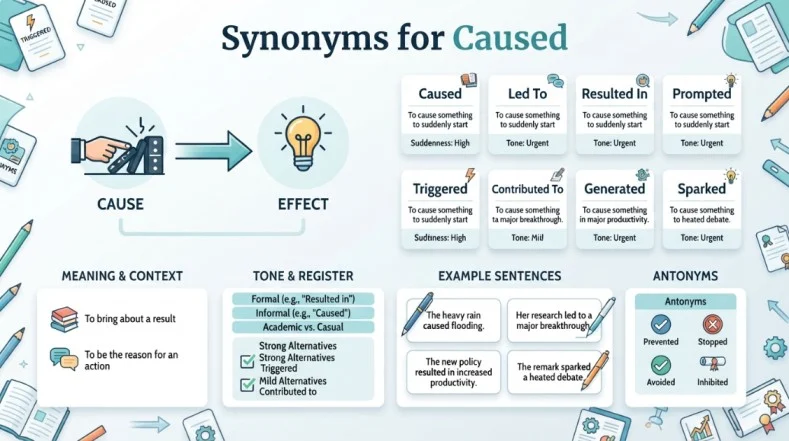
Caused means made something happen or produced a particular result. Depending on context, useful alternatives include led to in formal writing, resulted in academically, triggered for sudden effects, prompted for actions, and brought about for deliberate change.
Meaning, Tone and Context
Simple Definition
Caused means made something happen or made a particular result occur.
For example:
Heavy rain caused flooding in several neighborhoods.
The rain is the reason for the flooding, so caused connects an event with its result.
Part of Speech
Caused is the past tense and past participle form of the verb cause.
Common forms include:
| Word Form | Example |
|---|---|
| Cause | Poor planning can cause delays. |
| Causes | Stress sometimes causes sleep problems. |
| Caused | The storm caused significant damage. |
| Causing | The error is causing confusion. |
| Caused by | The delay was caused by traffic. |
| Cause, noun | The investigation identified the cause. |
Tone
Caused is generally neutral. It does not automatically express approval or disapproval.
Its emotional effect depends on the result being discussed.
For example:
The discovery caused excitement.
This sounds positive.
The accident caused serious injuries.
This sounds negative.
The policy caused several changes.
This is neutral.
Formality Level
Caused works in casual conversation, professional communication, academic writing, journalism, and everyday explanations.
However, repeating it too often can make your writing less precise. Words such as prompted, triggered, precipitated, or resulted in can communicate a more specific relationship.
Common Use Cases
You can use caused when discussing:
- Problems and damage
- Changes and developments
- Emotions and reactions
- Business results
- Academic findings
- Social events
- Physical effects
- Unexpected consequences
- Historical events
- Personal experiences
When and How to Use “Caused”
Use caused when you want to clearly identify something as the reason an outcome happened.
1. Professional Context
The software update caused several compatibility issues.
This is useful when describing a direct business or technical consequence.
2. Personal Context
The misunderstanding caused tension between the two friends.
Here, caused establishes a clear relationship between the misunderstanding and the resulting tension.
3. Academic Context
The change in temperature caused the material to expand.
This works well when explaining a cause and effect relationship.
4. Emotional Context
Her thoughtful message caused him to reconsider his decision.
The word identifies the message as the reason for a change in thinking.
5. Creative Context
The sudden silence caused everyone in the room to become uneasy.
Caused works naturally, although a more expressive word such as triggered may create a stronger effect.
6. Social Media Context
That unexpected announcement caused a huge reaction online.
This sounds natural in a casual digital setting.
7. Email Context
The scheduling error caused a delay in the delivery.
This is clear and professional for workplace communication.
Another Word for “Caused”
The best single replacement depends on the relationship between the action and the result.
Led to is one of the most versatile alternatives because it works in professional, academic, and everyday writing.
For example:
The mistake caused delays.
can become:
The mistake led to delays.
However, different situations call for different words.
| Context | Useful Alternative |
|---|---|
| Professional writing | Led to |
| Academic writing | Resulted in |
| Casual conversation | Made |
| Emotional writing | Triggered |
| Creative writing | Sparked |
| Resume or workplace use | Contributed to |
| Social media | Set off |
| Strong meaning | Precipitated |
| Softer meaning | Contributed to |
When Not to Use “Caused”
Although caused is versatile, it is not always the most precise choice.
When the relationship is indirect
If something only helped produce an outcome, contributed to may be more accurate.
The training contributed to higher employee confidence.
This avoids suggesting that training was the only reason for the change.
When something started a sudden reaction
Triggered may communicate sudden activation more clearly.
The announcement triggered a wave of criticism.
When someone encouraged an action
Prompted is often better.
The feedback prompted her to revise the proposal.
When discussing a chain of events
Led to often sounds more natural.
The initial error led to several additional problems.
When describing a formal result
Resulted in can fit professional or academic writing.
The investigation resulted in several policy changes.
Choosing a precise synonym makes your writing more informative because it tells readers not only that something happened, but also how it happened.
Words Commonly Confused With “Caused”
Caused vs. Led to
Both identify a relationship between an event and an outcome.
Caused can sound more direct, while led to often works well when describing a sequence of events.
The error caused confusion.
The error led to further confusion.
Caused vs. Resulted in
Resulted in is particularly common in formal, academic, technical, and professional writing.
The decision caused delays.
The decision resulted in delays.
The second sentence has a more formal tone.
Caused vs. Prompted
Prompted usually means encouraged someone or something to take an action or produce a response.
The criticism prompted the company to respond.
Caused is broader, while prompted focuses more strongly on the action that followed.
Caused vs. Triggered
Triggered suggests that something activated a reaction, event, process, or response.
The announcement triggered protests.
It often suggests a relatively immediate or noticeable response.
Caused vs. Created
Created means brought something into existence or produced something.
The project created new opportunities.
Caused can describe many types of outcomes, while created is more specific to producing something.
Caused vs. Produced
Produced emphasizes the result or output that came from something.
The experiment produced unexpected results.
Caused is broader and can describe negative, positive, physical, emotional, or abstract outcomes.
Best Synonym by Context for “Caused”
| Context | Best Synonym | Why It Works | Example |
|---|---|---|---|
| Formal writing | Resulted in | Sounds precise and professional | The policy resulted in several changes. |
| Academic writing | Led to | Clearly explains cause and effect | The study led to new questions. |
| Professional use | Contributed to | Avoids claiming a single cause | Training contributed to better performance. |
| Resume | Generated | Highlights an outcome or result | The campaign generated new leads. |
| Casual conversation | Made | Simple and natural | The joke made everyone laugh. |
| Creative writing | Sparked | Adds energy and imagery | Her idea sparked a lively debate. |
| Emotional tone | Triggered | Highlights an emotional response | The news triggered strong emotions. |
| Strong intensity | Precipitated | Suggests a sudden or significant development | The dispute precipitated a crisis. |
| Soft or moderate tone | Contributed to | Suggests partial influence | Several factors contributed to the outcome. |
| Social media | Set off | Informal and conversational | The post set off a heated discussion. |
| Business writing | Prompted | Shows that something encouraged action | The feedback prompted a policy review. |
| Technical writing | Produced | Focuses on an observable result | The process produced excess heat. |
Which Synonym Should You Choose?
Choosing the best synonym for caused starts with identifying the exact relationship between the action and the result.
Choose “led to” when:
You are describing a sequence or development.
Poor communication led to confusion.
Choose “resulted in” when:
You want a formal or academic tone.
The investigation resulted in several recommendations.
Choose “prompted” when:
Something encouraged an action.
The complaint prompted the company to investigate.
Choose “triggered” when:
Something activated a sudden reaction.
The announcement triggered a strong response.
Choose “contributed to” when:
Something was one factor among several.
Better training contributed to higher productivity.
Choose “sparked” when:
You want a more energetic or creative expression.
Her comment sparked a discussion.
Choose “precipitated” when:
You need a formal word for something that directly brought about a significant or sudden event.
The disagreement precipitated a leadership change.
Real Life Examples of “Caused” in Sentences
School
The lack of preparation caused the student to struggle during the presentation.
A more formal version would be:
The lack of preparation contributed to difficulties during the presentation.
Workplace
The scheduling error caused a delay in the meeting.
A professional alternative is:
The scheduling error resulted in a delay.
Writing
The unclear sentence caused confusion among readers.
A precise alternative is:
The unclear sentence created confusion among readers.
Conversation
That comment caused everyone to laugh.
A more conversational option is:
That comment made everyone laugh.
Social Media
The unexpected announcement caused a lot of discussion online.
A livelier alternative is:
The unexpected announcement sparked a lot of discussion online.
Resume
Instead of:
Caused higher customer satisfaction.
A stronger resume style is:
Contributed to higher customer satisfaction.
This wording can be useful when several factors influenced the result.
The missing information caused a delay in processing your request.
A polished professional version is:
The missing information resulted in a delay in processing your request.
Storytelling
The sudden storm caused everyone to leave the beach.
A more vivid version is:
The sudden storm forced everyone to leave the beach.
25 Synonyms for “Caused”
| Synonym | Simple Meaning | Best Used For | Example Sentence |
|---|---|---|---|
| Led to | Made something happen as a result | General, academic, professional | The error led to additional costs. |
| Resulted in | Produced a particular outcome | Formal and academic writing | The changes resulted in better communication. |
| Brought about | Made a change or event happen | Formal and professional writing | The reform brought about significant improvements. |
| Produced | Created a particular result | Technical and factual contexts | The experiment produced unexpected findings. |
| Generated | Produced something measurable or observable | Business and professional writing | The campaign generated thousands of new leads. |
| Prompted | Encouraged an action or response | Professional and personal contexts | The complaint prompted an internal review. |
| Triggered | Activated a reaction or event | Emotional, social, medical, and technical contexts | The announcement triggered a strong public response. |
| Sparked | Started something, often suddenly | Creative and conversational writing | Her question sparked an interesting debate. |
| Provoked | Caused a strong reaction | Emotional and confrontational contexts | His remarks provoked an angry response. |
| Precipitated | Brought about an important or sudden event | Formal writing | The dispute precipitated a major organizational change. |
| Induced | Caused a particular condition or state | Technical, medical, and formal contexts | The treatment induced temporary sleep. |
| Created | Brought something into existence | General and professional writing | The new system created several opportunities. |
| Made | Caused someone or something to become or do something | Casual conversation | The funny story made everyone smile. |
| Set off | Started a reaction or event | Casual and social contexts | The announcement set off a heated discussion. |
| Gave rise to | Caused something to develop | Formal and academic writing | The discovery gave rise to new research questions. |
| Contributed to | Helped produce an outcome | Careful and balanced explanations | Several factors contributed to the decline. |
| Was responsible for | Was a significant cause of something | Formal and professional contexts | Poor planning was responsible for the delay. |
| Occasioned | Caused something to happen | Very formal writing | The announcement occasioned considerable discussion. |
| Engendered | Caused a feeling, condition, or situation to develop | Formal and literary writing | The decision engendered considerable uncertainty. |
| Fostered | Encouraged the development of something | Positive growth and development | The program fostered greater cooperation. |
| Yielded | Produced a result | Academic and technical contexts | The study yielded useful information. |
| Provoked | Brought about a reaction, especially a strong one | Emotional or confrontational contexts | The accusation provoked an immediate response. |
| Initiated | Started a process or activity | Professional and technical contexts | The request initiated a review process. |
| Influenced | Affected an outcome without necessarily being the sole cause | Academic and analytical writing | Several factors influenced the final decision. |
| Brought on | Caused something, often a condition or situation | Personal and conversational contexts | The stress brought on a period of exhaustion. |
Synonym Groups and Usage Differences
Professional vs. Personal Synonyms
Professional writing often benefits from precise expressions such as resulted in, contributed to, prompted, and generated.
Personal conversation can use simpler expressions such as made, brought on, and set off.
Compare:
The misunderstanding caused tension.
The misunderstanding led to tension.
Both are correct, but the second can sound more polished in professional writing.
Formal vs. Conversational Synonyms
For reports, essays, and formal emails, consider:
Resulted in, precipitated, brought about, occasioned, and gave rise to.
For everyday speech, consider:
Made, set off, brought on, and led to.
The simplest word is not always the weakest choice. Clear language is usually more useful than unnecessarily complicated vocabulary.
Academic Synonyms
Academic writing benefits from words that clearly explain relationships without overstating causation.
Useful choices include:
Led to, resulted in, contributed to, produced, generated, and influenced.
Use contributed to when multiple factors may have shaped the outcome.
Economic conditions contributed to the change.
This is more cautious than saying:
Economic conditions caused the change.
Professional and Business Synonyms
In workplace communication, choose words according to the type of relationship.
Prompted works well for actions.
The feedback prompted the team to revise the proposal.
Generated works well for measurable outcomes.
The campaign generated new sales opportunities.
Resulted in works well for consequences.
The delay resulted in additional expenses.
Creative or Literary Synonyms
Creative writing can benefit from more expressive alternatives.
Sparked, provoked, engendered, and precipitated can add different shades of meaning.
For example:
Her question sparked a memory.
This feels more vivid than:
Her question caused a memory.
Slang or Modern Synonyms
There are informal expressions that can replace caused in casual digital communication, including set off and made.
They can work in texts, casual captions, and conversations.
Avoid overly casual alternatives in academic essays, professional reports, formal applications, and business documents.
Strongest vs. Weaker Synonyms
The following scale is approximate because strength depends on context.
Mild influence:
Influenced
Contributed to
Moderate cause:
Led to
Resulted in
Produced
Clear or noticeable cause:
Prompted
Triggered
Brought about
Strong or significant cause:
Provoked
Precipitated
The strongest sounding word is not automatically the best word. Precision matters more than intensity.
Emotional vs. Neutral Synonyms
Neutral choices include:
Led to, resulted in, produced, and contributed to.
More emotionally charged choices can include:
Provoked, triggered, and sparked.
For objective writing, neutral vocabulary is usually preferable unless the emotional reaction itself is important.
Antonyms of “Caused”
Because caused describes making something happen, its contextual opposites usually describe preventing, stopping, limiting, or avoiding an outcome.
| Antonym | Meaning | Example Sentence |
|---|---|---|
| Prevented | Stopped something from happening | The warning prevented an accident. |
| Avoided | Kept something undesirable from happening | Early planning avoided unnecessary delays. |
| Averted | Successfully prevented a serious problem | Quick action averted a crisis. |
| Stopped | Brought an activity or event to an end | The intervention stopped the problem from spreading. |
| Blocked | Prevented something from progressing | The security system blocked unauthorized access. |
| Inhibited | Made something less likely or difficult | The restrictions inhibited further growth. |
| Hindered | Made progress more difficult | Limited resources hindered the project. |
| Discouraged | Reduced the likelihood of an action | The warning discouraged further complaints. |
| Deterred | Prevented action through fear or concern | The penalties deterred further violations. |
| Restrained | Held something back | The new rules restrained excessive spending. |
| Suppressed | Prevented something from developing or becoming visible | The treatment suppressed the symptoms. |
| Eliminated | Completely removed a problem or possibility | The update eliminated the recurring error. |
| Minimized | Reduced the size or impact of something | Better planning minimized the risks. |
| Reduced | Made something smaller or less severe | The changes reduced unnecessary costs. |
| Mitigated | Made a harmful effect less severe | The new measures mitigated the damage. |
Comparison: “Caused” vs. Similar Words
Caused vs. Led to
Main difference: Caused can imply a direct relationship, while led to often describes a sequence.
Stronger: Caused can sound more direct.
More formal: Led to is often preferred in polished writing.
The error caused confusion.
The error led to confusion.
Caused vs. Resulted in
Main difference: Both describe an outcome, but resulted in has a more formal tone.
Stronger: Neither is automatically stronger.
More formal: Resulted in.
The changes caused delays.
The changes resulted in delays.
Caused vs. Prompted
Main difference: Prompted usually involves encouraging an action or response.
Stronger: Caused is broader.
More formal: Prompted often works well in professional writing.
The complaint caused an investigation.
The complaint prompted an investigation.
Caused vs. Triggered
Main difference: Triggered emphasizes activation or a sudden response.
Stronger: Triggered often sounds stronger or more immediate.
More formal: Both can work formally, depending on context.
The announcement caused concern.
The announcement triggered concern.
Caused vs. Contributed to
Main difference: Caused can suggest a direct cause, while contributed to indicates partial influence.
Stronger: Caused.
More formal: Both are appropriate in formal writing.
Poor planning caused the failure.
Poor planning contributed to the failure.
The second sentence is more cautious when several factors were involved.
Caused vs. Produced
Main difference: Produced emphasizes the result or output, while caused focuses on the relationship between cause and effect.
Stronger: Caused can sound more direct.
More formal: Produced is common in technical and academic contexts.
The experiment caused a reaction.
The experiment produced a reaction.
Common Phrases and Expressions with “Caused”
1. Caused a Problem
Meaning:
Created or produced a difficulty.
Example sentence:
The incorrect settings caused a problem with the software.
2. Caused Damage
Meaning:
Produced physical, financial, or other harm.
Example sentence:
The storm caused significant damage to local businesses.
3. Caused Concern
Meaning:
Made people feel worried or uncertain.
Example sentence:
The unexpected results caused concern among researchers.
4. Caused Confusion
Meaning:
Made something difficult to understand.
Example sentence:
The unclear instructions caused confusion for new employees.
5. Caused a Reaction
Meaning:
Produced a response from people or systems.
Example sentence:
The announcement caused a strong reaction from customers.
6. Caused Delays
Meaning:
Made something take longer than expected.
Example sentence:
Heavy traffic caused delays throughout the morning.
7. Caused Changes
Meaning:
Made a situation become different.
Example sentence:
The new regulations caused changes across the industry.
8. Caused an Increase
Meaning:
Produced growth in an amount, number, or level.
Example sentence:
Higher demand caused an increase in production.
Common Mistakes to Avoid
1. Using Caused When a More Precise Word Is Better
Caused is broad.
If you mean that something encouraged an action, prompted may be more accurate.
The feedback prompted the revision.
2. Confusing Caused With Contributed To
Do not claim a single cause when several factors were involved.
Several conditions contributed to the result.
This is more precise than saying one condition caused everything.
3. Using a Casual Synonym in Formal Writing
Expressions such as made or set off can sound too conversational in certain reports or academic assignments.
Choose resulted in, led to, or contributed to when appropriate.
4. Using an Overly Dramatic Synonym
Do not use precipitated or provoked when a simple situation does not justify the stronger tone.
The reminder caused a small change.
There is no need for an unnecessarily dramatic alternative.
5. Repeating Caused Too Often
Repetition can make an essay or report feel monotonous.
Instead of:
The policy caused delays. It caused confusion. It caused complaints.
Try:
The policy caused delays, created confusion, and prompted several complaints.
6. Choosing the Wrong Emotional Tone
Triggered and provoked can suggest a stronger reaction than intended.
For neutral writing, led to or resulted in may be safer.
7. Using Slang in Academic or Professional Writing
Casual expressions can weaken formal communication.
Use vocabulary that matches the audience and purpose instead of choosing a synonym simply because it sounds more sophisticated.
FAQs
What is the best synonym for caused?
The best synonym depends on context. Led to is versatile, while resulted in suits formal writing and triggered emphasizes a sudden reaction.
What is a formal synonym for caused?
Resulted in, brought about, precipitated, and gave rise to are formal alternatives. Choose according to the exact cause and effect relationship.
What is an informal synonym for caused?
Made, set off, and brought on can work in casual conversation. Made is especially natural when describing a person or thing producing an effect.
What is another word for caused in professional writing?
Resulted in, led to, prompted, generated, and contributed to are useful professional alternatives, depending on the relationship being described.
What is the difference between caused and triggered?
Caused is a broad term for making something happen. Triggered usually suggests that something activated a reaction, event, process, or emotional response.
What is the opposite of caused?
Common contextual opposites include prevented, avoided, averted, stopped, blocked, and inhibited. The correct choice depends on what was prevented.
Conclusion
The word caused describes something that made an event, condition, reaction, or result happen. It is clear and versatile, but repeating it can make writing less precise.
Formal and academic writing, resulted in and led to are reliable choices. For partial influence, use contributed to. Actions, prompted is often better. Sudden reactions, triggered can provide greater precision.
The best synonym for caused is not necessarily the most advanced word. Choose the word that accurately describes the relationship between the cause and the result.
Before publishing vocabulary content, definitions and usage should be verified with trusted dictionaries such as Cambridge, Oxford, Merriam Webster, Collins, or Britannica.
A useful vocabulary habit is simple: before replacing caused, ask yourself whether you mean direct cause, partial influence, encouragement, sudden activation, production, or a sequence of events. That one question can make your writing clearer and more natural.
Discover More Post:
- 25+ Synonyms for God | Meanings, Examples, and Best …
- 25+ Synonyms for Yelled | Meanings, Examples, and Best …
- 25+ Synonyms for Secret | Meanings, Examples, and Best …