Have you ever written “avoid” several times in the same essay, email, caption, or workplace document? The word is useful, but repeating it can make otherwise strong writing feel predictable.
The good news is that English offers many alternatives, from formal choices such as eschew and refrain to conversational options such as dodge and steer clear of.
The key is choosing a synonym that preserves your intended meaning. Avoiding a difficult conversation is different from preventing a problem, escaping danger, or leaving something out of a document.
This guide explains synonyms for avoid, their meanings, tone, strength, and practical uses so you can choose words that sound natural and precise.
What Does “Avoid” Mean?
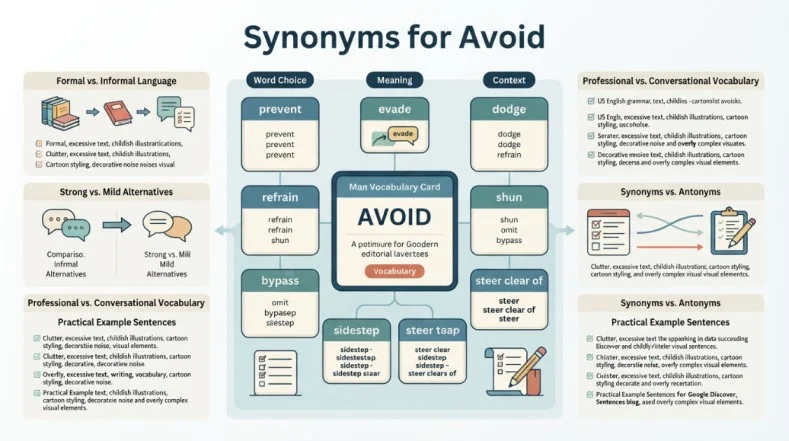
Avoid means to deliberately stay away from someone or something, or to prevent an undesirable situation from happening. Common alternatives include evade, shun, refrain from, prevent, bypass, sidestep, dodge, eschew, and steer clear of, depending on context and tone.
Meaning, Tone and Context
Simple Definition
Avoid means to stay away from something, not become involved with it, or take action that stops an unwanted situation from happening.
For example:
Try to avoid unnecessary distractions while studying.
It can also describe preventing an outcome:
Regular maintenance can help avoid expensive repairs.
Part of Speech
Avoid is a verb.
Common forms include:
| Form | Example |
|---|---|
| Avoid | We should avoid unnecessary delays. |
| Avoids | She avoids difficult conversations. |
| Avoided | They avoided the problem for months. |
| Avoiding | He is avoiding responsibility. |
The noun avoidance describes the act or practice of avoiding something.
Tone
The word avoid is generally neutral. It does not automatically sound positive or negative.
Its tone depends on what is being avoided.
Avoid unnecessary expenses.
This sounds practical.
He avoids his responsibilities.
This sounds critical because the object of avoidance is something he is expected to address.
Formality Level
Avoid is appropriate in almost every variety of English. It works in casual conversation, academic writing, professional communication, resumes, instructions, and formal documents.
Because it is so versatile, it is often a safe choice when you do not need a more specific alternative.
Common Use Cases
You can use avoid when talking about:
- Staying away from people or places
- Preventing problems
- Escaping danger
- Refusing unwanted involvement
- Not doing something
- Leaving something out
- Reducing risk
- Preventing unnecessary costs
- Staying away from unhealthy behavior
- Not discussing an uncomfortable subject
When and How to Use “Avoid”
Use avoid when you want to communicate deliberate distance, prevention, or nonparticipation without adding unnecessary emotional intensity.
1. Professional Context
The team changed the schedule to avoid unnecessary delays.
Here, avoid means prevent.
2. Personal Context
I usually avoid crowded restaurants on weekends.
Here, avoid means stay away from.
3. Academic Context
Students should avoid unsupported claims in research papers.
The word communicates that students should deliberately not use weak evidence.
4. Emotional Context
She avoided talking about the argument because she was still upset.
Avoid suggests deliberate unwillingness to engage with the subject.
5. Creative Context
He avoided the narrow road as the storm grew stronger.
The word creates a straightforward sense of staying away from danger.
6. Social Media Context
Avoid unnecessary drama and focus on what actually matters.
This sounds natural and conversational.
7. Email Context
Please avoid sending duplicate files so we can keep the project organized.
Avoid is clear, polite, and professional.
Another Word for “Avoid”
The best single replacement depends on what you mean.
| Context | Recommended Alternative |
|---|---|
| Professional writing | prevent |
| Academic writing | refrain from |
| Casual conversation | dodge |
| Emotional writing | shun |
| Creative writing | evade |
| Resume or workplace use | minimize |
| Social media captions | steer clear of |
| Stronger meaning | evade |
| Softer meaning | limit |
There is no single best synonym for avoid in every sentence. The right word depends on whether you mean staying away, refusing, preventing, escaping, or leaving something out.
Professional Writing
Use prevent when the intended meaning is stopping an undesirable result.
The updated process helps prevent reporting errors.
Academic Writing
Use refrain from when discussing behavior that someone should deliberately not engage in.
Researchers should refrain from making unsupported conclusions.
Casual Conversation
Use dodge when someone is deliberately avoiding a question, task, or situation.
He tried to dodge the question.
Emotional Writing
Use shun when the avoidance suggests deliberate rejection or social distance.
After the disagreement, she felt shunned by her former friends.
Creative Writing
Use evade when the subject is escaping something difficult, dangerous, or persistent.
The traveler managed to evade the pursuing guards.
Resume or Workplace Use
Use minimize when the goal is reducing risk, errors, costs, or problems.
Minimized customer complaints by improving response procedures.
Social Media Captions
Use steer clear of when you want an approachable, conversational expression.
Steer clear of unnecessary negativity.
Stronger Meaning
Use shun or evade when the avoidance is deliberate and stronger than ordinary distance.
Softer Meaning
Use limit or reduce when you want to communicate moderation rather than complete avoidance.
When Not to Use “Avoid”
Avoid is useful, but it can sometimes be too general.
Compare:
Avoid mistakes.
with:
Prevent common formatting errors.
The second sentence tells the reader exactly what kind of action is intended.
Similarly:
Avoid the difficult question.
is less specific than:
Address the difficult question directly.
- If you are describing physical danger, evade or escape may communicate the situation more precisely.
- If you are describing a recommendation to stop doing something, refrain from may sound more appropriate.
- If you mean leaving information out, omit may be the better word.
Precision matters because synonyms often overlap without being completely interchangeable.
Words Commonly Confused With “Avoid”
Avoid vs. Prevent
Avoid can mean staying away from something. Prevent means stopping something from happening.
We avoided the busy highway.
The safety system prevented an accident.
Avoid vs. Evade
Avoid is broad and neutral. Evade often suggests deliberately escaping something difficult, dangerous, or unwanted.
She avoided the crowded area.
The suspect tried to evade capture.
Avoid vs. Escape
Avoid can describe staying away before something happens. Escape usually suggests getting away from an existing threat, restriction, or danger.
He avoided the dangerous trail.
He escaped from the burning building.
Avoid vs. Refrain
Avoid is broader. Refrain from usually describes choosing not to perform an action.
Avoid unnecessary distractions.
Refrain from interrupting the speaker.
Avoid vs. Omit
Avoid means stay away from, prevent, or not engage with something. Omit means leave something out.
Avoid unnecessary details.
Omit unnecessary details from the final report.
Avoid vs. Shun
Avoid is usually neutral. Shun suggests deliberate rejection or persistent social or personal distance.
She avoids social events.
He shuns public attention.
Best Synonym by Context for “Avoid”
| Context | Best Synonym | Why It Works | Example |
|---|---|---|---|
| Formal writing | refrain from | Polite and formal | Employees should refrain from sharing confidential information. |
| Academic writing | refrain from | Suitable for formal recommendations | Researchers should refrain from unsupported claims. |
| Professional or business use | prevent | Clearly expresses risk reduction | The update helps prevent data errors. |
| Resume | minimize | Shows reduction of problems or risk | Minimized processing errors through quality checks. |
| Casual conversation | dodge | Natural and conversational | He tried to dodge the question. |
| Creative writing | evade | Adds a sense of escape or pursuit | The character evaded the guards. |
| Emotional tone | shun | Suggests deliberate rejection | She felt shunned by the group. |
| Strong intensity | evade | Implies deliberate escape | The driver evaded the pursuing vehicle. |
| Soft or moderate tone | limit | Suggests moderation rather than total avoidance | Try to limit unnecessary interruptions. |
| Social media captions | steer clear of | Friendly and conversational | Steer clear of unnecessary drama. |
| Physical danger | stay away from | Direct and easy to understand | Stay away from the damaged building. |
| Unwanted behavior | abstain from | Appropriate for deliberate nonparticipation | He chose to abstain from alcohol. |
| Information in writing | omit | Precise when something should be left out | Omit irrelevant details from the summary. |
| Difficult responsibility | sidestep | Suggests avoiding an issue rather than solving it | The manager sidestepped the main concern. |
| Unnecessary route or process | bypass | Means going around something | We bypassed the outdated approval process. |
Which Synonym Should You Choose?
Start by asking what avoid means in your sentence.
- If you mean stop something from happening, choose prevent, avert, or forestall.
- If you mean stay away from something, choose steer clear of, stay away from, or shun, depending on tone.
- If you mean escape something, choose evade or elude.
- If you mean not perform an action, choose refrain from or abstain from.
- If you mean leave something out, choose omit.
- If you mean go around an obstacle or process, choose bypass, circumvent, or sidestep.
Consider formality as well. Words such as eschew, abstain, and refrain can sound more formal, while dodge and steer clear of are more conversational.
Real Life Examples of “Avoid” in Sentences
School
Students should avoid relying on sources that cannot be verified.
A more formal alternative is:
Students should refrain from relying on unverifiable sources.
Workplace
Our team works carefully to avoid unnecessary mistakes.
A more precise alternative is:
Our team works carefully to prevent unnecessary mistakes.
Writing
Try to avoid repeating the same phrase throughout the article.
You could also say:
Try to eliminate repeated phrasing throughout the article.
Conversation
I try to avoid arguments when a calm discussion is possible.
A conversational alternative is:
I try to steer clear of unnecessary arguments.
Social Media
Avoid posting when you are angry.
A softer alternative is:
Consider limiting emotional posts when you are upset.
Resume
Avoid vague descriptions of your responsibilities.
For professional writing, a stronger instruction is:
Use specific descriptions of your responsibilities.
Please avoid sending large attachments unless they are necessary.
A more formal version is:
Please refrain from sending large attachments unless necessary.
Storytelling
The traveler avoided the main road and disappeared into the forest.
For stronger imagery:
The traveler evaded the guards and disappeared into the forest.
25 Synonyms for “Avoid”
| Synonym | Simple Meaning | Best Used For | Example Sentence |
|---|---|---|---|
| Evade | Get away from something difficult or unwanted | Danger, responsibility, pursuit | The driver managed to evade the pursuing vehicle. |
| Elude | Escape something that is trying to catch or find you | Pursuit, detection, understanding | The suspect continued to elude investigators. |
| Dodge | Quickly avoid something | Questions, objects, responsibilities | She tried to dodge the question. |
| Shun | Deliberately reject or stay away from | People, attention, behavior | He chose to shun unnecessary publicity. |
| Eschew | Deliberately avoid or reject | Formal and academic writing | The author eschews unnecessary technical language. |
| Refrain from | Choose not to do something | Formal instructions and behavior | Please refrain from interrupting the presentation. |
| Abstain from | Choose not to participate in something | Formal, health, voting, habits | She decided to abstain from the discussion. |
| Steer clear of | Deliberately stay away from | Casual conversation | We decided to steer clear of the crowded area. |
| Stay away from | Keep at a distance | Everyday speech and instructions | Stay away from the wet paint. |
| Keep away from | Maintain distance from something | Warnings and everyday language | Keep away from the edge of the platform. |
| Bypass | Go around instead of through | Processes, obstacles, systems | The team bypassed the outdated procedure. |
| Sidestep | Avoid dealing directly with something | Problems, questions, responsibilities | The spokesperson sidestepped the difficult question. |
| Circumvent | Find a way around a rule, obstacle, or restriction | Formal and technical contexts | The company found a legal way to circumvent the obstacle. |
| Skirt | Avoid dealing directly with something | Issues, rules, boundaries | The report skirted the central issue. |
| Avert | Prevent something undesirable | Danger, disaster, conflict | Quick action helped avert a larger problem. |
| Prevent | Stop something from happening | Risks, mistakes, problems | Regular checks can prevent costly errors. |
| Forestall | Act early to prevent something | Formal and strategic writing | The company changed its policy to forestall future complaints. |
| Ward off | Prevent or protect against something | Threats, illness, criticism | The measures helped ward off further damage. |
| Omit | Leave something out | Writing and information | Omit details that are unrelated to the main argument. |
| Leave out | Not include something | Casual and general writing | You can leave out the final paragraph. |
| Forgo | Decide not to have or do something | Choices, benefits, opportunities | She decided to forgo the extra expense. |
| Duck | Avoid something quickly or deliberately | Informal speech | He ducked the question with a joke. |
| Minimize | Reduce something to the smallest practical amount | Business, risk, problems | The new system minimizes processing errors. |
| Limit | Keep something within a smaller amount or range | Habits, exposure, spending | Try to limit unnecessary screen time. |
| Escape | Get free from an unwanted situation | Danger, confinement, difficulty | The hikers escaped the storm before nightfall. |
Synonym Groups and Usage Differences
Professional vs. Personal Synonyms
Professional writing often benefits from precise and neutral choices.
Use prevent, minimize, refrain from, circumvent, or omit when the situation calls for clarity.
Personal communication can sound more natural with stay away from, steer clear of, or dodge.
Professional: The procedure helps prevent reporting errors.
Personal: I try to stay away from unnecessary drama.
Formal vs. Conversational Synonyms
Formal alternatives include eschew, refrain from, abstain from, circumvent, forestall, and avert.
Conversational choices include dodge, steer clear of, stay away from, keep away from, and duck.
For everyday emails, avoid itself is often the most natural choice.
Academic Synonyms
Academic writing generally benefits from precise words rather than unnecessarily complicated vocabulary.
Refrain from works well when discussing behavior.
Omit is useful when discussing information.
Prevent is appropriate when describing causes and outcomes.
Circumvent can describe working around a restriction or established process.
Avoid choosing eschew simply because it sounds sophisticated. Precision is more valuable than complexity.
Professional and Business Synonyms
In workplace communication, choose a synonym according to the specific action.
- Use prevent for stopping problems.
- Use minimize for reducing risk or errors.
- Use omit for removing unnecessary information.
- Use bypass for going around a process.
- Use sidestep when someone avoids directly addressing an issue.
- Use refrain from for polite instructions.
Creative or Literary Synonyms
Creative writing gives you more freedom to choose words based on mood.
Evade can create tension.
Elude can suggest something difficult to capture.
Shun can communicate rejection.
Skirt can imply indirect movement around an issue.
Dodge can create a quick, energetic feeling.
The fox evaded the hunters and vanished into the woods.
This has more narrative energy than simply saying:
The fox avoided the hunters.
Slang or Modern Synonyms
There are informal expressions that can replace avoid in casual speech.
Dodge is common and widely understood.
Duck can mean quickly avoid something, especially a question or responsibility.
Steer clear of is conversational but not slang.
These choices should generally be avoided in formal academic writing when a clearer neutral alternative is available.
Strongest vs. Weaker Synonyms
A useful intensity scale is:
Limit → avoid → steer clear of → sidestep → evade → shun
The scale is not absolute because context changes the strength of each word.
Limit suggests reducing exposure.
Avoid is neutral.
Steer clear of emphasizes deliberate distance.
Sidestep suggests avoiding direct engagement.
Evade suggests deliberate escape.
Shun can suggest strong and persistent rejection.
Emotional vs. Neutral Synonyms
Neutral choices include avoid, prevent, limit, and omit.
More emotionally charged choices can include shun, evade, and sometimes dodge, depending on context.
Compare:
She avoided her former colleague.
with:
She shunned her former colleague.
The second sentence suggests a stronger form of rejection.
Antonyms of “Avoid”
Some opposites of avoid depend on whether the original meaning is staying away, refusing engagement, or preventing an event.
| Antonym | Meaning | Example Sentence |
|---|---|---|
| Approach | Move toward something | She approached the entrance slowly. |
| Face | Deal directly with something difficult | He decided to face the problem. |
| Confront | Address a difficult person or issue directly | The manager confronted the issue immediately. |
| Embrace | Accept or welcome something willingly | She embraced the new opportunity. |
| Accept | Receive or agree to something | He accepted the challenge. |
| Engage | Become involved with something | Students should engage with the material. |
| Pursue | Continue actively seeking something | She pursued a new career opportunity. |
| Seek | Actively look for something | They sought a practical solution. |
| Encounter | Meet or experience something | We encountered several challenges. |
| Address | Deal with an issue directly | The report addresses the main concern. |
| Tackle | Make a determined effort to solve something | The team tackled the problem together. |
| Welcome | Receive something positively | The company welcomed the feedback. |
| Invite | Encourage someone or something to come or participate | The organizers invited public discussion. |
| Include | Make something part of a group or whole | The report includes relevant evidence. |
| Undergo | Experience or go through something | The building underwent major repairs. |
Comparison: “Avoid” vs. Similar Words
Avoid vs. Prevent
Main difference: Avoid often means staying away from something, while prevent means stopping something from happening.
Stronger: Prevent is more specific when discussing an outcome.
More formal: Both are appropriate in formal writing.
Avoid example:
We avoided the crowded entrance.
Prevent example:
The new system prevents unauthorized access.
Avoid vs. Evade
Main difference: Evade usually suggests escaping something that is pursuing, challenging, or difficult to deal with.
Stronger: Evade often carries more deliberate intensity.
More formal: Both can work in formal writing, but evade may sound more dramatic.
Avoid example:
She avoided the busy intersection.
Evade example:
The suspect attempted to evade police.
Avoid vs. Refrain
Main difference: Refrain from usually means consciously choosing not to perform an action.
Stronger: Neither is automatically stronger.
More formal: Refrain from is more formal.
Avoid example:
Avoid unnecessary interruptions.
Refrain example:
Please refrain from interrupting the speaker.
Avoid vs. Omit
Main difference: Omit specifically means leave something out.
Stronger: Neither is inherently stronger.
More formal: Omit is especially useful in formal writing.
Avoid example:
Avoid unnecessary details.
Omit example:
Omit details that do not support your argument.
Avoid vs. Shun
Main difference: Shun suggests deliberate rejection or social distance.
Stronger: Shun is considerably more expressive.
More formal: Shun can work in formal writing but may sound literary or emotionally charged.
Avoid example:
He avoids large gatherings.
Shun example:
She shuns public attention.
Avoid vs. Sidestep
Main difference: Sidestep often suggests avoiding a problem, question, or responsibility instead of addressing it directly.
Stronger: Sidestep can imply criticism when someone refuses to deal with an issue.
More formal: Both can work in professional writing, although avoid is more neutral.
Avoid example:
The team avoided unnecessary complications.
Sidestep example:
The executive sidestepped the central question.
Common Phrases and Expressions with “Avoid”
1. Avoid at All Costs
Meaning:
To make a very strong effort not to experience or do something.
Example sentence:
The hikers were told to avoid the unstable section at all costs.
2. Avoid the Risk
Meaning:
To stay away from an action or situation that could produce an undesirable outcome.
Example sentence:
The company changed the procedure to avoid unnecessary risk.
3. Avoid Trouble
Meaning:
To stay away from situations that could cause problems.
Example sentence:
He left early to avoid trouble on the road.
4. Avoid Conflict
Meaning:
To prevent or stay away from disagreement or confrontation.
Example sentence:
She changed the subject to avoid conflict.
5. Avoid Unnecessary Expenses
Meaning:
To prevent spending money that is not needed.
Example sentence:
Planning ahead can help families avoid unnecessary expenses.
6. Avoid the Question
Meaning:
To refuse to answer a question directly.
Example sentence:
The spokesperson appeared to avoid the question.
7. Avoid Making Mistakes
Meaning:
To take steps that reduce the possibility of errors.
Example sentence:
Review your work carefully to avoid making mistakes.
8. Avoid Doing Something
Meaning:
To deliberately choose not to perform an action.
Example sentence:
Try to avoid making decisions when you are extremely tired.
Common Mistakes to Avoid
1. Using “Avoid” When a More Precise Word Is Better
Avoid is broad.
If you mean stopping an event, prevent is more precise.
If you mean leaving information out, omit is better.
2. Confusing “Avoid” With “Prevent”
These words overlap, but they are not always interchangeable.
You can avoid a person by staying away from them. You prevent an event by stopping it from occurring.
3. Using a Casual Synonym in Formal Writing
Words such as duck and dodge can sound too conversational in academic or highly formal writing.
Choose refrain, prevent, or another precise alternative when appropriate.
4. Using an Overly Dramatic Synonym
Not every situation requires shun or evade.
I avoid crowded stores.
is natural.
I shun crowded stores.
sounds much more deliberate and emotionally strong.
5. Repeating “Avoid” Too Often
Repeating the same word can make an article, essay, or report feel monotonous.
Replace it selectively with accurate alternatives rather than changing every occurrence.
6. Choosing the Wrong Emotional Tone
Shun can imply rejection.
Dodge can imply evasiveness.
Refrain sounds controlled and formal.
Choose based on the feeling you want the reader to receive.
7. Using Slang in Academic or Professional Writing
Informal words may sound natural in conversation but weaken formal communication.
Instead of:
The company dodged the issue.
consider:
The company sidestepped the issue.
when that meaning is accurate.
FAQs
What is the best synonym for “avoid”?
The best synonym depends on meaning. Use prevent for stopping something, evade for escaping, refrain from for actions, and steer clear of for casual speech.
What is a formal synonym for “avoid”?
Formal alternatives include refrain from, abstain from, eschew, circumvent, avert, and forestall, depending on the intended meaning.
What is an informal synonym for “avoid”?
Common informal alternatives include dodge, duck, stay away from, and steer clear of. Their suitability depends on the sentence and situation.
What is another word for “avoid” in professional writing?
Useful professional alternatives include prevent, minimize, refrain from, omit, bypass, and sidestep. Choose according to the exact action.
What is the difference between “avoid” and “evade”?
Avoid is a broad term for staying away or preventing something. Evade more strongly suggests deliberately escaping a threat, pursuit, question, or responsibility.
What is the opposite of “avoid”?
Common opposites include approach, face, confront, accept, engage, address, and embrace, depending on the context.
Conclusion
Avoid is a versatile verb meaning to stay away from something, choose not to engage with it, or prevent an unwanted outcome.
The best synonyms for avoid depend on your intended meaning. Use prevent for stopping problems, evade for escaping, refrain from for deliberate nonaction, omit for leaving information out, and steer clear of for conversational writing.
Tone matters too. A neutral word such as avoid works almost everywhere, while words such as shun, dodge, and eschew add specific emotional or stylistic qualities.
The practical vocabulary tip is simple: do not replace a word merely to sound more sophisticated. Choose the synonym that expresses your exact meaning most clearly.
Before publishing educational or professional content, verify individual definitions and usage with trusted dictionaries such as Cambridge, Oxford, Merriam Webster, Collins, or Britannica.
Discover More Post:
- 25+ Synonyms for God | Meanings, Examples, and Best …
- 25+ Synonyms for Yelled | Meanings, Examples, and Best …
- 25+ Synonyms for Secret | Meanings, Examples, and Best …