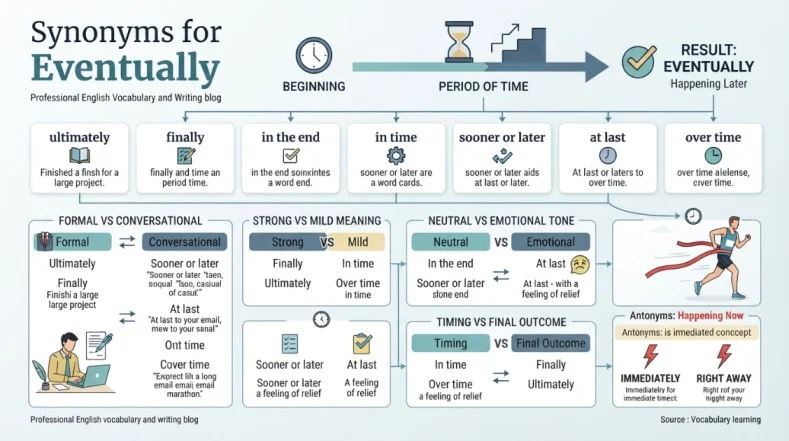
If you keep writing “eventually” in emails, essays, captions, stories, or everyday conversations, your sentences can start to sound repetitive. The good news is that English offers several alternatives, but the right choice depends on whether you mean finally, after some time, in the end, or sooner or later.
This guide explains synonyms for eventually by meaning, tone, formality, and context. You will learn which alternatives work best in academic writing, professional communication, casual conversation, creative writing, and everyday speech.
What Does “Eventually” Mean?
Eventually means after some time or following a series of events, especially when something happens at a later point. Depending on context, useful alternatives include ultimately, finally, in the end, in time, sooner or later, and in due course.
Meaning, Tone and Context
Simple Definition
Eventually means that something happens after a period of time, a process, a delay, or a series of events.
For example:
“She eventually found a solution.”
This means she did not find the solution immediately, but she found it later.
Part of Speech
Eventually is an adverb. It modifies a verb, adjective, or another adverb by explaining when something happens.
Example:
“He eventually agreed to the proposal.”
Tone
Eventually is generally neutral. It does not automatically express a positive or negative opinion.
However, context can give it an emotional quality. In one sentence, it can suggest patience. In another, it can suggest frustration caused by a long delay.
Formality Level
Eventually works well in both everyday and professional English. It is appropriate for conversations, emails, essays, reports, presentations, and many forms of creative writing.
Common Use Cases
You can use eventually when:
- Something takes time to happen.
- A person reaches a result after several attempts.
- A process produces a result later.
- A situation changes gradually.
- You want to describe a final outcome without emphasizing exactly when it happened.
- Something happens after a delay.
- A prediction about a later outcome comes true.
Related Word Forms
Eventually does not have a common adjective or noun form that directly corresponds to it.
The related adjective eventual means happening at some later point.
Example:
“The eventual decision surprised everyone.”
The noun event is related in spelling but does not have the same meaning as eventually.
When and How to Use “Eventually”
Eventually is useful when the exact timing is less important than the fact that something happened later.
1. Professional
“After several rounds of discussion, the team eventually reached an agreement.”
This works because the agreement came after a process.
2. Personal
“I eventually realized that I had left my keys at home.”
The realization happened later, rather than immediately.
3. Academic
“Researchers eventually identified the primary cause of the change.”
The word indicates that the discovery followed investigation.
4. Emotional
“After months of uncertainty, she eventually felt comfortable with the decision.”
Here, eventually emphasizes emotional change over time.
5. Creative
“The traveler eventually reached the quiet village beyond the mountains.”
The word creates a sense of movement toward a later destination.
6. Social Media
“I finally finished the project I had been working on for weeks.”
In a casual caption, finally may sound more natural than eventually when the writer wants to emphasize completion.
7. Email
“We eventually received confirmation from the supplier.”
This is useful when explaining that confirmation arrived after waiting.
Another Word for “Eventually”
The best single replacement for eventually depends on what you want to emphasize.
- If you mean a final result, ultimately is often a strong choice.
- If you mean completion after waiting, finally may work better.
- If you mean something will happen at some unspecified later point, sooner or later may be more natural.
Professional Writing
Use ultimately, in the end, or in due course when describing a result or process.
Academic Writing
Use ultimately, in the end, or over time when the sentence focuses on an outcome or development.
Casual Conversation
Use finally, sooner or later, or at some point.
Emotional Writing
Use finally or at last when you want to highlight relief, satisfaction, frustration, or anticipation.
Creative Writing
Use at last, in time, one day, or in the fullness of time when the style calls for a more expressive effect.
Resume or Workplace Use
Use ultimately or after a period of time when explaining a result or progression. However, precise wording is usually better than replacing every occurrence of eventually.
Social Media Captions
Finally, at last, one day, and sooner or later can sound more conversational than eventually.
Stronger Meaning
Ultimately can emphasize the final outcome more strongly than eventually.
Softer Meaning
In time or over time can sound less focused on a final conclusion.
When Not to Use “Eventually”
Eventually can become vague when the reader needs to know exactly when something happened.
For example:
“We eventually submitted the application.”
This does not tell the reader whether the application was submitted later that day, the following week, or several months later.
A more precise sentence would be:
“We submitted the application two days later.”
You should also avoid replacing eventually with an overly dramatic alternative when the situation is ordinary.
For example:
“She eventually answered my email.”
Using “at long last” could sound unnecessarily dramatic if the response arrived only a few hours later.
Choose the alternative that communicates the intended timing and emotional tone.
Words Commonly Confused With “Eventually”
Eventually vs. Finally
Eventually emphasizes that something happens after time or a process.
Finally often emphasizes completion, resolution, or the end of waiting.
“She eventually understood the lesson.”
“She finally understood the lesson.”
Both can work, but finally often carries a stronger sense of completion or relief.
Eventually vs. Ultimately
Eventually focuses on when something happens.
Ultimately focuses more strongly on the final result or conclusion.
“The company eventually expanded overseas.”
“The decision ultimately changed the company’s strategy.”
Eventually vs. In the End
In the end usually refers to the final result of a situation.
Eventually can simply indicate that something happened later.
“He eventually called me.”
“In the end, we decided to stay.”
Eventually vs. In Time
In time can mean after enough time has passed, but it can also mean before a deadline or before something becomes too late.
“She eventually recovered.”
“She arrived in time for the meeting.”
The second sentence has a specific deadline related meaning.
Eventually vs. Sooner or Later
Sooner or later means something is expected to happen at some unspecified future point.
Eventually usually describes something that did happen or is expected after a process.
“You will eventually understand.”
“You will understand sooner or later.”
Eventually vs. Over Time
Over time emphasizes gradual development.
Eventually emphasizes a later point or outcome.
“His confidence improved over time.”
“He eventually became confident.”
Best Synonym by Context for “Eventually”
| Context | Best Synonym | Why It Works | Example |
|---|---|---|---|
| Formal writing | Ultimately | Clearly emphasizes the final outcome | Ultimately, the committee approved the proposal. |
| Academic writing | Ultimately | Fits conclusions and final effects | The evidence ultimately supported the original theory. |
| Professional or business use | In the end | Clearly communicates the final result | In the end, the team chose the more practical option. |
| Resume | Ultimately | Highlights a final professional outcome | Ultimately, I became responsible for managing the project. |
| Casual conversation | Finally | Sounds natural and conversational | I finally finished my errands. |
| Creative writing | At last | Adds emotional or literary emphasis | At last, the traveler saw the lights of home. |
| Emotional tone | Finally | Can express relief or satisfaction | She finally received the answer she had been waiting for. |
| Strong intensity | Ultimately | Gives greater emphasis to the final consequence | The decision ultimately affected the entire organization. |
| Soft or moderate tone | In time | Sounds less forceful and focuses on gradual timing | In time, they learned to work together. |
| Social media captions | Finally | Natural for casual announcements | Finally, I visited the place I had always wanted to see. |
| Future expectation | Sooner or later | Indicates an expected future event | Sooner or later, you will need to make a decision. |
| Gradual development | Over time | Highlights change across a period | Over time, her writing became more confident. |
For US and UK English, eventually is standard and widely understood in both varieties. The main differences usually involve style and preference rather than meaning.
Which Synonym Should You Choose?
Start by asking what you actually mean.
- If you mean something happened after a delay, consider eventually or finally.
- If you want to emphasize the final result, use ultimately.
- If you want to describe the conclusion of a situation, in the end is often effective.
- If you want to express expected future timing, sooner or later works well.
- If you want to emphasize gradual development, over time is more precise.
- If you want emotional relief or satisfaction, finally or at last can add the right feeling.
- If you are writing academically or professionally, choose the word that explains the relationship between time and outcome most clearly rather than simply choosing a more sophisticated sounding synonym.
Real Life Examples of “Eventually” in Sentences
School
“After reviewing the material several times, Maya eventually understood the concept.”
Workplace
“The department eventually adopted the new scheduling system.”
Writing
“The author eventually reveals why the character left home.”
Conversation
“I was confused at first, but I eventually figured it out.”
Social Media
“After years of talking about it, I finally started the project.”
Resume
“After gaining experience in several departments, I ultimately moved into a leadership role.”
“We eventually received the requested documents from the client.”
Storytelling
“The travelers eventually reached the town just before sunset.”
25 Synonyms for “Eventually”
Not every alternative has exactly the same nuance. The table below includes direct synonyms and contextually equivalent expressions that can replace eventually when their specific meaning fits the sentence.
| Synonym | Simple Meaning | Best Used For | Example Sentence |
|---|---|---|---|
| Ultimately | In the final result | Conclusions and outcomes | The changes ultimately improved the process. |
| Finally | After waiting or at the end | Completion and relief | She finally completed the assignment. |
| In the end | At the final point | Final decisions and results | In the end, we chose the simpler solution. |
| Sooner or later | At some future point | Expected future events | Sooner or later, everyone faces difficult choices. |
| In time | After enough time has passed | Gradual adjustment or development | In time, he became comfortable with the new routine. |
| At last | Finally, after waiting | Emotional or literary emphasis | At last, the missing letter arrived. |
| In due course | At the appropriate later time | Formal and professional contexts | The office will respond in due course. |
| Over time | Gradually as time passes | Development and change | Over time, the team developed a better system. |
| After a while | After some time | Casual conversation | After a while, we stopped worrying about the delay. |
| After some time | Following a period of time | Neutral explanations | After some time, the noise finally stopped. |
| At some point | At an unspecified time | General future or past timing | At some point, we will need to review the plan. |
| One day | At an unspecified future or past time | Stories and future expectations | One day, she eventually hopes to open her own studio. |
| Sometime later | At a later unspecified time | Narratives and explanations | Sometime later, the two friends met again. |
| With time | As time passes | Gradual change | With time, the process became easier. |
| As time went on | During the passage of time | Narratives and gradual development | As time went on, their friendship grew stronger. |
| In the long run | Considering the eventual result | Long term consequences | In the long run, investing in training saved money. |
| After a period of time | Following a defined or undefined period | Formal explanations | After a period of time, the system stabilized. |
| Following a delay | After something takes longer than expected | Professional and practical contexts | Following a delay, the shipment eventually arrived. |
| Afterward | At a later time after an event | Sequential events | We discussed the issue and afterward reached an agreement. |
| Later on | At a later time | Casual conversation | Later on, he decided to change his career. |
| When the time came | When the appropriate moment arrived | Stories and decisions | When the time came, she accepted the opportunity. |
| Once the time came | After the appropriate point was reached | Narrative situations | Once the time came, they began the next stage. |
| In the fullness of time | After sufficient time has passed | Literary or formal writing | In the fullness of time, the value of the decision became clear. |
| Afterward in the process | At a later stage | Process descriptions | Afterward in the process, the team reviewed the results. |
| At a later point | At a later stage or time | Formal and academic contexts | At a later point, the researchers repeated the experiment. |
Synonym Groups and Usage Differences
Professional vs. Personal Synonyms
Professional writing often benefits from ultimately, in due course, in the end, or at a later point.
Personal communication can comfortably use finally, later on, after a while, or sooner or later.
The important difference is not simply formality. The meaning should also match the situation.
Formal vs. Conversational Synonyms
Formal alternatives include ultimately, in due course, and at a later point.
Conversational choices include finally, later on, after a while, and sooner or later.
For a business email, “We will respond in due course” sounds more formal than “We will get back to you later.”
Academic Synonyms
Academic writing often benefits from ultimately, over time, in the long run, and at a later point.
These expressions can help explain conclusions, long term effects, research developments, or changes across a period.
However, eventually remains perfectly acceptable in academic writing when it accurately expresses the intended meaning.
Professional and Business Synonyms
In workplace communication, ultimately is useful when discussing a final decision or consequence.
In due course works when a response or action will happen at an appropriate later time.
Finally is useful when emphasizing that a task has been completed.
Creative or Literary Synonyms
At last, one day, in the fullness of time, and as time went on can add narrative texture.
These choices can make a story feel more reflective or emotional than a straightforward use of eventually.
Slang or Modern Synonyms
Eventually does not have a major slang equivalent that should routinely replace it.
Casual phrases such as “later on” and “sooner or later” are natural in everyday speech, but they should not automatically be used in formal or academic writing.
Strongest vs. Weaker Synonyms
A useful intensity scale is:
Mild: in time, after a while, with time
Moderate: eventually, later on, sooner or later
Stronger focus on final outcome: finally, in the end, ultimately
Strong emotional emphasis: at last
The strongest option depends on context. A stronger sounding synonym is not necessarily a better synonym.
Emotional vs. Neutral Synonyms
Eventually is generally neutral.
Finally can suggest relief, impatience, or satisfaction.
At last often carries an even stronger emotional feeling.
Ultimately is usually more analytical and outcome focused.
In time is comparatively gentle and gradual.
Antonyms of “Eventually”
Because eventually describes something happening later, its opposites often describe immediate timing, early action, or action before a later point.
| Antonym | Meaning | Example Sentence |
|---|---|---|
| Immediately | Without waiting | She immediately answered the question. |
| Instantly | At once | The screen instantly displayed the result. |
| At once | Immediately | Please contact the office at once. |
| Right away | Without delay | He called the manager right away. |
| Straightaway | Immediately | The team began work straightaway. |
| Promptly | Without unnecessary delay | The company promptly responded to the complaint. |
| Without delay | Immediately | The issue was addressed without delay. |
| Without waiting | Acting immediately | She left without waiting for further instructions. |
| Now | At the present moment | We need to make the decision now. |
| This instant | Immediately at the present moment | You need to report the issue this instant. |
| Ahead of time | Before the expected time | We completed the report ahead of time. |
| In advance | Before something happens | Please register in advance. |
| Beforehand | Before an event or action | They prepared the materials beforehand. |
| Early | Before the expected time | She arrived early for the appointment. |
| Prematurely | Too early or before the proper time | The announcement was made prematurely. |
Comparison: Eventually vs. Similar Words
Eventually vs. Finally
The main difference is emphasis.
Eventually focuses on something happening after time has passed. Finally often emphasizes completion or relief.
Eventually is usually neutral. Finally can carry more emotional force.
Example:
“He eventually understood the instructions.”
“She finally understood the instructions.”
Eventually vs. Ultimately
Eventually focuses on timing. Ultimately focuses on the final result.
Ultimately is often more formal and analytical.
Example:
“The team eventually completed the project.”
“The decision ultimately changed the project’s direction.”
Eventually vs. In the End
In the end emphasizes the final result of a situation.
Eventually emphasizes the later timing of an event.
Example:
“She eventually returned home.”
“In the end, she decided to stay home.”
Eventually vs. In Time
Eventually means after some time.
In time can mean after enough time has passed or before it becomes too late.
Example:
“He eventually recovered from the setback.”
“She arrived in time to catch the train.”
Eventually vs. Sooner or Later
Eventually can describe an actual later result.
Sooner or later often expresses an expectation that something will happen at an unspecified future point.
Example:
“You will eventually find an answer.”
“You will find an answer sooner or later.”
Eventually vs. Over Time
Eventually points to a later moment or outcome.
Over time focuses on gradual development.
Example:
“The company eventually expanded.”
“The company grew stronger over time.”
Common Phrases and Expressions with “Eventually”
1. Eventually become
Meaning:
To gradually reach a new state, position, or condition after some time.
Example sentence:
“She eventually became the team’s project manager.”
2. Eventually find
Meaning:
To discover or locate something after searching or waiting.
Example sentence:
“We eventually found the information we needed.”
3. Eventually realize
Meaning:
To understand something after a period of thought or experience.
Example sentence:
“He eventually realized that the original plan was not practical.”
4. Eventually lead to
Meaning:
To produce a result after a sequence of events.
Example sentence:
“Small improvements eventually led to significant savings.”
5. Eventually decide
Meaning:
To make a decision after considering something for some time.
Example sentence:
“After several conversations, they eventually decided to move forward.”
6. Eventually reach
Meaning:
To arrive at a place, stage, goal, or conclusion after some time.
Example sentence:
“The researchers eventually reached a different conclusion.”
7. Eventually work out
Meaning:
To reach a satisfactory result after difficulties or uncertainty.
Example sentence:
“Although the process was difficult, everything eventually worked out.”
Common Mistakes to Avoid
1. Using Eventually When a Precise Time Is Available
“We eventually submitted the form” is vague if the exact timing matters.
If the form was submitted on Friday, say so.
2. Confusing Eventually With Finally
These words overlap, but finally can emphasize completion or relief more strongly.
Choose based on whether you want to emphasize time or the feeling of reaching an endpoint.
3. Using a Casual Synonym in Formal Writing
“Later on” may sound natural in conversation but can feel less precise in an academic report.
Consider eventually, ultimately, or at a later point when appropriate.
4. Using an Overly Dramatic Synonym
“At last” can suggest strong relief or anticipation.
It may sound excessive when describing a routine event that happened shortly after the expected time.
5. Repeating Eventually Too Often
Using the same adverb throughout an essay can make your writing feel repetitive.
Vary your wording only when the replacement preserves the intended meaning.
6. Choosing the Wrong Emotional Tone
Finally and at last can carry emotional emphasis that eventually does not necessarily have.
Do not use them when you want completely neutral wording.
7. Using Slang in Academic or Professional Writing
Casual expressions such as later on may be suitable for conversation but are not always the clearest choice for formal writing.
FAQs
What is the best synonym for eventually?
Ultimately is often the best synonym when you want to emphasize a final outcome. Finally is better when the focus is completion after waiting.
What is a formal synonym for eventually?
Ultimately and in due course are useful formal alternatives. Ultimately emphasizes a final result, while in due course emphasizes an appropriate later time.
What is an informal synonym for eventually?
Finally, later on, and sooner or later can sound natural in casual conversation. The best choice depends on whether you mean completion or future timing.
What is another word for eventually in professional writing?
Ultimately is useful for final outcomes, while in due course works well when describing an expected response or action at a later time.
What is the difference between eventually and ultimately?
Eventually mainly describes timing after some time has passed. Ultimately focuses more strongly on the final result, consequence, or conclusion.
What is the opposite of eventually?
Common opposites include immediately, instantly, right away, promptly, at once, and without delay because they describe actions that happen without waiting.
Conclusion
Eventually means that something happens after some time, a delay, or a series of events. It is neutral, flexible, and suitable for both everyday and professional English.
The best synonym depends on your intended meaning. Use finally for completion, ultimately for a final outcome, in the end for a concluding result, sooner or later for an expected future event, and over time for gradual development.
The most useful vocabulary tip is to choose a synonym based on meaning first and style second. A precise, natural word is usually better than a complicated word that only sounds more sophisticated.
When you understand the difference between timing, outcome, emotion, and formality, you can use synonyms for eventually with much greater confidence.
Discover More Post:
- 25+ Synonyms for God | Meanings, Examples, and Best …
- 25+ Synonyms for Yelled | Meanings, Examples, and Best …
- 25+ Synonyms for Secret | Meanings, Examples, and Best …