When you use the word “facilitate” several times in an essay, email, report, resume, or workplace conversation, your writing can start to sound repetitive. The good news is that English offers many alternatives, but the right choice depends on what you actually mean.
You might mean help, make something easier, enable an action, speed up a process, support a person, or guide a discussion. Those meanings are related, but they are not identical.
This guide explains synonyms for facilitate by meaning, tone, formality, and context. You will learn which alternatives work best in academic writing, professional communication, resumes, everyday conversation, creative writing, and social media.
What Does “Facilitate” Mean?
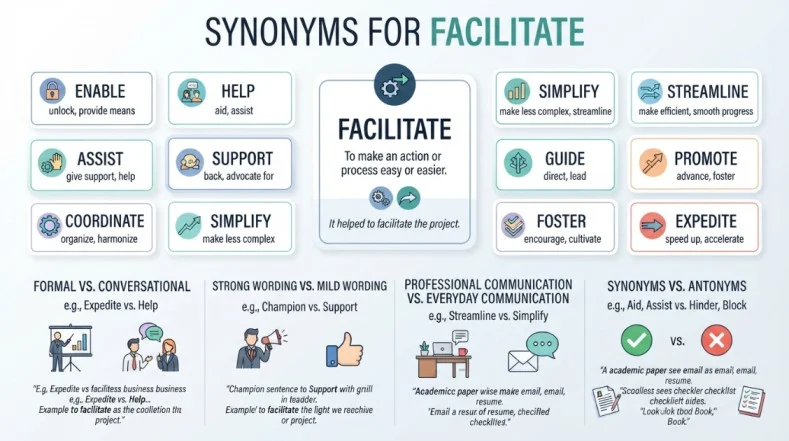
Facilitate means to make an action, process, or result easier or more likely to happen. Depending on context, useful synonyms include enable, assist, support, simplify, streamline, encourage, coordinate, guide, and help.
Meaning, Tone and Context
Simple Definition
To facilitate something means to make it easier to happen or to help a process move forward.
For example:
“The new software facilitates communication between departments.”
Here, facilitate means that the software makes communication easier.
The word can also describe a person who helps a group accomplish something. For example, someone may facilitate a meeting by guiding the discussion and keeping participants focused.
Part of Speech
Facilitate is a verb.
Common forms include:
Facilitate
Facilitates
Facilitated
Facilitating
Facilitation is the related noun.
Facilitator is the noun for a person who helps a process, meeting, discussion, or activity move forward.
Tone
Facilitate is generally neutral and professional.
It does not usually express strong emotion. Instead, it focuses on function, progress, cooperation, or improved conditions.
Formality Level
Facilitate is more common in professional, academic, organizational, technical, and formal writing than in casual conversation.
In everyday speech, people often say “help” or “make it easier” instead.
Common Use Cases
You may see facilitate used when discussing:
Business processes
Education
Communication
Meetings
Research
Technology
Customer service
Teamwork
Training
Project management
Policy implementation
Transportation
Access to resources
Important Word Forms
Facilitate is the verb.
Facilitation is the process of making something easier or guiding a process.
Facilitator is a person who supports or guides a process.
For example:
“The facilitator encouraged everyone to participate.”
“The workshop improved collaboration through effective facilitation.”
When and How to Use “Facilitate”
Use facilitate when you want to emphasize that someone or something makes a process easier, supports progress, or helps an outcome occur.
1. Professional
“The new platform will facilitate communication between remote teams.”
Here, facilitate means make communication easier.
2. Academic
“The research framework facilitates a clearer comparison of the two theories.”
The word works well because it describes something that makes an analytical task easier.
3. Workplace
“Our manager facilitated a discussion between the two departments.”
In this sentence, the manager helped guide the discussion.
4. Email
“The attached document should facilitate a faster review of the proposal.”
This sounds professional and precise.
5. Education
“Visual examples can facilitate student understanding.”
The examples make understanding easier.
6. Personal
“Planning the route beforehand facilitated a smoother trip.”
The planning helped the trip proceed more easily.
7. Social Media
“Good design can facilitate better communication with your audience.”
This usage is possible, although “help” may sound more natural in an informal post.
Another Word for “Facilitate”
There is no single replacement that works perfectly in every sentence. The best synonym depends on the exact meaning.
- For professional writing, enable, support, streamline, and coordinate can work well.
- For academic writing, enable, promote, foster, and advance may be appropriate.
- For casual conversation, help, aid, and make easier usually sound more natural.
- For emotional writing, support, encourage, and foster may fit when human relationships are involved.
- For creative writing, encourage, advance, smooth, and guide can provide more specific meaning.
- For resumes and workplace writing, streamline, coordinate, support, enable, and expedite can communicate useful professional actions when they accurately describe the work.
- For social media captions, help, support, and make easier are generally more conversational.
- For a stronger meaning, consider expedite, accelerate, or advance, but only when the sentence specifically involves speed or progress.
- For a softer meaning, help, support, or assist can sound less forceful.
When Not to Use “Facilitate”
Facilitate is useful, but it can sometimes sound unnecessarily formal.
In casual conversation, saying “I facilitated my friend with the move” sounds unnatural. “I helped my friend move” is clearer.
It can also be too vague. If you mean that you organized a meeting, “organized” gives the reader more information than “facilitated.”
Compare:
“She facilitated the event.”
“She coordinated the event.”
The second sentence tells the reader more about her role.
Facilitate can also be too broad for a resume. Instead of saying that you “facilitated projects,” explain whether you coordinated teams, improved workflows, trained employees, or supported implementation.
Precision is usually more valuable than simply choosing a sophisticated sounding word.
Words Commonly Confused With “Facilitate”
Facilitate vs. Enable
Enable means make something possible or give someone the ability or opportunity to do something.
Facilitate usually emphasizes making a process easier or helping it move forward.
“The software enabled employees to work remotely.”
“The software facilitated communication between employees.”
Facilitate vs. Assist
Assist means help someone with a task.
Facilitate can involve assistance, but it often describes the conditions or process that make an outcome easier.
“The technician assisted the customer.”
“The new system facilitated faster service.”
Facilitate vs. Support
Support means provide help, resources, encouragement, or assistance.
Facilitate is more focused on making progress or an activity easier.
“The manager supported the team.”
“The manager facilitated collaboration between the teams.”
Facilitate vs. Promote
Promote means encourage, advance, or actively support something.
Facilitate means make an action or result easier to achieve.
“The campaign promoted healthy eating.”
“The program facilitated access to healthy food.”
Facilitate vs. Simplify
Simplify means make something less complicated.
Facilitate has a broader meaning and can involve assistance, coordination, access, or progress.
“The guide simplified the instructions.”
“The guide facilitated the training process.”
Facilitate vs. Coordinate
Coordinate means organize people, activities, or resources so they work effectively together.
Facilitate may involve coordination, but it does not always mean that you were responsible for organizing everything.
“She coordinated the project.”
“She facilitated communication among the project teams.”
Best Synonym by Context for “Facilitate”
| Context | Best Synonym | Why It Works | Example |
|---|---|---|---|
| Formal writing | Enable | Clearly describes making something possible | The policy enables broader access to services. |
| Academic writing | Promote | Works well for processes that encourage development or progress | The program promotes independent learning. |
| Professional or business use | Streamline | Highlights greater efficiency | The new system streamlined the approval process. |
| Resume | Coordinate | Shows an active organizational responsibility | Coordinated training sessions for new employees. |
| Casual conversation | Help | Natural and easy to understand | This app helps me organize my schedule. |
| Creative writing | Encourage | Adds a human sense of support or development | Her words encouraged his confidence. |
| Emotional tone | Support | Emphasizes care, assistance, or encouragement | Her friends supported her through the transition. |
| Strong intensity | Expedite | Specifically emphasizes making something happen faster | The revised process expedited customer approvals. |
| Soft or moderate tone | Assist | Sounds helpful without implying complete responsibility | The staff assisted visitors with registration. |
| Social media captions | Help | Fits conversational digital language | These tips can help you plan your next trip. |
| Communication | Improve | Directly describes better communication | The platform improved communication across teams. |
| Meetings | Guide | Clearly describes helping a discussion move forward | She guided the group through the discussion. |
| Project management | Coordinate | Emphasizes organization among people and tasks | He coordinated the project across three departments. |
| Access | Enable | Strongly communicates availability or opportunity | The program enables students to access new resources. |
| Efficiency | Streamline | Shows that unnecessary steps were reduced | Automation streamlined the reporting process. |
Which Synonym Should You Choose?
Start by asking what facilitate means in your sentence.
- If you mean make possible, choose enable.
- If you mean give help, choose assist or help.
- If you mean provide ongoing help, choose support.
- If you mean make something simpler, choose simplify.
- If you mean make a process more efficient, choose streamline.
- If you mean make something happen faster, choose expedite.
- If you mean organize people or resources, choose coordinate.
- If you mean guide a discussion or group, choose guide or moderate.
- If you mean encourage growth or development, choose foster or promote.
- If you mean move something forward, choose advance or further.
The most accurate synonym is usually the one that preserves the original meaning while making the sentence more specific.
Real Life Examples of “Facilitate” in Sentences
School
“Interactive activities can facilitate deeper student engagement.”
Workplace
“The manager facilitated communication between the design and engineering teams.”
Writing
“Clear headings facilitate easier reading.”
Conversation
“I created a shared document to facilitate our planning.”
Social Media
“Short captions can facilitate faster understanding of complex ideas.”
Resume
“Facilitated cross department communication during a major software implementation.”
“I have included the requested information to facilitate your review.”
Storytelling
“The quiet conversation facilitated a deeper understanding between the two characters.”
25 Synonyms for “Facilitate”
| Synonym | Simple Meaning | Best Used For | Example Sentence |
|---|---|---|---|
| Enable | Make something possible | Access, opportunity, technology, ability | The new system enables employees to access files remotely. |
| Help | Make a task easier | Casual, personal, and general situations | This checklist will help you prepare for the interview. |
| Assist | Give practical help | Professional and formal situations | Our staff can assist customers with account questions. |
| Aid | Provide useful help | Formal, academic, and professional contexts | The visual guide aided students in understanding the concept. |
| Support | Provide help or resources | People, teams, projects, and processes | The organization supports small businesses with training. |
| Ease | Make something less difficult | Problems, pressure, discomfort, or difficulty | The new schedule eased pressure on the support team. |
| Simplify | Make something less complicated | Instructions, processes, explanations | The redesigned form simplified the application process. |
| Streamline | Make a process more efficient | Business, technology, administration, and workflows | Automation streamlined the monthly reporting process. |
| Expedite | Make something happen sooner | Approvals, processing, delivery, and procedures | The additional documentation expedited the application review. |
| Advance | Move something forward | Progress, research, projects, and causes | The study advanced understanding of the issue. |
| Promote | Encourage or advance something | Growth, development, behavior, and awareness | The program promotes collaboration among students. |
| Encourage | Give confidence or motivation | People, behavior, participation, and development | The teacher encouraged students to ask questions. |
| Foster | Help something develop gradually | Relationships, skills, culture, and growth | The program fosters creativity in young learners. |
| Further | Help progress or development | Goals, causes, research, and interests | The initiative furthered the company’s sustainability goals. |
| Smooth | Make a process work with fewer difficulties | Transitions, operations, communication, and experiences | Better planning smoothed the transition to the new system. |
| Coordinate | Organize people or activities | Projects, teams, events, and schedules | She coordinated several teams during the conference. |
| Arrange | Organize something in advance | Meetings, events, resources, and logistics | He arranged transportation for the visiting researchers. |
| Organize | Put people or activities into an effective structure | Events, projects, information, and operations | The coordinator organized the workshop for new employees. |
| Guide | Help someone move through a process | Discussions, learning, decisions, and procedures | The instructor guided the class through the research process. |
| Moderate | Guide a discussion fairly | Meetings, debates, forums, and group conversations | She moderated the discussion between the two panels. |
| Mediate | Help people resolve a disagreement | Conflicts and negotiations | A trained adviser mediated the dispute between the teams. |
| Accommodate | Make room for needs or circumstances | Customers, accessibility, schedules, and preferences | The hotel accommodated guests with special accessibility needs. |
| Make possible | Cause something to become possible | General explanations and accessible writing | The scholarship made it possible for her to attend college. |
| Empower | Give someone the ability or confidence to act | Leadership, education, communities, and workplaces | The training empowered employees to make informed decisions. |
| Catalyze | Cause or stimulate significant action or change | Research, innovation, business, and social change | The discovery catalyzed new research in the field. |
Synonym Groups and Usage Differences
Professional vs. Personal Synonyms
Professional writing often benefits from specific verbs that describe what actually happened.
- Use coordinate when you organized people or activities.
- Use streamline when you improved efficiency.
- Use enable when you made an action possible.
- Use support when you provided resources or assistance.
In personal communication, help, assist, and support are often more natural.
For example:
Professional: “The new platform streamlined the approval process.”
Personal: “The new app helped me finish the application.”
Formal vs. Conversational Synonyms
Words such as facilitate, enable, expedite, foster, and catalyze are common in formal contexts.
Words such as help, make easier, and support are generally easier for everyday conversation.
Formal:
“The policy facilitates access to educational resources.”
Conversational:
“The policy makes it easier for students to access educational resources.”
Both sentences can communicate the same general idea, but the second sounds more conversational.
Academic Synonyms
Academic writing benefits from precision.
Enable works well when something makes an outcome possible.
Promote works when something encourages a behavior or development.
Foster is useful for gradual development.
Advance can describe progress in knowledge or research.
Facilitate itself remains useful when describing a mechanism that makes a research process or outcome easier.
Professional and Business Synonyms
Business writing often benefits from verbs that describe measurable actions.
- Use streamline for efficiency.
- Use coordinate for organization.
- Use expedite for speed.
- Use enable for capability.
- Use support for assistance.
For example:
“Streamlined the customer onboarding process.”
This is more informative on a resume than simply saying:
“Facilitated customer onboarding.”
Creative or Literary Synonyms
Creative writing may benefit from more expressive choices.
Encourage can emphasize emotion.
Foster can suggest gradual growth.
Guide can create a sense of direction.
Smooth can describe an easy transition.
Empower can emphasize personal agency.
The best creative synonym depends on the mood and the relationship between the characters.
Slang or Modern Synonyms
Facilitate does not have a direct slang equivalent that works naturally in most contexts.
Casual expressions such as “help out” can replace facilitate when the meaning is simply to help.
For example:
Formal: “The volunteer facilitated the registration process.”
Casual: “The volunteer helped people sign up.”
Use the casual version in conversation or informal posts, but avoid overly casual language in academic and professional writing.
Strongest vs. Weaker Synonyms
The intensity of these words depends on context, but this general scale can help:
Mild: help
Mild to moderate: assist
- Moderate: support
- Moderate: enable
- Moderate: simplify
- Moderate to strong: streamline
- Strong for speed: expedite
- Strong for progress: advance
- Strong for major change: catalyze
Do not automatically choose the strongest word. Choose the word that accurately describes the action.
Emotional vs. Neutral Synonyms
Facilitate, enable, coordinate, and streamline are usually neutral.
Support, encourage, foster, and empower can carry more human or positive emotional meaning.
Compare:
“The program facilitated communication.”
“The program empowered participants to communicate confidently.”
The second sentence adds an emotional and human dimension.
Antonyms of “Facilitate”
Because facilitate means to make something easier or help it happen, its opposites generally describe making something harder, stopping it, restricting it, or interfering with progress.
| Antonym | Meaning | Example Sentence |
|---|---|---|
| Hinder | Make progress more difficult | Poor communication hindered the project. |
| Obstruct | Block progress or movement | Construction obstructed access to the building. |
| Impede | Slow or interfere with progress | Outdated software impeded the team’s work. |
| Prevent | Stop something from happening | The safety barrier prevented unauthorized access. |
| Block | Stop movement, action, or access | The technical issue blocked the payment process. |
| Thwart | Stop a plan or effort from succeeding | The unexpected problem thwarted their plans. |
| Hamper | Make progress difficult | Limited resources hampered the research effort. |
| Complicate | Make something more difficult | Additional requirements complicated the application process. |
| Delay | Cause something to happen later | Missing documents delayed the approval. |
| Disrupt | Interrupt normal progress or operation | The outage disrupted online services. |
| Discourage | Reduce willingness or confidence | Negative feedback discouraged participation. |
| Inhibit | Restrict or hold back an action | Fear can inhibit open communication. |
| Restrict | Limit freedom, access, or activity | The new rule restricted access to the facility. |
| Constrain | Limit available choices or actions | Budget limitations constrained the project. |
| Undermine | Weaken an effort, process, or result | Poor planning undermined the team’s progress. |
These are contextual antonyms rather than perfect opposites in every sentence. The appropriate choice depends on what facilitate means in the original sentence.
Comparison: “Facilitate” vs. Similar Words
Facilitate vs. Enable
The main difference is emphasis.
Facilitate usually means make a process easier or help something happen. Enable usually means make something possible or give someone the ability to act.
Enable can sound more direct when capability or access is the focus.
Example:
“The software facilitates collaboration.”
“The software enables remote collaboration.”
Facilitate vs. Help
Help is broader and much more conversational.
Facilitate sounds more formal and often describes a process, system, or organized activity.
Help is usually better for everyday speech.
Example:
“The guide helped me understand the instructions.”
“The guide facilitated understanding of the procedure.”
Facilitate vs. Assist
Assist means provide help with a task.
Facilitate has a broader range and can describe systems, processes, discussions, and conditions.
Assist is often a good professional alternative when a person directly provides help.
Example:
“The employee assisted the customer.”
“The new system facilitated faster service.”
Facilitate vs. Support
Support suggests providing help, resources, encouragement, or stability.
Facilitate emphasizes making something easier or helping a process move forward.
Example:
“The manager supported the employees.”
“The manager facilitated communication between the employees.”
Facilitate vs. Streamline
Streamline specifically suggests making a process simpler or more efficient by reducing unnecessary steps.
Facilitate is broader.
Example:
“The consultant facilitated the implementation.”
“The consultant streamlined the implementation process.”
Facilitate vs. Coordinate
Coordinate means organize people, resources, or activities so that they work together effectively.
Facilitate can involve coordination but does not necessarily mean that the person organized every part of the activity.
Example:
“She coordinated the conference.”
“She facilitated the discussion.”
Common Phrases and Expressions with “Facilitate”
1. Facilitate communication
Meaning:
Help people exchange information more easily.
Example sentence:
“The shared platform facilitates communication between teachers and parents.”
2. Facilitate learning
Meaning:
Make learning easier or support the learning process.
Example sentence:
“Interactive exercises can facilitate learning in a classroom.”
3. Facilitate discussion
Meaning:
Guide a discussion so participants can communicate effectively.
Example sentence:
“The instructor facilitated a discussion about the research findings.”
4. Facilitate collaboration
Meaning:
Make it easier for people or groups to work together.
Example sentence:
“The new workspace facilitates collaboration across departments.”
5. Facilitate access
Meaning:
Make it easier for people to obtain or use something.
Example sentence:
“The program facilitates access to educational resources.”
6. Facilitate growth
Meaning:
Create conditions that help development occur.
Example sentence:
“The mentorship program facilitates professional growth.”
7. Facilitate change
Meaning:
Help a transition or transformation happen more smoothly.
Example sentence:
“Clear communication can facilitate organizational change.”
8. Facilitate progress
Meaning:
Help something move forward.
Example sentence:
“Regular feedback can facilitate progress toward the team’s goals.”
Common Mistakes to Avoid
1. Using Facilitate When Help Is Clearer
Facilitate can sound unnecessarily formal when you simply mean help.
Instead of:
“This tool facilitates me with my homework.”
Use:
“This tool helps me with my homework.”
2. Confusing Facilitate With Enable
Enable often focuses on possibility or capability.
Facilitate often focuses on making a process easier.
Choose the word that matches the actual relationship.
3. Using a Casual Synonym in Formal Writing
Words such as “help out” may sound too informal in a research paper or professional report.
Use a precise alternative such as assist, support, enable, or facilitate when appropriate.
4. Using an Overly Dramatic Synonym
Do not replace facilitate with catalyze simply because it sounds more sophisticated.
Catalyze suggests stimulating substantial action or change. It may exaggerate a minor contribution.
5. Repeating Facilitate Too Often
Repeating the same formal verb can make professional writing feel mechanical.
Vary your wording when the meaning genuinely changes.
For example, use coordinate for organization, streamline for efficiency, and support for assistance.
6. Choosing the Wrong Emotional Tone
Facilitate is usually neutral.
If you are describing emotional encouragement, support or encourage may communicate the intended meaning more naturally.
7. Using Slang in Academic or Professional Writing
Casual expressions such as “help out” can be appropriate in conversation but may sound too informal in research, business reports, or resumes.
Always consider your audience before choosing a synonym.
FAQs
What is the best synonym for facilitate?
The best synonym depends on context. Enable works for possibility, help for general use, streamline for efficiency, and coordinate for organizing people or activities.
What is a formal synonym for facilitate?
Enable, assist, support, promote, foster, streamline, and expedite can all work as formal alternatives when their specific meanings match the sentence.
What is an informal synonym for facilitate?
Help is the most natural informal alternative in many situations. “Make easier” also works when explaining the meaning conversationally.
What is another word for facilitate in professional writing?
Professional alternatives include enable, assist, support, coordinate, streamline, expedite, and promote. Choose the word that accurately describes your responsibility.
What is the difference between facilitate and enable?
Facilitate usually means make a process easier, while enable emphasizes making something possible or giving someone the ability or opportunity to act.
What is the opposite of facilitate?
Common contextual opposites include hinder, obstruct, impede, prevent, block, hamper, complicate, delay, disrupt, inhibit, restrict, and constrain.
Conclusion
Facilitate means to make something easier, support a process, guide an activity, or help an outcome happen. It is a useful neutral and professional verb, especially in academic, workplace, business, and organizational writing.
The best synonym depends on the exact meaning. Choose enable when something becomes possible, streamline when efficiency improves, coordinate when people or activities are organized, support when help is provided, and expedite when speed is the main idea.
For casual communication, help is often clearer and more natural. For professional writing, a more specific synonym can show exactly what you did.
When choosing among synonyms for facilitate, do not focus only on finding a more sophisticated word. Focus on precision. The strongest vocabulary choice is the one that communicates your intended meaning clearly and naturally.
Discover More Post:
- 25+ Synonyms for God | Meanings, Examples, and Best …
- 25+ Synonyms for Yelled | Meanings, Examples, and Best …
- 25+ Synonyms for Secret | Meanings, Examples, and Best …