Sometimes the word “cruel” says exactly what you mean. Other times, especially in an essay, email, story, review, or social media caption, you may want a more precise word.
A person can be cruel, but they can also be callous, ruthless, merciless, heartless, or simply unkind. Each word creates a slightly different impression.
This guide explains 25 useful synonyms for cruel, including their meanings, intensity, tone, and best contexts. You will also find examples to help you choose the right word for school, work, conversation, creative writing, and everyday communication.
What Does “Cruel” Mean?
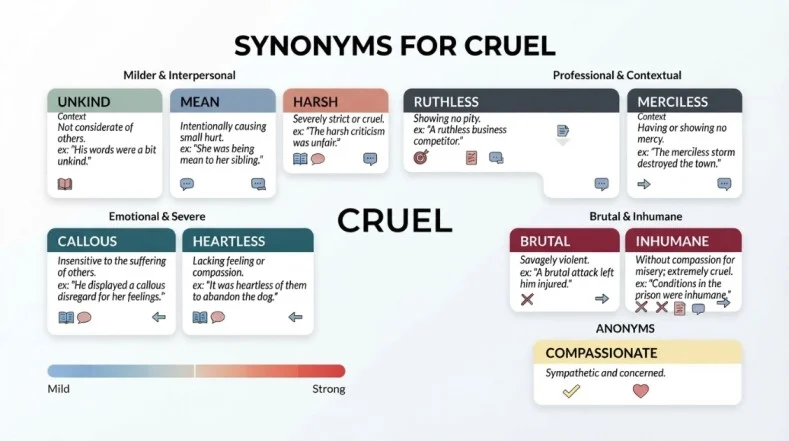
Cruel means causing pain, suffering, or distress intentionally or without concern for others. Common synonyms include harsh, unkind, callous, brutal, heartless, ruthless, merciless, and inhumane, depending on context and intensity.
Meaning, Tone and Context
Simple Definition
The adjective cruel describes someone or something that causes pain, suffering, fear, or distress, especially when there is little concern for the feelings or well being of others.
For example:
The cruel treatment of the animals shocked everyone at the shelter.
Cruel can describe a person, action, decision, punishment, joke, situation, or outcome.
Part of Speech
Cruel is primarily an adjective.
Related forms include:
Cruel: The adjective describing something that causes suffering.
Cruelty: The noun referring to cruel behavior or treatment.
Cruelly: The adverb describing an action performed in a cruel manner.
Crueler: The comparative form.
Cruelest: The superlative form.
Tone
Cruel has a strongly negative tone. It usually communicates moral disapproval or emotional concern.
The exact strength depends on the situation. Calling someone unkind is generally milder than calling them brutal or sadistic.
Formality Level
Cruel is common in both everyday and formal English. It works in conversation, essays, news writing, literature, workplace communication, and personal writing.
More specific alternatives can make formal or academic writing more precise.
Common Use Cases
You can use cruel to describe:
- Cruel behavior
- Cruel treatment
- Cruel punishment
- Cruel remarks
- Cruel jokes
- Cruel decisions
- Cruel people
- Cruel circumstances
- Cruel outcomes
- Cruel acts toward animals or people
When and How to Use “Cruel”
Cruel works best when the behavior or situation clearly involves unnecessary suffering, pain, humiliation, or a serious lack of compassion.
1. Personal Context
It was cruel to make fun of her mistake in front of everyone.
Here, cruel communicates that the behavior was unnecessarily hurtful.
2. Academic Context
The essay examines how cruel treatment of prisoners affected public opinion.
The word is appropriate because the subject involves serious treatment and human suffering.
3. Professional Context
The manager was criticized for what employees considered a cruel response to a difficult situation.
The wording communicates serious concern without automatically accusing the manager of intentional abuse.
4. Emotional Context
Losing the opportunity after working for years felt cruel.
Here, cruel describes an emotionally painful situation rather than deliberate behavior.
5. Creative Writing
The cruel winter left the village isolated for weeks.
Cruel creates a vivid, personified description of difficult conditions.
6. Social Media
That was a cruel thing to say when she was already struggling.
The word is direct and emotionally understandable in a caption or post.
7. Email
I found the proposed treatment of the affected employees unnecessarily cruel.
This version is strong but remains suitable for a serious written complaint.
Another Word for “Cruel”
There is no single replacement that works perfectly in every sentence. The best synonym depends on what kind of cruelty you want to emphasize.
| Context | Recommended Word |
|---|---|
| Professional writing | Callous |
| Academic writing | Inhumane |
| Casual conversation | Mean |
| Emotional writing | Heartless |
| Creative writing | Merciless |
| Resume or workplace description | Harsh |
| Social media captions | Heartless |
| Stronger meaning | Brutal |
| Softer meaning | Unkind |
Professional Writing
Callous works well when the main issue is a lack of concern for other people’s feelings or suffering.
Academic Writing
Inhumane is useful when discussing treatment that violates basic standards of human dignity or compassion.
Casual Conversation
Mean is a natural choice for everyday situations involving hurtful behavior.
Emotional Writing
Heartless emphasizes a striking absence of compassion or sympathy.
Creative Writing
Merciless can create a stronger and more dramatic image, especially in fiction or storytelling.
Resume or Workplace Use
Harsh can be useful when describing criticism, treatment, conditions, or policies without making the strongest possible accusation.
Social Media Captions
Heartless, mean, or cruel can work naturally depending on the emotional intensity of the message.
Stronger Meaning
Use brutal, savage, or sadistic only when the context genuinely supports their stronger meanings.
Softer Meaning
Use unkind when the behavior is hurtful but does not necessarily involve serious suffering or severe malice.
When Not to Use “Cruel”
Cruel can be too strong when someone is merely rude, impatient, strict, insensitive, or unpleasant.
For example:
The teacher was cruel because she assigned extra homework.
This may overstate the situation.
A more precise sentence could be:
The teacher was strict because she assigned extra homework.
Similarly, calling a mildly sarcastic comment cruel can make the writer sound overly dramatic.
Choose a more specific word when the situation involves simple rudeness, criticism, firmness, or disagreement rather than genuine cruelty.
Words Commonly Confused With “Cruel”
Cruel vs. Mean
Mean is broader and more common in casual English. Cruel usually suggests more serious or deliberate harm.
He was mean about my haircut.
The abusive treatment was cruel.
Cruel vs. Harsh
Harsh describes severity or lack of gentleness. It does not always involve intentional harm.
The criticism was harsh.
The treatment was cruel.
Cruel vs. Callous
Callous emphasizes emotional insensitivity. A callous person may ignore suffering without necessarily intending to cause it.
Her callous response surprised everyone.
Cruel vs. Ruthless
Ruthless describes a willingness to pursue a goal without mercy or concern for others.
The competitor was ruthless in business negotiations.
Cruel focuses more directly on causing suffering.
Cruel vs. Brutal
Brutal is generally stronger and often suggests extreme violence, severity, or force.
The attack was brutal.
Cruel can involve emotional or psychological harm without physical violence.
Cruel vs. Inhumane
Inhumane emphasizes treatment that lacks basic human compassion or dignity.
The organization was criticized for inhumane working conditions.
Best Synonym by Context for “Cruel”
| Context | Best Synonym | Why It Works | Example |
|---|---|---|---|
| Formal writing | Callous | Emphasizes lack of concern | The decision appeared callous to many observers. |
| Academic writing | Inhumane | Fits serious discussions of suffering and dignity | The study examined inhumane treatment of vulnerable groups. |
| Professional or business use | Harsh | Describes severe treatment without always implying extreme malice | The company faced criticism for harsh employment policies. |
| Resume or workplace | Harsh | Can describe difficult treatment or conditions neutrally | Employees reported harsh working conditions. |
| Casual conversation | Mean | Natural and familiar | That was a mean thing to say. |
| Creative writing | Merciless | Adds dramatic intensity | The merciless storm destroyed the crops. |
| Emotional tone | Heartless | Highlights a lack of compassion | Her heartless response made the situation worse. |
| Strong intensity | Brutal | Communicates extreme severity | The brutal attack left the town in shock. |
| Mild or moderate tone | Unkind | Softer and less accusatory | His comment was unkind but probably not intentional. |
| Social media | Heartless | Direct and emotionally recognizable | That comment was completely heartless. |
| US usage | Mean | Very common in everyday American English | Stop being mean to your brother. |
| UK usage | Unkind | Common natural alternative in many situations | That was rather unkind of him. |
Which Synonym Should You Choose?
Start by identifying what you actually mean.
- If the problem is hurtful behavior, consider mean or unkind.
- If the person shows little concern for suffering, consider callous or heartless.
- If the behavior involves severe treatment, consider harsh, brutal, or merciless depending on the intensity.
- If the behavior involves extreme violence or severity, brutal may be more precise.
- If the focus is on lack of mercy, merciless or pitiless can work well.
- If the focus is on human dignity and unacceptable treatment, inhumane may be the clearest choice.
Always consider whether your synonym describes the action accurately rather than simply sounding stronger.
Real Life Examples of “Cruel” in Sentences
School
The student apologized after realizing that his cruel joke had embarrassed his classmate.
Workplace
Several employees described the policy as unnecessarily harsh.
Writing
The author presents a cruel society where the weakest characters have few choices.
Conversation
That was cruel. You knew how much the situation mattered to her.
Social Media
Making fun of someone’s appearance when they are already struggling is cruel.
Resume
A resume usually should not simply describe someone as cruel. More precise workplace language is usually better.
Addressed concerns about harsh workplace conditions through structured employee feedback.
I believe the proposed response is unnecessarily harsh and should be reconsidered.
Storytelling
The merciless ruler punished anyone who dared to question his authority.
25 Synonyms for “Cruel”
| Synonym | Simple Meaning | Best Used For | Example Sentence |
|---|---|---|---|
| Unkind | Not considerate or nice | Mild hurtful behavior | Her unkind remark stayed with him all day. |
| Mean | Hurtful or unpleasant | Casual conversation | It was mean to laugh at his mistake. |
| Harsh | Severe or lacking gentleness | Criticism, treatment, conditions | The review was harsh but detailed. |
| Callous | Unconcerned about others’ feelings or suffering | Emotional insensitivity | His callous response upset the family. |
| Heartless | Showing little compassion | Emotional descriptions | The heartless comment made the situation worse. |
| Ruthless | Without mercy when pursuing an aim | Competition, power, conflict | The ruthless leader eliminated every rival. |
| Merciless | Showing no mercy | Conflict, dramatic writing | The merciless enemy refused to negotiate. |
| Pitiless | Showing no pity | Literary and serious contexts | The pitiless attack devastated the community. |
| Brutal | Extremely harsh or violent | Severe treatment or violence | The documentary described a brutal attack. |
| Savage | Extremely violent or ferocious | Strong descriptive writing | The novel portrays a savage battle. |
| Vicious | Deliberately harmful or aggressive | Attacks, remarks, behavior | She faced a vicious personal attack online. |
| Inhumane | Lacking basic human compassion | Serious treatment issues | The report criticized the inhumane conditions. |
| Barbaric | Extremely cruel and uncivilized in behavior | Historical or strongly critical contexts | The prisoners endured barbaric treatment. |
| Sadistic | Taking pleasure in causing suffering | Deliberate enjoyment of pain | The villain has a sadistic desire to control others. |
| Remorseless | Showing no regret for causing harm | Serious wrongdoing | The remorseless offender showed no regret. |
| Malicious | Intending to cause harm | Actions, rumors, comments | The company rejected the malicious accusation. |
| Malevolent | Having an intention to cause harm | Formal or literary writing | The story centers on a malevolent force. |
| Spiteful | Motivated by a desire to hurt someone | Personal conflicts | His spiteful comment was clearly intended to provoke her. |
| Brute | A person who behaves with violent cruelty | People and literary descriptions | The story describes him as a brutal brute. |
| Brutish | Rough, violent, and lacking civilized behavior | Literary descriptions | His brutish behavior frightened the villagers. |
| Fiendish | Extremely wicked or cruel | Literary and dramatic writing | The villain devised a fiendish plan. |
| Tyrannical | Exercising oppressive and cruel power | Leaders, governments, authority | The tyrannical ruler silenced his critics. |
| Oppressive | Exercising unjust or burdensome control | Systems, conditions, authority | Workers protested the oppressive conditions. |
| Vindictive | Seeking revenge or punishment | Personal conflicts | Her vindictive behavior prolonged the dispute. |
| Unmerciful | Showing no mercy | Formal or literary contexts | The unmerciful punishment shocked the audience. |
Synonym Groups and Usage Differences
Professional vs. Personal Synonyms
Professional writing usually benefits from precise language rather than emotionally charged accusations.
For workplace communication, harsh, callous, or insensitive can sometimes describe conduct more carefully than cruel.
In personal communication, mean, heartless, or unkind may sound more natural.
Formal vs. Conversational Synonyms
For reports, essays, and formal correspondence, consider words such as callous, inhumane, merciless, or oppressive, when their meanings fit.
For casual conversation, mean, unkind, and harsh are generally easier and more natural.
Academic Synonyms
Academic writing benefits from specificity.
Inhumane works well when discussing treatment that violates basic standards of dignity.
Callous is useful when analyzing emotional indifference.
Oppressive can describe systems or conditions that impose unjust burdens.
Avoid choosing an extreme synonym merely to make an argument sound stronger.
Professional and Business Synonyms
Workplace writing should distinguish between severity, insensitivity, and deliberate harm.
Use harsh for severe criticism or conditions, callous for insensitive decisions, and oppressive for burdensome systems or conditions when supported by the context.
Creative or Literary Synonyms
Creative writing allows more emotionally vivid choices.
Merciless, pitiless, fiendish, savage, and malevolent can create a stronger atmosphere.
These words should support the mood of the story rather than appear simply because they sound dramatic.
Slang or Modern Synonyms
There is no single slang synonym that precisely replaces cruel in every situation.
Words such as mean are informal and widely understood, but they are not slang in the strictest sense.
Avoid using internet expressions when writing academic papers, professional emails, resumes, or formal reports unless the context specifically calls for them.
Strongest vs. Weaker Synonyms
A useful approximate intensity scale is:
Mild: unkind, mean
Moderate: harsh, callous, spiteful
Strong: heartless, ruthless, merciless, vicious
Very strong: brutal, savage, barbaric, sadistic
Intensity depends heavily on context. A word should never be selected only because it appears stronger.
Emotional vs. Neutral Synonyms
Heartless, sadistic, vicious, and savage carry strong emotional force.
Harsh, callous, and inhumane can sound more analytical in appropriate contexts.
The most neutral choice is often harsh when the situation involves severity rather than deliberate cruelty.
Antonyms of “Cruel”
| Antonym | Meaning | Example Sentence |
|---|---|---|
| Kind | Caring and considerate | She was kind to everyone who needed help. |
| Compassionate | Showing concern for suffering | The compassionate doctor listened carefully. |
| Merciful | Showing mercy instead of punishment | The judge was merciful under the circumstances. |
| Humane | Showing respect and concern for others | The organization promotes humane treatment of animals. |
| Gentle | Mild and careful | He used a gentle approach with the frightened child. |
| Caring | Showing concern for others | Her caring nature made people feel welcome. |
| Considerate | Thoughtful about other people’s needs | He was considerate of his neighbors. |
| Benevolent | Generous and well meaning | The benevolent donor supported the community. |
| Sympathetic | Understanding another person’s feelings | She was sympathetic when I explained the problem. |
| Tender | Showing affection and gentleness | The parent gave the child a tender hug. |
| Forgiving | Willing to let go of resentment | He was forgiving after the apology. |
| Charitable | Generous toward people in need | The charitable group provided meals to families. |
| Gracious | Kind, polite, and generous | She was gracious even after losing the competition. |
| Loving | Showing affection and deep care | They created a loving home for their children. |
| Tolerant | Accepting differences without hostility | The community became more tolerant of different views. |
Comparison: Cruel vs. Similar Words
Cruel vs. Mean
Main difference: Mean is broader and more casual, while cruel generally suggests more serious suffering or harm.
Which one is stronger: Cruel is usually stronger.
Which one is more formal: Cruel is more suitable for formal writing.
Examples:
That was a mean comment.
The prisoners experienced cruel treatment.
Cruel vs. Harsh
Main difference: Harsh emphasizes severity, while cruel emphasizes suffering or lack of compassion.
Which one is stronger: Cruel can be stronger when intentional harm is involved.
Which one is more formal: Both work in formal writing.
Examples:
The teacher gave harsh criticism.
The prisoners received cruel treatment.
Cruel vs. Callous
Main difference: Callous focuses on emotional indifference, while cruel focuses on causing or permitting suffering.
Which one is stronger: Cruel usually communicates a more direct accusation of harmful behavior.
Which one is more formal: Callous can sound more analytical.
Examples:
His callous response showed little empathy.
His cruel actions caused unnecessary suffering.
Cruel vs. Ruthless
Main difference: Ruthless means willing to act without mercy, often while pursuing a goal.
Which one is stronger: Both can be strong, but ruthless emphasizes determination without mercy.
Which one is more formal: Ruthless works well in professional, political, literary, and analytical contexts when appropriate.
Examples:
The company used ruthless tactics to eliminate competition.
The manager’s cruel treatment upset the staff.
Cruel vs. Brutal
Main difference: Brutal emphasizes extreme force, violence, or severity.
Which one is stronger: Brutal is generally stronger.
Which one is more formal: Both can be formal, depending on context.
Examples:
The criticism was cruel.
The attack was brutal.
Cruel vs. Inhumane
Main difference: Inhumane focuses on treatment that lacks basic human compassion or dignity.
Which one is stronger: Inhumane can sound particularly serious when discussing institutional or systematic treatment.
Which one is more formal: Inhumane is often more suitable for academic or formal discussions.
Examples:
The remark was cruel.
The report described the conditions as inhumane.
Common Phrases and Expressions with “Cruel”
1. Cruel to Be Kind
Meaning: Causing temporary discomfort or disappointment because the person believes it may ultimately help.
Example sentence:
Sometimes you have to be cruel to be kind and tell someone the truth.
2. Cruel Joke
Meaning: A joke that causes unnecessary embarrassment, pain, or humiliation.
Example sentence:
The cruel joke made the new student uncomfortable.
3. Cruel Treatment
Meaning: Behavior that causes unnecessary pain, suffering, or distress.
Example sentence:
The organization was accused of cruel treatment of animals.
4. Cruel Punishment
Meaning: A punishment considered excessively painful, harsh, or inhumane.
Example sentence:
The court rejected the proposal because it considered the punishment cruel.
5. Cruel Fate
Meaning: A painful or unfortunate outcome that seems especially unfair.
Example sentence:
It was a cruel fate for someone who had worked so hard.
6. Cruel World
Meaning: A phrase describing life as difficult, unfair, or lacking compassion.
Example sentence:
The novel portrays a cruel world where survival is difficult.
7. Cruel Irony
Meaning: An especially painful or unfortunate contradiction between expectations and reality.
Example sentence:
The cruel irony was that the award arrived after his retirement.
8. Act of Cruelty
Meaning: A specific behavior that intentionally or carelessly causes serious suffering.
Example sentence:
The rescue group described the incident as an unacceptable act of cruelty.
Common Mistakes to Avoid
1. Using Cruel When Unkind Is Enough
Calling a minor social mistake cruel may exaggerate the situation.
Use unkind when the behavior is simply insensitive or inconsiderate.
2. Confusing Cruel With Harsh
Harsh means severe or unpleasant. Cruel usually adds an element of suffering or lack of compassion.
3. Using Casual Synonyms in Formal Writing
Words such as mean work naturally in conversation but may sound too informal in an academic paper.
Consider callous, harsh, or inhumane when their meanings fit.
4. Choosing an Overly Dramatic Synonym
Using sadistic for ordinary rude behavior changes the meaning considerably.
Reserve very strong words for situations that genuinely support them.
5. Repeating Cruel Too Often
Repeating the same word can make writing feel flat.
Instead, choose alternatives according to the exact meaning you want to communicate.
6. Choosing the Wrong Emotional Tone
Heartless sounds more emotional than harsh.
Brutal sounds much stronger than unkind.
Always match the synonym to the seriousness of the situation.
7. Using Slang in Academic or Professional Writing
Casual expressions can weaken formal communication.
Use precise standard English when writing essays, reports, workplace emails, resumes, or business documents.
FAQs
What is the best synonym for cruel?
The best synonym depends on context. Callous emphasizes emotional indifference, harsh emphasizes severity, and brutal indicates extreme violence or severity.
What is a formal synonym for cruel?
Inhumane, callous, merciless, and oppressive can work as formal alternatives when their specific meanings accurately describe the situation.
What is an informal synonym for cruel?
Mean is one of the most natural informal alternatives. Unkind is also common when the behavior is hurtful but not extremely severe.
What is another word for cruel in professional writing?
Harsh, callous, or insensitive may work in professional writing, depending on whether you mean severe treatment, emotional indifference, or lack of consideration.
What is the difference between cruel and harsh?
Cruel emphasizes causing or allowing suffering without sufficient compassion. Harsh emphasizes severity or lack of gentleness and does not always imply intentional harm.
What is the opposite of cruel?
Common opposites include kind, compassionate, humane, merciful, gentle, and caring, depending on the exact context.
Conclusion
The word cruel describes behavior, treatment, or circumstances that cause suffering, pain, or distress without sufficient concern for others.
The best synonym depends on the meaning you want to emphasize. Use mean or unkind for milder situations, callous for emotional indifference, harsh for severity, ruthless for a lack of mercy, and brutal for extreme violence or severity.
For academic and professional writing, precision matters more than choosing the strongest sounding word. A carefully selected synonym makes your writing clearer, more credible, and more expressive.
Before publishing important vocabulary content, verify individual definitions and usage with trusted dictionaries such as Cambridge, Oxford, Merriam Webster, Collins, or Britannica.
The practical takeaway is simple: do not just replace cruel with another strong word. First identify the exact kind of cruelty, then choose the synonym that communicates that meaning accurately.
Discover More Post:
- 25+ Synonyms for Shadow | Meanings, Examples, and Best …
- 25+ Synonyms for Dream | Meanings, Examples, and Best …
- 25+ Synonyms for Potential | Meanings and Examples